
AQA GCSE Chemistry Paper 1: every topic, the required practicals, marks and timing for 2027
Work down every Paper 1 sub-topic with AQA's tier and course labels, check the practicals and the 2027 changes, then try exam questions with answers.
On this page
AQA GCSE Chemistry Paper 1 covers the first five topics of the course: atomic structure and the periodic table; bonding, structure, and the properties of matter; quantitative chemistry; chemical changes; and energy changes. This guide is for both GCSE Chemistry (8462) and Combined Science: Trilogy (8464), at Foundation and Higher tier. It lists every Paper 1 sub-topic with AQA's Higher tier and GCSE Chemistry only labels, then covers the required practicals, AQA's changes for 2027, how the paper is marked and exam questions with answers.
AQA Chemistry Paper 1 at a glance: GCSE Chemistry and Combined Science
AQA runs two courses with a Chemistry Paper 1. GCSE Chemistry students sit two chemistry papers. Combined Science: Trilogy students sit six science papers, two of them chemistry. Your teacher can tell you which course you're on, and the column that matches it is the one to use.
| GCSE Chemistry (8462) Paper 1 | Combined Science: Trilogy (8464) Chemistry Paper 1 | |
|---|---|---|
| Topics | 1 to 5: atomic structure and the periodic table; bonding, structure, and the properties of matter; quantitative chemistry; chemical changes; energy changes | The same five topics, without the GCSE Chemistry only parts |
| Time | 1 hour 45 minutes | 1 hour 15 minutes |
| Marks | 100 | 70 |
| Share of the GCSE | 50% | 16.7% |
| Tiers | Foundation (grades 1 to 5) or Higher (grades 4 to 9) | Foundation (grades 1-1 to 5-5) or Higher (grades 4-4 to 9-9) |
| Question types | Multiple choice, structured, closed short answer and open response | Multiple choice, structured, closed short answer and open response |
| June 2027 sitting | Monday 17 May 2027, morning (8462/1F and 8462/1H) | Monday 17 May 2027, morning (8464/C/1F and 8464/C/1H) |
| What the June 2025 papers listed | A ruler, a scientific calculator and the periodic table (enclosed) | A ruler, a scientific calculator and the periodic table (enclosed) |
You sit one tier for the whole course. A Higher tier student who just misses the lowest Higher grade can be awarded an allowed grade 3 in GCSE Chemistry, or 4-3 in Combined Science. The last row is what AQA's June 2025 Paper 1 question papers listed on their covers for each course, and both covers also said "You are expected to use a calculator where appropriate." Exam dates can move, so check AQA's key dates page for GCSE Chemistry or for Combined Science: Trilogy before you plan around 17 May 2027. Paper 2, on topics 6 to 10, is in June: our Paper 2 guide has its date, and our specification guide covers the whole course.
What topics are on AQA Chemistry Paper 1?
The tables below list every Paper 1 sub-topic in AQA's order and numbering, as AQA sets them out in its subject content for GCSE Chemistry. The two label columns are AQA's own: "(HT only)" marks content that is only on the Higher tier, and "(chemistry only)" marks content in GCSE Chemistry that isn't in Combined Science: Trilogy. "Part" means AQA labels only part of the sub-topic, and the note under the table says exactly which part. Foundation tier papers do not test these parts. Trilogy papers do not test the rows marked GCSE Chemistry only.
The codes are GCSE Chemistry's. In Trilogy's specification the same sub-topics have codes that begin with 5 instead of 4, and strong and weak acids is 5.4.2.5 there because Trilogy has no titrations sub-topic.
Topic 1: Atomic structure and the periodic table
| Sub-topic | What it covers | Higher tier only | GCSE Chemistry only |
|---|---|---|---|
| 4.1.1.1 Atoms, elements and compounds | Atoms, symbols, compounds, word and symbol equations; the names and symbols of the first 20 elements and of Groups 1 and 7 | Part | No |
| 4.1.1.2 Mixtures | Filtration, crystallisation, simple and fractional distillation, chromatography; choosing a separation method | No | No |
| 4.1.1.3 The development of the model of the atom | Indivisible spheres, the plum pudding model, alpha particle scattering, the nuclear model, Bohr, protons and Chadwick's neutrons | No | No |
| 4.1.1.4 Relative electrical charges of subatomic particles | Proton +1, neutron 0, electron −1; equal numbers of protons and electrons; atomic number | No | No |
| 4.1.1.5 Size and mass of atoms | Atomic radius of about 0.1 nm; mass number; isotopes; protons, neutrons and electrons in an atom or ion | No | No |
| 4.1.1.6 Relative atomic mass | An average that allows for isotope abundance; calculating it from percentage abundances | No | No |
| 4.1.1.7 Electronic structure | Electrons in energy levels (shells); structures of the first 20 elements as numbers or diagrams | No | No |
| 4.1.2.1 The periodic table | Elements in order of atomic number, groups, outer electrons and similar properties | No | No |
| 4.1.2.2 Development of the periodic table | Early tables ordered by atomic weight, Mendeleev's gaps and predictions, isotopes | No | No |
| 4.1.2.3 Metals and non-metals | Metals form positive ions; where metals and non-metals sit in the table; their properties | No | No |
| 4.1.2.4 Group 0 | Noble gases: unreactive, stable outer shells, boiling points rising down the group | No | No |
| 4.1.2.5 Group 1 | Alkali metals with oxygen, chlorine and water; reactivity increasing down the group | No | No |
| 4.1.2.6 Group 7 | Halogens: trends down the group, reactivity decreasing, displacement from salt solutions | No | No |
| 4.1.3.1 Comparison with Group 1 elements | Transition metals against Group 1: melting point, density, strength, hardness and reactivity; Cr, Mn, Fe, Co, Ni and Cu | No | Yes |
| 4.1.3.2 Typical properties | Transition metal ions with different charges, coloured compounds, use as catalysts | No | Yes |
In 4.1.1.1, the Higher tier only part is writing balanced half equations and ionic equations where appropriate.
Topic 2: Bonding, structure, and the properties of matter
| Sub-topic | What it covers | Higher tier only | GCSE Chemistry only |
|---|---|---|---|
| 4.2.1.1 Chemical bonds | Ionic, covalent and metallic bonding: which particles are involved and where each occurs | No | No |
| 4.2.1.2 Ionic bonding | Electron transfer; dot and cross diagrams for Groups 1 and 2 with Groups 6 and 7; ion charges from group number | No | No |
| 4.2.1.3 Ionic compounds | Giant ionic lattices, the structure of sodium chloride, limits of diagrams, empirical formula from a diagram | No | No |
| 4.2.1.4 Covalent bonding | Shared pairs of electrons; small molecules, polymers and giant covalent structures; dot and cross diagrams for eight molecules | No | No |
| 4.2.1.5 Metallic bonding | Giant structures of atoms with delocalised electrons | No | No |
| 4.2.2.1 The three states of matter | The particle model of solids, liquids and gases; melting and boiling points and the forces between particles | Part | No |
| 4.2.2.2 State symbols | (s), (l), (g) and (aq) in chemical equations | No | No |
| 4.2.2.3 Properties of ionic compounds | High melting and boiling points; conducting when melted or dissolved | No | No |
| 4.2.2.4 Properties of small molecules | Low melting and boiling points, weak intermolecular forces, no electrical conduction | No | No |
| 4.2.2.5 Polymers | Very large molecules that are solid at room temperature | No | No |
| 4.2.2.6 Giant covalent structures | Very high melting points; diamond, graphite and silicon dioxide | No | No |
| 4.2.2.7 Properties of metals and alloys | High melting points; layers of atoms; why alloys are harder than pure metals | No | No |
| 4.2.2.8 Metals as conductors | Delocalised electrons carry charge and transfer thermal energy | No | No |
| 4.2.3.1 Diamond | Four covalent bonds per carbon atom; hard, very high melting point, no conduction | No | No |
| 4.2.3.2 Graphite | Layers of hexagonal rings; one delocalised electron per carbon atom | No | No |
| 4.2.3.3 Graphene and fullerenes | Graphene, Buckminsterfullerene (C₆₀) and carbon nanotubes, and their uses | No | No |
| 4.2.4.1 Sizes of particles and their properties | Nanoparticles of 1 to 100 nm, fine and coarse particles, surface area to volume ratio | No | Yes |
| 4.2.4.2 Uses of nanoparticles | Uses in medicine, electronics, cosmetics and sun creams, deodorants and catalysts; possible risks | No | Yes |
In 4.2.2.1, AQA labels two sentences Higher tier only. The first gives the limitations of the simple particle model: in the model there are no forces, all particles are represented as spheres, and the spheres are solid. The second asks you to explain those limitations in relation to changes of state, when particles are represented by solid inelastic spheres with no forces between them.
Topic 3: Quantitative chemistry
| Sub-topic | What it covers | Higher tier only | GCSE Chemistry only |
|---|---|---|---|
| 4.3.1.1 Conservation of mass and balanced chemical equations | No atoms are lost or made; balancing symbol equations | No | No |
| 4.3.1.2 Relative formula mass | Mr as the sum of relative atomic masses; percentage by mass in a compound | No | No |
| 4.3.1.3 Mass changes when a reactant or product is a gas | Explaining mass changes in non-enclosed systems | No | No |
| 4.3.1.4 Chemical measurements | Uncertainty; the range of results about the mean | No | No |
| 4.3.2.1 Moles | The mole, the Avogadro constant (6.02 × 10²³ per mole), moles from mass and Mr | Yes | No |
| 4.3.2.2 Amounts of substances in equations | Reacting masses from balanced symbol equations | Yes | No |
| 4.3.2.3 Using moles to balance equations | Balancing an equation from the masses of reactants and products | Yes | No |
| 4.3.2.4 Limiting reactants | How the reactant that is used up limits the amount of product | Yes | No |
| 4.3.2.5 Concentration of solutions | Concentration in g/dm³; the mass of solute in a given volume | Part | No |
| 4.3.3.1 Percentage yield | Why the yield is below the maximum; calculating percentage yield | Part | Yes |
| 4.3.3.2 Atom economy | Calculating atom economy from the balanced equation; why a high atom economy matters | Part | Yes |
| 4.3.4 Using concentrations of solutions in mol/dm³ | Concentration in mol/dm³; finding an unknown concentration from reacting volumes | Yes | Yes |
| 4.3.5 Use of amount of substance in relation to volumes of gases | One mole of any gas is 24 dm³ at room temperature and pressure; gas volumes from equations | Yes | Yes |
Topic 3 has three sub-topics with a Higher tier only part:
- In 4.3.2.5, the labelled part is explaining how the mass of a solute and the volume of a solution are related to the concentration of the solution. Calculating the mass of solute from a concentration in mass per volume is for both tiers.
- In 4.3.3.1, it is calculating the theoretical mass of a product from a given mass of reactant and the balanced equation.
- In 4.3.3.2, it is explaining why a particular reaction pathway is chosen to make a product, given data such as atom economy (if not calculated), yield, rate, equilibrium position and usefulness of by-products.
Topic 4: Chemical changes
| Sub-topic | What it covers | Higher tier only | GCSE Chemistry only |
|---|---|---|---|
| 4.4.1.1 Metal oxides | Metals react with oxygen to form oxides; oxidation and reduction as gain and loss of oxygen | No | No |
| 4.4.1.2 The reactivity series | Potassium, sodium, lithium, calcium, magnesium, zinc, iron and copper with water and dilute acids; displacement | No | No |
| 4.4.1.3 Extraction of metals and reduction | Extracting metals less reactive than carbon from their oxides by reduction with carbon | No | No |
| 4.4.1.4 Oxidation and reduction in terms of electrons | Oxidation as loss and reduction as gain of electrons; ionic equations for displacement | Yes | No |
| 4.4.2.1 Reactions of acids with metals | Acids and some metals give salts and hydrogen: magnesium, zinc and iron with hydrochloric and sulfuric acids | Part | No |
| 4.4.2.2 Neutralisation of acids and salt production | Acids with alkalis, bases and carbonates; naming salts; formulae of salts from ions | No | No |
| 4.4.2.3 Soluble salts | Making a pure, dry sample of a soluble salt from an insoluble solid. Required practical 1 | No | No |
| 4.4.2.4 The pH scale and neutralisation | H⁺ and OH⁻ ions, the pH scale, indicators and pH probes, H⁺(aq) + OH⁻(aq) → H₂O(l) | No | No |
| 4.4.2.5 Titrations | Titrations with strong acids and strong alkalis. Required practical 2 | Part | Yes |
| 4.4.2.6 Strong and weak acids | Complete and partial ionisation; dilute and concentrated; pH and hydrogen ion concentration | Yes | No |
| 4.4.3.1 The process of electrolysis | Electrolytes; positive ions to the cathode, negative ions to the anode | Part | No |
| 4.4.3.2 Electrolysis of molten ionic compounds | Predicting the products from a molten binary ionic compound | No | No |
| 4.4.3.3 Using electrolysis to extract metals | Aluminium from aluminium oxide and cryolite; why the positive electrode is replaced | No | No |
| 4.4.3.4 Electrolysis of aqueous solutions | Which products form at each electrode. Required practical 3 | No | No |
| 4.4.3.5 Representation of reactions at electrodes as half equations | Reduction at the cathode, oxidation at the anode, written as half equations | Yes | No |
Topic 4 has three sub-topics with a Higher tier only part:
- In 4.4.2.1, the labelled part is explaining, in terms of gain or loss of electrons, that the reactions of acids with metals are redox reactions, and identifying which species are oxidised and which are reduced in given equations. AQA's limit to the reactions of magnesium, zinc and iron with hydrochloric and sulfuric acids applies to both tiers.
- In 4.4.2.5, the labelled parts are calculating chemical quantities in titrations involving concentrations in mol/dm³ and g/dm³, and the second half of required practical 2: working out the concentration of one solution from the reacting volumes and the known concentration of the other. Describing how to carry out a titration is for both tiers.
- In 4.4.3.1, it is writing half equations for the reactions at the electrodes, which AQA applies throughout its electrolysis section, including completing and balancing half equations you are given.
Topic 5: Energy changes
| Sub-topic | What it covers | Higher tier only | GCSE Chemistry only |
|---|---|---|---|
| 4.5.1.1 Energy transfer during exothermic and endothermic reactions | Temperature change of the surroundings; examples and uses. Required practical 4 | No | No |
| 4.5.1.2 Reaction profiles | Drawing and using reaction profiles; activation energy | No | No |
| 4.5.1.3 The energy change of reactions | Breaking and making bonds; the energy change from bond energies | Yes | No |
| 4.5.2.1 Cells and batteries | Simple cells, batteries, non-rechargeable and rechargeable cells | No | Yes |
| 4.5.2.2 Fuel cells | Hydrogen fuel cells compared with rechargeable cells and batteries | Part | Yes |
In 4.5.2.2, the Higher tier only part is writing the half equations for the electrode reactions in the hydrogen fuel cell.
Across the 66 sub-topics, 11 are GCSE Chemistry only, 10 are Higher tier only in full, and 9 have a Higher tier only part. Everything else is for every student who sits Paper 1. Topics 1 to 3 also matter after 17 May: AQA says Paper 2 questions may draw on them, and our Paper 2 guide quotes its wording.
Which required practicals are on AQA Chemistry Paper 1?
Four of the eight GCSE Chemistry required practicals sit in topics 1 to 5. Three of them are also in Trilogy, where they have different numbers.
| Required practical | Sub-topic | GCSE Chemistry number | Trilogy number |
|---|---|---|---|
| Preparation of a pure, dry sample of a soluble salt from an insoluble oxide or carbonate | 4.4.2.3 | 1 | 8 |
| Determination of the reacting volumes of solutions of a strong acid and a strong alkali by titration | 4.4.2.5 | 2 (GCSE Chemistry only) | Not in Trilogy |
| Investigate what happens when aqueous solutions are electrolysed using inert electrodes | 4.4.3.4 | 3 | 9 |
| Investigate the variables that affect temperature changes in reacting solutions | 4.5.1.1 | 4 | 10 |
The second half of practical 2, working out a concentration from the titration results, is Higher tier only. AQA says questions drawing on the practicals "will count for at least 15% of the overall marks for the qualification". On its June 2025 GCSE Chemistry (8462) papers, the Higher Paper 1 mark scheme tagged questions on practicals 1 and 2 (09.1, and 08.2 to 08.4), and the Foundation Paper 1 mark scheme tagged questions on all four. For each practical, know the method in order, the variables you change, measure and control, one hazard and how to reduce it, and how you'd process the results. Practicals 5 to 8 belong to topics 6 to 10 and Paper 2; in Trilogy, practicals 11, 12 and 13 cover the same ones without practical 7.
What changes on AQA Chemistry Paper 1 in 2027?
AQA has announced two changes that affect the 2027 papers. Both are about how questions are set out and marked, not about the content of the specification.
Calculations: "show your working"
In its autumn 2026 science update, AQA says that from the 2027 exams it will add the prompt "show your working" to the stem of multi-step calculation questions. It adds: "Where this instruction appears on the papers students must show some working. The correct answer on the answer line with no working shown will gain one mark."
That is different from older papers. AQA's June 2025 Higher Paper 1 mark scheme, for example, says "Full marks should be awarded for a correct numerical answer, without any working shown." Keep that in mind when you mark yourself against past mark schemes.
AQA's condition matters. Working is "only compulsory where a question specifically says 'show your working' in the stem". But AQA's advice goes further: "We advise students to show their working in all calculation questions as they may gain compensatory marks for earlier stages of the calculation." Your steps don't have to copy the mark scheme: "The steps do not need to follow the mark scheme exactly but need to show the examiner the logical steps they’ve taken to arrive at their answer."
Question formats
On 22 September 2026, AQA announced format changes for all its question papers from summer 2027, in every subject except modern foreign languages. For a chemistry paper, the main ones are that you will no longer be asked to circle words, tasks that need you to draw lines or write letters in boxes will be used less often, and every multiple-choice question will use the same tick-box format. AQA also plans to use less bold and italic text, fewer capital letters and less underlining. It said it would put updated papers showing the changes for some subjects on its secure website for schools, so ask your teacher whether your mocks use the new layout.
What stays the same
AQA's key dates for June 2027 give the same lengths as before: 1 hour 45 minutes for GCSE Chemistry and 1 hour 15 minutes for Trilogy. The topic list above is still the one to revise. In practice, three habits cover the changes: write out your working for every calculation, expect a tick box for every multiple-choice question, and keep practising with older papers, because the chemistry they test hasn't moved.
How AQA Chemistry Paper 1 is marked
Paper 1 mixes multiple choice, structured, closed short answer and open response questions. AQA says extended responses "may be prose, extended calculations, or a combination of both, as appropriate to the question."
Every mark is tied to an assessment objective. The ranges below are AQA's approximate weightings for Paper 1. Trilogy's Chemistry Paper 1 uses the same ranges.
| Assessment objective | What it asks you to do | Share of Paper 1 |
|---|---|---|
| AO1 | Show knowledge and understanding of scientific ideas, techniques and procedures | 37 to 43% |
| AO2 | Apply that knowledge to scientific ideas, enquiry, techniques and procedures | 37 to 43% |
| AO3 | Analyse information and ideas: interpret and evaluate, draw conclusions, improve experimental procedures | 17 to 23% |
Maths counts too. Ofqual requires at least 20% of the marks across the two GCSE Chemistry papers to credit maths skills. For Combined Science, Ofqual requires at least 20% of the marks for the whole qualification, shared between biology, chemistry and physics in the ratio 1:2:3. In topics 1 to 5, the maths in the specification includes relative atomic mass from isotope abundances, percentage by mass, concentration, surface area to volume ratios (GCSE Chemistry only) and standard form, with moles and bond energies on the Higher tier.
AQA marks extended response questions in levels, with two marks in each level: on its June 2025 Higher papers, each 6-mark extended response question had three levels, of 1 to 2, 3 to 4 and 5 to 6 marks. On the June 2025 GCSE Chemistry (8462) Higher Paper 1, that was question 09.1, a method for making zinc iodide crystals. The same paper had two 4-mark questions marked in two levels: 02.3, on the structure and bonding of graphite, and 07.1, a judgement between two fuel cells. The examiner decides which level fits the whole answer best, then the mark within it. AQA's mark scheme says "Students do not have to cover all of the points mentioned in the indicative content to reach the highest level of the mark scheme", and also that "full marks can be awarded only if there are no incorrect statements that contradict a correct response."
Calculations are marked a step at a time. On the same paper, question 07.4 (finding a bond energy, 4 marks, Higher tier content) gave one mark for each stage of the working, and question 03.5 (showing that mass is conserved in an equation, 2 marks) gave one mark for each side. AQA's past papers and mark schemes are on our pages for Chemistry Higher, Chemistry Foundation, Combined Chemistry Higher and Combined Chemistry Foundation.
Here is an exam-style question from Medly, marked with Medly's mark scheme.
Worked example (6 marks)
Copper(II) nitrate is required as a pure, dry crystalline salt. A technician has dilute nitric acid and copper(II) oxide. Plan how the technician could prepare the crystals.
Medly's mark scheme for this question uses three levels: 1 to 2 marks, 3 to 4 marks and 5 to 6 marks. At 1 to 2 marks, some relevant practical steps are stated, but they do not give a complete preparation. At 3 to 4 marks, a partly workable method includes most stages, but has omissions or sequencing gaps. At 5 to 6 marks, a fully workable, ordered method produces a dry sample of copper(II) nitrate crystals.
An answer at the top level of Medly's mark scheme could read:
Pour dilute nitric acid into a beaker. Add copper(II) oxide a little at a time, stirring, until no more reacts and some solid remains, so that all the acid has been neutralised. The acid supplies the nitrate ions and the copper(II) oxide supplies the copper(II) ions. Filter the mixture to remove the unreacted copper(II) oxide, and collect the filtrate, which is copper(II) nitrate solution. Heat the filtrate gently to concentrate it, but do not evaporate it to dryness. Leave it to cool so that crystals form, then filter off the crystals and dry them.
It reaches the top level because every stage is there and in a workable order: the excess solid is filtered off before crystallising, and the solution is concentrated and then cooled rather than evaporated to dryness. This is required practical 1, which both courses share, and nothing in it is labelled Higher tier only or GCSE Chemistry only. AQA's title for this practical has the dilute acid heated with a Bunsen burner and the solution evaporated with a water bath or an electric heater, so in an AQA answer say what you would heat with at each stage.
How long to spend on AQA Chemistry Paper 1
The arithmetic is close to a minute a mark. GCSE Chemistry gives you 105 minutes for 100 marks, which is 1.05 minutes a mark. Trilogy gives you 75 minutes for 70 marks, about 1.07 minutes a mark. Either way, working at a minute a mark leaves about 5 minutes spare.
- Work through the paper at about a minute a mark: about 6 minutes for a 6-mark question, about 4 for a 4-mark calculation.
- If a question stops you, mark it and move on.
- Use the spare minutes to go back to the marked questions, then check that every calculation shows its working and its unit.
Timing only feels natural after a few full papers under time. If your mocks are close, our two-week mock plan shows how to fit timed practice in.
AQA GCSE chemistry paper 1 exam questions with answers
Each question below is an exam-style question from Medly, marked with Medly's mark scheme. There's one for each Paper 1 topic, and all five suit both tiers and both courses. Try each one before you open the answer.
Question 1: (3 marks)
The alpha-particle scattering experiment used a thin foil. The numbers of alpha particles producing different outcomes are shown in the table.
| alpha-particle outcome | number out of 10 000 |
|---|---|
| passed through with little or no deflection | 9680 |
| deflected | 310 |
| deflected backwards | 10 |
Explain why the alpha-particle scattering results occur. Use the table.
Answer
- Most alpha particles passed through the foil with little or no deflection (1 mark).
- Most of the atom is empty space (1 mark).
- The deflected and backward-deflected alpha particles interacted with a small central nucleus containing concentrated positive charge and most of the atom's mass (1 mark).
Point 3 is needed for full marks. Medly's mark scheme allows equivalent wording for each point.
Question 2: (3 marks)
This question is about carbon.
Explain why diamond has a very high melting point.
Answer
- Diamond has a rigid three-dimensional network of strong covalent bonds (1 mark).
- Many strong covalent bonds must be overcome (1 mark).
- A large amount of energy is needed to overcome the bonds, which gives diamond a very high melting point (1 mark).
Point 3 is needed for full marks. Medly's mark scheme accepts "a lot of energy is needed to break the bonds".
Question 3: (3 marks)
Iron wool is heated in air. The balanced equation is:
4Fe(s) + 3O₂(g) → 2Fe₂O₃(s)
| Measurement | Mass / g |
|---|---|
| Iron wool before heating in air | 2.80 |
| Solid after heating in air | 4.00 |
Explain why the observed increase in the mass of the solid occurs. Use the equation and mass data.
Answer
- The measured mass of the solid increases from 2.80 g to 4.00 g, an increase of 1.20 g (1 mark).
- Oxygen gas from the air is a reactant (1 mark).
- Oxygen particles become part of the iron oxide solid that is weighed, so its mass increases (1 mark).
Medly's mark scheme accepts "oxygen from the surroundings is used in the reaction" for point 2 and "oxygen atoms become part of the solid" for point 3. No atoms are made: the extra mass was in the air before the reaction.
Question 4: (3 marks)
Medly's question writes the unit as mol dm⁻³. AQA's papers write the same unit as mol/dm³. Concentration in mol/dm³ is Higher tier and GCSE Chemistry only content, and this question does not ask you to calculate with it.
A student adds 0.10 mol dm⁻³ hydrochloric acid to 25.0 cm³ sodium hydroxide solution. The pH is measured after each addition.
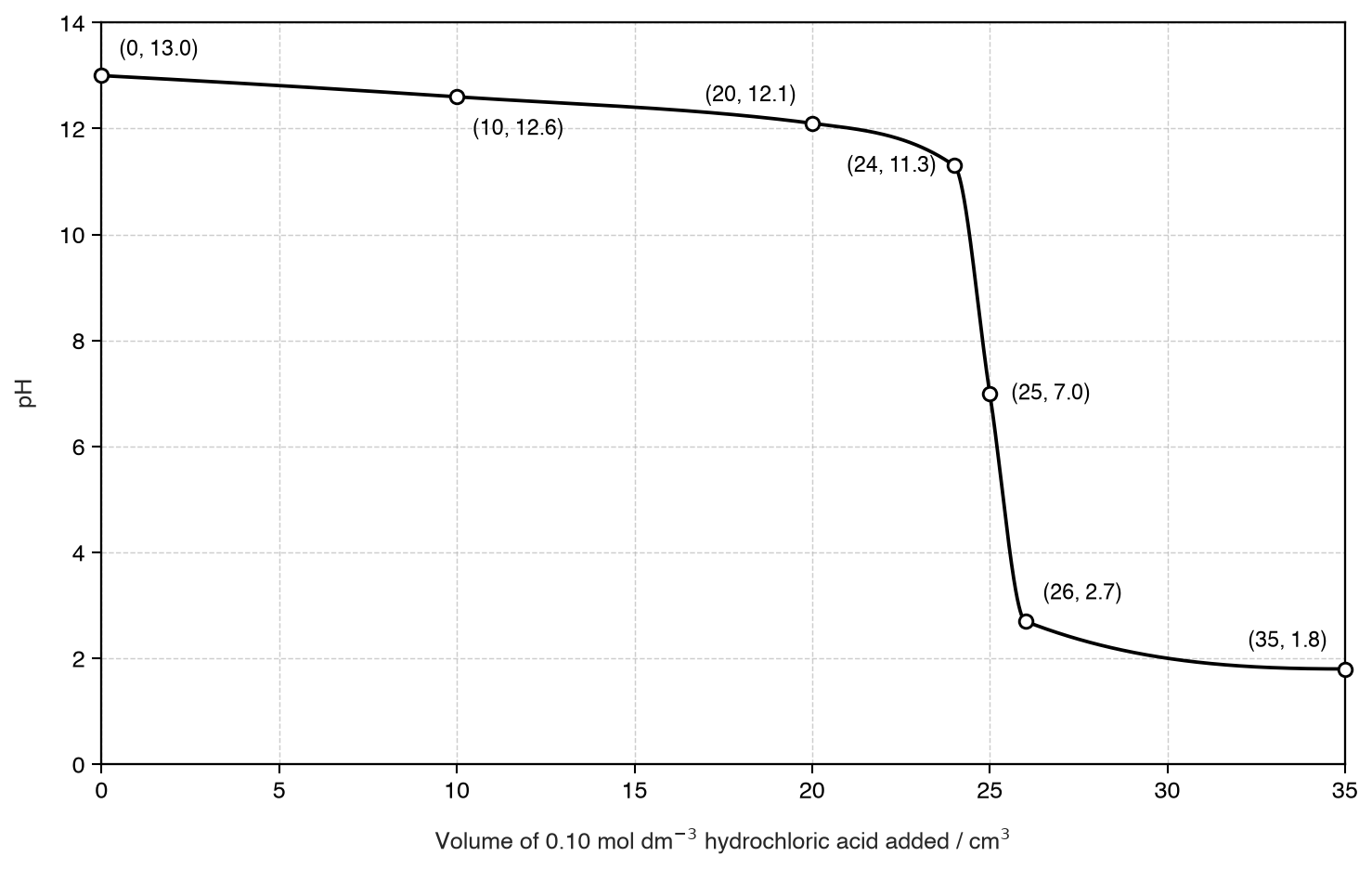
Explain why the pH decreases as hydrochloric acid is added. Use the figure. Refer to ions in your answer.
Answer
Medly's mark scheme gives up to 3 marks from these four points:
- Adding hydrochloric acid adds hydrogen ions, H⁺, which react with hydroxide ions, OH⁻, so the concentration of hydroxide ions falls.
- At 25 cm³, where the pH is 7, the neutral point is reached: all the hydroxide ions have reacted.
- After 25 cm³, hydrogen ions are in excess, so the pH falls below 7 and the solution becomes acidic.
- Hydrogen ions react with hydroxide ions from the alkali to form water: H⁺(aq) + OH⁻(aq) → H₂O(l).
Points 1 and 4 can't both be awarded for the same statement, so link your points to the graph: the fall before 25 cm³, the neutral point at 25 cm³ and the acid in excess after it.
Question 5: (3 marks)
Magnesium reacts with hydrochloric acid in an exothermic reaction:
Mg + 2HCl → MgCl₂ + H₂
A student investigated the effect of changing the mass of magnesium on the highest temperature reached. Each trial used 50.0 cm³ of hydrochloric acid of fixed concentration.
The figure shows a graph of magnesium mass against highest temperature, with a line of best fit.
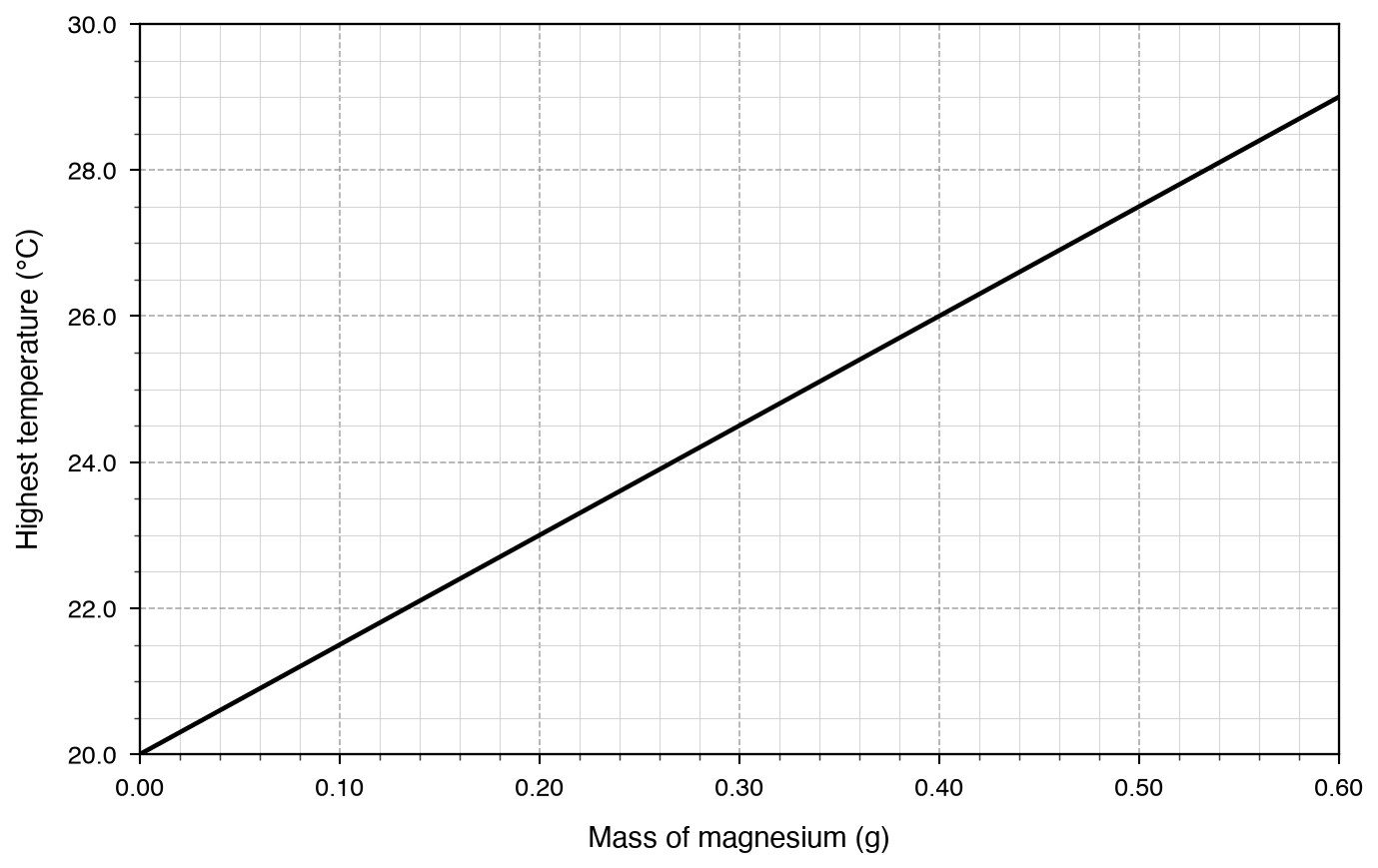
(a) Determine the initial temperature of the reaction mixture. How is the value obtained from the line of best fit? [2 marks]
(b) Which of the following claims is supported by the graph? Select one answer. [1 mark]
A. The highest temperature reached is directly proportional to the mass of magnesium.
B. The reaction stops when 0.40 g of magnesium is used.
C. The relationship continues unchanged at every mass beyond the tested range.
D. Within the tested range, there is a positive linear relationship between the mass of magnesium and the highest temperature reached.
Answer
(a) Medly's mark scheme gives up to 2 marks from these three points:
- Use or extend the line of best fit to find where it meets the vertical axis.
- The vertical-axis intercept is 20.0 °C. This value must be given for full marks.
- The vertical-axis intercept is the initial temperature of the reaction mixture, the temperature before the reaction.
(b) D (1 mark). The graph is a straight line with a positive slope from 0.00 g to 0.60 g.
A. The line meets the vertical axis at 20.0 °C rather than passing through the origin, so the highest temperature is not directly proportional to the mass.
B. The line keeps rising beyond 0.40 g, so greater masses reach higher temperatures.
C. The graph gives evidence only up to 0.60 g, so the trend can't be assumed to continue beyond the tested range.
When you've tried these, go back to the topic tables and pick out the rows you're least sure of. On Medly you can practise those Paper 1 sub-topics one at a time: Medly has AQA GCSE Chemistry courses at Foundation and Higher, and AQA GCSE Combined Chemistry courses at Foundation and Higher for Combined Science students. Medly marks written answers like Question 1 against the mark scheme, so you can see which point you missed. In a randomised controlled trial in GCSE science, students using Medly for 30 minutes a week for four weeks scored 22% higher on the post-test than students revising in their usual way, adjusted for where they started. The students it was compared with weren't left without help: they used revision guides, notes, videos and, in most classes, other online revision platforms, and the trial covered biology, chemistry and physics. To keep track as you go, print the Paper 1 checklist, which has every row of the topic tables with its labels and a box to tick.
Frequently asked questions
What topics are in AQA Chemistry Paper 1?
Topics 1 to 5: atomic structure and the periodic table; bonding, structure, and the properties of matter; quantitative chemistry; chemical changes; and energy changes. Combined Science: Trilogy has the same five topics without the GCSE Chemistry only parts, such as transition metals, nanoparticles, yield and atom economy, titrations, and chemical cells and fuel cells.
How long is AQA Chemistry Paper 1?
1 hour 45 minutes for GCSE Chemistry, for 100 marks. In Combined Science: Trilogy, Chemistry Paper 1 is 1 hour 15 minutes, for 70 marks.
When is AQA Chemistry Paper 1 in 2027?
On the morning of Monday 17 May 2027, for both GCSE Chemistry and Combined Science: Trilogy. Exam dates can change, so check AQA's key dates page for your course.
Which required practicals are in AQA Chemistry Paper 1?
In GCSE Chemistry, required practicals 1 to 4: making a soluble salt, titration, electrolysis of aqueous solutions, and temperature changes. In Trilogy, practicals 8, 9 and 10 cover the same ones without titration.
Is Chemistry Paper 1 or Paper 2 harder?
There's no official answer: AQA gives both papers the same length, the same marks and the same assessment objective weightings. The harder paper for you is the one with your weaker topics, so the checklist is a better guide than any general answer.
Is Combined Science Chemistry Paper 1 the same as GCSE Chemistry Paper 1?
No. It covers the same five topics without the GCSE Chemistry only sub-topics, and it's shorter: 1 hour 15 minutes and 70 marks, against 1 hour 45 minutes and 100 marks. Both are sat on the morning of 17 May 2027.