
Covalent bonding for GCSE Chemistry: dot and cross diagrams and exam questions
Draw dot and cross diagrams, compare small molecules with diamond, graphite and silica, and practise with exam questions and answers.
On this page
A covalent bond is a shared pair of electrons between two atoms, and it is a strong bond. Covalent bonding holds together most non-metal elements and compounds made only of non-metals, from small molecules such as water to giant structures such as diamond. This guide follows AQA GCSE Chemistry (8462) and Combined Science: Trilogy (8464), both tiers, and covers the eight molecules AQA asks you to draw dot and cross diagrams for, with four of them drawn, small molecules and giant covalent structures, with exam questions and answers.
What is covalent bonding?
AQA's specification puts it in two sentences: "When atoms share pairs of electrons, they form covalent bonds. These bonds between atoms are strong."
The shared electrons are attracted to the nuclei of both atoms, and that attraction holds the atoms together. Covalent bonding occurs in most non-metal elements, such as hydrogen and oxygen, and in compounds of non-metals, such as water. It is one of the three types of strong chemical bond in AQA's bonding content.
What it is not: in ionic bonding, electrons are transferred to make oppositely charged ions. In metallic bonding, electrons are delocalised across many atoms. In covalent bonding, each pair of electrons is shared between two particular atoms.
Dot and cross diagrams for covalent molecules
A dot and cross diagram shows the outer-shell electrons. Dots are one atom's electrons and crosses the other's: the symbols show where the electrons came from, not different charges. A shared pair sits between the two atoms, and electrons not used in bonds stay around their atom as lone pairs.
AQA asks you to draw dot and cross diagrams for eight molecules:
| Molecule | Formula | Shared pairs | Bonds | Lone pairs |
|---|---|---|---|---|
| Hydrogen | H₂ | 1 | One single bond | None |
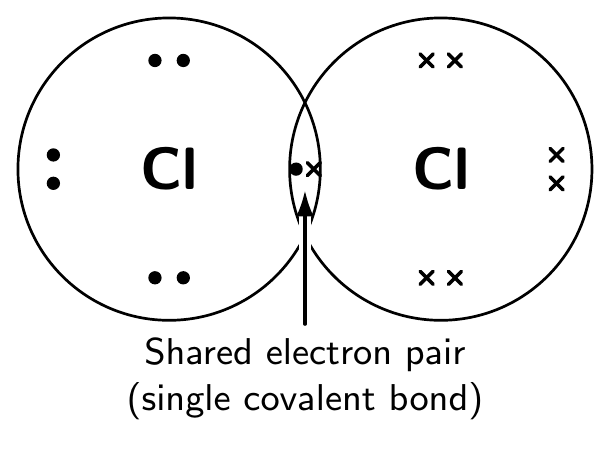
| Chlorine | Cl₂ | 1 | One single bond | Three on each Cl |
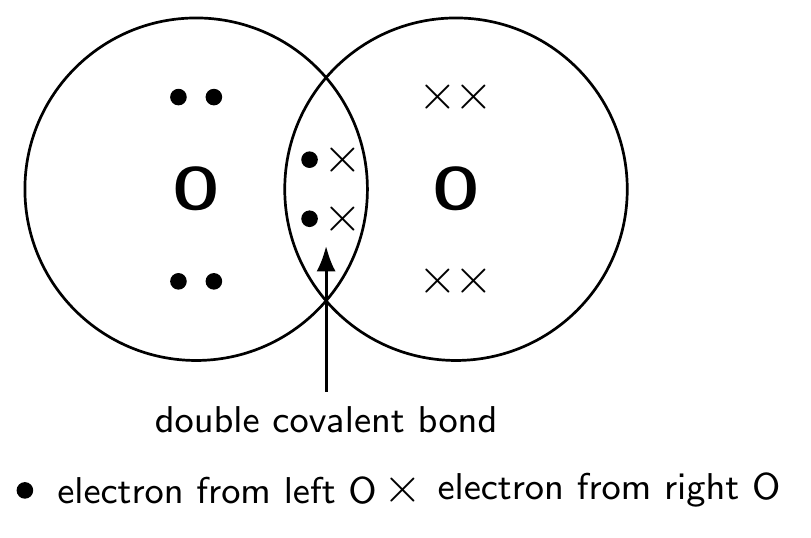
| Oxygen | O₂ | 2 | A double covalent bond | Two on each O |
| Nitrogen | N₂ | 3 | A triple covalent bond | One on each N |
| Hydrogen chloride | HCl | 1 | One single bond | Three on Cl |
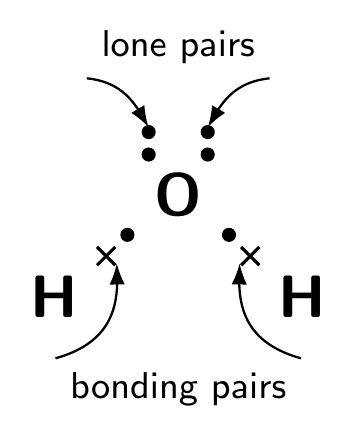
| Water | H₂O | 2 | Two O-H single bonds | Two on O |
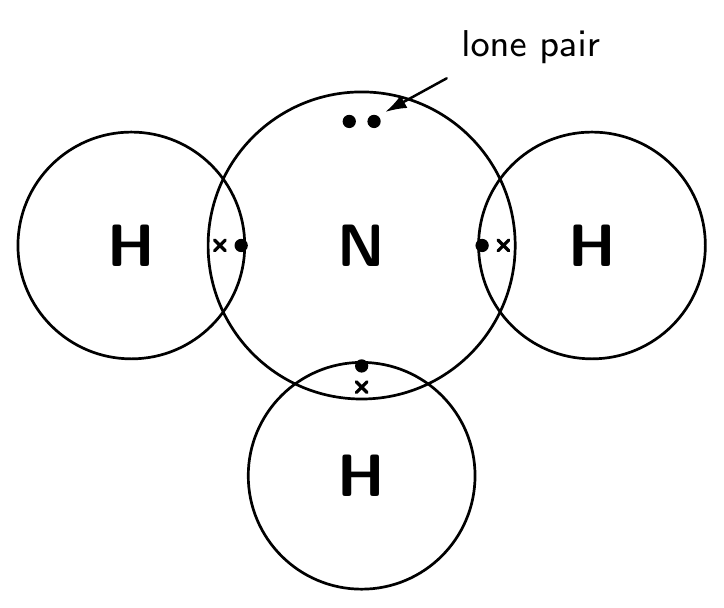
| Ammonia | NH₃ | 3 | Three N-H single bonds | One on N |
| Methane | CH₄ | 4 | Four C-H single bonds | None |
For hydrogen, one electron from each atom forms one shared pair. Chlorine works the same way, but each chlorine atom also keeps three lone pairs:
In oxygen, two shared pairs lie between the atoms:
In water, oxygen sits in the centre and shares one pair with each hydrogen atom:
In ammonia, nitrogen shares one pair with each of three hydrogen atoms and keeps one lone pair:
You can also draw each shared pair as a line: H-H, Cl-Cl, H-Cl, H-O-H, O=O and N≡N. One line is one single bond. Lines do not show lone pairs, so a dot and cross diagram carries more detail.
Why do small molecules have low melting points?
Inside a small molecule, the atoms are held by strong covalent bonds. Between separate molecules there are only weak intermolecular forces.
- Melting or boiling overcomes the weak intermolecular forces, not the covalent bonds, so only a little energy is needed.
- So substances made of small molecules are usually gases or liquids at room temperature, with relatively low melting and boiling points.
- Larger molecules have stronger intermolecular forces, so they melt and boil at higher temperatures.
- The molecules have no overall electric charge, so these substances do not conduct electricity.
Polymers such as poly(ethene) are very large molecules. The intermolecular forces between polymer molecules are relatively strong, so polymers are solids at room temperature.
Giant covalent structures: diamond, graphite and silicon dioxide
In a giant covalent structure, every atom is linked to other atoms by strong covalent bonds in a network that extends throughout the solid. There are no separate molecules. To melt it, many strong covalent bonds must be overcome, which takes a large amount of energy, so giant covalent substances are solids with very high melting points.
- Diamond: each carbon atom forms four covalent bonds with other carbon atoms in a rigid three-dimensional network. It is very hard, has a very high melting point and does not conduct electricity, because it has no delocalised electrons.
- Graphite: each carbon atom forms three covalent bonds, making flat layers of hexagonal rings with no covalent bonds between the layers. One electron from each carbon atom is delocalised, so graphite conducts electricity, like a metal. Weak forces between the layers let them slide, so graphite is soft and slippery. It still has a very high melting point, because of the many strong covalent bonds within the layers.
- Silicon dioxide (silica): silicon and oxygen atoms joined in a giant covalent network.
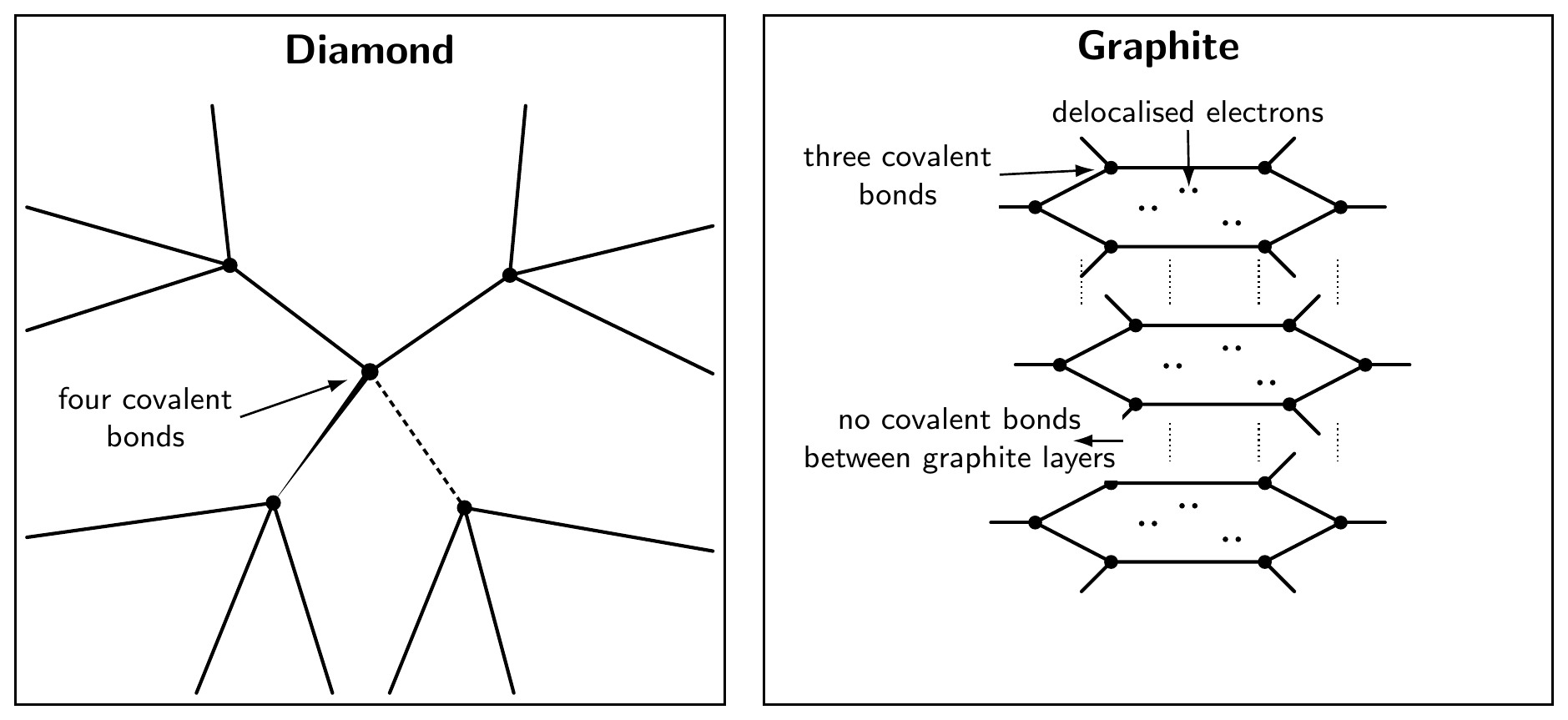
The dotted lines in the graphite panel mark the gaps between the layers, where there are no covalent bonds.
A diagram of a giant covalent structure can only show part of the network. You can recognise one by bonds that continue past the edge of the drawing and by the lack of any separate small groups of atoms.
Small molecule or giant covalent structure: how to tell
| Feature | Small molecules | Giant covalent structures |
|---|---|---|
| What the substance is made of | Separate molecules | A network of atoms joined throughout |
| What melting overcomes | Weak intermolecular forces | Many strong covalent bonds |
| Melting and boiling points | Relatively low | Very high |
| Conducts electricity? | No: the molecules have no overall charge | No, except graphite, which has delocalised electrons |
| Examples | Water, methane, chlorine | Diamond, graphite, silicon dioxide |
Where marks are lost on covalent bonding questions
On questions about small molecules, marks go to the forces between molecules, not to the covalent bonds inside them. These notes are from AQA's mark schemes for GCSE Chemistry (8462) Higher tier Paper 1.
| Question | What the mark scheme credited | What to write |
|---|---|---|
| June 2024, 08.1 (3 marks), propane | "propane is a small molecule"; "(so) the forces between molecules are weak"; "(which) require little energy to overcome". It said "do not accept covalent bonds are weak" and "do not accept answers in terms of breaking covalent bonds" | Small molecule, weak intermolecular forces, little energy to overcome them. Do not write about breaking covalent bonds: they are strong and stay intact when propane melts or boils |
| June 2025, 02.3 (4 marks, two levels), graphite | Indicative content: "giant structure", "layers", "of hexagonal rings", "each (carbon) atom forms three bonds", "has no covalent bonds between layers", "one delocalised electron from each carbon atom", "the bonds are covalent", "with shared (pairs of) electrons", "the (covalent) bonds are strong" | Describe the structure and the bonds in detail: layers, rings, three bonds, no bonds between layers, one delocalised electron per carbon |
| June 2025, 02.4 (1 mark), small molecules | "the molecules do not have an (overall electric) charge"; it allowed "there are no ions" and "there are no delocalised electrons" | Say why nothing can carry charge: the molecules have no overall charge |
| June 2025, 02.5 (1 mark), poly(ethene) and methane | "poly(ethene) has stronger intermolecular forces to overcome than methane" | Compare the intermolecular forces, and say which are stronger |
Covalent bonding exam questions with answers
The worked example and the four questions below are exam-style questions from Medly, marked with Medly's mark schemes.
Worked example (6 marks)
The figure represents the structure of graphite.
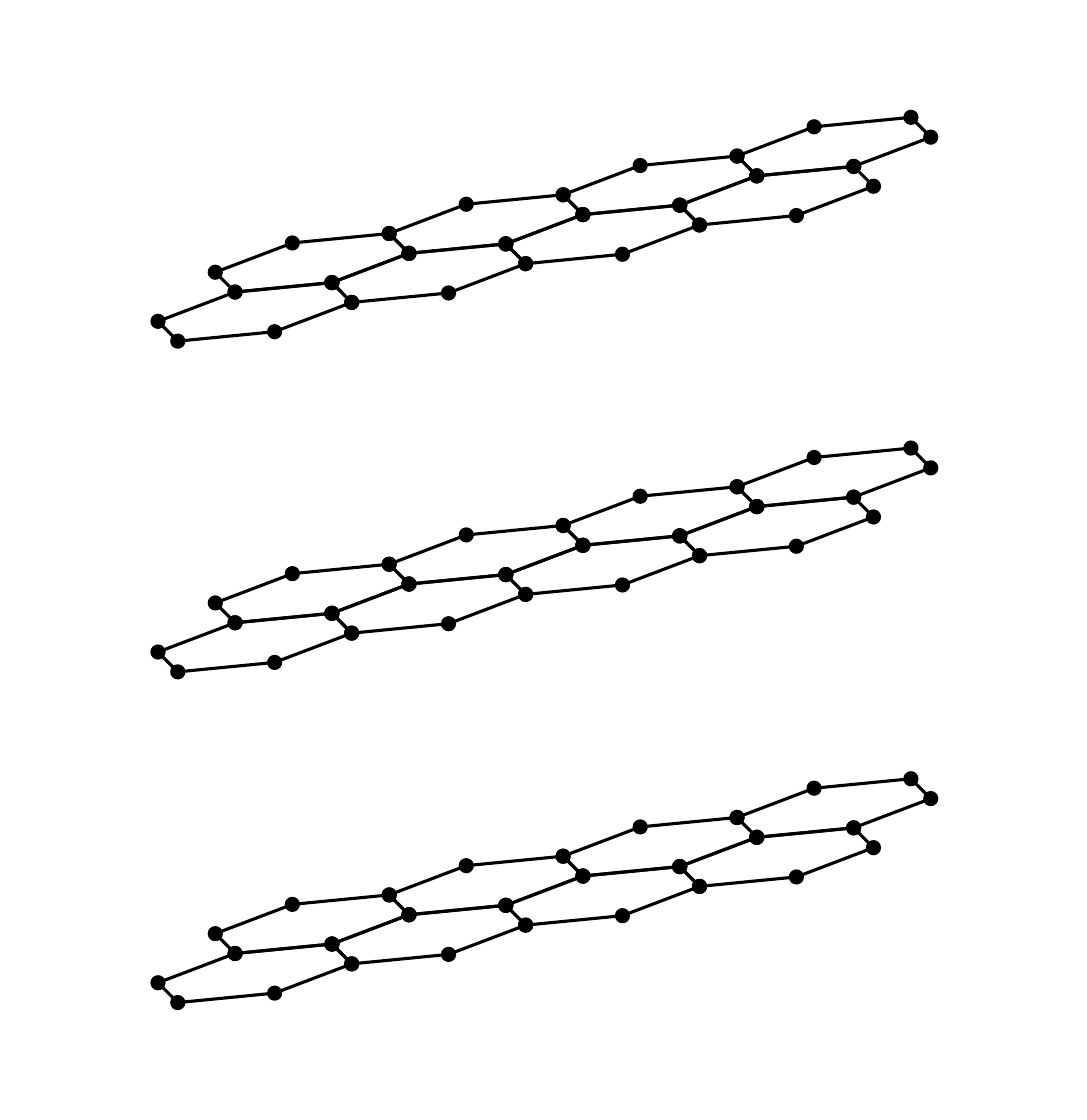
Explain why graphite conducts electricity and is soft and slippery. Answer in terms of structure and bonding.
Medly's mark scheme for this question uses three levels: 1 to 2, 3 to 4 and 5 to 6 marks. AQA marks extended response questions in levels, with two marks in each level: on its June 2025 Higher papers, each 6-mark extended response question had three levels, of 1 to 2, 3 to 4 and 5 to 6 marks.
An answer at the top level of Medly's mark scheme could read:
Graphite is made of layers of hexagonal rings of carbon atoms, and each carbon atom forms three covalent bonds within its layer. One electron from each carbon atom is delocalised. These delocalised electrons can move through the structure and carry charge, so graphite conducts electricity. There are no covalent bonds between the layers, only weak forces, so the layers can slide over each other. This makes graphite soft and slippery.
The top level of Medly's mark scheme needs both properties explained. Points stated without links reach the bottom level.
Question 1: (2 marks)
A silica casting mould is a giant covalent substance. Molten metal at 1200 °C is poured into the mould, but the mould does not melt.
Explain why the silica mould does not melt when the molten metal is poured into it.
Answer
- Strong covalent bonds must be overcome to melt silica (1 mark). "Strong covalent bonds must be broken" is accepted.
- That needs a large amount of energy, so silica's melting point is above 1200 °C (1 mark, needed for full marks).
Question 2: (3 marks)
The results of heating two materials are shown in the table.
| Material | Structural information recorded before heating | Result after 30 minutes at 1500 °C |
|---|---|---|
| Graphite | A form of carbon; atoms are joined by covalent bonds in a continuous structure | Solid |
| Silicon dioxide (silica) | Silicon and oxygen atoms are joined by covalent bonds in a continuous structure | Solid |
Explain why both graphite and silicon dioxide remained solid after heating. Use the table.
Answer
- Both stayed solid after heating at 1500 °C (1 mark).
- Both are giant covalent structures, with atoms linked by strong covalent bonds throughout an extended network (1 mark).
- A large amount of energy is needed to overcome this strong covalent network, so their melting points are very high (1 mark, needed for full marks).
Question 3: (3 marks)
Observations from a laboratory investigation:
Sample R completes an electrical circuit and is easily rubbed into a low-friction coating. A microscope description shows stacked hexagonal carbon layers separated by visible gaps.
Explain why the observations for Sample R occur. You should refer to the source in your answer.
Answer
- Both observations: it conducts electricity, and it rubs into a low-friction coating (1 mark; both are needed).
- One electron from each carbon atom is delocalised and moves through the structure, so it conducts (1 mark).
- There are no covalent bonds between the layers, so weak forces let the layers slide into a low-friction coating (1 mark).
Question 4: (8 marks)
The figure shows models of two giant covalent structures involved in shaping optical glass. Structure A is used to shape glass because it is hard.
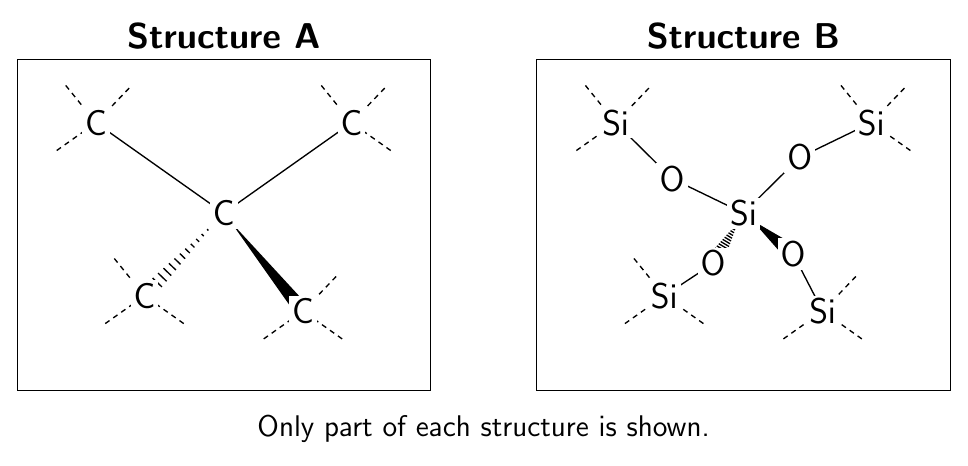
(a) Name Structure A and Structure B shown in the figure. [2 marks]
(b) Compare Structure A with Structure B. Use the figure. [4 marks]
(c) Explain why structure A has a very high melting point. Refer to its structure and bonding. [2 marks]
Answer
(a)
- Structure A is diamond (1 mark).
- Structure B is silicon dioxide (1 mark). Silica, silicon(IV) oxide and SiO₂ are accepted.
(b)
Medly's mark scheme for this part uses two levels: 1 to 2 marks and 3 to 4 marks. The top level needs relevant features with the similarities and differences made clear. The points it looks for:
- Both are giant covalent structures, not separate molecules.
- Both are extended networks of atoms joined by strong covalent bonds.
- Diamond contains carbon atoms only, whereas silicon dioxide contains silicon and oxygen atoms.
- Each carbon atom in diamond is bonded directly to four other carbon atoms, whereas silicon dioxide has Si-O links.
- The diamond model shows a rigid three-dimensional network of carbon atoms.
Only direct comparisons earn credit; facts recalled without reference to the figure do not.
(c)
- Diamond has an extended giant covalent network of atoms linked by strong covalent bonds (1 mark).
- Many strong covalent bonds must be overcome to melt it, so it has a very high melting point (1 mark). "A large amount of energy is needed" is accepted.
Every question here turns on the same choice: the weak forces between molecules, or the strong covalent bonds that must be overcome in a giant structure. Medly has AQA GCSE Chemistry courses at Foundation and Higher, and AQA GCSE Combined Chemistry courses at Foundation and Higher for Combined Science students. Medly marks written answers like Question 4 against the mark scheme, so you can see which point you missed, and Medly's free plan includes 5 marked questions, 20 AI tutor messages and 1 uploaded paper a day, with no card needed.
Frequently asked questions
Are covalent bonds strong?
Yes. A covalent bond is strong. Substances made of small molecules melt easily only because the forces between their molecules are weak.
Why do simple covalent substances have low boiling points?
Boiling overcomes the weak intermolecular forces between molecules, not the covalent bonds inside them, so little energy is needed.
Why does graphite conduct electricity but diamond does not?
In graphite, each carbon atom forms three bonds and one electron from each atom is delocalised, so it can carry charge. In diamond, each carbon atom forms four bonds and there are no delocalised electrons.
What are examples of covalent bonding?
Hydrogen, chlorine, oxygen, nitrogen, hydrogen chloride, water, ammonia and methane are small covalent molecules. Diamond, graphite and silicon dioxide are giant covalent structures, and poly(ethene) is a polymer.
Which paper is covalent bonding on?
Paper 1, for both AQA courses: see the Paper 1 guide. AQA also says Paper 2 questions may draw on the fundamental concepts of the first three topics, so covalent bonding can come up there too: our Paper 2 guide has AQA's wording.