
Ionic bonding for GCSE Chemistry: dot and cross diagrams, properties and exam questions
Understand electron transfer, draw dot and cross diagrams, explain the sodium chloride lattice and practise with exam questions and answers.
On this page
Ionic bonding is the strong electrostatic attraction between oppositely charged ions. It forms when a metal atom transfers outer-shell electrons to a non-metal atom, so the metal becomes a positive ion and the non-metal a negative ion. This guide follows AQA GCSE Chemistry (8462) and Combined Science: Trilogy (8464), both tiers, and covers dot and cross diagrams, the charge on an ion, the sodium chloride lattice and the properties of ionic compounds, with exam questions and answers.
What is ionic bonding?
Ionic bonding holds together compounds made from a metal and a non-metal, such as sodium chloride.
When a metal atom reacts with a non-metal atom, electrons in the outer shell of the metal atom are transferred to the non-metal atom:
- the metal atom loses electrons, so it has more protons than electrons and becomes a positive ion
- the non-metal atom gains those electrons, so it has more electrons than protons and becomes a negative ion
The oppositely charged ions attract each other strongly. That electrostatic attraction, acting in all directions through the solid, is ionic bonding. It is one of the three types of strong chemical bond in AQA's bonding content. The other two are covalent bonding, where atoms share pairs of electrons, and metallic bonding, where atoms share delocalised electrons.
Dot and cross diagrams for ionic compounds
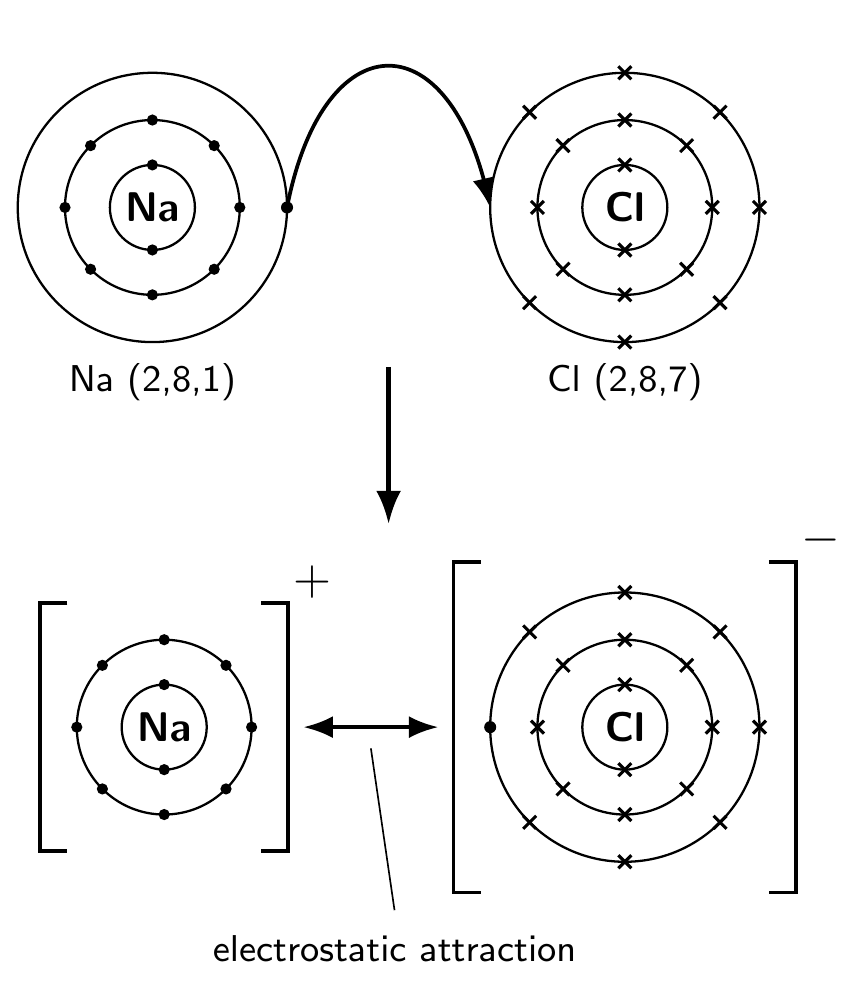
A dot and cross diagram shows the transfer of outer-shell electrons. Dots and crosses only tell you which atom each electron came from. Each ion is drawn in square brackets, with its charge written outside the bracket.
In sodium chloride, sodium (2,8,1) transfers its one outer electron to chlorine (2,8,7). Sodium becomes [Na]⁺ with the arrangement 2,8, and chlorine becomes [Cl]⁻ with eight electrons in its outer shell. Chlorine's own electrons are crosses and the electron from sodium is a dot, so you can see where it went.
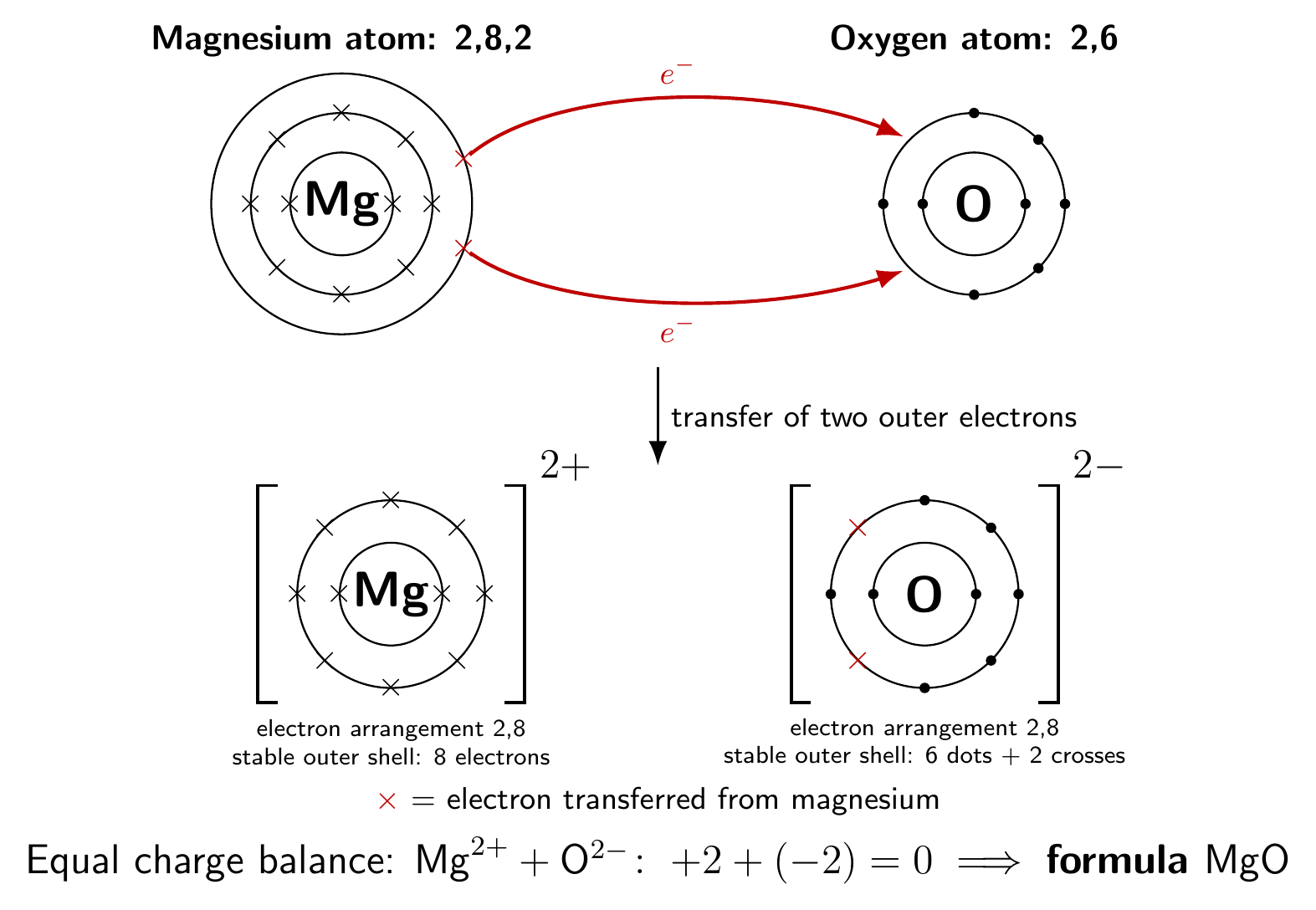
In magnesium oxide, magnesium (2,8,2) transfers two outer electrons to oxygen (2,6), which needs two to complete its outer shell. That gives [Mg]²⁺ and [O]²⁻, both with the arrangement 2,8. In this picture magnesium's electrons are crosses, and its key marks the red crosses as the electrons transferred from magnesium.
How to work out the charge on an ion
Use the group number. A metal loses its outer-shell electrons; a non-metal gains enough electrons to fill its outer shell.
| Group | Outer-shell electrons | What happens | Charge on the ion | Examples |
|---|---|---|---|---|
| 1 (metals) | 1 | Loses one electron | +1 | Li⁺, Na⁺ |
| 2 (metals) | 2 | Loses two electrons | +2 | Mg²⁺, Ca²⁺ |
| 6 (non-metals) | 6 | Gains two electrons | −2 | O²⁻, S²⁻ |
| 7 (non-metals) | 7 | Gains one electron | −1 | F⁻, Cl⁻ |
AQA asks you to work out the charge from the group number, "limited to the metals in Groups 1 and 2, and non-metals in Groups 6 and 7". Each of these ions has a noble gas's electronic structure: Na⁺, Mg²⁺ and O²⁻ are 2,8, and Cl⁻ is 2,8,8.
Ionic compounds with two ions of one kind
An ionic compound has no overall charge, so the ions join in the ratio that makes the charges cancel.
| Compound | Positive ion | Negative ion | Ratio of ions |
|---|---|---|---|
| Sodium chloride, NaCl | Na⁺ | Cl⁻ | One Na⁺ to one Cl⁻ |
| Magnesium oxide, MgO | Mg²⁺ | O²⁻ | One Mg²⁺ to one O²⁻ |
| Sodium oxide, Na₂O | Na⁺ | O²⁻ | Two Na⁺ to one O²⁻ |
| Magnesium chloride, MgCl₂ | Mg²⁺ | Cl⁻ | One Mg²⁺ to two Cl⁻ |
In sodium oxide, two sodium atoms each transfer one electron, so the oxide ion receives two in total. In magnesium chloride, the magnesium atom transfers one electron to each of two chlorine atoms.
The giant ionic lattice of sodium chloride
An ionic compound is a giant structure of ions, not a set of separate molecules. In solid sodium chloride, Na⁺ and Cl⁻ ions alternate in a regular three-dimensional lattice that repeats in all directions.
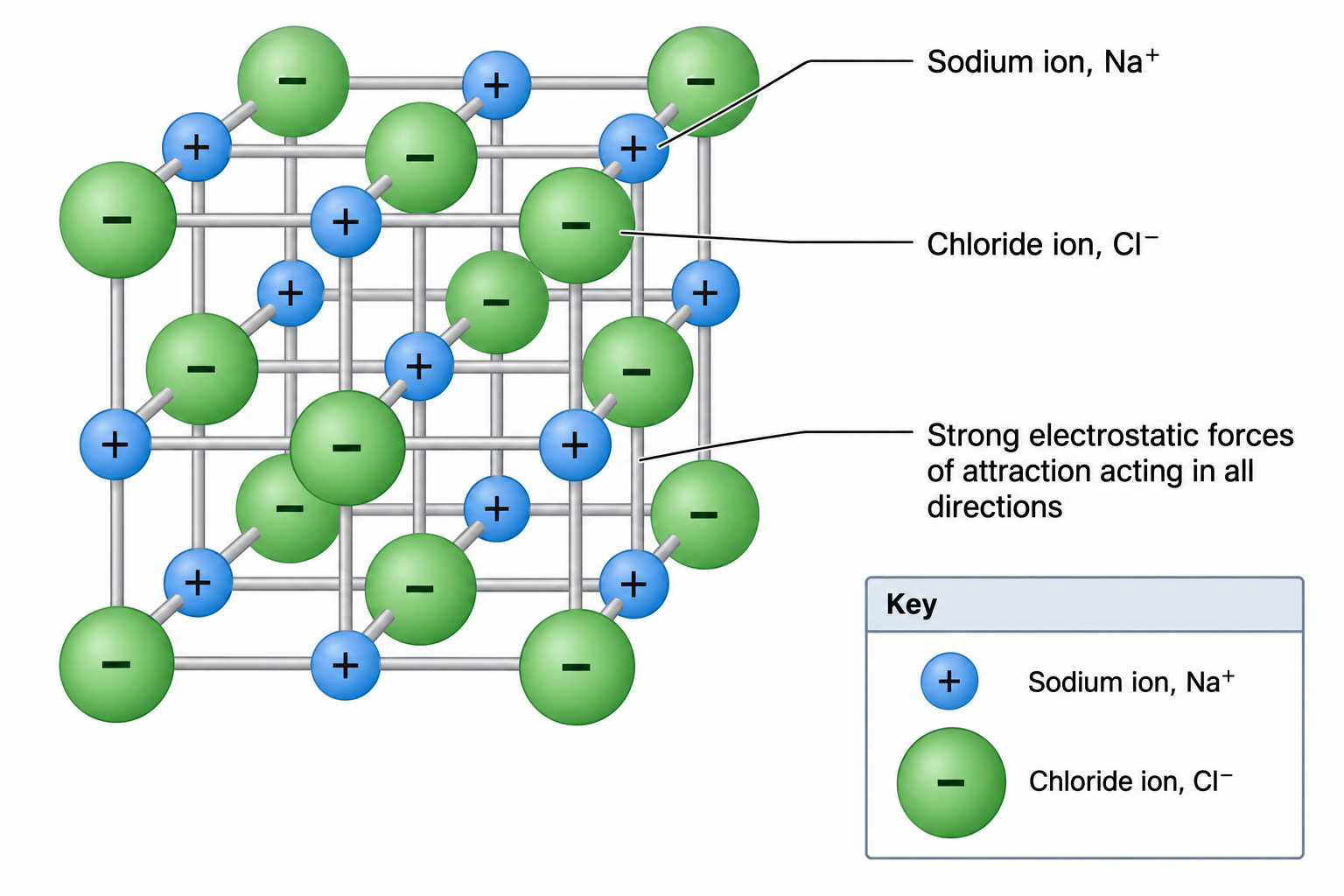
Each sodium ion is surrounded by six chloride ions, and each chloride ion by six sodium ions. So each ion is held by attractions to many neighbours, not joined to just one.
NaCl is an empirical formula: the simplest whole-number ratio of the ions. For example, a model with 6 Na⁺ and 6 Cl⁻ gives 6 : 6, which simplifies to 1 : 1, so the formula is NaCl. It does not mean NaCl molecules exist.
AQA's specification says: "Students should be familiar with the structure of sodium chloride but do not need to know the structures of other ionic compounds."
AQA also asks you to describe the limits of each way of showing a giant ionic structure:
| Representation | Does not show |
|---|---|
| Dot and cross diagram | The giant lattice in three dimensions |
| Two-dimensional lattice | The three-dimensional arrangement |
| Ball and stick model | The full lattice; its sticks suggest bonds between pairs of ions, but the attraction acts in all directions |
| Three-dimensional model | The whole structure: only a small piece, usually not to scale |
What are the properties of ionic compounds?
Ionic compounds have high melting and boiling points, and they conduct electricity only when melted or dissolved in water.
| Property | Why |
|---|---|
| High melting and boiling points | Many strong electrostatic forces act between oppositely charged ions throughout the lattice, and large amounts of energy are needed to overcome them |
| A solid does not conduct electricity | The ions are held in fixed positions in the lattice and cannot move |
| Conducts when molten | The ions are free to move, so they carry charge |
| Conducts when dissolved in water | The ions move through the solution and carry charge |
Melting does not destroy the ions. The energy goes into overcoming the attractions that hold them in the lattice.
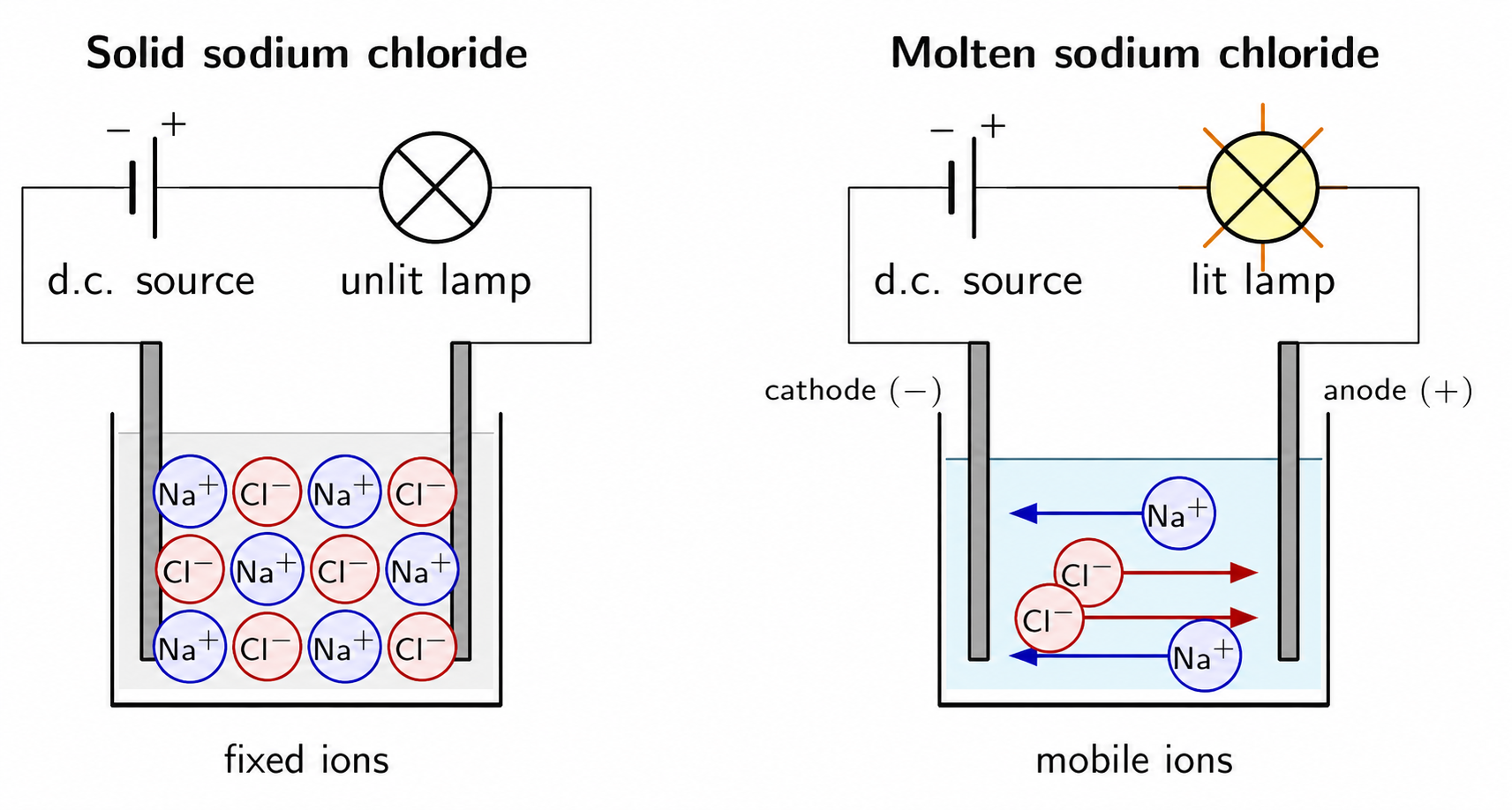
What happens to the ions when a current passes through a molten or dissolved ionic compound is the subject of our electrolysis guide.
Where marks are lost on ionic bonding questions
Marks go to the named force, the named particles and the number of electrons. These notes are from AQA's mark schemes for GCSE Chemistry (8462) Higher tier Paper 1.
| Question | What the mark scheme credited | What to write |
|---|---|---|
| June 2025, 06.1 (4 marks), aluminium oxide | "strong electrostatic forces", "between oppositely charged ions", "(which) act in all directions", "(so) need a lot of energy to break"; it said "ignore strong ionic bonds" | Name the force and the particles: strong electrostatic forces between oppositely charged ions, acting in all directions, needing a lot of energy to overcome |
| June 2025, 02.2 (4 marks), calcium sulfide | "calcium (atom) loses electrons", "sulfur (atom) gains electrons", "reference to transfer of two electrons", "calcium forms positive ions and sulfur forms negative ions" | Say which atom loses and which gains, that two electrons move (calcium is in Group 2, sulfur in Group 6), and that Ca²⁺ and S²⁻ ions form |
| June 2024, 05.1 (4 marks), calcium and chlorine | "each calcium atom loses two electrons", "(and) each chlorine atom gains one electron", "(so) one calcium atom reacts with two chlorine atoms", Ca²⁺ and Cl⁻ ions; without the numbers, "calcium atoms lose electrons and chlorine atoms gain electrons" earned 1 mark, not 2 | Give the number of electrons for each atom and the 1 : 2 ratio |
| June 2024, 05.2 (1 mark) | "the ions cannot move"; it allowed "the ions are in fixed positions" | For a solid ionic compound, say the ions are fixed in the lattice and cannot move |
Ionic bonding exam questions with answers
The worked example and the five questions below are exam-style questions from Medly, marked with Medly's mark schemes.
Worked example (3 marks)
When sodium metal reacts with the Group 6 element oxygen, sodium oxide is formed.
With reference to its structure and bonding, explain why sodium oxide has a high melting point.
- Sodium oxide contains strong electrostatic attractions between oppositely charged ions (1 mark).
- Many of these attractions act throughout its giant ionic lattice (1 mark).
- A large amount of energy is needed to overcome them (1 mark, needed for full marks).
Question 1: (3 marks)
The table shows the formulae of sulfides formed by three coded metals.
| Coded metal | Formula of its sulfide |
|---|---|
| A | A₂S |
| B | BS |
| C | C₂S₃ |
Which of the coded metals could be sodium? Explain your answer using the ionic formula A₂S.
Answer
- Metal A (1 mark, needed for full marks).
- Sodium forms ions with a +1 charge (1 mark).
- A sulfide ion is S²⁻, so two Na⁺ ions are needed to balance one S²⁻ ion in Na₂S (1 mark).
Question 2: (3 marks)
The table gives the charge on the ion formed by each coded metal.
| coded metal | charge on its ion |
|---|---|
| P | +1 |
| Q | +2 |
| R | +3 |
Chloride ions have charge −1.
Metal X forms a chloride. Which of the coded metals could be X? Explain your answer using the ionic formula XCl₃.
Answer
- R (1 mark, needed for full marks).
- X forms a 3+ ion (1 mark).
- Three chloride ions, each with charge −1, are needed to balance the 3+ charge (1 mark).
Question 3: (2 marks)
Solid sodium chloride (NaCl) has a giant three-dimensional ionic lattice structure.
Describe the immediate surroundings of a single sodium ion (Na⁺) in the interior of the sodium chloride lattice by giving both the identity and the number of the nearest-neighbour ions around it.
Answer
- The nearest-neighbour ions are chloride ions, Cl⁻ (1 mark).
- There are six of them around each sodium ion (1 mark).
"Six chloride ions surrounding each sodium ion" earns both marks.
Question 4: (4 marks)
Medly's question is answered on screen, so it asks for a typed version. On paper, draw the diagram.
Describe the transfer of electrons when calcium reacts with chlorine to form calcium chloride using a typed dot-and-cross representation. Use distinct electron symbols to indicate their origins, and include square brackets and the charge on each ion.
Answer
- Start with one calcium atom and two chlorine atoms, using different symbols, such as dots and crosses, for each atom's electrons (1 mark).
- Show calcium and chlorine in the ratio 1 : 2 (1 mark).
- Calcium loses its two outer electrons to form [Ca]²⁺, with the charge outside the square brackets (1 mark).
- Each chlorine atom gains one electron, giving two [Cl]⁻ ions, each with the charge outside the brackets (1 mark, needed for full marks).
Question 5: (7 marks)
Sodium is in Group 1 and iodine is in Group 7.
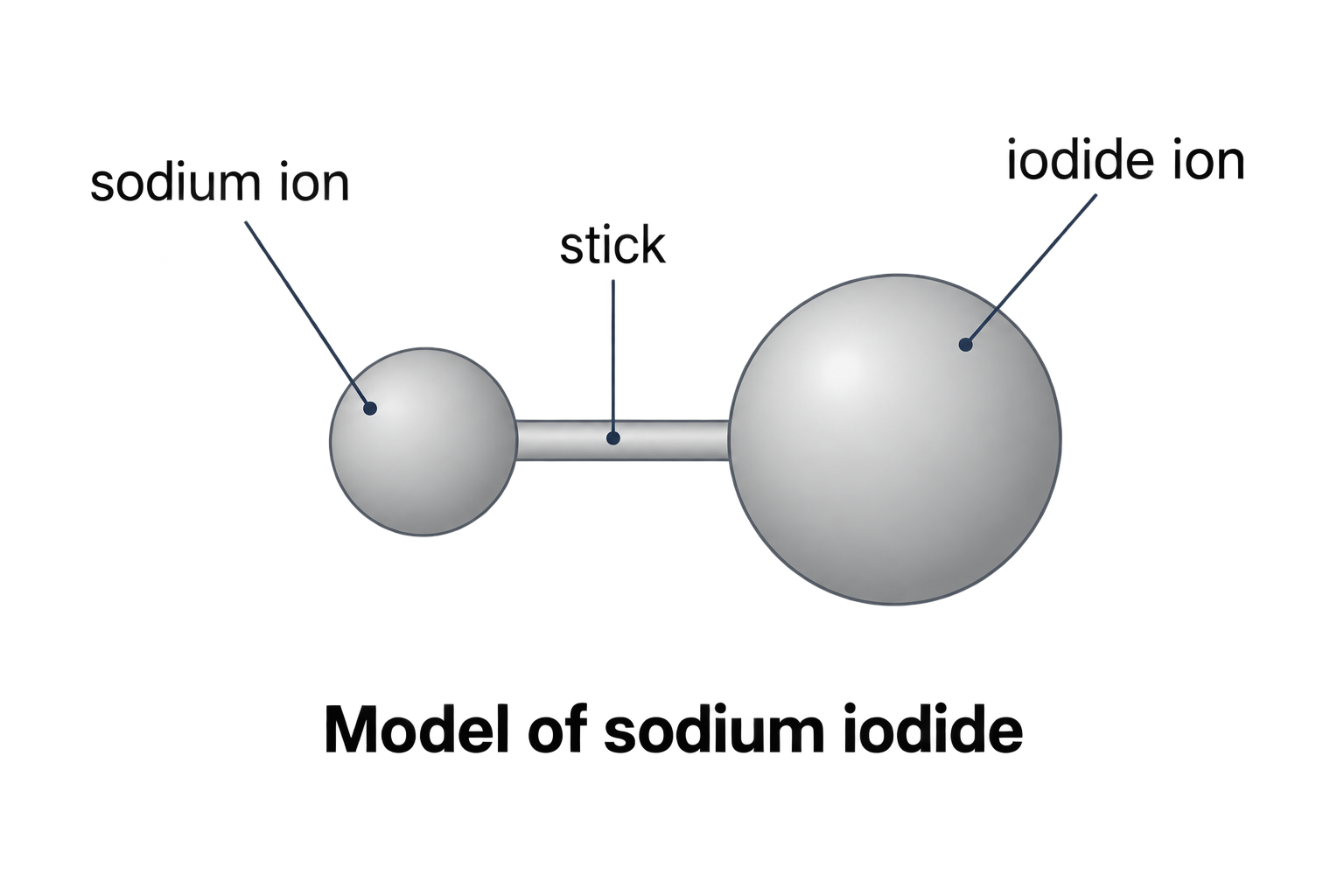
The figure shows a model a student made to represent sodium iodide.
(a) Give the charge on an ion formed from an iodine atom. [1 mark]
(b) Give the charge on a sodium ion and explain how a sodium atom forms this ion. [2 marks]
(c) A model shows one sodium ion joined to one iodide ion by a stick. Evaluate how well this model represents the structure and bonding in a sodium iodide crystal. [4 marks]
Answer
(a)
- The iodide ion has a charge of −1, I⁻ (1 mark). +1 earns nothing.
(b)
- The sodium ion has a charge of +1, Na⁺ (1 mark).
- A sodium atom loses one outer-shell electron to form the ion (1 mark). "Transfers one electron to iodine" is allowed; "gains an electron" is not.
(c)
- The model correctly shows a 1 : 1 ratio of sodium ions to iodide ions, which gives the formula NaI (1 mark).
- A single pair does not show that the ions form a giant, regular lattice (1 mark).
- Each ion attracts several neighbouring ions of the opposite charge, rather than forming an isolated pair (1 mark).
- The stick suggests one link in one direction, but the electrostatic attractions act in all directions. Also creditworthy: the ions are held by electrostatic forces, not physical sticks; or the stick suggests a covalent bond (shared electrons) when the bonding is ionic (1 mark).
Most of the marks in these questions go to naming the force, the particles and the number of electrons, as the dot and cross diagrams above show. Medly has AQA GCSE Chemistry courses at Foundation and Higher, and AQA GCSE Combined Chemistry courses at Foundation and Higher for Combined Science students. In a randomised controlled trial in GCSE science, students using Medly for 30 minutes a week for four weeks scored 22% higher on the post-test than students revising in their usual way, adjusted for where they started. The comparison group kept revising with guides, notes, videos and, in most classes, other online revision platforms, and the trial covered biology, chemistry and physics. Medly marks written answers like Question 5 against the mark scheme, so you can see which point you missed.
Frequently asked questions
What is ionic bonding in simple terms?
A metal atom gives electrons to a non-metal atom, making a positive ion and a negative ion. The two ions attract each other strongly, and that attraction is the ionic bond.
What is the difference between ionic and covalent bonding?
In ionic bonding, electrons are transferred and the particles are oppositely charged ions. In covalent bonding, atoms share pairs of electrons. Ionic bonding is in compounds of metals with non-metals; covalent bonding is in most non-metal elements and compounds of non-metals.
Why do ionic compounds have high melting points?
There are many strong electrostatic forces between oppositely charged ions throughout the giant lattice. Large amounts of energy are needed to overcome them.
Why do ionic compounds conduct electricity when molten but not when solid?
In the solid, the ions are fixed in the lattice and cannot move. When melted or dissolved in water, the ions are free to move and carry charge.
Do I need to know the structure of every ionic compound?
AQA's specification says: "Students should be familiar with the structure of sodium chloride but do not need to know the structures of other ionic compounds."
Which paper is ionic bonding on?
Paper 1, for both AQA courses: see the Paper 1 guide. AQA also says Paper 2 questions may draw on the fundamental concepts of the first three topics, so ionic bonding can come up there too: our Paper 2 guide has AQA's wording.