
Metallic bonding for GCSE Chemistry: structure, properties and exam questions
Understand delocalised electrons, explain conduction, melting points and alloys, and practise with exam questions and answers.
On this page
Metallic bonding is the strong attraction between positive metal ions and the delocalised electrons shared through the whole structure. It explains why most metals have high melting points, and why metals conduct electricity and heat and can be bent into shape. This guide follows AQA GCSE Chemistry (8462) and Combined Science: Trilogy (8464), both tiers, and covers the metallic bonding diagram, the properties of metals and why alloys are harder, with exam questions and answers.
What is metallic bonding?
A metal is a giant structure of atoms arranged in a regular pattern. The electrons in the outer shells of the metal atoms are delocalised: they are not attached to any one atom and are free to move through the whole structure. What is left behind are positive metal ions.
The positive ions attract the negatively charged delocalised electrons, and that attraction acts throughout the structure. The sharing of delocalised electrons gives strong metallic bonds. Metallic bonding occurs in metallic elements and in alloys, and it is one of the three types of strong chemical bond in AQA's bonding content.
Metallic bonding diagram: what it shows
A metallic bonding diagram shows regular rows or layers of positive metal particles with delocalised electrons in the spaces between them.
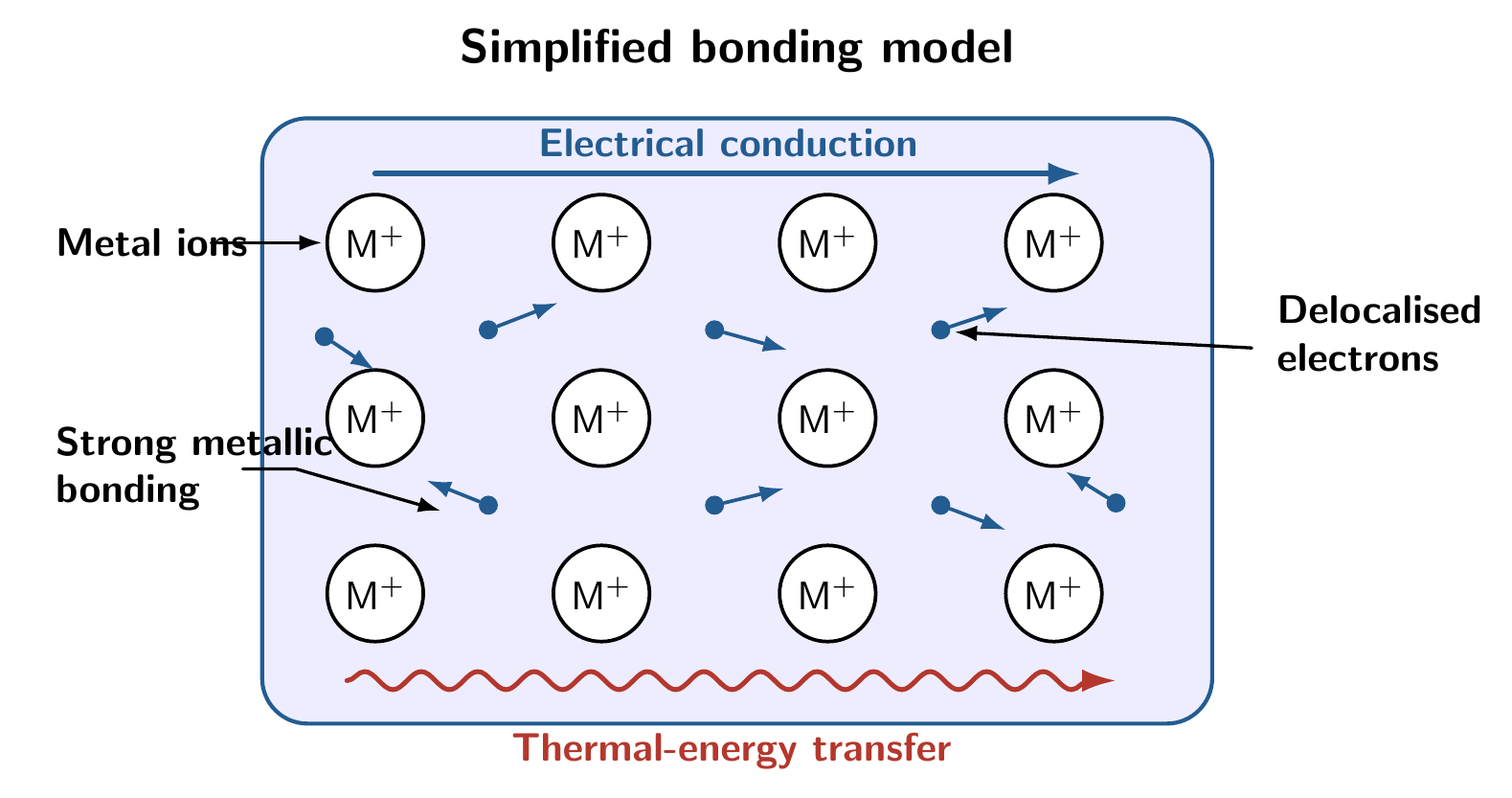
| Feature of the diagram | What it represents |
|---|---|
| Regular rows or layers of positive particles | The giant structure of metal atoms in a regular pattern |
| Small negative electrons between the positive particles | Delocalised electrons from the outer shells |
| Electrons spread through the arrangement | Electrons shared by the whole structure |
| Attraction between positive particles and electrons | Strong metallic bonds |
The electrons are drawn between many positive particles, not fixed to one atom, because they are delocalised.
What are the properties of metals?
Most metals have high melting and boiling points, conduct electricity and thermal energy well, and can be bent and shaped. Each property comes from the structure:
| Property | Why |
|---|---|
| High melting and boiling points (most metals) | Strong metallic bonding must be overcome, which needs a large amount of energy |
| Good conductor of electricity | Delocalised electrons move through the metal and carry electrical charge |
| Good conductor of thermal energy | Delocalised electrons transfer thermal energy through the metal |
| Can be bent and shaped | The layers of atoms slide over one another; the delocalised electrons keep attracting the positive ions, so the metal does not break apart |
Why are alloys harder than pure metals?
An alloy is a mixture of two or more elements, at least one of which is a metal.
In a pure metal, all the atoms are the same size, so they sit in regular layers that slide over each other quite easily. That is why pure metals are often too soft for many uses. In an alloy, atoms of different sizes distort the layers, so the layers cannot slide over one another as easily. More force is needed to change the alloy's shape, so it is harder.
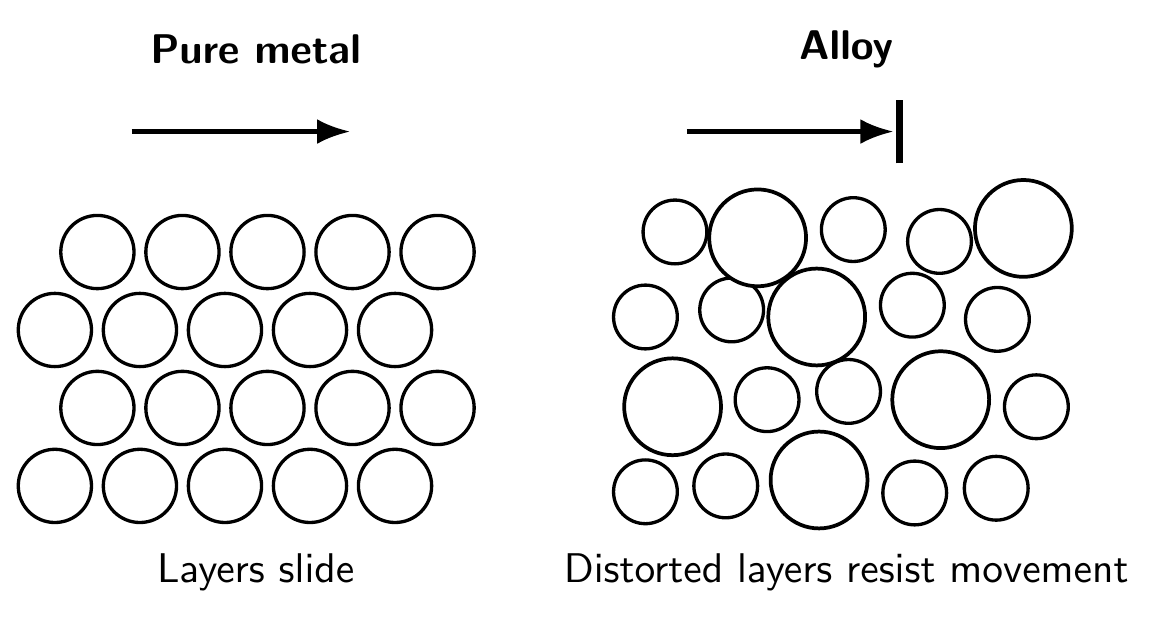
AQA asks you to explain why alloys are harder "in terms of distortion of the layers of atoms in the structure of a pure metal". Different sizes, distorted layers, layers cannot slide: that is the chain.
Metallic, ionic or covalent bonding?
| Metallic | Ionic | Covalent | |
|---|---|---|---|
| Where it occurs | Metallic elements and alloys | Compounds of metals with non-metals | Most non-metal elements and compounds of non-metals |
| Particles | Positive metal particles and delocalised electrons | Positive and negative ions | Atoms |
| What the electrons do | Shared throughout the structure | Transferred from metal atoms to non-metal atoms | Pairs shared between particular atoms |
| The strong attraction is between | Positive metal particles and delocalised electrons | Oppositely charged ions | The atoms and their shared pair |
Our guides to ionic bonding and covalent bonding cover the other two.
Where marks are lost on metallic bonding questions
Marks go to the delocalised electrons and, for alloys, to each step of the chain. These notes are from AQA's June 2024 mark scheme for GCSE Chemistry (8462) Higher tier Paper 1.
| Question | What the mark scheme credited | What to write |
|---|---|---|
| 07.1 (2 marks) | "(thermal) energy is transferred" (it allowed "heat is transferred") and "by delocalised electrons" | Say what is transferred and what carries it: thermal energy, by delocalised electrons |
| 07.2 (3 marks) | "(the alloy / mixture has) different sized atoms", "(so the) layers are distorted", "(so the) layers cannot easily slide"; it allowed "(positive / metal) ions" for atoms | Give all three steps: different-sized atoms, distorted layers, layers cannot slide as easily |
Metallic bonding exam questions with answers
The worked example and the four questions below are exam-style questions from Medly, marked with Medly's mark schemes.
Worked example (3 marks)
Describe how electrical conduction occurs in copper. Refer to the role of electrons in your answer.
- Copper contains delocalised electrons (1 mark).
- The delocalised electrons carry electrical charge (1 mark).
- The delocalised electrons move through the copper structure (1 mark, needed for full marks).
Question 1: (1 mark)
A student compared models of three solids. The table summarises what each model shows.
| Substance | What the model shows |
|---|---|
| Lithium fluoride | A repeating three-dimensional arrangement of Li⁺ and F⁻ ions. |
| Copper | Regularly arranged positive copper particles with electrons in the spaces between them. |
| Diamond | A small section of carbon atoms joined to neighbouring carbon atoms by sticks. |
Use the table to suggest why copper conducts electricity.
Answer
- Delocalised electrons can move through the copper structure and carry charge (1 mark). "Free-moving electrons carry charge" is allowed; movement of the positive copper particles is not.
Question 2: (2 marks)
Iron is a metal. Describe how iron conducts thermal energy.
Answer
- Thermal energy is transferred through the iron (1 mark). "Heat" is accepted for thermal energy.
- The transfer is by delocalised electrons (1 mark, needed for full marks). "Free electrons" is accepted.
Question 3: (3 marks)
Stainless steel is an alloy used in engineering components. It is harder than pure iron.
Explain why stainless steel is harder than pure iron.
Answer
- Stainless steel contains atoms of different sizes (1 mark).
- The different-sized atoms distort the regular layers (1 mark).
- The distorted layers cannot slide over one another as easily (1 mark, needed for full marks).
Question 4: (4 marks)
An engineer is choosing a metal to make electrical leads for a lightweight drone.
Each lead must conduct electricity effectively while adding minimal mass to the drone, and material costs should be kept low. Pure copper and pure aluminium are under consideration, as well as the alloy bronze.
The table shows data for these three metals.
| Metal | Relative electrical conductivity / % of pure copper | Density / g/cm³ | Cost / £ per kg |
|---|---|---|---|
| Copper | 100 | 8.9 | 8.10 |
| Aluminium | 61 | 2.7 | 2.60 |
| Bronze | 15 | 8.8 | 6.20 |
Evaluate the use of copper, aluminium and bronze for the drone lead. Use the table.
Answer
Medly's mark scheme for this question uses two levels: 1 to 2 marks and 3 to 4 marks. The top level needs logically linked reasons about all three metals, and there may be a simple judgement. AQA marks extended response questions in levels, with two marks in each level: on its June 2025 Higher papers, each 6-mark extended response question had three levels, of 1 to 2, 3 to 4 and 5 to 6 marks.
An answer at the top level of Medly's mark scheme could read:
Copper has the highest relative conductivity, 100%, so it is the best choice if conduction matters most. Aluminium conducts less well, at 61%, but its density is 2.7 g/cm³ against copper's 8.9, and it costs £2.60 per kg against £8.10, so it is much lighter and cheaper for a drone. Bronze conducts poorly, at 15%, and its density of 8.8 g/cm³ is close to copper's, so the data give little reason to choose it. Overall, aluminium is the best balance of adequate conduction, low mass and low cost, although copper could be preferred if conduction outweighs mass.
Alloy questions follow the chain from different-sized atoms to distorted layers to layers that cannot slide, and conduction questions turn on the delocalised electrons. Medly marks written answers like Question 3 against the mark scheme, so you can see which point you missed. Medly's free plan includes 5 marked questions, 20 AI tutor messages and 1 uploaded paper a day, with no card needed, and Medly has AQA GCSE Chemistry courses at Foundation and Higher, and AQA GCSE Combined Chemistry courses at Foundation and Higher for Combined Science students.
Frequently asked questions
What is metallic bonding in simple terms?
The outer electrons of metal atoms become delocalised and are shared by the whole structure. The positive metal ions left behind and the delocalised electrons attract each other strongly, and that attraction is the metallic bond.
Why do metals conduct electricity?
Their delocalised electrons can move through the metal and carry electrical charge.
Why do metals have high melting points?
Metallic bonding is strong, so a large amount of energy is needed to overcome it. Most metals melt only at high temperatures.
Why are alloys harder than pure metals?
The different-sized atoms in an alloy distort the regular layers, so the layers cannot slide over one another as easily.
What is the difference between metallic and ionic bonding?
In metallic bonding, electrons are delocalised and shared through the whole structure. In ionic bonding, electrons are transferred from metal atoms to non-metal atoms, making oppositely charged ions.
Which paper is metallic bonding on?
Paper 1, for both AQA courses: see the Paper 1 guide. AQA also says Paper 2 questions may draw on the fundamental concepts of the first three topics, so metallic bonding can come up there too: our Paper 2 guide has AQA's wording.