
What is electrolysis? How it works in GCSE chemistry, with exam questions and answers
Understand electrolytes and electrodes, predict products from molten and aqueous compounds, and see how the required practical is examined.
On this page
Electrolysis in GCSE chemistry is the splitting of an ionic compound using electricity: when the compound is melted or dissolved in water, its ions move to the electrodes and are discharged, producing elements. This guide follows AQA GCSE Chemistry (8462) and Combined Science: Trilogy (8464) at both tiers, and covers molten and aqueous electrolysis, extracting aluminium, the required practical and exam questions with answers.
What is electrolysis in GCSE chemistry?
Electrolysis is the movement and discharge of ions caused by passing an electric current through an electrolyte. An electrolyte is a molten ionic compound, or a solution of an ionic compound in water, that conducts electricity because its ions are free to move.
| Word | What it means |
|---|---|
| Electrolyte | A molten or dissolved ionic compound that conducts because its ions can move |
| Electrodes | Conducting parts placed in the electrolyte and connected to the electrical supply |
| Cathode | The negative electrode: positive ions move towards it |
| Anode | The positive electrode: negative ions move towards it |
| Discharged | Describes an ion that loses its charge at an electrode, producing an element |
A solid ionic compound does not conduct, because its ions are held in fixed positions. Melt it, or dissolve it in water, and the ions are free to move and carry charge. Our page on ionic bonding explains why the ions are held so firmly in the solid.
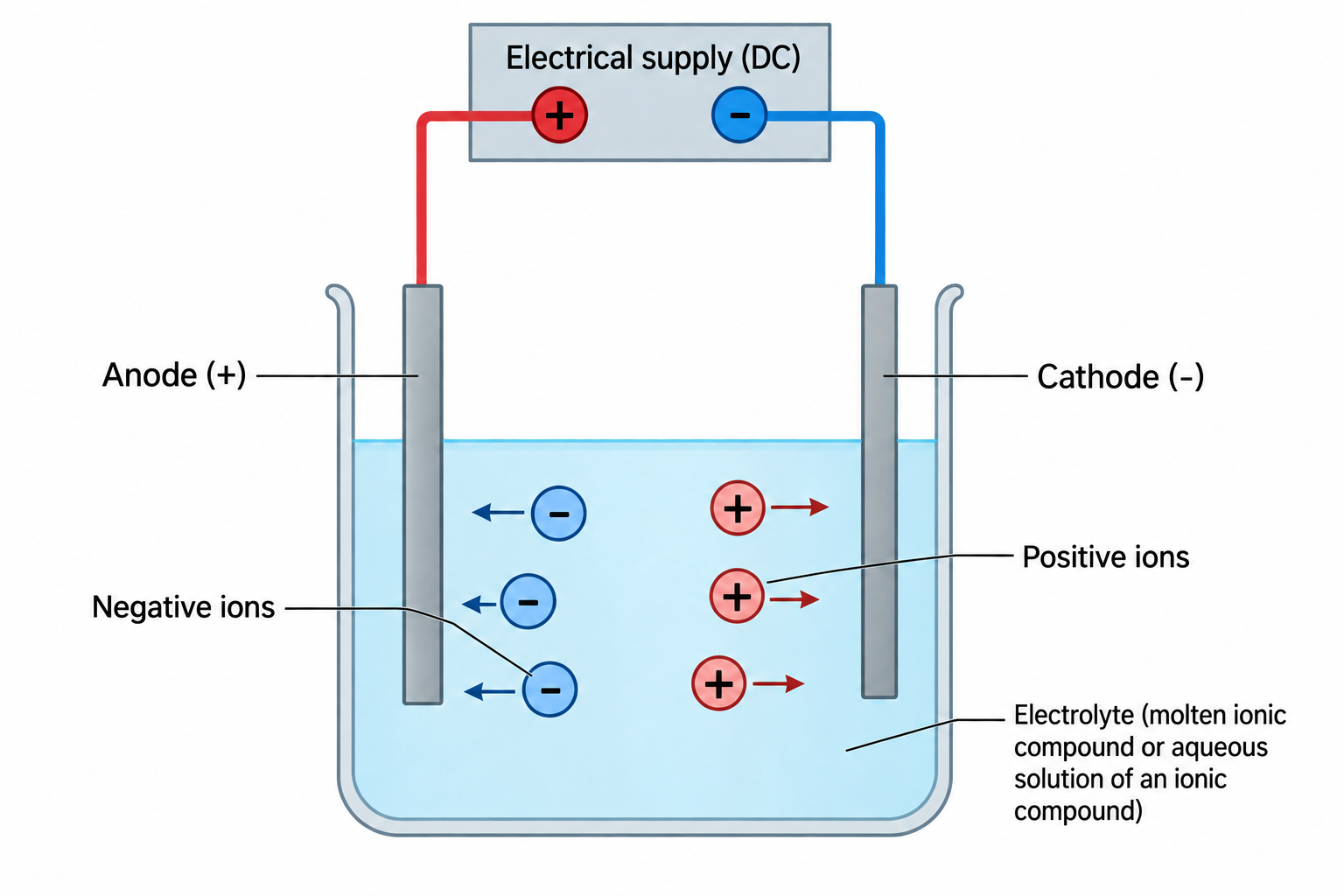
At the electrodes the ions are discharged: they lose their charge and form elements. AQA's specification puts it this way: "Ions are discharged at the electrodes producing elements. This process is called electrolysis."
Paper 1, for both AQA courses: see the Paper 1 guide.
Electrolysis of molten ionic compounds
When a molten compound of a metal and a non-metal is electrolysed, the metal forms at the cathode and the non-metal forms at the anode. The electrodes are often inert, such as graphite: they conduct without adding any products of their own.
To predict the products from a formula:
- Find the metal. Its positive ions move to the cathode and form the metal.
- Find the non-metal. Its negative ions move to the anode and form the non-metal.
AQA's example is lead bromide, PbBr₂, which contains Pb²⁺ and Br⁻ ions. Lead forms at the cathode and bromine at the anode:
PbBr₂(l) → Pb(l) + Br₂(g)
AQA's specification says anhydrous zinc chloride is a safer alternative for practical work. Anhydrous means containing no water. Zinc forms at the cathode and chlorine at the anode:
ZnCl₂(l) → Zn(s) + Cl₂(g)
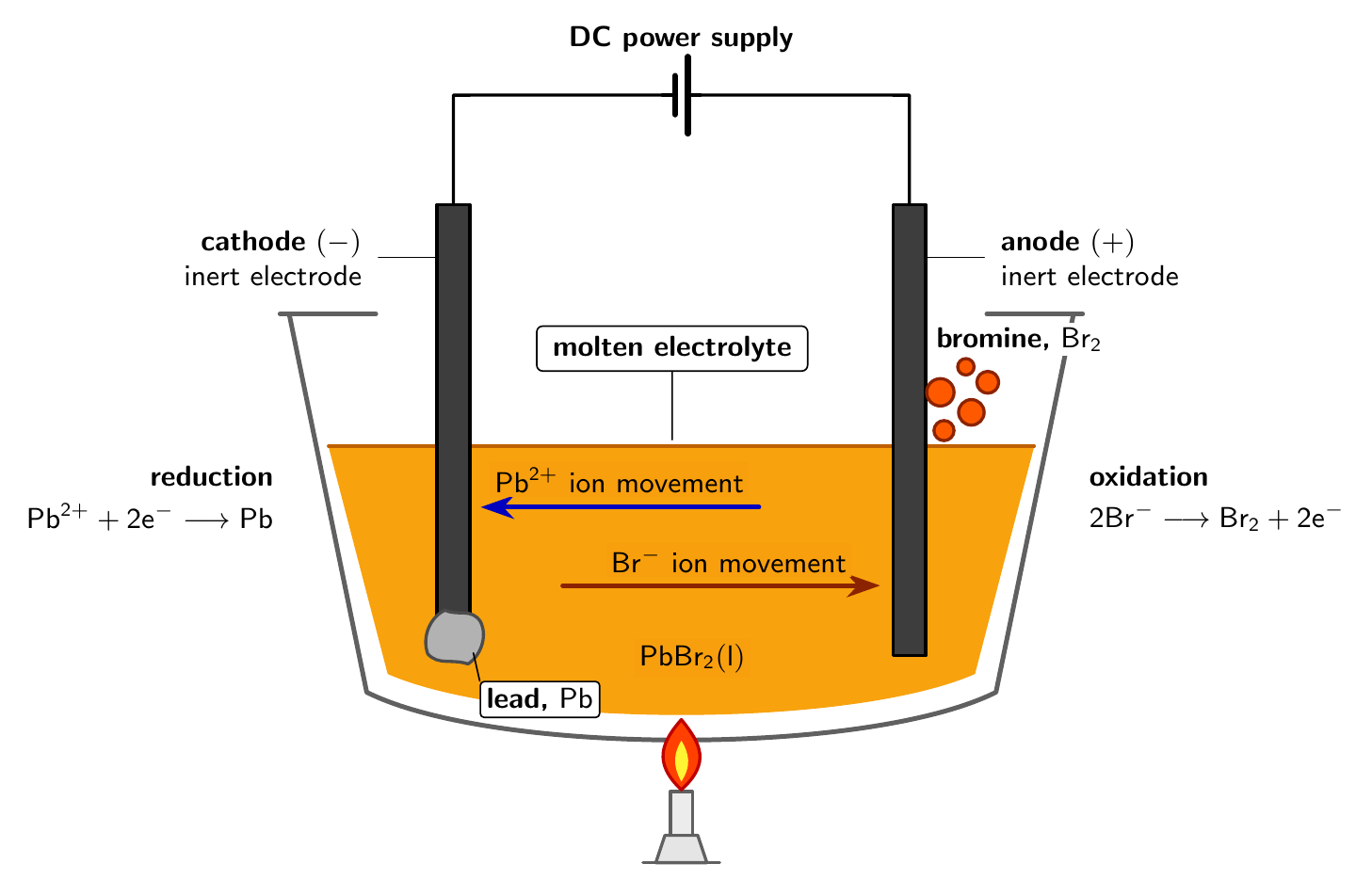
The labels at the sides of this picture are half equations, which are Higher tier content and are covered further down the page.
How is aluminium extracted by electrolysis?
Aluminium is too reactive to be extracted from aluminium oxide by reduction with carbon, so it is extracted by electrolysis.
Aluminium oxide has a very high melting point, so melting it alone would take a very large amount of energy. That is why a mixture is used as the electrolyte: cryolite is mixed with the aluminium oxide, and the mixture melts at a lower temperature, so less energy is needed to keep it molten.
Positive aluminium ions, Al³⁺, move to the cathode and form aluminium. Negative oxide ions, O²⁻, move to the positive electrode, which is made of carbon, and form oxygen.
The positive electrode must be replaced because the oxygen reacts with the hot carbon to form carbon dioxide, so the electrode is gradually used up:
C(s) + O₂(g) → CO₂(g)
The process uses large amounts of energy, to melt the mixture and to produce the electric current. That, and replacing the carbon electrodes, makes aluminium expensive to produce.
Electrolysis of aqueous solutions: what forms at each electrode
In a solution, water adds its own ions. Water molecules break down to form hydrogen ions and hydroxide ions:
H₂O(l) ⇌ H⁺(aq) + OH⁻(aq)
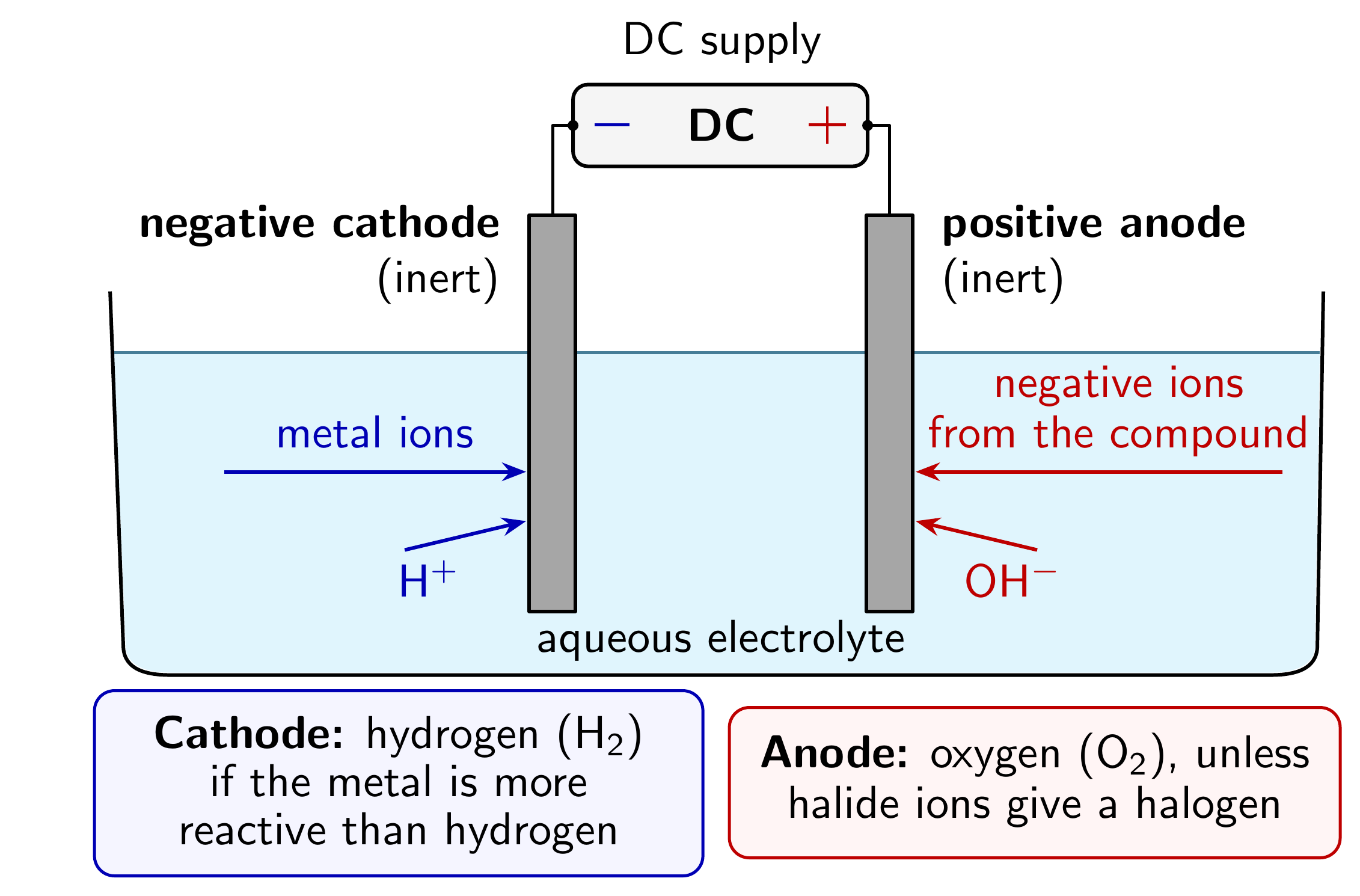
So at each electrode, ions from water compete with ions from the dissolved compound. AQA's rule decides which are discharged:
| Electrode | What forms | Sodium chloride solution | Copper sulfate solution |
|---|---|---|---|
| Cathode (negative) | Hydrogen, if the metal is more reactive than hydrogen; the metal, if it is less reactive | Hydrogen | Copper |
| Anode (positive) | Oxygen, unless the solution contains halide ions, when the halogen is produced | Chlorine | Oxygen |
The two decisions are separate. Reactivity compared with hydrogen decides the cathode product, and whether there are halide ions (chloride, bromide or iodide) decides the anode product.
This is why molten and aqueous sodium chloride give different products at the cathode. Molten sodium chloride has only sodium ions to discharge at the cathode, so sodium forms. The solution also has hydrogen ions from water, and sodium is more reactive than hydrogen, so hydrogen forms instead.
The electrolysis required practical
The electrolysis required practical is required practical 3 in GCSE Chemistry and required practical activity 9 in Combined Science: Trilogy. AQA describes it as: "investigate what happens when aqueous solutions are electrolysed using inert electrodes. This should be an investigation involving developing a hypothesis."
A typical school version uses sodium chloride solution and copper sulfate solution. Your hypothesis comes from the rule above.
- Pour one solution into a beaker and stand two clean graphite electrodes in it, not touching.
- Connect the electrodes to a low-voltage direct-current supply. The one connected to the negative terminal is the cathode.
- Fill two test tubes with the solution and turn one upside down over each electrode, so that the gases are collected separately and do not mix.
- Switch on for a set time and record what you see at each electrode.
- Switch off, then test any gas collected. Repeat with the second solution, using clean apparatus.
| Solution | Electrode | What you see | Test | Product |
|---|---|---|---|---|
| Sodium chloride | Cathode | Bubbles | A burning splint gives a pop | Hydrogen |
| Sodium chloride | Anode | Bubbles | Damp litmus paper is bleached white | Chlorine |
| Copper sulfate | Cathode | Pink-brown coating | None needed | Copper |
| Copper sulfate | Anode | Bubbles | A glowing splint relights | Oxygen |
Keep the variables the same between runs: the volume and concentration of solution, the electrodes and the distance between them, the supply setting and the time. Chlorine is harmful if breathed in, so only small amounts are made, in a well-ventilated room. Keep flames away from the cell except to test a small hydrogen sample, and wear eye protection.
AQA's method for this practical uses copper(II) chloride solution and sodium chloride solution, and tests for chlorine with blue litmus paper held in the solution next to the positive electrode, which is bleached white. Copper(II) chloride gives copper at the cathode and chlorine at the anode. The solutions differ from those above, but the rule being tested is the same.
Higher tier only: half equations at the electrodes
Foundation tier papers do not test this part.
At Higher tier you write half equations for the reactions at the electrodes during electrolysis, and you may be asked to complete and balance half equations you are given. At the cathode, positive ions gain electrons, so the reactions are reductions. At the anode, negative ions lose electrons, so the reactions are oxidations.
| Electrode | Half equation |
|---|---|
| Cathode | 2H⁺(aq) + 2e⁻ → H₂(g) |
| Cathode | Pb²⁺(l) + 2e⁻ → Pb(l) |
| Cathode | Zn²⁺(l) + 2e⁻ → Zn(s) |
| Cathode | Cu²⁺(aq) + 2e⁻ → Cu(s) |
| Anode | 4OH⁻(aq) → O₂(g) + 2H₂O(l) + 4e⁻ |
| Anode | 2Br⁻(l) → Br₂(g) + 2e⁻ |
| Anode | 2Cl⁻(l) → Cl₂(g) + 2e⁻ |
The state symbols follow each example: (l) for ions in a molten compound and (aq) for ions in a solution. So when chlorine forms from sodium chloride solution, the chloride ions are Cl⁻(aq).
The hydroxide half equation can also be written 4OH⁻(aq) − 4e⁻ → O₂(g) + 2H₂O(l). Both forms show four electrons lost.
To balance one, write the ion and the product, balance the atoms, then add electrons until the total charge is the same on both sides. Electrons are added on the left at the cathode and on the right at the anode. The second hydroxide form above takes them away on the left instead. For hydroxide ions, 4OH⁻ gives the four oxygen and four hydrogen atoms in O₂ + 2H₂O. The left side then has a charge of −4, so four electrons go on the right.
Here is an exam-style question from Medly, marked with Medly's mark scheme.
Worked example (2 marks)
Medly's question is answered on screen, so it says "Type". On paper, write the equation.
In the industrial extraction of aluminium, an electric current is passed through a molten electrolyte containing aluminium oxide and cryolite:
2Al₂O₃ → 4Al + 3O₂
Oxygen gas forms at the positive electrode.
Write the balanced half-equation for the formation of oxygen from oxide ions at the positive electrode. Type the complete balanced equation: 2O²⁻ →
- The product is oxygen, O₂ (1 mark).
- Two oxide ions contain two oxygen atoms, which make one O₂ molecule. The left side has a charge of 2 × (−2) = −4 and O₂ has no charge, so four electrons go on the right: 2O²⁻ → O₂ + 4e⁻ (1 mark). This mark is needed for full marks.
Medly's mark scheme accepts equivalent whole-number multiples, such as 4O²⁻ → 2O₂ + 8e⁻.
Where marks are lost on electrolysis questions
Each row is from one of AQA's published GCSE Chemistry (8462) Higher Paper 1 mark schemes.
| Question | What the mark scheme did | How to fix it |
|---|---|---|
| June 2024, 05.2: why solid calcium chloride cannot be electrolysed | "the ions cannot move", with "the ions are in fixed positions" allowed | Say the ions cannot move |
| June 2024, 05.5: coloured ions moving to the electrodes | 1 mark for which ion is which colour (Cu²⁺ blue, CrO₄²⁻ yellow), 1 for Cu²⁺ moving to the negative electrode, 1 for CrO₄²⁻ moving to the positive electrode. "Cathode", "anode" and "attraction" were allowed | Name each ion, its colour and the electrode it moves to |
| June 2025, 06.3: why a mixture is used | "the mixture has a lower melting point than aluminium oxide", with "to lower the energy demand" allowed | Compare the mixture's melting point with aluminium oxide's |
| June 2025, 06.4 (Higher tier): the oxygen half equation | 2O²⁻ → O₂ + 4e⁻ for 2 marks; 1 mark for O²⁻ → O₂ + e⁻ with missing or wrong balancing numbers | Balance the oxygen atoms, then the charge |
| June 2025, 06.5: why the positive electrode is replaced | Three marks: the electrode is carbon; it reacts with the oxygen produced; this produces carbon dioxide | Give all three steps |
Electrolysis exam questions with answers
The worked example and the four questions below are exam-style questions from Medly, marked with Medly's mark schemes.
Worked example (3 marks)
A student investigated the electrolysis of a solution containing blue P²⁺ ions and orange Q²⁻ ions.
Blue colour became concentrated near the electrode labelled negative, and orange colour became concentrated near the electrode labelled positive.
Explain the colour changes.
- The blue ions are P²⁺ and the orange ions are Q²⁻ (1 mark).
- P²⁺ ions move to the negative electrode, the cathode (1 mark).
- Q²⁻ ions move to the positive electrode, the anode (1 mark). This point is needed for full marks.
Medly's mark scheme accepts "towards the negative electrode" or "towards the cathode", and the same for the anode.
Question 1: (1 mark)
Both barium chloride samples use graphite electrodes and the same 6.0 V supply.
| State of barium chloride | Current | Products observed |
|---|---|---|
| Solid | 0.00 A | None |
| Molten | 0.42 A | Products at both electrodes |
Which of the following claims is supported by the evidence?
Select one answer.
A. Melting enables positive and negative ions in barium chloride to move, allowing current to flow.
B. Melting creates electrons inside barium chloride, and these electrons carry the current.
C. The solid sample has more mobile ions than the molten sample.
D. Graphite becomes a reaction product only when barium chloride is molten.
Answer
A (1 mark). The molten sample conducts current and produces products at both electrodes, which supports the movement of positive and negative ions.
B is wrong because the evidence does not support the formation of electrons: the result is explained by the movement of ions. C is wrong because the solid carried no current and produced no products, so it did not have more mobile ions than the molten sample. D is wrong because graphite electrodes were used for both samples, so the evidence does not support graphite becoming a product.
Question 2: (2 marks)
Molten potassium chloride can be electrolysed to produce potassium at the negative electrode (cathode). A technician proposes using an aqueous potassium chloride solution instead.
Explain why electrolysis cannot be used to produce potassium from aqueous potassium chloride solution.
Answer
- Potassium is more reactive than hydrogen (1 mark). Medly's mark scheme also accepts "potassium is higher in the reactivity series than hydrogen".
- Hydrogen is produced instead of potassium at the negative electrode (1 mark). It also accepts "hydrogen ions from water are discharged to form hydrogen". This point is needed for full marks.
Question 3: (2 marks)
Iron is extracted from its oxide by reduction with carbon. Aluminium is extracted by electrolysis of a molten mixture of aluminium oxide and cryolite.
Explain why aluminium is more expensive to produce than iron.
Answer
Any two of these, 1 mark each. Point 1 is needed for full marks.
- Electrolytic extraction requires more energy, to heat the electrolyte and to provide the electric current. Medly's mark scheme accepts "large amounts of energy are needed", and ignores a bare mention of electricity.
- Aluminium is obtained by electrolysis of a molten mixture of aluminium oxide and cryolite.
- Aluminium is too reactive to be extracted by reduction with carbon. It accepts "carbon cannot reduce aluminium oxide" or "aluminium is above carbon in the reactivity series".
Question 4: (6 marks)
This question is about the electrolysis of an aqueous solution.
Plan an investigation to find how potential difference affects the volume of gas collected in four minutes. Your plan should give valid results.
Answer
Medly's mark scheme for this question uses three levels: 1 to 2 marks, 3 to 4 marks and 5 to 6 marks. At 1 to 2 marks the method would not give valid results: some relevant steps are given, but how they connect is not shown. At 3 to 4 marks the method might not give valid results: most steps are given, but not all in a logical order. At 5 to 6 marks the method would give valid results, with all the key steps in a logical order.
An answer at the top level of Medly's mark scheme could read:
- Prediction: increasing the potential difference will change the volume of gas collected in four minutes.
- Put inert electrodes into the aqueous solution and connect them to a direct-current supply.
- Set the first potential difference, then collect the gas for exactly four minutes and measure its volume.
- Repeat for a range of potential differences.
- Keep the solution's volume and concentration, the electrode material and the distance between the electrodes, the collection time and the way the gas is measured the same each time.
- Use the electrical equipment carefully and work in a well-ventilated room because of the gases produced.
- Repeat each reading, work out the mean volume for each potential difference, and compare the means before drawing a conclusion.
AQA marks extended response questions in levels, with two marks in each level: on its June 2025 Higher papers, each 6-mark extended response question had three levels, of 1 to 2, 3 to 4 and 5 to 6 marks.
Electrolysis questions repeat the same few decisions: which ions are present, where each one goes, and what it forms. Medly marks written answers like Question 4 against the mark scheme, so you can see which point you missed. Medly has AQA GCSE Chemistry courses at Foundation and Higher, and AQA GCSE Combined Chemistry courses at Foundation and Higher for Combined Science students. Medly's free plan includes 5 marked questions, 20 AI tutor messages and 1 uploaded paper a day, with no card needed.
Frequently asked questions
What is electrolysis, in one sentence?
It is the splitting of an ionic compound using electricity. The compound is melted or dissolved so that its ions can move to the electrodes, where they are discharged and form elements.
Why does an ionic compound have to be molten or dissolved?
In a solid the ions are held in fixed positions, so they cannot move and carry charge. When the compound is melted or dissolved, the ions are free to move.
What is produced at the cathode and anode in aqueous electrolysis?
At the cathode, hydrogen forms if the metal is more reactive than hydrogen; otherwise the metal forms. At the anode, oxygen forms unless the solution contains halide ions, in which case the halogen forms.
Why is cryolite used in the extraction of aluminium?
The mixture of aluminium oxide and cryolite melts at a lower temperature than aluminium oxide alone, so less energy is needed to keep the electrolyte molten.
Do Foundation students need to write half equations?
Foundation tier papers do not test half equations for electrolysis. They are Higher tier content in both AQA courses.