
Reactivity series: the order of metals, a way to remember it, and GCSE exam questions
Learn the ten in AQA's list in order, a way to remember them, how displacement works and how exam answers are marked.
On this page
The reactivity series puts metals in order of how readily they react, from potassium at the top to copper at the bottom, with carbon and hydrogen included for comparison. This guide follows AQA GCSE Chemistry (8462) and Combined Science: Trilogy (8464) at both tiers, and covers the order, a way to remember it, displacement reactions and exam questions with answers.
What is the reactivity series?
The reactivity series is a list of substances in order of their reactivity, with the most reactive at the top and the least reactive at the bottom. Reactivity means how readily a substance takes part in a chemical reaction.
For a metal, that depends on how readily its atoms form positive ions, which they do by losing electrons. Potassium atoms form positive ions very readily, so potassium is highly reactive. Metals near the bottom form them less readily, so they react slowly or not at all under the same conditions.
Paper 1, for both AQA courses: see the Paper 1 guide.
The reactivity series of metals in order
Here are the ten substances in order, with how each metal reacts with cold water and with dilute acid at room temperature.
| Position | Substance | Cold water | Dilute hydrochloric or sulfuric acid |
|---|---|---|---|
| 1 | Potassium | Very vigorous reaction; hydrogen produced | Very vigorous reaction, producing hydrogen |
| 2 | Sodium | Vigorous reaction; hydrogen produced | Very vigorous reaction, producing hydrogen |
| 3 | Lithium | Vigorous but less rapid reaction; hydrogen produced | Vigorous reaction, producing hydrogen |
| 4 | Calcium | Readily reacts; hydrogen produced | Vigorous reaction, producing hydrogen |
| 5 | Magnesium | Very slow reaction | Rapid reaction, producing hydrogen |
| 6 | Carbon | Non-metal, included for comparison | Non-metal, included for comparison |
| 7 | Zinc | No reaction | Moderate reaction, producing hydrogen |
| 8 | Iron | No reaction | Slow reaction, producing hydrogen |
| 9 | Hydrogen | Non-metal, included for comparison | Non-metal, included for comparison |
| 10 | Copper | No reaction | No reaction with dilute hydrochloric or sulfuric acid |
Zinc, iron and copper all show no reaction with cold water, so water alone cannot put them in order. Their reactions with dilute acids do.
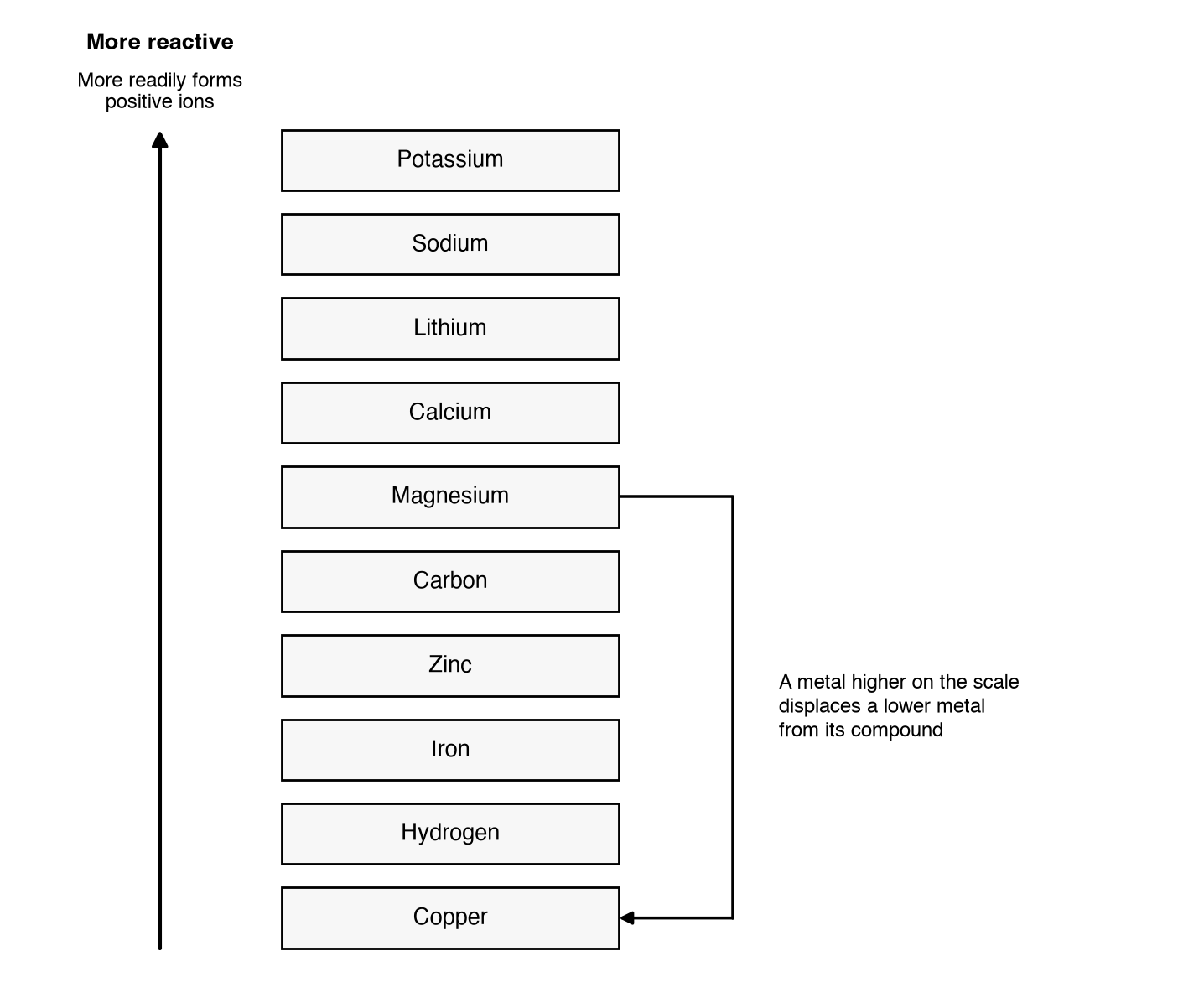
This is the list in AQA's specification: "The metals potassium, sodium, lithium, calcium, magnesium, zinc, iron and copper can be put in order of their reactivity from their reactions with water and dilute acids." It adds: "The non-metals hydrogen and carbon are often included in the reactivity series." This is AQA's list. If you are on another board, check your own specification.
AQA's specification says: "The reactions of metals with water and acids are limited to room temperature and do not include reactions with steam."
How to remember the reactivity series
Here is one way to remember the order of the ten:
Purple Snails Lick Cold Melons, Carefully Zipping Into Hot Custard.
| Word | Letter | Element |
|---|---|---|
| Purple | P | potassium |
| Snails | S | sodium |
| Lick | L | lithium |
| Cold | C | calcium |
| Melons | M | magnesium |
| Carefully | C | carbon |
| Zipping | Z | zinc |
| Into | I | iron |
| Hot | H | hydrogen |
| Custard | C | copper |
The letters come from the names, not the symbols, so P is potassium (not K) and I is iron. Three words start with C, so check the table for which C is calcium, which is carbon and which is copper.
What is a displacement reaction?
A more reactive metal can displace a less reactive metal from its compound. To displace means to take its place in the compound.
Zinc is above copper, so zinc displaces copper from copper sulfate solution:
Zn(s) + CuSO₄(aq) → ZnSO₄(aq) + Cu(s)
When a zinc strip is placed in blue copper sulfate solution:
- zinc goes into the solution as zinc ions
- copper is deposited on the zinc as a reddish-brown solid
- the blue colour of the solution becomes less intense as copper ions are removed.
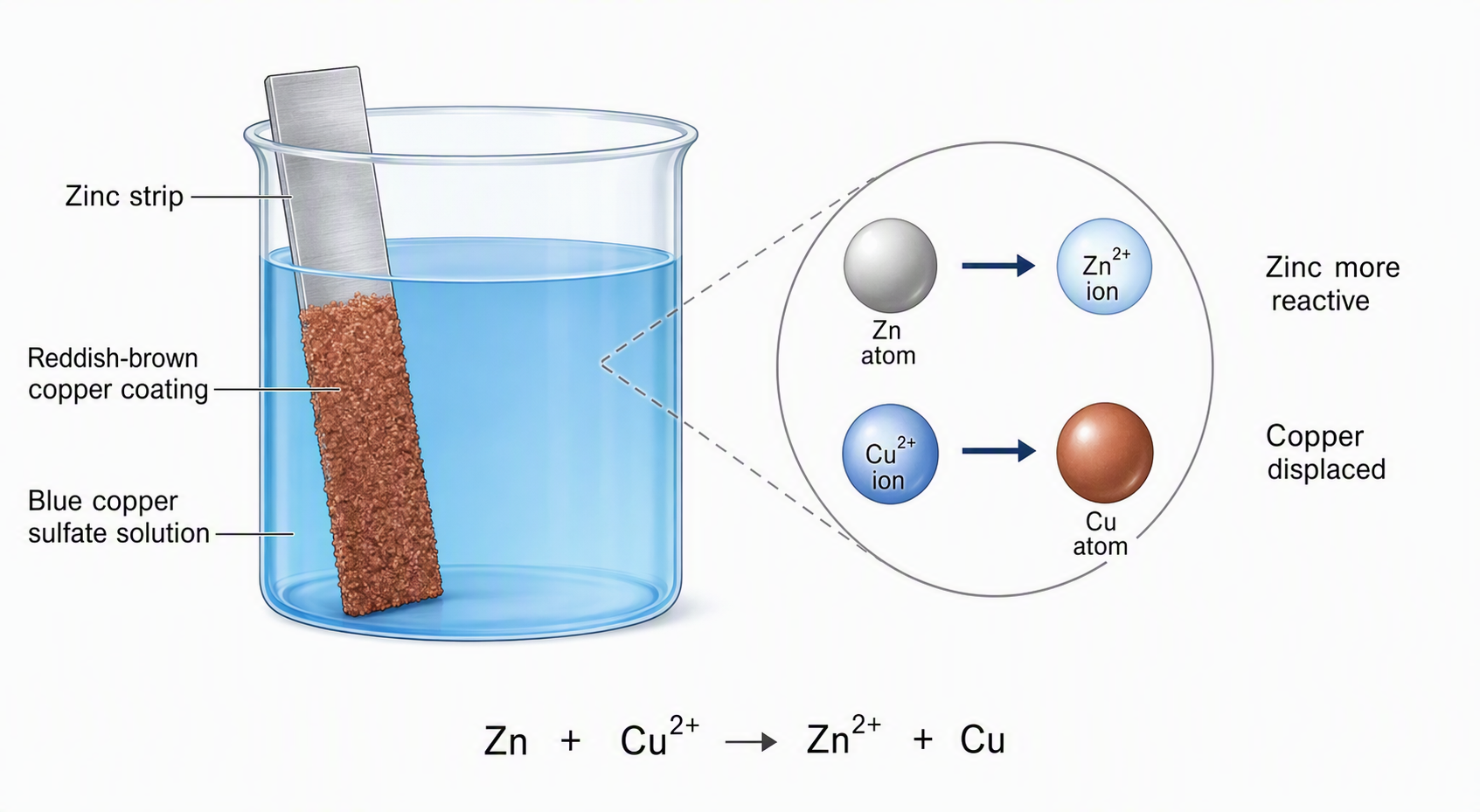
The equation printed under the picture is an ionic equation. Ionic equations for displacement are Higher tier content, covered further down the page.
To predict whether a displacement happens, compare the two metals' positions. A metal higher in the series can displace a metal lower in the series from its compound. A metal lower in the series cannot displace one higher up, so copper cannot displace zinc from zinc sulfate.
You can also work out an order from results. In a fair comparison, metal strips with the same exposed surface area go into the same volume and concentration of dilute hydrochloric acid at the same temperature. If magnesium bubbles rapidly, zinc moderately, iron slowly and copper not at all, the order is magnesium, zinc, iron, copper.
Why are carbon and hydrogen in the reactivity series?
Hydrogen and carbon are non-metals, but they are useful reference points.
Hydrogen shows which metals react with dilute acids. Metals above hydrogen react with dilute hydrochloric or sulfuric acid to form a salt and hydrogen:
metal + dilute acid → salt + hydrogen
Mg(s) + 2HCl(aq) → MgCl₂(aq) + H₂(g)
Copper is below hydrogen, so it does not react with dilute hydrochloric or sulfuric acid.
Carbon shows which metals can be extracted from their oxides with carbon. Very unreactive metals such as gold can be found in the Earth as the metal itself, but most metals are found as compounds. A metal less reactive than carbon can be extracted from its oxide by reduction with carbon:
2CuO(s) + C(s) → 2Cu(s) + CO₂(g)
Oxidation is the gain of oxygen and reduction is the loss of oxygen. Here copper(II) oxide loses oxygen, so it is reduced, and carbon gains oxygen, so it is oxidised. A metal reacting with oxygen to form its oxide is oxidised in the same way:
2Mg(s) + O₂(g) → 2MgO(s)
Aluminium is too reactive to be extracted from aluminium oxide by reduction with carbon, so electrolysis is used instead.
AQA's specification says: "Knowledge of the details of processes used in the extraction of metals is not required."
Higher tier only: oxidation and reduction in terms of electrons
Foundation tier papers do not test this part.
At Higher tier, you need to know that oxidation is the loss of electrons and reduction is the gain of electrons. You also need to write ionic equations for displacement reactions, and to identify which species are oxidised and which are reduced in a given reaction, symbol equation or half equation. A species is an atom, ion or molecule.
In the zinc and copper sulfate reaction, each zinc atom loses two electrons, so zinc is oxidised:
Zn(s) → Zn²⁺(aq) + 2e⁻
Each copper ion gains the two electrons, so copper ions are reduced:
Cu²⁺(aq) + 2e⁻ → Cu(s)
The sulfate ions are there before and after the reaction without changing, so they are left out of the ionic equation:
Zn(s) + Cu²⁺(aq) → Zn²⁺(aq) + Cu(s)
It balances: one zinc and one copper on each side, and a total charge of +2 on each side. In a half equation, electrons on the right mean the species is oxidised, and electrons on the left mean it is reduced.
Where marks are lost on reactivity series questions
Each row is from one of AQA's published GCSE Chemistry (8462) Higher Paper 1 mark schemes.
| Question | What the mark scheme did | How to fix it |
|---|---|---|
| June 2024, 01.6: why copper is not used to produce a salt with sulfuric acid | Gave the mark for copper not reacting with the acid, and allowed "is below hydrogen in the reactivity series". It ignored "is not reactive enough" | Say that copper does not react with the acid, or that it is below hydrogen in the reactivity series |
| June 2024, 04.4 (Higher tier): ionic equation for zinc and copper sulfate | Zn(s) + Cu²⁺(aq) → Zn²⁺(aq) + Cu(s) for 2 marks, with 1 mark allowed for Zn²⁺ + Cu | Write only the species that change, and leave out the sulfate ions |
| June 2025, 03.1: which substance is reduced in SnO₂ + C → Sn + CO₂ | Tin oxide, because it "loses oxygen". The reason mark depended on naming tin oxide | Name the substance that loses oxygen (tin oxide, not tin), then give the reason |
| June 2025, 03.2: why carbon can be used to extract tin | "carbon is more reactive than tin", with "tin is less reactive than carbon" allowed | Compare carbon with the metal |
Reactivity series exam questions with answers
The worked example and the three questions below are exam-style questions from Medly, marked with Medly's mark schemes.
Worked example (3 marks)
An iron strip is placed in copper(II) nitrate solution. A red-brown solid identified as copper forms, and the solution changes from blue to pale green. A supplied colour key identifies the pale green solution as containing Fe²⁺ ions.
Explain how these observations show that copper is less reactive than iron.
- The red-brown deposit shows that copper metal forms from the copper(II) ions in the solution (1 mark).
- The pale green colour shows that iron has reacted to form iron(II) ions, Fe²⁺, in solution (1 mark).
- So iron displaces copper from its ions, which shows that iron is more reactive and copper is less reactive (1 mark). This point is needed for full marks.
At Higher tier you can put the first two points in terms of electrons: copper(II) ions gain electrons (reduction) and iron atoms lose electrons (oxidation). Medly's mark scheme accepts either way and does not require electrons. It gives no mark for calling the deposit iron, or for iron(III) ions as the reason for the green colour.
Question 1: (2 marks)
Two equal samples of oxide of metal X were heated for the same time. The sample heated with carbon formed metal X; the sample heated without carbon did not form metal X.
Explain what this evidence shows about the position of X relative to carbon in the reactivity series.
Answer
- Metal X is less reactive than carbon (1 mark). Medly's mark scheme also accepts "X is below carbon in the reactivity series" or "carbon is more reactive than X".
- X can be extracted from its oxide by reduction with carbon (1 mark). It also accepts "carbon reduces the oxide of X to form X".
Question 2: (4 marks)
Three metal strips, known to be magnesium, zinc, and copper, have been labelled with identification codes.
Describe an experimental procedure using dilute hydrochloric acid to determine which metal corresponds to each code.
Your method should ensure that the comparison is valid.
Answer
Medly's mark scheme for this question uses two levels: 1 to 2 marks and 3 to 4 marks. At the lower level the method would not give valid results: some relevant steps are given, but how they connect is not shown. At the higher level the method would lead to a valid outcome, with the key steps in a logical order. It is marked on best fit.
An answer at the top level of Medly's mark scheme could read:
- Place equal-sized samples of each coded metal in separate labelled test tubes.
- Add the same measured volume of dilute hydrochloric acid, of the same concentration, to each tube, at the same starting temperature.
- Compare the rate of bubbling in each tube over the same time, or measure the volume of hydrogen given off in the same fixed time.
- The sample with no reaction is copper, because copper is below hydrogen.
- The faster reaction is magnesium and the slower one is zinc, so magnesium is above zinc and copper in the reactivity series.
AQA marks extended response questions in levels, with two marks in each level: on its June 2025 Higher papers, each 6-mark extended response question had three levels, of 1 to 2, 3 to 4 and 5 to 6 marks.
Question 3: (5 marks)
This question is about displacement reactions.
A student investigated solid coded metals in aqueous nitrate solutions. The letters A, B, C and D represent different metals. Each row gives a reaction and its recorded products.
| reaction | record |
|---|---|
| A + B(NO₃)₂ | A(NO₃)₂ + B |
| C added to A(NO₃)₂ | Metal A and a solution of C(NO₃)₃ form |
| D + C(NO₃)₃ | no reaction |
Metal C forms C³⁺ ions. Nitrate ions are NO₃⁻.
(a) Which is the correct equation for the reaction between C and aqueous A(NO₃)₂? Select one answer. [1 mark]
A. C + A(NO₃)₂ → C(NO₃)₃ + A
B. 2C + 3A(NO₃)₂ → 2C(NO₃)₃ + 3A
C. 3C + 2A(NO₃)₂ → 3C(NO₃)₃ + 2A
D. 2C + 3A(NO₃)₃ → 2C(NO₃)₂ + 3A
(b) Which of the following claims is supported by the evidence? Select one answer. [1 mark]
A. B is more reactive than A and C, so it displaces both metals.
B. D is more reactive than C, as no reaction occurred.
C. C is more reactive than A; A is more reactive than B.
D. All four metals have the same reactivity in tests.
(c) Which of the coded metals could form a nitrate with one metal ion for every three nitrate ions? Explain your answer using the ionic formula. [3 marks]
Answer
(a) Option B (1 mark). The coefficients balance C, A and the nitrate groups: 2 C, 3 A and 6 nitrate groups on each side. Option A is wrong because the nitrate groups are not balanced. Option C is wrong because the coefficients do not balance the nitrate groups. Option D is wrong because the nitrate ratio is not balanced between the reactants and products.
(b) Option C (1 mark). The records show that C displaces A and A displaces B, giving the order C, then A, then B. Option A is wrong because the records support the opposite order for B and A, and for A and C. Option B is wrong because no reaction shows that D does not displace C, not that D is more reactive. Option D is wrong because the records show differences in reactivity between the metals.
(c)
- C (1 mark).
- C forms C³⁺ ions (1 mark).
- Three NO₃⁻ ions balance one C³⁺ ion in C(NO₃)₃ (1 mark). This point is needed for the third mark.
Displacement questions come down to the same steps each time: which metal is higher, what was seen, and what that shows. On Medly you can keep practising them, and Medly marks written answers like Question 2 against the mark scheme, so you can see which point you missed. Medly has AQA GCSE Chemistry courses at Foundation and Higher, and AQA GCSE Combined Chemistry courses at Foundation and Higher for Combined Science students. In a randomised controlled trial in GCSE science, students using Medly for 30 minutes a week for four weeks scored 22% higher on the post-test than students revising in their usual way, adjusted for where they started. The students they were compared with used revision guides, notes, videos and, in most classes, other online revision platforms, and the trial covered biology, chemistry and physics.
Frequently asked questions
What is the order of the reactivity series for AQA GCSE?
From most to least reactive: potassium, sodium, lithium, calcium, magnesium, carbon, zinc, iron, hydrogen, copper. Carbon and hydrogen are non-metals included for comparison.
How do you remember the reactivity series?
One way is a sentence whose first letters follow the order, such as "Purple Snails Lick Cold Melons, Carefully Zipping Into Hot Custard". The letters come from the names, so check which C is calcium, carbon or copper.
Why does copper not react with dilute acid?
Copper is below hydrogen in the reactivity series. Only metals above hydrogen react with dilute hydrochloric or sulfuric acid to give a salt and hydrogen.
Do I need to know how metals react with steam?
AQA's specification says: "The reactions of metals with water and acids are limited to room temperature and do not include reactions with steam."
Do I need to know the details of how metals are extracted?
AQA's specification says: "Knowledge of the details of processes used in the extraction of metals is not required." You do need to know that metals less reactive than carbon can be extracted from their oxides by reduction with carbon.