
Moles in chemistry: the formula, the Avogadro constant and GCSE exam questions
Use n = m ÷ Mr, understand the Avogadro constant, calculate reacting masses and practise Higher tier exam questions marked step by step.
On this page
A mole is the unit chemists use to measure an amount of substance. One mole of a substance has a mass in grams equal to its relative formula mass (Mr), so moles = mass ÷ Mr. This guide is for Higher tier students on AQA GCSE Chemistry (8462) and Combined Science: Trilogy (8464), and covers the formula, the Avogadro constant, reacting masses and exam questions with answers.
What is a mole in chemistry?
AQA's specification puts it plainly: "Chemical amounts are measured in moles. The symbol for the unit mole is mol." It adds that "the mass of one mole of a substance in grams is numerically equal to its relative formula mass", and that one mole of any substance contains the same number of the stated particles as one mole of any other.
A mole can count atoms, molecules, ions, electrons, formulae or equations, so always say which. One mole of carbon, C, means carbon atoms. One mole of carbon dioxide, CO₂, means carbon dioxide molecules.
AQA labels all four sub-topics on this page Higher tier: "Moles (HT only)", "Amounts of substances in equations (HT only)", "Using moles to balance equations (HT only)" and "Limiting reactants (HT only)". Foundation tier papers do not test moles.
Paper 1, for both AQA courses: see the Paper 1 guide. AQA also says Paper 2 questions may draw on the fundamental concepts of the first three topics, so moles can come up there too: our Paper 2 guide has AQA's wording.
How to calculate moles: the formula
n = m ÷ Mr
m = n × Mr
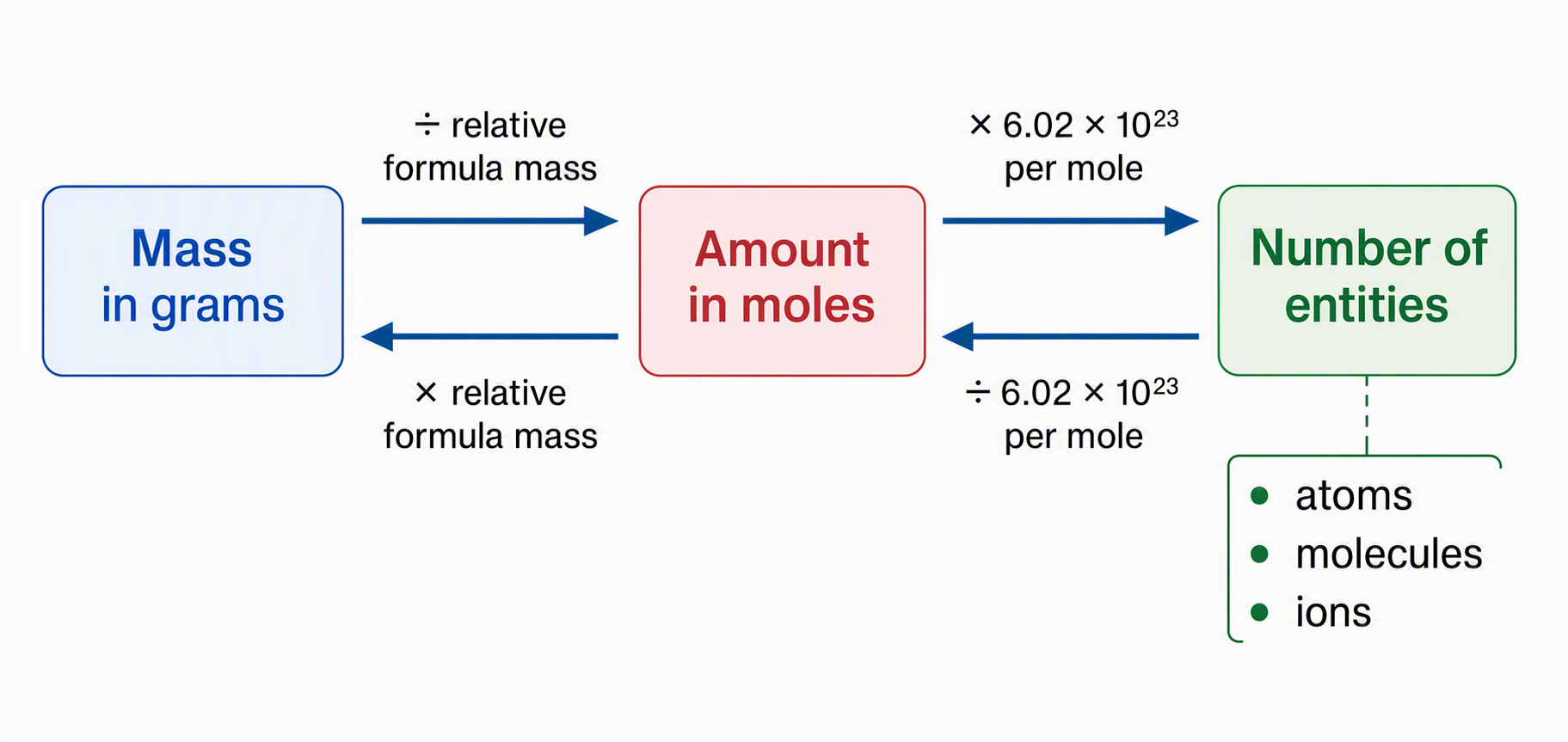
Here n is the amount in mol, m is the mass in g, and Mr is the relative formula mass, which has no unit. If you need to work out an Mr first, see our guide to relative formula mass.
On AQA's GCSE science papers from 2027, where a calculation says "show your working", the right answer alone earns one mark (see our Paper 1 guide).
Worked example: moles from mass
Calculate the amount in moles in 8.80 g of carbon dioxide, CO₂. The Mr of carbon dioxide is 44.0.
- n = m ÷ Mr = 8.80 ÷ 44.0
- n = 0.200 mol
That is sensible: 8.80 g is less than the mass of one mole, 44.0 g, so the answer is less than 1 mol.
Worked example: mass from moles
Calculate the mass of 0.352 mol of magnesium oxide, MgO. The Mr of magnesium oxide is 40.0.
- m = n × Mr = 0.352 × 40.0 = 14.08 g
- To 3 significant figures, matching the data: m = 14.1 g
What is the Avogadro constant?
The Avogadro constant is the number of atoms, molecules or ions in one mole of a substance. AQA gives its value: "The value of the Avogadro constant is 6.02 × 10²³ per mole."
So 1 mol of carbon contains 6.02 × 10²³ carbon atoms, 1 mol of carbon dioxide contains 6.02 × 10²³ carbon dioxide molecules, and 1 mol of electrons contains 6.02 × 10²³ electrons. As AQA puts it, "in one mole of carbon (C) the number of atoms is the same as the number of molecules in one mole of carbon dioxide (CO₂)". The count is the same even though the masses are not (12 g and 44 g).
Keep the two links on the map separate: Mr links mass in grams to moles, and the Avogadro constant links moles to a number of particles.
Here is an exam-style question from Medly, marked with Medly's mark scheme.
Question 1: (2 marks)
Medly's question writes the unit of the Avogadro constant as mol⁻¹. AQA's specification writes the same unit as per mole.
A student compares a sample of calcium ions with a sample of oxygen molecules. Each contains 1.00 mol of the stated particles. A separate sample contains 7.224 × 10²¹ oxygen molecules. The Avogadro constant is 6.02 × 10²³ mol⁻¹.
Calculate the amount of oxygen molecules in the separate sample, in moles.
Answer
- Divide the number of molecules by the Avogadro constant: n = (7.224 × 10²¹) ÷ (6.02 × 10²³) (1 mark).
- n = 0.0120 mol (1 mark). This point is needed for full marks.
Medly's mark scheme accepts 1.20 × 10⁻² mol or an equivalent value, with or without the unit.
How to calculate reacting masses
A balanced equation tells you how many moles react. AQA's example is:
Mg + 2HCl → MgCl₂ + H₂
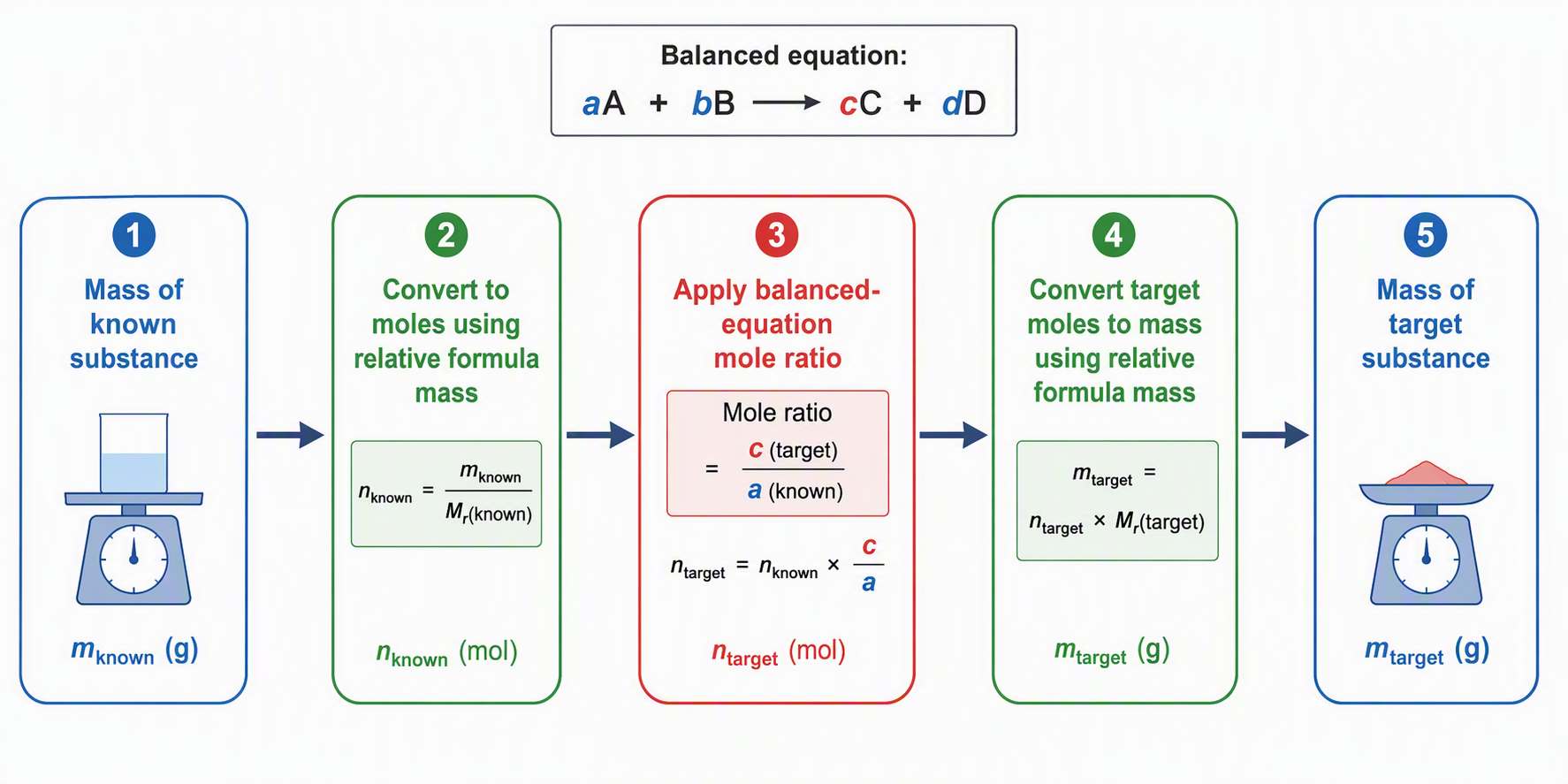
One mole of magnesium reacts with two moles of hydrochloric acid to produce one mole of magnesium chloride and one mole of hydrogen. The numbers in front give a mole ratio, not a mass ratio, so follow the same route every time:
- Write the balanced equation.
- Work out the Mr values you need.
- Convert the known mass to moles.
- Use the mole ratio to find the moles of the substance you want.
- Convert those moles back to a mass.
Worked example: mass of product
Calculate the mass of magnesium chloride produced when 12.0 g of magnesium reacts completely with hydrochloric acid. (Ar of Mg = 24; Mr of MgCl₂ = 95, so step 2 is already done.)
- Mg + 2HCl → MgCl₂ + H₂
- Moles of magnesium = 12.0 ÷ 24 = 0.500 mol
- Mg : MgCl₂ is 1 : 1, so 0.500 mol of MgCl₂ forms.
- Mass of magnesium chloride = 0.500 × 95 = 47.5 g
Using moles to balance an equation
You can find an equation's balancing numbers from the masses that react and form. Convert each mass to moles, divide by the smallest amount, and the simplest whole-number ratio gives the balancing numbers. For example, 4.8 g of magnesium reacts with 3.2 g of oxygen to form 8.0 g of magnesium oxide:
| Substance | Mass (g) | Ar or Mr | Moles | ÷ 0.10 |
|---|---|---|---|---|
| Mg | 4.8 | 24 | 0.20 | 2 |
| O₂ | 3.2 | 32 | 0.10 | 1 |
| MgO | 8.0 | 40 | 0.20 | 2 |
The ratio 2 : 1 : 2 gives 2Mg + O₂ → 2MgO, with 2 magnesium and 2 oxygen atoms on each side. To balance an equation by counting atoms instead, see our guide to balancing equations.
Here is an exam-style question from Medly, marked with Medly's mark scheme.
Worked example (6 marks)
In an investigation, a teacher passed chlorine gas over heated iron inside a combustion tube to synthesise an iron chloride. The reaction is represented by the word equation:
iron + chlorine → iron chloride
The teacher concluded that the chemical formula of the product was FeCl₃.
To determine the reacting quantities, the teacher measured the mass of the empty tube, the mass of the tube containing iron before heating, and the mass of the tube containing the product once the reaction had finished. The table shows the teacher's results.
| Measurement | Mass |
|---|---|
| Empty tube | 43.2 g |
| Tube and iron before reaction | 54.4 g |
| Tube and product after reaction | 75.7 g |
The relative atomic masses are Ar(Fe) = 56 and Ar(Cl) = 35.5.
Determine the simplest whole-number ratio of iron atoms to chlorine atoms; write a balanced equation for the reaction.
- Iron: 54.4 − 43.2 = 11.2 g (1 mark). Chlorine: 75.7 − 54.4 = 21.3 g (1 mark).
- Moles of iron = 11.2 ÷ 56 = 0.200 mol (1 mark).
- Moles of chlorine atoms = 21.3 ÷ 35.5 = 0.600 mol (1 mark).
- Fe : Cl = 0.200 : 0.600 = 1 : 3, giving FeCl₃ (1 mark).
- 2Fe + 3Cl₂ → 2FeCl₃, with 2 iron and 6 chlorine atoms on each side (1 mark).
Medly's mark scheme carries forward a wrong mass or a wrong number of moles. It accepts multiples of the equation, or fractions in it, for the last mark.
Limiting reactants in moles calculations
AQA defines it: "The reactant that is completely used up is called the limiting reactant because it limits the amount of products." The other reactant is in excess, and some of it is left over.
With Mg + 2HCl → MgCl₂ + H₂, 3 mol of magnesium and 4 mol of hydrochloric acid, the 4 mol of HCl needs only 2 mol of magnesium. So HCl is limiting: 2 mol of MgCl₂ and 2 mol of H₂ form, and 1 mol of magnesium is left.
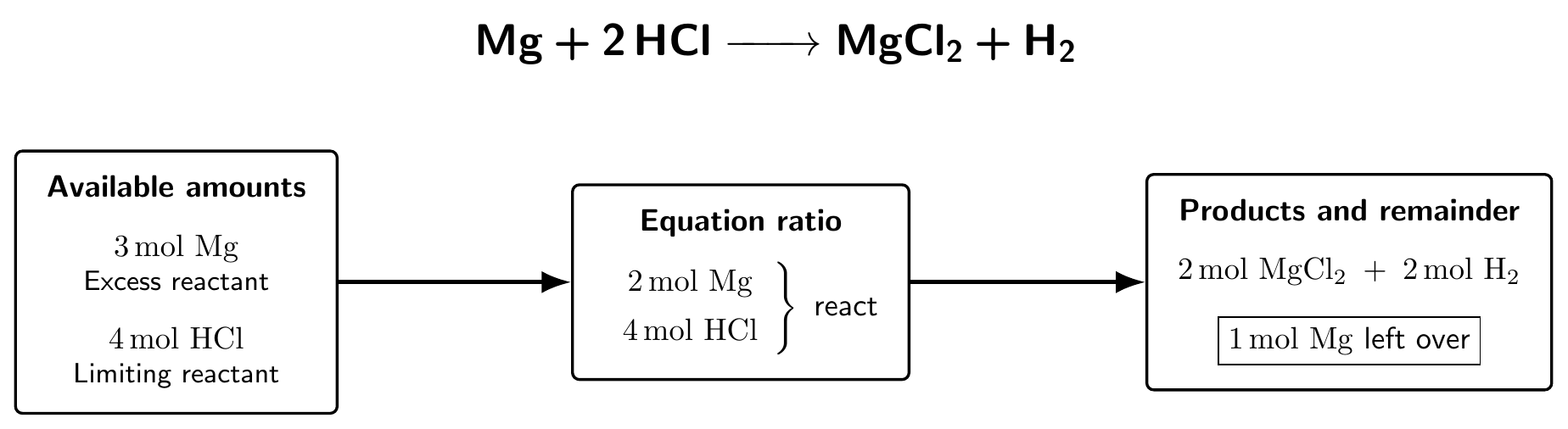
Compare reactants in moles, not grams. A larger mass does not mean a reactant is in excess, because a substance with a larger Mr has fewer moles in the same mass.
Where marks are lost on moles questions
AQA marks moles calculations a step at a time, so each line you write can earn a mark. Both rows are from AQA's GCSE Chemistry (8462) Higher Paper 1 mark schemes.
| What the question needed | What the mark scheme gave | How to keep the marks |
|---|---|---|
| A mass in kilograms: AQA's June 2024 Higher Paper 1, question 07.6 | 1 mark for 40.0 kg = 40 000 g; 1 for 40 000 ÷ 160 = 250 mol of Fe₂O₃, allowing an unconverted mass; 1 for 250 × 3 ÷ 2 = 375 mol, allowing a wrong number of moles of Fe₂O₃. Its last two marks are a gas volume, which Combined Science: Trilogy papers do not test | Convert to grams, then write each step on its own line |
| A first moles step: AQA's June 2025 Higher Paper 1, question 09.2 | The first mark is for 6.35 ÷ 254 = 0.025 mol of I₂, and the next step allows a wrong number of moles of I₂. The rest of the question is percentage yield, which is GCSE Chemistry only content | Write the moles line down first |
Moles exam questions with answers
Each question below is an exam-style question from Medly, marked with Medly's mark scheme. They get harder as you go.
Question 2: (1 mark)
A student measures the mass of a fixed salt for different amounts.
| Amount of salt (mol) | Measured mass (g) |
|---|---|
| 0.15 | 21.3 |
| 0.30 | 42.6 |
| 0.45 | 63.9 |
The student concludes that mass is directly proportional to amount.
Use the supplied results. How does the result pattern support the stated proportional relationship?
Answer
Mass doubles when the amount doubles: 0.15 mol gives 21.3 g and 0.30 mol gives 42.6 g (1 mark).
Medly's mark scheme also accepts another matched pair, such as 0.30 mol to 0.45 mol, or a constant mass-to-amount ratio (142 for each row). It rejects a statement that repeats "directly proportional" without numbers.
Question 3: (2 marks)
A student uses a mass of 5.6 g and a relative formula mass, Mr, of 120 to calculate the amount of a substance. The student reports the result as 0.0466667 mol.
Explain why 0.0466667 mol is unsuitable.
Answer
- The supplied mass and relative formula mass are given to limited precision (1 mark).
- The result should be rounded to 0.047 mol, because the data support only 2 significant figures (1 mark). This point is needed for full marks.
Question 4: (3 marks)
Magnesium reacts with oxygen to form magnesium oxide.
The balanced equation is 2Mg + O₂ → 2MgO.
The relative atomic masses are Ar(Mg) = 24 and Ar(O) = 16.
The results from two runs are shown in the table.
| Run | mass of Mg / g | mass of O₂ that reacted / g | mass of MgO / g |
|---|---|---|---|
| 1 | 4.80 | 3.20 | 8.00 |
| 2 | 9.60 | 6.40 | 16.00 |
Explain why the results support the equation. You should refer to the table in your answer.
Answer
Medly's mark scheme gives 1 mark for each point:
- The mass of MgO equals the combined masses of Mg and O₂: 4.80 g + 3.20 g = 8.00 g (or 9.60 g + 6.40 g = 16.00 g).
- Run 1 gives 4.80 ÷ 24 = 0.200 mol of Mg and 3.20 ÷ 32 = 0.100 mol of O₂. Simplifying the masses to a 3 : 2 : 5 ratio also earns this mark. Using 16 as the Mr of O₂ does not.
- The 2 : 1 mole ratio matches the equation, whose quantities have masses of 48 g Mg + 32 g O₂ = 80 g MgO. This point is needed for full marks. Saying the Mg : O₂ mass ratio is 2 : 1 earns nothing, because that is the mole ratio.
Question 5: (3 marks)
Aluminium reacts with chlorine according to this equation:
2Al + 3Cl₂ → 2AlCl₃
The amounts present and the maximum amount of product are shown for two mixtures.
| mixture | initial Al / mol | initial Cl₂ / mol | maximum AlCl₃ / mol | Al remaining / mol |
|---|---|---|---|---|
| A | 0.200 | 0.300 | 0.200 | 0 |
| B | 0.200 | 0.200 | 0.133 | 0.067 |
All the chlorine was consumed in both mixtures.
Explain why mixture B produces less aluminium chloride and leaves aluminium. You should refer to the balanced-equation ratio and the data in the table in your answer.
Answer
Medly's mark scheme gives 1 mark for each point:
- Mixture B produces 0.133 mol of AlCl₃ rather than 0.200 mol, and leaves 0.067 mol of aluminium.
- The 2 : 3 equation ratio shows that 0.200 mol of Cl₂ reacts with about 0.133 mol of aluminium (0.200 × 2 ÷ 3).
- Chlorine is the limiting reactant, so it fixes the maximum amount of AlCl₃, and aluminium is left in excess. This point is needed for full marks.
Question 6: (4 marks)
Zirconium is a transition metal. A company extracts zirconium from zirconium dioxide in a two-stage process. Stage 2:
ZrCl₄ + 2Mg → Zr + 2MgCl₂
For a batch, 95.0 kg of ZrCl₄ reacts with 12.0 kg of Mg. The relative atomic masses are Ar(Zr) = 91, Ar(Cl) = 35.5 and Ar(Mg) = 24. Show your working. Explain why magnesium is the limiting reactant.
Answer
- Mr(ZrCl₄) = 91 + (4 × 35.5) = 233 (1 mark).
- 95.0 kg = 95 000 g, so moles of ZrCl₄ = 95 000 ÷ 233 ≈ 408 mol (1 mark).
- 12.0 kg = 12 000 g, so moles of Mg = 12 000 ÷ 24 = 500 mol (1 mark).
- The 1 : 2 ratio means 408 mol of ZrCl₄ needs about 816 mol of Mg. Only 500 mol is available, so magnesium is the limiting reactant (1 mark). This point is needed for full marks.
Medly's mark scheme carries forward an error in the Mr or in the moles.
If moles still feel slippery, more questions worked one step at a time are the way through. Medly has an AQA GCSE Chemistry course at Higher, and an AQA GCSE Combined Chemistry course at Higher for Combined Science students. Medly marks written answers like Question 4 against the mark scheme, so you can see which point you missed. Medly's free plan includes 5 marked questions, 20 AI tutor messages and 1 uploaded paper a day, with no card needed.
Frequently asked questions
What is the formula for moles?
Moles = mass ÷ Mr (n = m ÷ Mr), with the mass in grams. Rearranged, mass = moles × Mr.
What is the Avogadro constant?
The number of atoms, molecules or ions in one mole of a substance: 6.02 × 10²³ per mole.
Do Foundation tier students need to know moles?
Foundation tier papers do not test moles. AQA labels these sub-topics "(HT only)" in both courses.
Does one mole of every substance have the same mass?
No. Every mole has the same number of particles, but the masses differ: one mole of carbon is 12 g and one mole of carbon dioxide is 44 g.
Which paper are moles on?
Paper 1 of both courses, at Higher tier, and Paper 2 questions may draw on them too.