
Balancing equations: a step-by-step method and GCSE exam questions with answers
Balance any equation by counting atoms, check your answer and practise with AQA GCSE exam questions marked step by step.
On this page
Balancing equations means making a chemical equation show the same number of atoms of each element on both sides, because no atoms are made or lost in a reaction. You balance one by putting numbers in front of formulae, never by changing the formulae. This guide gives a step-by-step method, two worked examples with atom counts, the equations AQA's recent papers asked for and exam questions with answers, for AQA GCSE Chemistry (8462) and Combined Science: Trilogy (8464).
What does a balanced equation mean?
A balanced equation shows that atoms are rearranged in a reaction, not created or destroyed. AQA's specification states the law of conservation of mass: "The law of conservation of mass states that no atoms are lost or made during a chemical reaction so the mass of the products equals the mass of the reactants." That's why a symbol equation must have equal numbers of atoms of each element on both sides.
AQA also expects you to understand "the use of the multipliers in equations in normal script before a formula and in subscript within a formula". Those are two different kinds of number:
- A subscript is part of the formula. In H₂O, the 2 means two hydrogen atoms and there is one oxygen atom.
- A multiplier (or balancing number) goes in front and multiplies the whole formula. 3H₂O means three water molecules: 3 × 2 = 6 hydrogen atoms and 3 × 1 = 3 oxygen atoms.
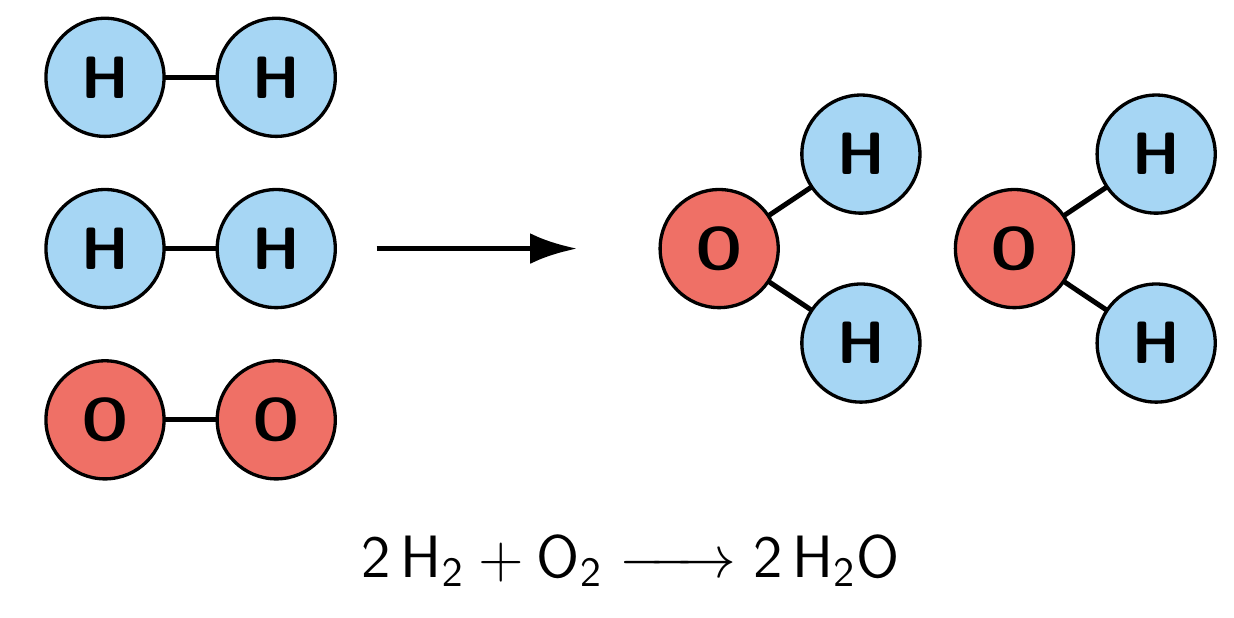
Count them: 4 hydrogen atoms and 2 oxygen atoms on each side.
Paper 1, for both AQA courses: see the Paper 1 guide. AQA also says Paper 2 questions may draw on the fundamental concepts of the first three topics, so balancing equations can come up there too: our Paper 2 guide has AQA's wording.
How to balance an equation, step by step
Use these four steps:
- Write the correct formula for each reactant and product, with state symbols if the question asks for them.
- Count the atoms of each element on both sides.
- Add whole-number balancing numbers in front of formulae until each element has the same number of atoms on both sides.
- Check every element again, and check that no formula has changed.
Never change a subscript to make an equation balance. Changing MgO to MgO₂ would describe a different substance.
Balancing equations worked examples
Worked example: magnesium and oxygen
Magnesium reacts with oxygen to form magnesium oxide. The unbalanced equation is:
Mg(s) + O₂(g) → MgO(s)
| Element | Left | Right |
|---|---|---|
| Mg | 1 | 1 |
| O | 2 | 1 |
- There are two oxygen atoms on the left and one on the right, so put a 2 in front of MgO: Mg + O₂ → 2MgO.
- Now there are two magnesium atoms on the right, so put a 2 in front of Mg.
2Mg(s) + O₂(g) → 2MgO(s)
| Element | Left | Right |
|---|---|---|
| Mg | 2 | 2 |
| O | 2 | 2 |
Worked example: aluminium and oxygen
Aluminium reacts with oxygen to form aluminium oxide, Al₂O₃:
Al(s) + O₂(g) → Al₂O₃(s)
| Element | Left | Right |
|---|---|---|
| Al | 1 | 2 |
| O | 2 | 3 |
- Oxygen comes in twos on the left and threes on the right, so aim for 6 oxygen atoms. Put a 2 in front of Al₂O₃: Al + O₂ → 2Al₂O₃. That gives 4 aluminium atoms and 6 oxygen atoms on the right.
- Put a 4 in front of Al and a 3 in front of O₂.
4Al(s) + 3O₂(g) → 2Al₂O₃(s)
| Element | Left | Right |
|---|---|---|
| Al | 4 | 4 |
| O | 6 | 6 |
State symbols in equations
AQA's specification lists them: "In chemical equations, the three states of matter are shown as (s), (l) and (g), with (aq) for aqueous solutions." So (s) is solid, (l) is liquid, (g) is gas and (aq) is dissolved in water. State symbols never change a formula: NaCl(s) is solid sodium chloride and NaCl(aq) is sodium chloride dissolved in water.
Equations AQA's papers have asked you to balance
Each row below is an equation from an AQA GCSE Chemistry (8462) Higher mark scheme, with the marks it carried.
| Paper and question | Balanced equation | Marks | Atoms on each side |
|---|---|---|---|
| June 2024 Higher Paper 1, 07.3 | 2Fe + 3Cl₂ → 2FeCl₃ | 1 | Fe 2, Cl 6 |
| June 2025 Higher Paper 1, 04.6 | Br₂ + 2KI → I₂ + 2KBr | 3 for the balanced equation. If it is not fully right, 1 mark is allowed for Br₂ and I₂, and 1 for KI and KBr | Br 2, K 2, I 2 |
| June 2025 Higher Paper 2, 02.7 | C₃H₈ + 5O₂ → 3CO₂ + 4H₂O | 2: 1 mark for 3CO₂ and 1 for 4H₂O | C 3, H 8, O 10 |
| June 2024 Higher Paper 2, 08.4 | 2C₄H₆O₂ + 9O₂ → 8CO₂ + 6H₂O | 3 for the balanced equation. If it is not fully right, 1 mark is allowed for the correct reactants and 1 for the correct products, with wrong or missing multipliers | C 8, H 12, O 22 |
The last equation comes from GCSE Chemistry only content: Combined Science: Trilogy papers do not test it. The schemes for 04.6 and 08.4 give marks for correct formulae even when the balancing numbers are wrong, so write every formula correctly first, then balance.
Higher tier: balancing from masses and half equations
Two more kinds of balancing are Higher tier only. Foundation tier papers do not test them.
- AQA's sub-topic "Using moles to balance equations (HT only)" says: "The balancing numbers in a symbol equation can be calculated from the masses of reactants and products by converting the masses in grams to amounts in moles and converting the numbers of moles to simple whole number ratios." Our moles guide shows how.
- AQA also lists "(HT only) write balanced half equations and ionic equations where appropriate." Half equations for the electrodes are worked through in our electrolysis guide.
On AQA's GCSE science papers from 2027, where a calculation says "show your working", the right answer alone earns one mark (see our Paper 1 guide).
Balancing equations exam questions with answers
Each question below is an exam-style question from Medly, marked with Medly's mark scheme. They get harder as you go, and the last two are Higher tier.
Question 1: (1 mark)
Aluminium is heated in a tube while chlorine gas passes through it. The word equation is aluminium + chlorine → aluminium chloride. The product is aluminium chloride, AlCl₃.
Which is the correct equation for the reaction? Select one answer.
A. Al + Cl₂ → AlCl₃
B. 2Al + Cl₂ → 2AlCl
C. 2Al + 3Cl₂ → 2AlCl₃
D. 2AlCl₃ → 2Al + 3Cl₂
Answer
C (1 mark). The balancing numbers give equal numbers of aluminium and chlorine atoms, and the substances are in the stated direction.
A. The atom counts are not equal on both sides.
B. The product formula is not aluminium chloride.
D. The reactants and products are written in the reverse direction.
Question 2: (3 marks)
A student changes the equation for the reaction between hydrogen and oxygen.
The atom counts for the original and revised equations are shown in the table.
| Equation | H atoms on left | H atoms on right | O atoms on left | O atoms on right |
|---|---|---|---|---|
| Original: H₂ + O₂ → H₂O | 2 | 2 | 2 | 1 |
| Revised: 2H₂ + O₂ → 2H₂O | 4 | 4 | 2 | 2 |
Explain why the revised equation is correct. You should refer to the atom-count evidence in your answer.
Answer
Medly's mark scheme gives 1 mark for each point:
- The revised equation has 2 oxygen atoms on each side.
- The revised equation has 4 hydrogen atoms on each side.
- The number of atoms of each element is the same on both sides, so atoms are conserved and the equation is balanced. This point is needed for full marks.
The scheme accepts "numbers before formulae" for balancing numbers, and you don't have to name which numbers changed.
Question 3: (5 marks)
A student heated iron wool in an open crucible to form iron(III) oxide, Fe₂O₃.
(a) A symbol equation for the reaction is aFe + bO₂ → cFe₂O₃. Determine a, b and c, using the smallest whole-number multipliers. [3 marks]
(b) In 5Fe₂O₃, explain what the multiplier 5 and the subscript 3 represent. [2 marks]
Answer
(a) a = 4 (1 mark), b = 3 (1 mark), c = 2 (1 mark), giving 4Fe + 3O₂ → 2Fe₂O₃.
| Element | Left | Right |
|---|---|---|
| Fe | 4 | 4 |
| O | 6 | 6 |
Medly's mark scheme awards each multiplier on its own, and gives no credit for changing a chemical formula in place of a multiplier.
(b)
- The 5 is a multiplier in front of the formula Fe₂O₃, so it multiplies the number of every atom shown: 10 iron atoms and 15 oxygen atoms in total (1 mark).
- The subscript 3 means three oxygen atoms in the formula Fe₂O₃ (1 mark). The scheme does not accept that the 3 means three atoms of every element.
Question 4: (2 marks)
Balancing an equation from masses is Higher tier content.
Carbon dioxide from biogas reacts with hydrogen to produce methane fuel and water. The unbalanced equation is CO₂ + H₂ → CH₄ + H₂O. The table shows the masses that reacted or formed in one batch.
| Substance | Mass / g |
|---|---|
| carbon dioxide, CO₂ | 44.0 |
| hydrogen, H₂ | 8.00 |
| methane, CH₄ | 16.0 |
| water, H₂O | 36.0 |
Use Ar: H = 1, C = 12, O = 16.
Describe how the mass data in the table can be used to find the coefficients in the balanced equation.
Answer
- Divide each mass by its relative formula mass (Mr) to get amounts in moles: 44.0 ÷ 44 = 1.00 mol CO₂, 8.00 ÷ 2 = 4.00 mol H₂, 16.0 ÷ 16 = 1.00 mol CH₄ and 36.0 ÷ 18 = 2.00 mol H₂O (1 mark).
- Use the simplest whole-number ratio, 1 : 4 : 1 : 2, as the balancing numbers: CO₂ + 4H₂ → CH₄ + 2H₂O (1 mark). This point is needed for full marks.
| Element | Left | Right |
|---|---|---|
| C | 1 | 1 |
| H | 8 | 8 |
| O | 2 | 2 |
Medly's mark scheme also gives the first mark for stating the ratio 1 : 4 : 1 : 2, and the second for writing the balanced equation.
Question 5: (4 marks)
Balancing an equation from masses is Higher tier content.
A potter makes coloured glazes for pots. A brown glaze contains manganese dioxide, MnO₂. When manganese dioxide is heated strongly, it breaks down to form another oxide of manganese, Mn₃O₄, and oxygen, O₂.
In a test, 5.22 g of MnO₂ was heated strongly. It formed 4.58 g of Mn₃O₄ and 0.64 g of O₂.
Use the masses to write the balanced equation for this reaction. You must show your working.
Relative atomic masses (Ar): O = 16; Mn = 55
Answer
- Mr(MnO₂) = 55 + (2 × 16) = 87, so the amount of MnO₂ = 5.22 ÷ 87 = 0.0600 mol (1 mark).
- Mr(Mn₃O₄) = (3 × 55) + (4 × 16) = 229, so the amount of Mn₃O₄ = 4.58 ÷ 229 = 0.0200 mol. The amount of O₂ = 0.64 ÷ 32 = 0.0200 mol (1 mark).
- Ratio MnO₂ : Mn₃O₄ : O₂ = 0.0600 : 0.0200 : 0.0200 = 3 : 1 : 1 (1 mark).
- 3MnO₂ → Mn₃O₄ + O₂ (1 mark).
| Element | Left | Right |
|---|---|---|
| Mn | 3 | 3 |
| O | 6 | 6 |
Medly's mark scheme gives only the equation mark for a correct equation with no working from the masses. It accepts amounts written as 0.06 mol and 0.02 mol, carries a wrong amount through to the ratio, accepts correct multiples of the equation, and does not accept O in place of O₂.
Balancing gets quicker with every equation you count, so the best practice is more equations. Medly has AQA GCSE Chemistry courses at Foundation and Higher, and AQA GCSE Combined Chemistry courses at Foundation and Higher for Combined Science students. Medly marks written answers like Question 2 against the mark scheme, so you can see which point you missed. Medly's free plan includes 5 marked questions, 20 AI tutor messages and 1 uploaded paper a day, with no card needed.
Frequently asked questions
Can you change the small numbers to balance an equation?
No. The small numbers are subscripts and are part of the formula, so changing one makes a different substance. Only change the numbers in front.
Do I need to include state symbols?
AQA's specification says: "Students should be able to include appropriate state symbols in chemical equations for the reactions in this specification." The symbols are (s), (l), (g) and (aq).
What is a balancing number?
A number placed in front of a formula in an equation. It multiplies every atom in that formula and shows how much of that substance takes part.
Do Foundation tier students need half equations?
Foundation tier papers do not test half equations. AQA's specification says: "(HT only) write balanced half equations and ionic equations where appropriate."
Which paper is balancing equations on?
Paper 1 of both AQA courses, and Paper 2 questions may draw on it too.