
Titration in GCSE Chemistry: the required practical method, calculations and exam questions
Follow the titration method step by step, record concordant results, calculate concentrations and practise with exam questions and answers.
On this page
A titration measures the volumes of an acid and an alkali that react exactly with each other, using an indicator to show when the reaction is complete. This guide follows AQA GCSE Chemistry (8462), where titration is required practical 2; Combined Science: Trilogy papers do not test titration. It covers the method step by step, your results, what AQA's mark schemes have rewarded and, for Higher tier, the calculation, with exam questions and answers.
What is a titration in GCSE Chemistry?
A titration finds the exact volume of acid that reacts with a measured volume of alkali. The alkali goes in a conical flask, acid is added from a burette until an indicator changes colour, and the volume of acid used is read from the burette.
AQA's specification says: "The volumes of acid and alkali solutions that react with each other can be measured by titration using a suitable indicator." Required practical 2 is the "determination of the reacting volumes of solutions of a strong acid and a strong alkali by titration". At Higher tier it adds the "determination of the concentration of one of the solutions in mol/dm³ and g/dm³ from the reacting volumes and the known concentration of the other solution."
Paper 1 of GCSE Chemistry (8462): see the Paper 1 guide. Combined Science: Trilogy papers do not test it.
What apparatus do you need for a titration?
You need a pipette to measure a fixed volume of alkali and a burette to measure a variable volume of acid.
| Apparatus | What it is for |
|---|---|
| Pipette and pipette filler | Transfers one accurate, fixed volume of alkali, such as 25.0 cm³, into the flask |
| Burette, clamp stand and funnel | The burette delivers and measures a variable volume of acid; it is clamped upright and its tap controls the flow. The funnel is only for filling it |
| Conical flask | Holds the alkali and indicator; its shape lets you swirl without splashing |
| White tile | Makes a faint colour change easier to see |
| Phenolphthalein indicator | Pink in the alkali, colourless once enough acid has been added |
| Distilled water wash bottle | Washes splashes back into the solution without changing the amount of acid or alkali |
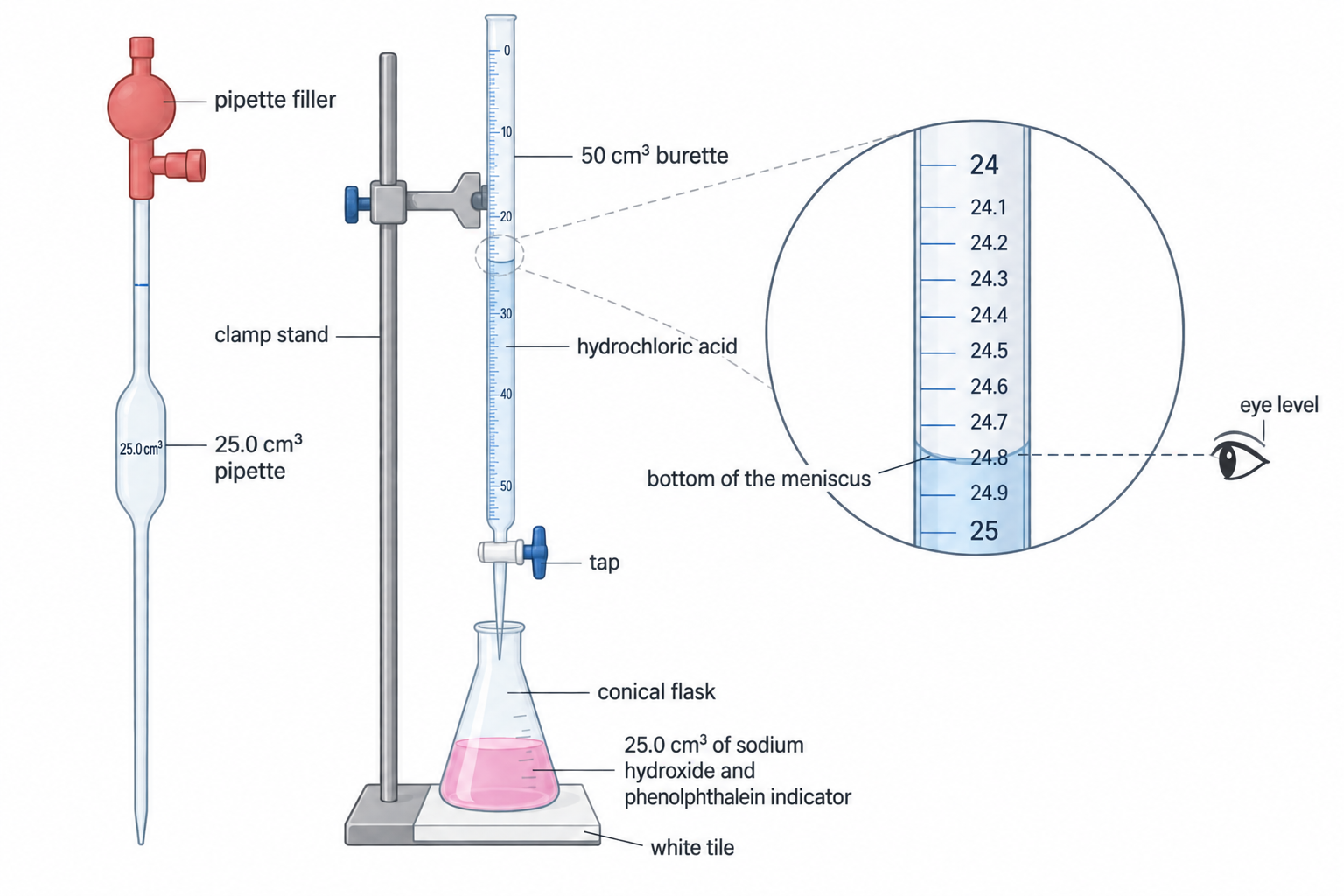
The acid is in the burette and the measured alkali is in the flask. Each reading is taken from the bottom of the meniscus, the curved surface of the liquid, with your eye level with it.
How do you do a titration? The required practical step by step
You add acid from a burette to a measured volume of alkali until the indicator changes colour for good, then repeat until two titres agree. Here the acid is hydrochloric acid, the alkali is sodium hydroxide solution and the indicator is phenolphthalein.
- Rinse the burette with a little of the acid, close the tap and fill it with acid using the funnel.
- Run some acid through the tap to remove any air bubble from the tip, then take the funnel out.
- Rinse the pipette with a little sodium hydroxide solution, then use the pipette filler to transfer 25.0 cm³ into a clean conical flask.
- Add 2 or 3 drops of phenolphthalein and stand the flask on a white tile.
- Read the bottom of the meniscus at eye level and record the initial reading to two decimal places.
- Do a rough titration: add acid fairly quickly while swirling, until the pink colour just disappears. Record the final reading. This shows roughly where the end point is.
- Repeat with fresh sodium hydroxide. Add acid quickly at first, then drop by drop near the rough titre, swirling all the time.
- Stop at the end point, the first permanent colour change: the solution turns colourless and stays colourless for about 30 seconds after swirling. Record the final reading.
- Repeat until at least two titres agree within 0.10 cm³.
AQA's method for this practical differs in three ways. It uses sulfuric acid in the burette, with the sodium hydroxide in the flask. It fills the burette to the 0.00 cm³ line every time, so the volume added is read straight off the scale. And it does a rough run, then two more. Either way, AQA's specification limits titrations to "strong acids and strong alkalis only (sulfuric, hydrochloric and nitric acids only)".
Hydrochloric acid and sodium hydroxide can irritate or damage skin and eyes, depending on their concentration. Wear eye protection throughout, use a pipette filler and never pipette by mouth, and keep the burette clamped securely and fill it below eye level. If acid or alkali gets on your skin or in your eyes, rinse with plenty of water straight away and tell your teacher. This practical is done in the school lab with your teacher.
How do you find the mean titre?
The titre is the volume of acid delivered: titre = final burette reading − initial burette reading. The mean titre uses only concordant results, which are titres within 0.10 cm³ of each other.
| Run | Initial reading / cm³ | Final reading / cm³ | Titre / cm³ | In the mean? |
|---|---|---|---|---|
| Rough | 0.00 | 24.90 | 24.90 | No: it only locates the end point |
| Accurate 1 | 0.10 | 24.80 | 24.70 | Yes |
| Accurate 2 | 0.00 | 24.65 | 24.65 | Yes |
| Accurate 3 | 0.20 | 24.90 | 24.70 | Yes |
| Accurate 4 | 0.00 | 25.30 | 25.30 | No: anomalous, the end point was probably overshot |
Mean titre = (24.70 + 24.65 + 24.70) ÷ 3 = 24.683…, so the mean titre is 24.68 cm³.
On AQA's GCSE science papers from 2027, where a calculation says "show your working", the right answer alone earns one mark (see our Paper 1 guide).
Why each step matters for accuracy
Each step in the method guards against one slip.
| Problem | What goes wrong | How to avoid it |
|---|---|---|
| Water left in the burette or pipette | The solution is diluted | Rinse each one with the solution it will hold |
| Air bubble in the burette tip | Some measured acid fills the tip instead of entering the flask | Run acid through the tap before the first reading |
| Funnel left in the burette | Extra drops enter after the initial reading | Remove the funnel before taking readings |
| Reading from above or below the meniscus | The reading is wrong | Read the bottom of the meniscus at eye level |
| Acid added too fast near the end point | Too much acid goes in, so the titre is too large | Add acid drop by drop near the rough titre |
| Flask not swirled | The indicator may change colour before all the solution has mixed | Swirl the flask throughout |
| End point judged too early | Too little acid goes in, so the titre is too small | Use a white tile and wait for a permanent colour change |
Repeats make results more reliable, but they cannot fix a systematic problem such as acid diluted by water left in the burette.
How AQA examines the titration practical
AQA's recent papers have asked for steps of the method and for improvements to a student's plan.
- June 2024 Higher Paper 1, question 09.3 (3 marks). A student had filled a burette with acid and had to give three more steps before adding it. The mark scheme gave 1 mark for using a (volumetric) pipette to add the alkali, then any two from: into a conical flask; add an indicator; take the initial burette reading; use a white tile. It said "do not accept add universal indicator".
- June 2025 Higher Paper 1, question 08.2 (4 marks). A student's plan used universal indicator. In that plan the sodium hydroxide solution was in the burette and the sulfuric acid was in the flask, the other way round from the method above. Two improvements were needed, each with a linked reason. The scheme credited: phenolphthalein instead of universal indicator "so that the colour change is sharp" (methyl orange or any named single change indicator allowed, and "universal indicator changes colour too gradually" allowed as the reason); a pH probe, for a sharper end point; adding the sodium hydroxide drop by drop near the end point, or reading the burette at eye level, so the volume is more accurate; rinsing the burette with sodium hydroxide and the pipette with acid, to remove contaminants.
- June 2025 Foundation Paper 1, question 04.4 (1 mark). Adding the acid dropwise near the end point, or swirling the flask.
The idea behind the indicator improvement in 08.2: a suitable indicator changes colour near the end point.
Titration calculations (Higher tier only)
AQA's specification asks Higher tier students to "calculate the chemical quantities in titrations involving concentrations in mol/dm³ and in g/dm³". Foundation tier papers do not test this part. If moles are new to you, start with our moles guide.
- Write the balanced equation.
- Change each volume from cm³ to dm³ by dividing by 1000.
- Work out the moles in the solution you know: moles = concentration × volume.
- Use the balancing numbers to find the moles of the other substance.
- Divide by its volume to get its concentration in mol/dm³.
- For g/dm³, multiply by the relative formula mass (Mr).
For example, 25.0 cm³ of sulfuric acid is neutralised by 30.0 cm³ of 0.100 mol/dm³ sodium hydroxide solution.
H₂SO₄ + 2NaOH → Na₂SO₄ + 2H₂O
Relative atomic masses (Ar): H = 1, S = 32, O = 16.
- Moles of NaOH = 0.100 × 0.0300 = 0.00300 mol.
- One mole of H₂SO₄ reacts with two moles of NaOH, so moles of H₂SO₄ = 0.00300 ÷ 2 = 0.00150 mol.
- Concentration of H₂SO₄ = 0.00150 ÷ 0.0250 = 0.0600 mol/dm³.
- Mr of H₂SO₄ = (2 × 1) + 32 + (4 × 16) = 98, so 0.0600 × 98 = 5.88 g/dm³.
The ratio comes from the balancing numbers in front of the formulae, never from the small numbers inside a formula.
AQA's June 2025 Higher Paper 1, question 08.4 (4 marks), was a calculation of this kind: 25.0 cm³ of 0.216 mol/dm³ sulfuric acid needed 11.25 cm³ of sodium hydroxide solution. The mark scheme's steps were 25.0 × 0.216 ÷ 1000 = 0.00540 mol of acid; × 2 = 0.0108 mol of alkali; 0.0108 × 1000 ÷ 11.25 = 0.960 mol/dm³. June 2024 Higher Paper 1, question 09.4 (2 marks), asked for a volume: 0.0045 moles of sodium hydroxide reacts with 0.0045 moles of hydrochloric acid (1 : 1), so 0.15 mol/dm³ hydrochloric acid needs 0.0045 ÷ 0.15 = 0.030 dm³, which is 30 cm³.
Titration exam questions with answers
Each question below is an exam-style question from Medly, marked with Medly's mark scheme.
Question 1: (2 marks)
A student carries out a titration to determine the reacting volume of a strong acid and a strong alkali. The student obtains a rough titre of 24.8 cm³. The accurate titres are 24.62 cm³, 24.64 cm³ and 26.10 cm³.
Explain why the student used a rough titration and based the final reacting volume on the two close accurate titres rather than on the 26.10 cm³ titre.
Answer
- The rough titration finds the approximate end-point volume, so the accurate titrations can be carried out around that volume (1 mark).
- The 24.62 cm³ and 24.64 cm³ titres are concordant, so they give a representative reacting volume, while 26.10 cm³ is anomalous (1 mark).
Medly's mark scheme needs the second point for full marks, and allows "close together" for concordant and "outlier" for anomalous.
Question 2: (5 marks)
A student uses titration to determine the concentration of the sodium hydroxide solution. The titration method begins:
- Measure 25.0 cm³ of the sodium hydroxide solution into a conical flask using a pipette.
- Add a few drops of indicator.
- Fill a burette with hydrochloric acid.
(a) Describe how to finish a titration using hydrochloric acid and sodium hydroxide solution. [3 marks]
(b) Give two reasons why a burette is used to add hydrochloric acid. [2 marks]
Answer
(a)
- Add the hydrochloric acid drop by drop near the end point, until the indicator changes colour permanently (1 mark).
- Record the initial and final burette readings to work out the titre: final reading − initial reading (1 mark).
- Swirl the flask while adding acid, or place it on a white tile so the colour change is easy to see (1 mark).
Medly's mark scheme also allows "record the volume of acid added" for the second point.
(b)
Any two of these, 1 mark each:
- A burette delivers a measured volume of hydrochloric acid that you can vary.
- It lets you add the acid drop by drop near the end point.
- Its fine scale gives a more accurate measurement of the volume added.
- Its initial and final readings give the reacting volume.
Medly's mark scheme gives a maximum of 2 marks, and does not give both for point 1 and point 4 together.
Question 3: (6 marks)
Titration calculations are Higher tier only.
Medly's question writes the units as mol dm⁻³ and g dm⁻³. AQA's papers write the same units as mol/dm³ and g/dm³.
A student uses titration to determine the concentration of the sodium hydroxide solution. The student prepares hydrochloric acid with concentration 0.150 mol dm⁻³. The titration method begins:
- Measure 25.0 cm³ of the sodium hydroxide solution into a conical flask using a pipette.
- Add a few drops of indicator.
- Fill a burette with hydrochloric acid.
The neutralising volume of hydrochloric acid is 20.0 cm³. The equation for the reaction is:
HCl + NaOH → NaCl + H₂O
Relative atomic masses are Ar(Na) = 23, Ar(O) = 16 and Ar(H) = 1.
(a) Calculate the concentration of the sodium hydroxide solution. [3 marks]
(b) Calculate the concentration of the sodium hydroxide solution in g dm⁻³. [3 marks]
Answer
(a)
- 20.0 cm³ = 0.0200 dm³, so moles of HCl = 0.150 × 0.0200 = 0.00300 mol (1 mark).
- The equation is 1 : 1, so moles of NaOH = 0.00300 mol (1 mark).
- 25.0 cm³ = 0.0250 dm³, so concentration = 0.00300 ÷ 0.0250 = 0.120 mol dm⁻³ (1 mark).
Medly's mark scheme accepts at least 2 significant figures, and gives later marks for correctly using a wrong earlier value.
(b)
- Mr of NaOH = 23 + 16 + 1 = 40.0 (1 mark).
- Concentration in g dm⁻³ = concentration in mol dm⁻³ × Mr = 0.120 × 40.0 (1 mark).
- = 4.80 g dm⁻³ (1 mark).
Medly's mark scheme accepts at least 2 significant figures, and allows correct use of a wrong Mr or a wrong concentration in mol dm⁻³.
Question 4: (3 marks)
Using the mole ratio in a titration calculation is Higher tier only.
A student titrates 25.0 cm³ samples of sodium hydroxide solution with 0.100 mol dm⁻³ sulfuric acid.
The equation for the reaction is:
H₂SO₄ + 2NaOH → Na₂SO₄ + 2H₂O
| Trial | Sulfuric acid titre / cm³ | Calculated sodium hydroxide concentration / mol dm⁻³ |
|---|---|---|
| P | 24.60 | 0.197 |
| Q | 25.20 | 0.202 |
Explain why the calculated concentration for Trial Q is greater than for Trial P. You should refer to the table and the equation in your answer.
Answer
- Trial Q has the larger sulfuric acid titre: 25.20 cm³ compared with 24.60 cm³ (1 mark).
- The acid concentration is the same, so the larger titre contains more moles of sulfuric acid, because moles = concentration × volume (1 mark).
- The 1 : 2 ratio of moles means more sulfuric acid reacts with more sodium hydroxide in the same 25.0 cm³ sample, so the calculated concentration is greater (1 mark).
Medly's mark scheme needs the third point for full marks, and accepts the converse argument for each point.
Titration questions reward two habits: the right steps in the right order, and every stage of a calculation written down. Medly has AQA GCSE Chemistry courses at Foundation and Higher. Medly marks written answers like Question 2 against the mark scheme, so you can see which point you missed. In a randomised controlled trial in GCSE science, students using Medly for 30 minutes a week for four weeks scored 22% higher on the post-test than students revising in their usual way, adjusted for where they started. The students they were compared with used revision guides, notes, videos and, in most classes, other online revision platforms, and the trial covered biology, chemistry and physics.
Frequently asked questions
What is titration in simple words?
A titration finds exactly how much acid reacts with a measured amount of alkali. You add acid from a burette until an indicator changes colour, then read the volume you used.
Is titration on GCSE Combined Science?
AQA labels titrations "(chemistry only)": they are in GCSE Chemistry (8462), and Combined Science: Trilogy papers do not test them. If you are on another board, check your own specification.
Which indicator do you use in a GCSE titration?
Phenolphthalein works: it is pink in the alkali and turns colourless at the end point. AQA's June 2025 Higher Paper 1 mark scheme also allowed methyl orange, and its June 2024 Higher Paper 1 scheme did not accept universal indicator.
What are concordant results in titration?
Titres that agree closely, within 0.10 cm³ of each other. Their mean is the reacting volume.
Do you include the rough titre in the mean?
No. The rough titre only shows roughly where the end point is, so the mean uses the concordant accurate titres.