
Exothermic and endothermic reactions for GCSE Chemistry: reaction profiles and exam questions
Compare the two types, read and draw reaction profiles, calculate energy changes from bond energies and practise with exam questions and answers.
On this page
An exothermic reaction transfers energy to the surroundings, so the temperature of the surroundings rises. An endothermic reaction takes in energy from the surroundings, so their temperature falls. This guide follows AQA GCSE Chemistry (8462) and Combined Science: Trilogy (8464) and covers telling the two apart, reaction profiles, the temperature practical and, for Higher tier, bond energy calculations, with exam questions and answers.
What is the difference between exothermic and endothermic reactions?
The difference is the direction of the energy transfer: out of the reaction for exothermic, into it for endothermic.
| Exothermic | Endothermic | |
|---|---|---|
| Energy transfer | From the reaction to the surroundings | From the surroundings to the reaction |
| Temperature of the surroundings | Increases | Decreases |
| Energy of the products | Less than the reactants, by the amount transferred | More than the reactants, by the amount transferred |
| Examples | Combustion, many oxidation reactions, neutralisation | Thermal decompositions, citric acid with sodium hydrogencarbonate |
| Everyday uses | Self-heating cans, hand warmers | Some sports injury packs |
Energy is conserved: it is never made or destroyed in a reaction. In an exothermic reaction the products have less energy because that energy has gone to the surroundings. These are the examples and uses AQA lists in its energy changes content.
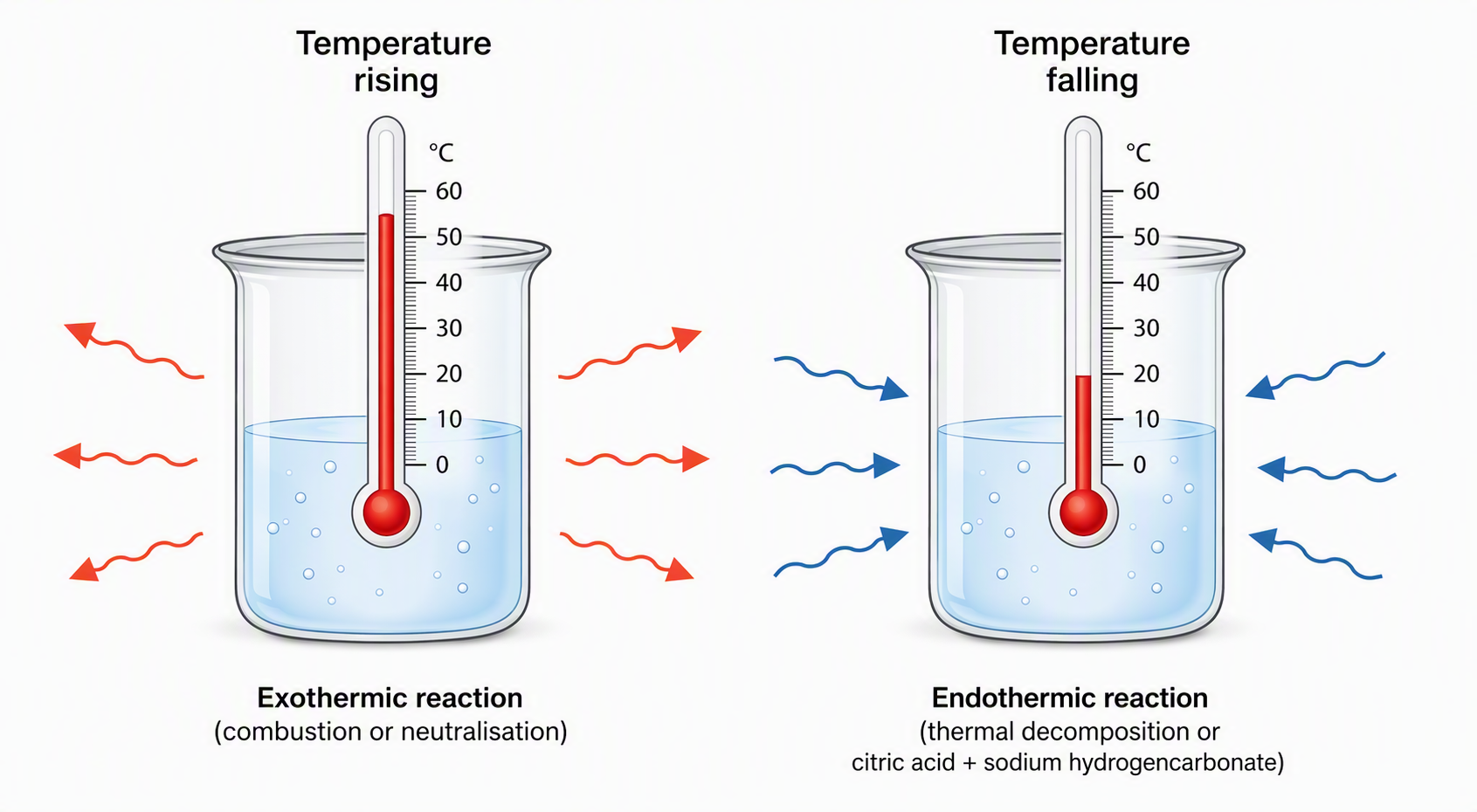
The uses follow from the direction. A self-heating can and a hand warmer need heating, so they use exothermic reactions. A sports injury pack needs cooling, so some packs use an endothermic reaction: it absorbs thermal energy from the surroundings, and the pack becomes cold.
How can you tell from a temperature change?
Record the temperature before the substances are mixed, then the highest or lowest temperature reached. A rise means energy was transferred to the surroundings: exothermic. A fall means energy was taken in from the surroundings: endothermic.
- From 20.0 °C to 26.5 °C is a rise of 6.5 °C, so the reaction is exothermic.
- From 20.0 °C to 16.8 °C is a fall of 3.2 °C, so the reaction is endothermic.
A thermometer does not measure energy directly. It measures the temperature of the water or solution around the reacting substances, and the change is the evidence for which way the energy went.
Reaction profiles for exothermic and endothermic reactions
A reaction profile, or energy level diagram, plots energy against the progress of the reaction.
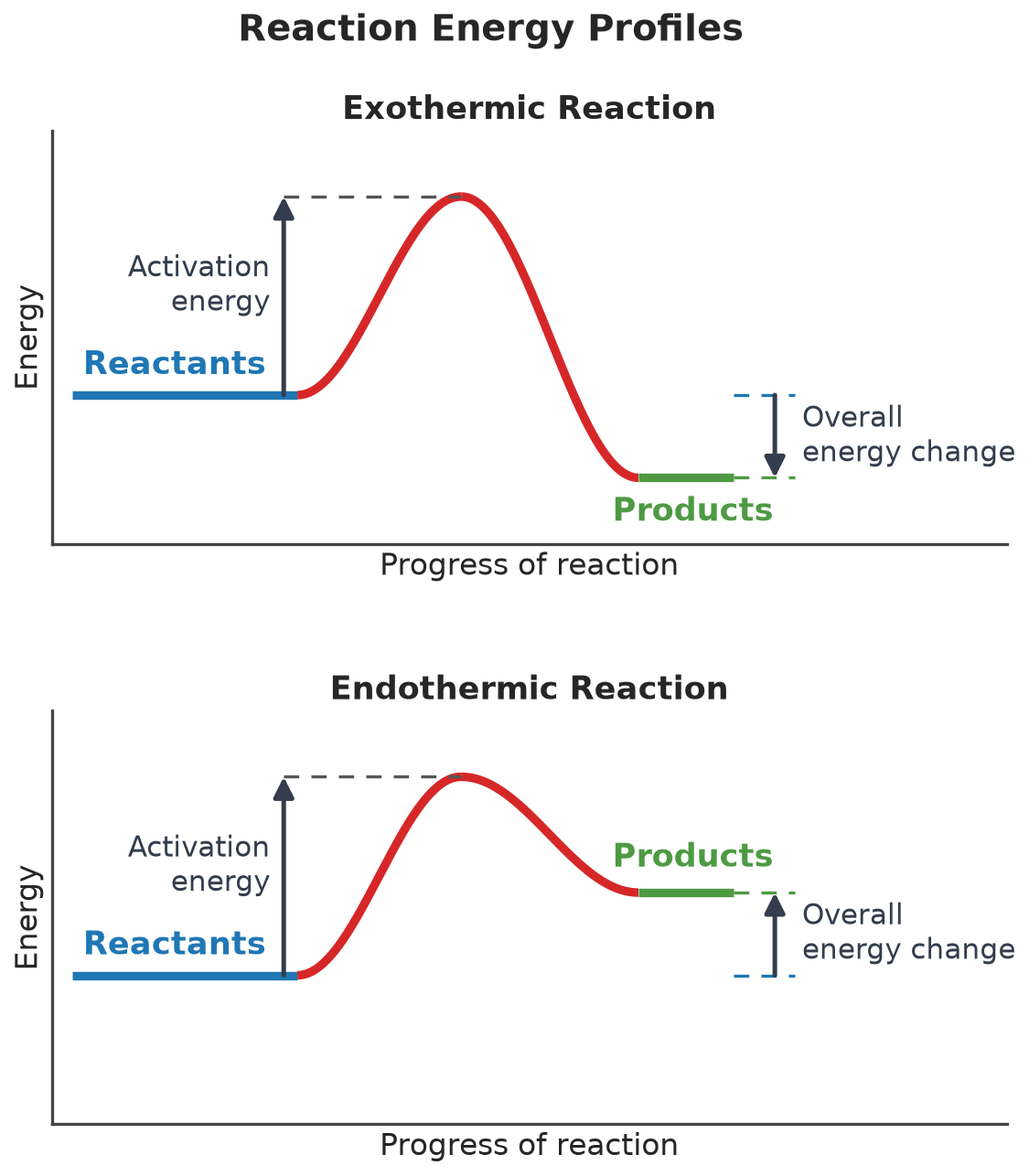
- Reactants are a level at the start; products are a level at the end.
- The curve rises to a maximum and then falls to the products.
- Activation energy is the rise from the reactant level to the top of the curve. It is the minimum energy that particles must have when they collide for a reaction to happen.
- The overall energy change is the difference between the reactant and product levels: an arrow pointing down for exothermic, up for endothermic.
To identify the type, compare the reactant and product levels first. Products below reactants means exothermic; products above means endothermic. AQA asks you to draw these profiles "with a curved line to show the energy as the reaction proceeds".
Reading one: a profile has reactants at 45 energy units, a maximum at 80 and products at 20.
- Activation energy = 80 − 45 = 35 energy units.
- The products (20) are below the reactants (45), so the reaction is exothermic.
- Overall energy change = 45 − 20 = 25 energy units, downwards.
The temperature change required practical
The temperature change practical measures how much a reacting solution warms or cools. It is required practical 4 in GCSE Chemistry and required practical activity 10 in Combined Science: Trilogy. AQA describes it as: "investigate the variables that affect temperature changes in reacting solutions such as, eg acid plus metals, acid plus carbonates, neutralisations, displacement of metals". You measure the initial temperature of a solution, add the other reactant, stir, and record the highest temperature reached (or the lowest, for a reaction that cools). The temperature change is the difference.
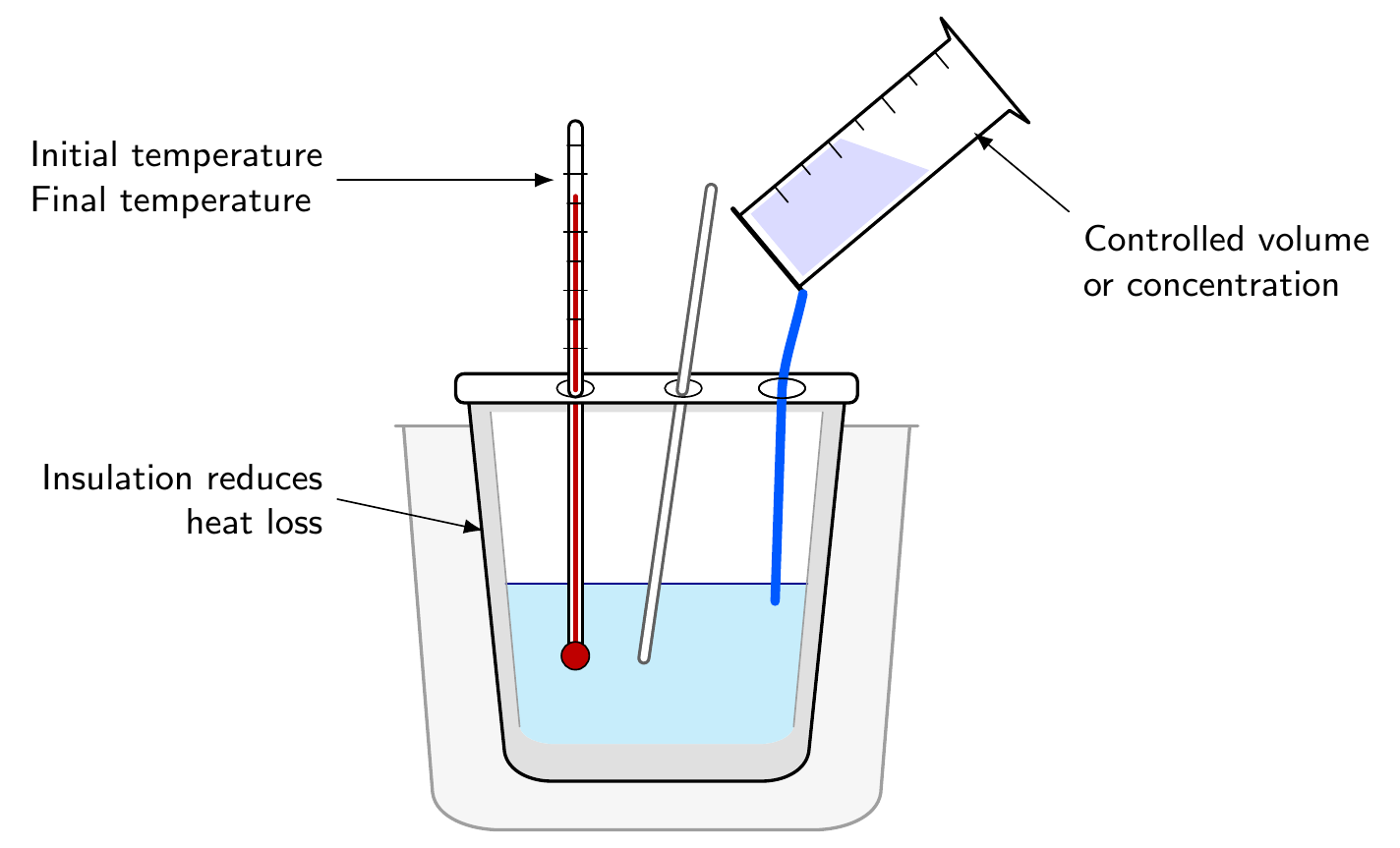
The polystyrene cup is an insulated reaction vessel: it reduces unwanted energy transfer between the reacting solution and the wider surroundings. The lid reduces heat loss from the top, and the beaker holds the cup steady. Our Paper 1 guide lists every practical on the paper.
Bond energy calculations (Higher tier)
Foundation tier papers do not test this part.
Energy must be supplied to break bonds in the reactants, and energy is released when bonds in the products form. Bond energies let you calculate both:
overall energy change = energy needed to break bonds − energy released when bonds form
If more energy is released forming bonds than is needed to break them, the answer is negative and the reaction is exothermic. If breaking needs more, the answer is positive and the reaction is endothermic.
- Use the balanced equation.
- Count every bond broken in the reactants, using the balancing numbers.
- Add the bond energies for all the bonds broken.
- Count every bond formed in the products.
- Add the bond energies for all the bonds formed.
- Subtract the bonds-formed total from the bonds-broken total.
On AQA's GCSE science papers from 2027, where a calculation says "show your working", the right answer alone earns one mark (see our Paper 1 guide).
Here is an exam-style question from Medly, marked with Medly's mark scheme.
Worked example (5 marks)
Bond energy calculations are Higher tier content. Medly's question writes the unit as kJ mol⁻¹. AQA's papers write the same unit as kJ/mol.
This question is about ammonia, NH₃. Ammonia reacts with oxygen in the presence of a catalyst:
4NH₃ + 5O₂ → 4NO + 6H₂O
The reaction breaks 12 N-H and 5 O=O bonds and forms 4 N=O and 12 O-H bonds. The table shows the bond energies.
| Bond | N-H | O=O | N=O | O-H |
|---|---|---|---|---|
| Energy / kJ mol⁻¹ | 391 | 498 | 607 | 463 |
(a) Calculate the overall energy change for the reaction. Use the bond counts in the stem and the table. Give your answer in kJ mol⁻¹. [3 marks]
(b) Explain why the reaction is exothermic. Use values from your earlier result. [2 marks]
(a)
- Energy needed to break bonds = 12 × 391 + 5 × 498 = 4692 + 2490 = 7182 kJ mol⁻¹ (1 mark).
- Energy released when bonds form = 4 × 607 + 12 × 463 = 2428 + 5556 = 7984 kJ mol⁻¹ (1 mark).
- Overall energy change = 7182 − 7984 = −802 kJ mol⁻¹ (1 mark). The value must be −802 kJ mol⁻¹ for full marks.
Medly's mark scheme lists four stages (the two totals, the subtraction and the final value) and gives a maximum of 3 marks.
(b)
- 7984 kJ mol⁻¹ is released by forming bonds, which is more than the 7182 kJ mol⁻¹ needed to break bonds (1 mark, needed for full marks).
- The overall energy change is negative, so the products are lower in energy and energy is transferred to the surroundings (1 mark).
Where marks are lost on energy change questions
Marks go to each stage of the working, so write it all down. These notes are from AQA's mark schemes for GCSE Chemistry (8462) Higher tier Paper 1.
| Question | What the mark scheme did | What to write |
|---|---|---|
| June 2024, 04.3 (2 marks), the polystyrene cup | Credited "polystyrene is a better (thermal) insulator" and "(so) there is less energy transfer to the surroundings"; allowed "less energy is lost (to the surroundings)" and "heat" for energy | Give both steps: a better insulator, so less energy is transferred to the surroundings |
| June 2024, 08.3 (5 marks), bond energies | A mark for each stage: "3184 + 8X" for bonds broken, "8542" for bonds made, the line "2219 = 8542 − (3184 + 8X)", "(8X =) 3139", then "(X =) 392 (kJ/mol)", which is 392.375 rounded; it allowed correct use of wrong totals | Write each total on its own line, and count every bond with its balancing number |
| June 2025, 07.4 (4 marks), bond energies | A mark for each stage: "2062 + X" for bonds broken, "2801" for bonds formed, the line "581 = 2801 − (2062 + X)", then "(X =) 158 (kJ/mol)"; it allowed correct use of wrong totals | Write each total on its own line, and count every bond with its balancing number |
Both bond energy questions said that the reaction was exothermic and gave the difference between the two totals as a positive number: 2219 kJ/mol in 2024 and 581 kJ/mol in 2025. So each mark scheme wrote the energy released when bonds form first and took away the energy needed to break bonds. It is the same sum as the rule above with the two totals the other way round, which is why the number is positive.
Exothermic and endothermic exam questions with answers
Each question below is an exam-style question from Medly, marked with Medly's mark scheme.
Question 1: (3 marks)
A reaction takes place in a polystyrene cup. The temperature of the mixture is measured before mixing and after the reaction.
| Measurement | Temperature |
|---|---|
| Before mixing | 20.0 °C |
| After the reaction | 13.5 °C |
The temperature of the mixture decreases after the reaction starts. Explain why this occurs. You should refer to the temperature readings in your answer.
Answer
- The temperature decreases from 20.0 °C to 13.5 °C, a fall of 6.5 °C (1 mark).
- The reaction takes in energy from the surroundings (1 mark, needed for full marks). Calling it endothermic earns this mark when it is linked to taking in energy.
- The products have more energy than the reactants, by the amount transferred (1 mark). Also accepted: more energy is needed to break bonds in the reactants than is released when bonds form in the products. Medly's mark scheme does not credit saying that bond breaking releases energy or that bond formation absorbs energy.
Question 2: (2 marks)
Hydrogen reacts with oxygen in a fuel cell and the reaction releases energy.
A student prepared an energy profile for the reaction between hydrogen and oxygen. The figure shows the profile.
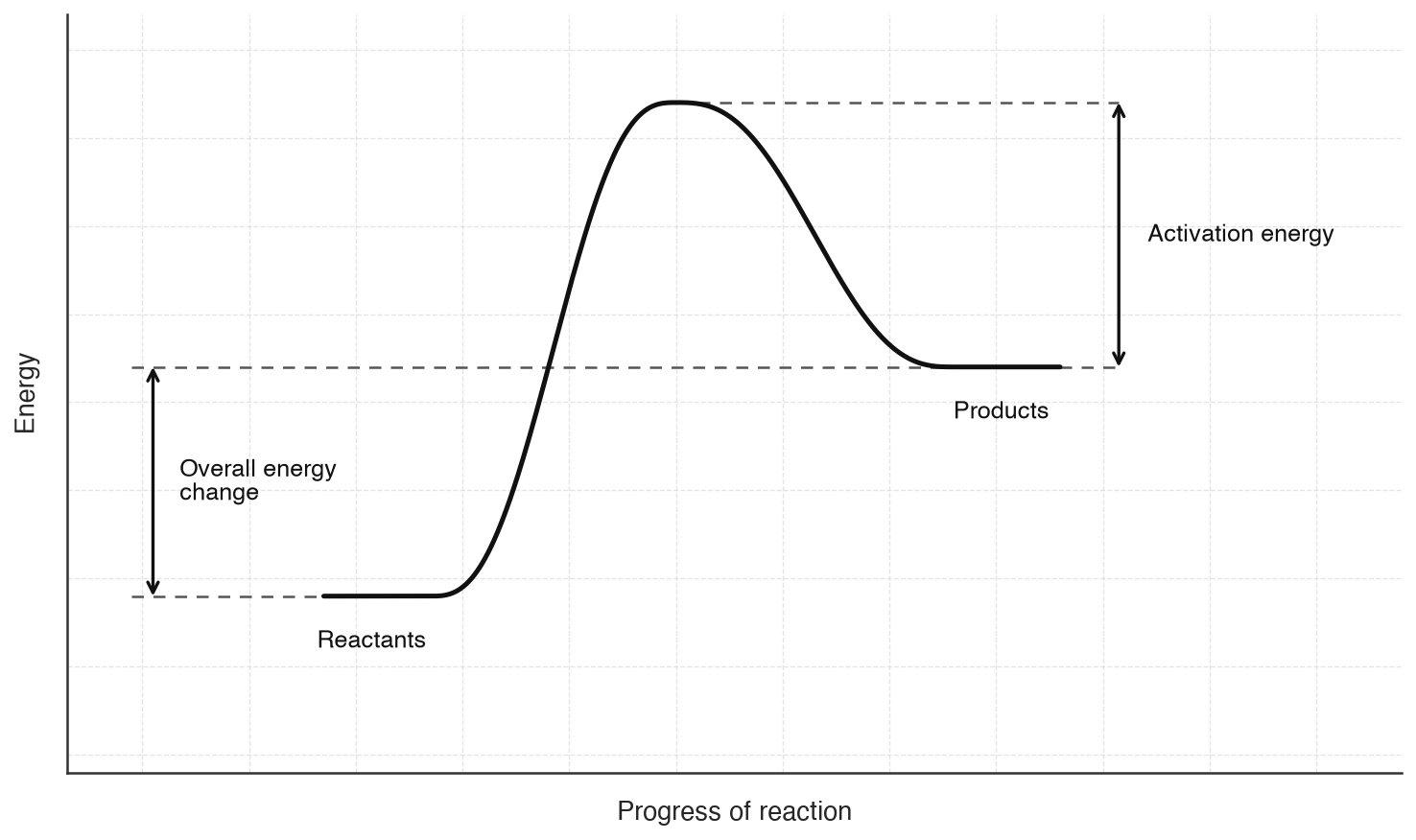
The reaction profile contains two errors. Describe the errors.
Answer
- The products should be below the reactants (1 mark).
- The activation energy should be measured from the reactant level to the peak, not from the product level (1 mark).
Each mark needs the error and its correction.
Question 3: (3 marks)
Bond energy calculations are Higher tier content.
The results of bond-energy calculations for two reactions are shown.
| Reaction P | Reaction Q | |
|---|---|---|
| Total energy needed to break bonds / kJ mol⁻¹ | 1240 | 1260 |
| Total energy released when bonds form / kJ mol⁻¹ | 1450 | 1100 |
| Overall energy change / kJ mol⁻¹ | −210 | +160 |
Explain why Reaction P is exothermic whereas Reaction Q is endothermic. You should refer to the data in your answer.
Answer
- Reaction P: 1450 kJ mol⁻¹ is released when bonds form, more than the 1240 kJ mol⁻¹ needed to break bonds (1 mark).
- Reaction Q: 1260 kJ mol⁻¹ is needed to break bonds, more than the 1100 kJ mol⁻¹ released when bonds form (1 mark).
- The negative overall energy change (−210 kJ mol⁻¹) shows P is exothermic, and the positive one (+160 kJ mol⁻¹) shows Q is endothermic (1 mark, needed for full marks).
Question 4: (5 marks)
The calculation in part (a) is Higher tier content.
Hydrogen sulfide burns in oxygen to form sulfur dioxide and water. The reaction is exothermic.
2H₂S + 3O₂ → 2SO₂ + 2H₂O
The table shows the bond energies. For this question, treat each sulfur dioxide molecule as containing two S=O bonds.
| Bond | Bond energy in kJ mol⁻¹ |
|---|---|
| S-H | 347 |
| O=O | 498 |
| S=O | 523 |
| O-H | 463 |
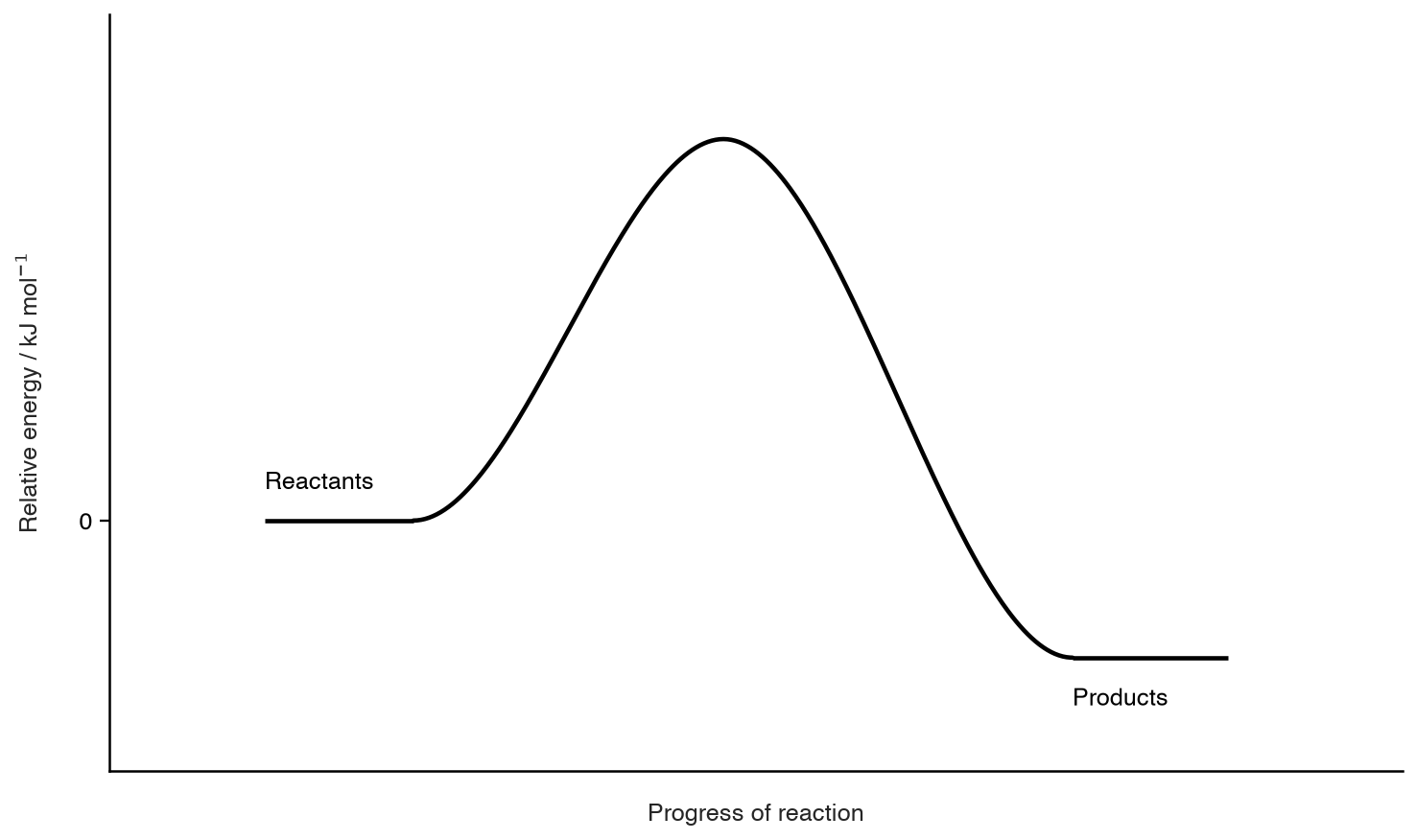
(a) The figure shows a reaction profile for the combustion of hydrogen sulfide. The reactants are at 0 kJ mol⁻¹; the peak and product energy level have no numerical labels. Explain why the products are shown below the reactants. Identify the interval that represents the activation energy. Calculate the overall energy change for the equation as written, in kJ mol⁻¹. [3 marks]
(b) A student measured the temperature change when hydrochloric acid reacted with sodium hydroxide solution. Explain why the student used an insulated cup fitted with a lid. [2 marks]
Answer
(a)
- Energy is transferred to the surroundings, so the products have less energy than the reactants (1 mark). Saying only that the reaction is exothermic is not credited.
- The activation energy is the energy difference from the reactant level (0 kJ mol⁻¹) up to the peak of the curve (1 mark). The difference between reactants and products is not accepted.
- Bonds broken (4 S-H and 3 O=O): 4 × 347 + 3 × 498 = 1388 + 1494 = 2882 kJ mol⁻¹. Bonds formed (4 S=O and 4 O-H): 4 × 523 + 4 × 463 = 2092 + 1852 = 3944 kJ mol⁻¹. Overall energy change = 2882 − 3944 = −1062 kJ mol⁻¹ (1 mark, needed for full marks).
(b)
- The insulated cup reduces unwanted energy transfer through the sides of the cup (1 mark). A statement only that the cup keeps the solution warm is ignored.
- The lid reduces energy transfer or loss of material through the open top (1 mark). Also credited for this mark: less energy is lost, so the measured temperature change is closer to the true value.
Question 5: (2 marks)
Ammonia reacts with oxygen in the presence of a catalyst: 4NH₃ + 5O₂ → 4NO + 6H₂O. The reaction profile has products below the reactants and a peak above the reactants.
Complete this response in words by naming the activation-energy interval and the overall-energy-change interval for the stated reaction profile.
Answer
- The energy difference from the reactant level to the peak is the activation energy (1 mark).
- The energy difference between the reactant level and the lower product level is the overall energy change (1 mark, needed for full marks).
These questions keep coming back to two things: which way the energy moved, and every stage of a bond energy sum written on its own line. Medly marks written answers like Question 4 against the mark scheme, so you can see which point you missed. Medly has AQA GCSE Chemistry courses at Foundation and Higher, and AQA GCSE Combined Chemistry courses at Foundation and Higher for Combined Science students. Medly's free plan includes 5 marked questions, 20 AI tutor messages and 1 uploaded paper a day, with no card needed.
Frequently asked questions
Is burning exothermic or endothermic?
Exothermic. Combustion transfers energy to the surroundings, usually as thermal energy.
Is neutralisation exothermic?
Yes. When an acid reacts with an alkali, energy is transferred to the surroundings and the temperature rises.
What is activation energy?
The minimum amount of energy that particles must have when they collide for a reaction to happen. On a reaction profile it is the rise from the reactants to the top of the curve.
Is a sports injury pack exothermic or endothermic?
Some sports injury packs are based on endothermic reactions. The reaction absorbs thermal energy from its surroundings, so the pack becomes cold.
Do Foundation tier students need bond energy calculations?
Bond energy calculations are Higher tier content. Foundation tier papers do not test this part.
Which paper are energy changes on?
Paper 1, for both AQA courses: see the Paper 1 guide.