
Percentage yield formula: how to calculate it, with GCSE exam questions
Use the percentage yield formula, rearrange it, find the theoretical mass at Higher tier and practise with exam questions and answers.
On this page
Percentage yield compares the mass of product you actually made with the most you could have made. You divide the mass actually made by the maximum theoretical mass and multiply by 100. This guide follows AQA GCSE Chemistry (8462); Combined Science: Trilogy papers do not test percentage yield. It covers the formula, how to rearrange it, why a yield falls short of 100% and the Higher tier theoretical mass, with exam questions and answers.
What is the percentage yield formula?
Percentage yield is the mass of product actually made as a percentage of the maximum theoretical mass of that product.
percentage yield = (mass of product actually made ÷ maximum theoretical mass of product) × 100
AQA's specification says: "The amount of a product obtained is known as the yield. When compared with the maximum theoretical amount as a percentage, it is called the percentage yield."
- The actual yield is the amount of product actually made and collected, usually a mass in grams.
- The maximum theoretical mass is the most of that product the balanced equation predicts.
- Both masses are of the same product and in the same unit. The actual yield goes on top.
Paper 1 of GCSE Chemistry (8462): see the Paper 1 guide. Combined Science: Trilogy papers do not test it. AQA also says Paper 2 questions may draw on the fundamental concepts of the first three topics, so percentage yield can come up there too: our Paper 2 guide has AQA's wording.
How to calculate percentage yield: worked example
A reaction made 7.5 g of a product. The maximum theoretical mass of that product was 12 g. Calculate the percentage yield.
Worked example
- Put the mass actually made on top and the maximum theoretical mass underneath: percentage yield = 7.5 ÷ 12 × 100.
- Work it out: 62.5%.
- Both masses are given to 2 significant figures, so give the answer to 2 significant figures: 63%.
- Check it makes sense: 7.5 g is less than 12 g, so the answer must be below 100%.
A percentage yield of 63% means 63% of the maximum theoretical mass was obtained.
On AQA's GCSE science papers from 2027, where a calculation says "show your working", the right answer alone earns one mark (see our Paper 1 guide).
How to rearrange the percentage yield formula
Questions often give you the percentage yield and ask for one of the masses.
- Mass actually made = percentage yield ÷ 100 × maximum theoretical mass
- Maximum theoretical mass = mass actually made ÷ percentage yield × 100
Here is an exam-style question from Medly, marked with Medly's mark scheme.
Worked example (2 marks)
Zinc is a metal. Zinc is extracted from zinc oxide in a two-stage process.
The maximum theoretical mass of zinc is 9.81 kg. The percentage yield is 82.0%.
Calculate the actual mass of zinc produced from the percentage yield.
- Rearrange the formula: actual mass = percentage yield ÷ 100 × maximum theoretical mass (1 mark).
- Substitute: 82.0 ÷ 100 × 9.81 = 0.820 × 9.81 (1 mark).
- Actual mass = 8.0442 kg, which is 8.04 kg (1 mark).
Medly's mark scheme gives this part 2 marks at most, from those three points, and an answer of 8.04 kg on its own scores both. It also accepts 8.0442 kg before rounding.
Why is percentage yield less than 100%?
No atoms are gained or lost in a reaction, but you still rarely collect the full amount. AQA's specification says: "Even though no atoms are gained or lost in a chemical reaction, it is not always possible to obtain the calculated amount of a product because:
- the reaction may not go to completion because it is reversible
- some of the product may be lost when it is separated from the reaction mixture
- some of the reactants may react in ways different to the expected reaction."
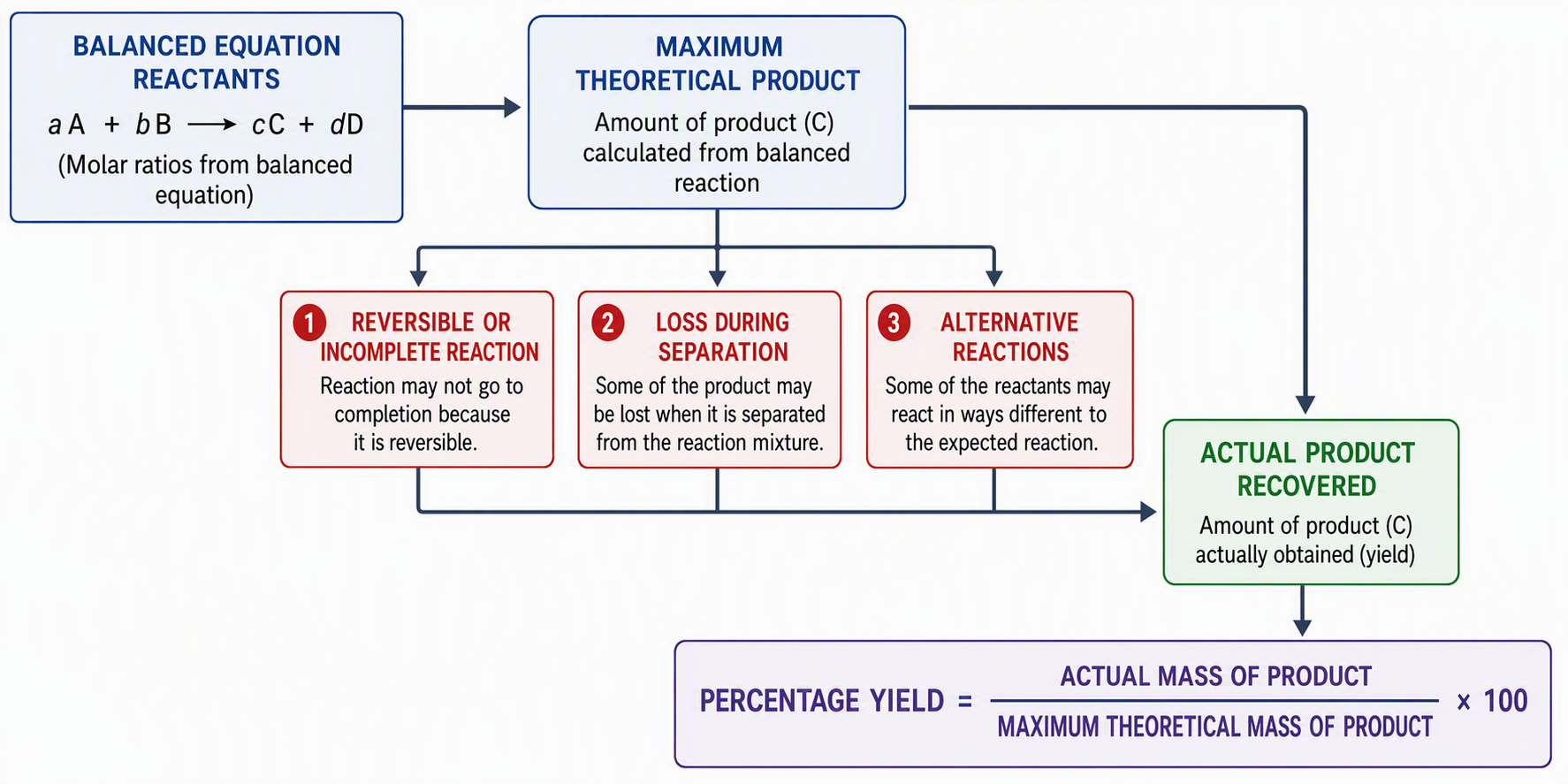
The picture writes the top of the formula as "actual mass of product", which means the same as the mass of product actually made.
- Reversible reaction. The products can react to re-form the starting substances, so some reactant may remain, or some product may change back.
- Lost during separation. Product can stay mixed with other substances, stick to equipment or be lost when it is moved between containers.
- Other reactions. Side reactions use up some of the reactants before they can form the desired product.
A percentage yield shows how much was recovered, but not which of these reasons caused the shortfall.
Working out the theoretical mass (Higher tier only)
AQA's specification asks Higher tier students to "calculate the theoretical mass of a product from a given mass of reactant and the balanced equation for the reaction." Foundation tier papers do not test this part. The method uses moles, which our moles guide explains.
For example, calculate the theoretical mass of calcium oxide made from 25.0 g of calcium carbonate.
CaCO₃ → CaO + CO₂
Relative atomic masses (Ar): Ca = 40, C = 12, O = 16.
- Relative formula masses (Mr): CaCO₃ = 40 + 12 + (3 × 16) = 100, and CaO = 40 + 16 = 56.
- Moles of CaCO₃ = mass ÷ Mr = 25.0 ÷ 100 = 0.250 mol.
- The equation shows 1 mole of CaCO₃ makes 1 mole of CaO, so 0.250 mol of CaO.
- Mass of CaO = moles × Mr = 0.250 × 56 = 14.0 g.
The mole ratio comes from the balancing numbers in front of the formulae, not from the small numbers inside a formula. The answer is less than 25.0 g because carbon dioxide is made too.
How AQA examines percentage yield
AQA's recent Higher papers have set both the rearranged form and the full calculation through moles.
- June 2024 Higher Paper 1, question 01.5 (3 marks). The maximum theoretical mass of a salt was 12.5 g and the percentage yield was 92.8%. The mark scheme's steps: 92.8 = mass produced ÷ 12.5 × 100; mass produced = 92.8 ÷ 100 × 12.5; 11.6 g.
- June 2025 Higher Paper 1, question 09.2 (5 marks). Zn + I₂ → ZnI₂, with 6.35 g of iodine giving 6.29 g of zinc iodide, Mr I₂ = 254 and ZnI₂ = 319, and the answer to 3 significant figures. The steps: 6.35 ÷ 254 = 0.025 mol; 0.025 × 319 = 7.975 g; 6.29 ÷ 7.975 × 100 = 78.871%; 78.9%. The last mark was for 3 significant figures, and it was allowed from a wrong calculation that used both masses in the question.
What is the difference between percentage yield and atom economy?
Percentage yield compares what you actually made with the most you could have made. Atom economy comes from the balanced equation alone and shows how much of the starting materials can end up in the desired product: our atom economy guide compares the two.
Percentage yield exam questions with answers
Each question below is an exam-style question from Medly, marked with Medly's mark scheme.
Question 1: (2 marks)
This question is about a pharmaceutical batch. Compound N is the desired product. The actual yield of compound N was 15.6 kg. The maximum theoretical yield was 20.0 kg.
Calculate the percentage yield of compound N. Give your answer to 2 significant figures.
Use the equation % yield = (mass of product actually made ÷ maximum theoretical mass of product) × 100.
Answer
- Percentage yield = (15.6 ÷ 20.0) × 100 (1 mark).
- = 78% to 2 significant figures (1 mark).
Medly's mark scheme accepts only 78% for the second mark, and ignores units.
Question 2: (4 marks)
Medly's mark scheme for this question uses two levels: 1 to 2 marks and 3 to 4 marks. AQA marks extended response questions in levels, with two marks in each level: on its June 2025 Higher papers, each 6-mark extended response question had three levels, of 1 to 2, 3 to 4 and 5 to 6 marks.
The stem uses the term limiting reactant, the reactant that is completely used up. It is a Higher tier term, and this question does not ask you to use it.
Three routes are used to make the same product. For each route, the maximum theoretical mass of product is 10.0 kg, calculated from the balanced equation when the limiting reactant reacts completely.
| Route | Process information | Mass of product obtained / kg |
|---|---|---|
| A | The reaction is reversible. | 6.0 |
| B | Some of the reactants react in ways different to the expected reaction. | 7.0 |
| C | 1.0 kg of product is lost during separation. | 9.0 |
Evaluate the routes for obtaining the highest percentage yield.
Answer
An answer at the top level of Medly's mark scheme could read:
Each route has a maximum theoretical mass of 10.0 kg. Using percentage yield = mass obtained ÷ maximum theoretical mass × 100, Route A gives 6.0 ÷ 10.0 × 100 = 60%, Route B gives 7.0 ÷ 10.0 × 100 = 70% and Route C gives 9.0 ÷ 10.0 × 100 = 90%. Route A's reaction is reversible, so it may not go to completion, which lowers its yield. In Route B, some reactants react in other ways, using up reactant that could have made the desired product. Route C loses some of its product during separation, which lowers its actual yield. Route C gives the highest percentage yield, and reducing its separation loss could raise it further.
The top level of Medly's mark scheme gives reasons that are logically linked, and may make a simple judgement. Medly's mark scheme accepts a different conclusion if it is justified by the evidence.
Question 3: (4 marks)
Calculating a theoretical mass from a balanced equation is Higher tier only.
Magnesium reacts completely with oxygen. Calculate the theoretical mass of magnesium oxide from 12.0 g of magnesium. The equation for the reaction is 2Mg + O₂ → 2MgO. Relative atomic masses (Ar): Mg = 24, O = 16.
Answer
- Moles of magnesium = 12.0 ÷ 24 = 0.500 mol (1 mark).
- The equation gives 2Mg : 2MgO, which is 1 : 1, so moles of magnesium oxide = 0.500 mol (1 mark).
- Mr of MgO = 24 + 16 = 40, and mass = moles × Mr = 0.500 × 40 (1 mark).
- Theoretical mass of magnesium oxide = 20.0 g (1 mark).
Medly's mark scheme accepts only 20.0 g for the last mark, and the unit is needed. It gives each later mark for correctly using a wrong earlier value.
Question 4: (4 marks)
Calculating a theoretical mass from a balanced equation is Higher tier only.
Medly's mark scheme for this question uses two levels: 1 to 2 marks and 3 to 4 marks.
Two students calculate the theoretical mass of aluminium chloride made when 5.40 g of aluminium reacts completely with excess chlorine.
Evaluate Student A's and Student B's methods for calculating the theoretical mass of aluminium chloride.
Use Ar(Al) = 27 and Ar(Cl) = 35.5.
The balanced equation is:
2Al + 3Cl₂ → 2AlCl₃
Student A:
5.40 ÷ 27 = 0.200 mol Al.
The equation has a 2:2 ratio for Al:AlCl₃, so 0.200 mol Al produces 0.200 mol AlCl₃.
Mr(AlCl₃) = 133.5, so theoretical mass = 0.200 × 133.5 = 26.7 g.
Student B:
5.40 ÷ 27 = 0.200 mol Al.
The equation has a 2:3 ratio for Al:AlCl₃, so 0.200 mol Al produces 0.300 mol AlCl₃.
Theoretical mass = 0.300 × 133.5 = 40.1 g.
Answer
An answer at the top level of Medly's mark scheme could read:
Both students correctly calculate 5.40 ÷ 27 = 0.200 mol of aluminium. Student A correctly uses the 2Al : 2AlCl₃ ratio from the balancing numbers, so 0.200 mol of aluminium makes 0.200 mol of aluminium chloride. Student A also correctly works out Mr(AlCl₃) = 27 + (3 × 35.5) = 133.5 and the theoretical mass, 0.200 × 133.5 = 26.7 g. Student B has wrongly used the balancing number 3, which belongs to Cl₂, as if it were the product's, so 0.300 mol and 40.1 g are not valid. Student A's value of 26.7 g is the correct theoretical mass.
The top level of Medly's mark scheme gives logically linked reasons based on the balancing numbers, and a supported conclusion that Student A's 26.7 g is valid.
The percentage yield calculations on this page all come down to the same check: the mass actually made goes on top, and the masses are of the same product in the same unit. Medly has AQA GCSE Chemistry courses at Foundation and Higher. Medly marks written answers like Question 2 against the mark scheme, so you can see which point you missed. Medly's free plan includes 5 marked questions, 20 AI tutor messages and 1 uploaded paper a day, with no card needed.
Frequently asked questions
How do you calculate percentage yield?
Percentage yield = (mass of product actually made ÷ maximum theoretical mass of product) × 100.
Why is percentage yield usually less than 100%?
The reaction may be reversible and not go to completion, some product may be lost when it is separated, and some reactants may react in other ways.
Is percentage yield on GCSE Combined Science?
AQA labels percentage yield "(chemistry only)": it is in GCSE Chemistry (8462), and Combined Science: Trilogy papers do not test it. If you are on another board, check your own specification.
Do I need to calculate the theoretical mass at Foundation tier?
AQA labels calculating the theoretical mass of a product from a given mass of reactant and the balanced equation "(HT only)". Foundation tier papers do not test this part.
How many significant figures should I give for percentage yield?
The number the question asks for. If it does not say, match the least precise value you were given, as with 63% from 7.5 g and 12 g.