
Relative atomic mass: the formula, isotopes and GCSE exam questions with answers
Use the relative atomic mass formula, see how isotopes and abundance set the value and practise with exam questions marked step by step.
On this page
Relative atomic mass (Ar) is an average mass for an element that takes account of how common each of its isotopes is. To calculate it, multiply each isotope's mass by its percentage abundance, add the results and divide by 100. This guide gives the formula, a worked exam question and practice questions with answers for AQA GCSE Chemistry (8462) and Combined Science: Trilogy (8464), at both tiers.
What is relative atomic mass?
Relative atomic mass is a single value for an element, averaged over its isotopes. AQA's specification defines it like this: "The relative atomic mass of an element is an average value that takes account of the abundance of the isotopes of the element."
That definition needs isotopes, so here they are in three lines:
- The mass number of an atom is its number of protons plus its number of neutrons.
- Isotopes are atoms of the same element with different numbers of neutrons.
- So isotopes of one element have the same atomic number but different mass numbers.
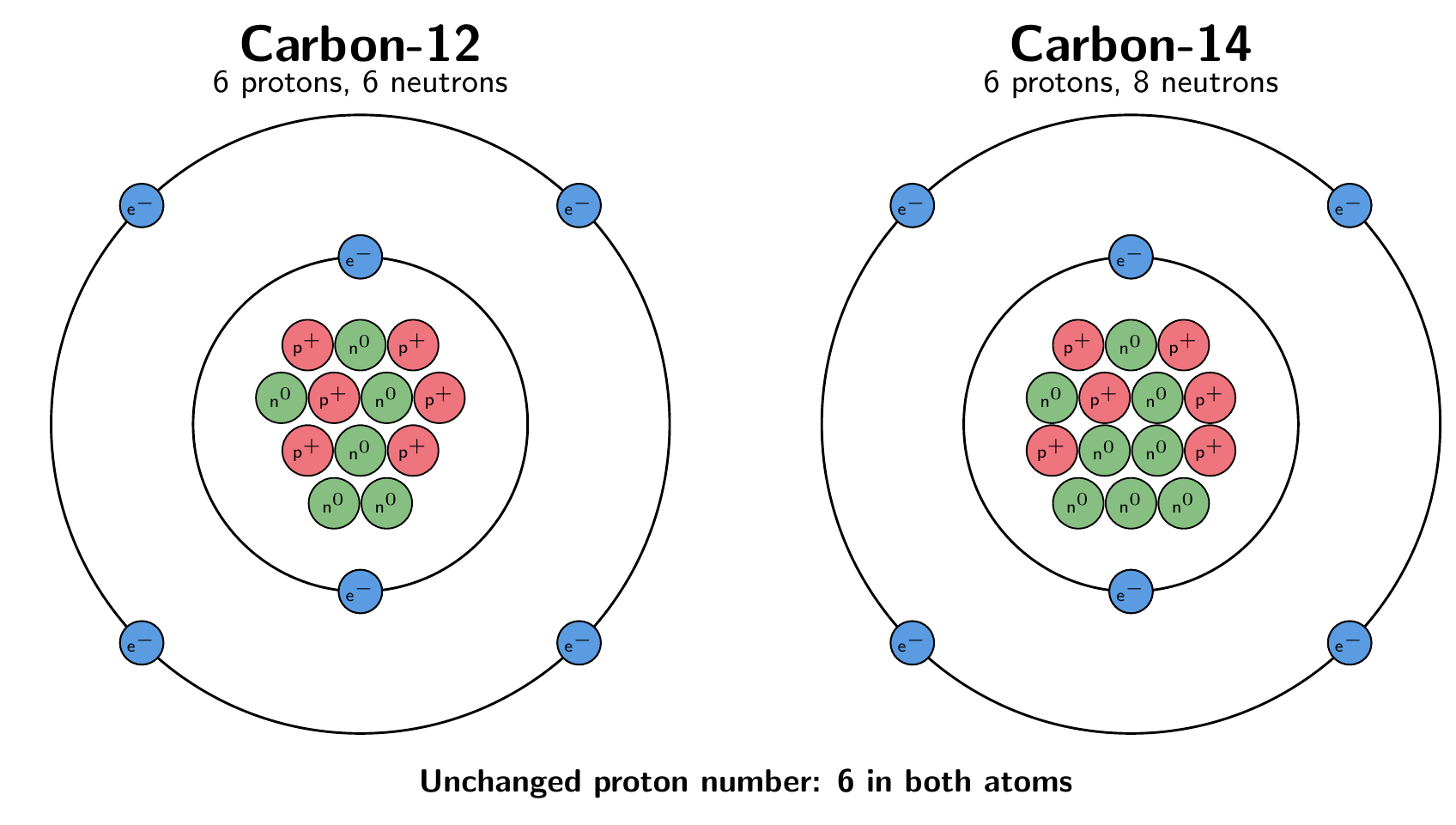
Carbon-12 and carbon-14 both have 6 protons. Carbon-12 has 6 neutrons and carbon-14 has 8, which is why their mass numbers are 12 and 14.
Abundance means how common an isotope is in a sample, and percentage abundance gives that proportion out of 100. A more abundant isotope has a bigger effect on the relative atomic mass than a less abundant one.
Paper 1, for both AQA courses: see the Paper 1 guide. AQA also says Paper 2 questions may draw on the fundamental concepts of the first three topics, so relative atomic mass can come up there too: our Paper 2 guide has AQA's wording.
The relative atomic mass formula
Ar = sum of (isotope mass × percentage abundance) ÷ 100
- Isotope mass is the mass number of each isotope.
- Percentage abundance is how much of the sample that isotope makes up, out of 100.
- Sum means you work out isotope mass × percentage abundance for every isotope, then add the results.
- Dividing by 100 turns the percentages back into a proportion.
Two quick checks help. When the data include every isotope in the sample, the percentage abundances add up to 100%. And your answer must lie between the isotope masses, nearer the more abundant one.
On AQA's GCSE science papers from 2027, where a calculation says "show your working", the right answer alone earns one mark (see our Paper 1 guide).
Here's a simple example first. An element has two isotopes:
| Isotope mass | Percentage abundance |
|---|---|
| 24 | 80.0% |
| 26 | 20.0% |
- Check the abundances: 80.0 + 20.0 = 100.0.
- Multiply: 24 × 80.0 = 1920 and 26 × 20.0 = 520.
- Add: 1920 + 520 = 2440.
- Divide by 100: Ar = 2440 ÷ 100 = 24.4.
The answer, 24.4, is closer to 24 because the isotope of mass 24 is the more abundant one.
How to calculate relative atomic mass: worked example
Here is an exam-style question from Medly, marked with Medly's mark scheme.
Worked example (3 marks)
Neon is an element in Group 0. The table shows data for the isotopes of neon.
| Mass number | Percentage abundance |
|---|---|
| 20 | 90.0 |
| 21 | 0.5 |
| 22 | 9.5 |
Calculate the relative atomic mass (Ar) of neon. Give your answer to 3 significant figures.
- Set up the weighted calculation using all three isotopes: ((20 × 90.0) + (21 × 0.5) + (22 × 9.5)) ÷ 100. This earns 1 mark.
- Work it out: 1800 + 10.5 + 209 = 2019.5, and 2019.5 ÷ 100 = 20.195. The unrounded value 20.195 earns 1 mark, and Medly's mark scheme accepts only that value for this mark.
- Round to 3 significant figures: Ar = 20.2. This earns the last mark.
Medly's mark scheme gives the last mark for a correctly rounded answer even after an arithmetic slip, but rejects answers with extra figures the data don't support. The answer sits close to 20 because neon-20 makes up 90.0% of the sample.
Relative atomic mass and mass number
Mass number and relative atomic mass are easy to mix up, but they describe different things.
| Mass number | Relative atomic mass (Ar) | |
|---|---|---|
| Describes | One atom or isotope | An element, with all its isotopes |
| Meaning | Number of protons plus neutrons | Average based on isotope masses and abundances |
| Value | Always a whole number | Can be a decimal |
| Example | Carbon-14 has mass number 14 | An element with isotopes of masses 24 and 26 can have Ar = 24.4 |
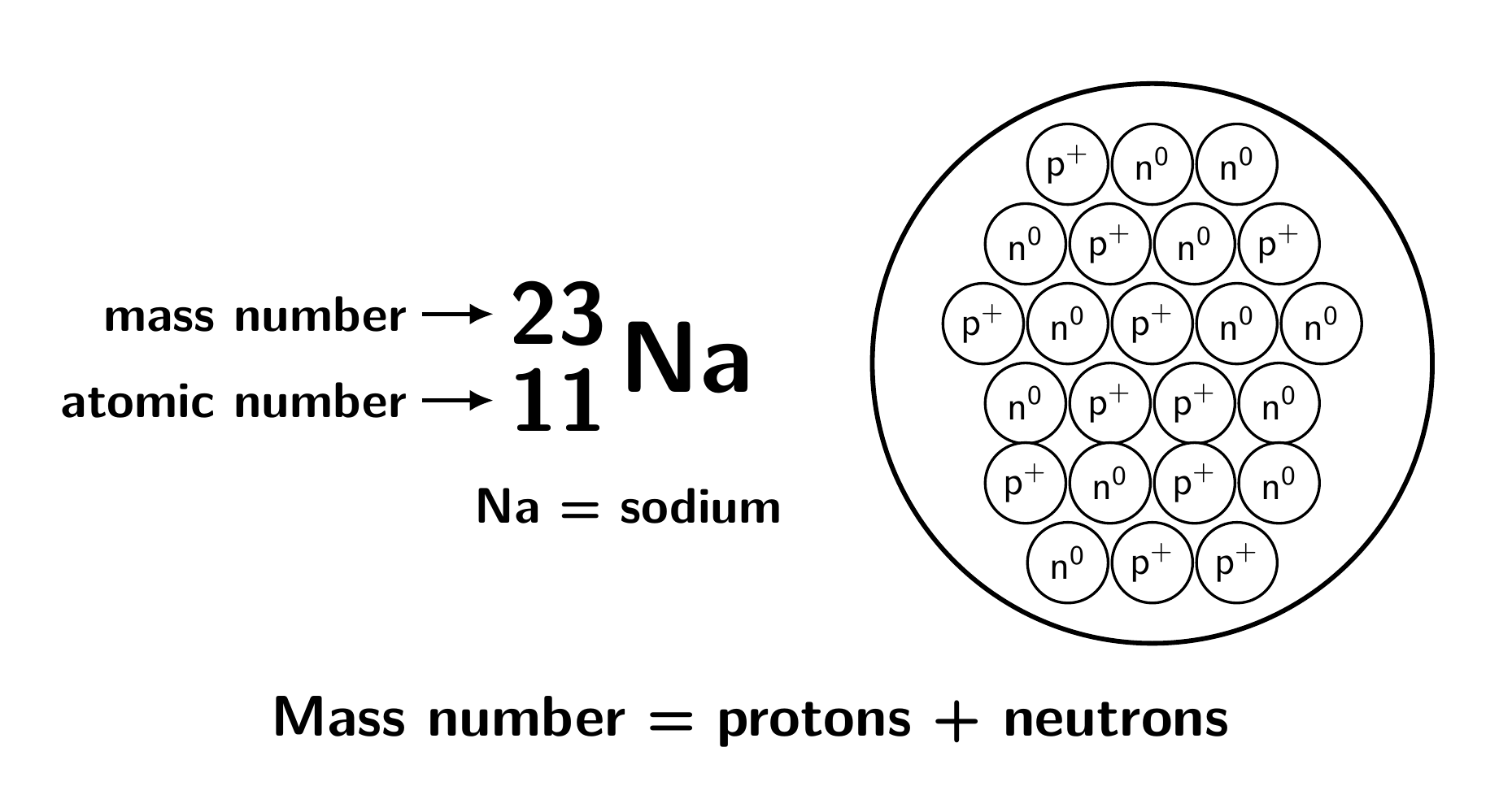
In ²³₁₁Na the top number, 23, is the mass number and the bottom number, 11, is the atomic number. So a sodium-23 atom has 11 protons and 23 − 11 = 12 neutrons. That mass number belongs to one isotope. Relative atomic mass belongs to the element as a whole and depends on the abundance of each isotope.
Where to find relative atomic mass on AQA's periodic table
You don't have to remember any values: AQA gives you a periodic table in the exam. Its key shows the relative atomic mass at the top of each box, then the atomic symbol and the name, with the atomic (proton) number at the bottom. For example, carbon's box shows 12 at the top and 6 at the bottom. In the ²³₁₁Na symbol above, the top number is the mass number of one isotope; in a periodic table box, the top number is the relative atomic mass of the element.
Most relative atomic masses on AQA's table are whole numbers. Two are not, and AQA's table says so: "Relative atomic masses for Cu and Cl have not been rounded to the nearest whole number." Chlorine is 35.5 and copper is 63.5.
These are the values you use when you work out a relative formula mass.
Where marks are lost on relative atomic mass questions
On AQA's recent GCSE Chemistry (8462) Higher papers, each mark for isotopes and relative atomic mass rested on one precise idea.
| What the question asked | What the mark scheme gave | How to keep the marks |
|---|---|---|
| What isotopes are: AQA's June 2025 Higher Paper 1, question 01.6 (2 marks) | 1 mark for "atoms with the same number of protons" (it allows "atoms of the same element" and "atoms with the same atomic number", and ignores "atoms with the same number of electrons") and 1 mark for "(but with) different numbers of neutrons" | Give both halves: same protons, different neutrons |
| What isotopes are: AQA's June 2024 Higher Paper 1, question 03.3 (2 marks) | The same two marks, with "ignore references to electrons" | Electrons don't earn either mark here |
| The closest estimate of Ar: AQA's June 2025 Higher Paper 1, question 01.7 (1 mark) | Isotopes of mass number 113 (4%) and 115 (96%); the mark is for ∼115 | The answer lies nearer the more abundant isotope |
Relative atomic mass exam questions with answers
Each question below is an exam-style question from Medly, marked with Medly's mark scheme. They get harder as you go.
Question 1: (3 marks)
A mass spectrometer is an instrument that measures the masses of particles. A mass-spectrometry investigation compared two samples of chlorine atoms. Both samples had atomic number 17. One sample had mass number 35 and the other had mass number 37.
Explain how these results show that the two samples contain isotopes of chlorine.
Answer
Medly's mark scheme gives 1 mark for each of these points:
- The same atomic number means the atoms have the same number of protons.
- The atoms have different mass numbers, 35 and 37.
- So they have different numbers of neutrons, which makes them isotopes: atoms of the same element with different numbers of neutrons. This point is needed for full marks.
Question 2: (2 marks)
Gallium is an element in Group 3 of the periodic table.
Naturally occurring gallium is composed of two isotopes. The table shows the mass number and percentage abundance of each isotope.
| Isotope mass number | Percentage abundance (%) |
|---|---|
| 69 | 60 |
| 71 | 40 |
Calculate the relative atomic mass (Ar) of gallium. Give your answer to 1 decimal place.
Answer
- Weighted average: ((69 × 60) + (71 × 40)) ÷ 100 (1 mark).
- (4140 + 2840) ÷ 100 = 6980 ÷ 100 = 69.8 (1 mark).
Medly's mark scheme accepts only 69.8 for the second mark, and rejects 69 and 71. The answer is nearer 69 because gallium-69 is the more abundant isotope.
Question 3: (4 marks)
This question uses different abundance figures for neon from the worked example above. Use the figures in its table.
The table provides data on the isotopic composition of neon.
| Isotope mass | Percentage abundance |
|---|---|
| 20 | 90.48% |
| 21 | 0.27% |
| 22 | 9.25% |
(a) Which is the correct statement about relative atomic mass? Select one answer. [1 mark]
A. Relative atomic mass is the mass number of the most common isotope only.
B. Relative atomic mass is the sum of the mass numbers of all the isotopes.
C. All isotopes of an element have the same mass number.
D. Relative atomic mass is an average that takes account of the relative abundances of isotopes.
(b) Calculate the relative atomic mass (Ar) of neon. Give your answer to 3 significant figures. [3 marks]
Answer
(a) D (1 mark). This is the definition of relative atomic mass.
A. This confuses relative atomic mass with the mass number of the most common isotope.
B. This adds isotope mass numbers without allowing for their abundances.
C. This incorrectly states that isotopes have identical mass numbers.
(b)
- Abundance-weighted calculation: ((20 × 90.48) + (21 × 0.27) + (22 × 9.25)) ÷ 100 (1 mark).
- 1809.6 + 5.67 + 203.5 = 2018.77, and 2018.77 ÷ 100 = 20.1877 (1 mark).
- Ar = 20.2 to 3 significant figures (1 mark).
Medly's mark scheme accepts only 20.1877 for the second mark. For the third, it accepts a correctly rounded answer to 3 significant figures from a wrong intermediate value, as long as all three isotopes were used.
Weighted averages get quicker with practice, and in each calculation question above the set-up line earns a mark of its own. Medly has AQA GCSE Chemistry courses at Foundation and Higher, and AQA GCSE Combined Chemistry courses at Foundation and Higher for Combined Science students. Medly marks written answers like Question 1 against the mark scheme, so you can see which point you missed. Medly's free plan includes 5 marked questions, 20 AI tutor messages and 1 uploaded paper a day, with no card needed.
Frequently asked questions
What is the formula for relative atomic mass?
Ar = sum of (isotope mass × percentage abundance) ÷ 100. Multiply each isotope's mass by its percentage abundance, add the results and divide by 100.
Is relative atomic mass the same as mass number?
No. Mass number is the number of protons plus neutrons in one isotope and is always a whole number. Relative atomic mass is an average for the element that takes account of every isotope's abundance, so it can be a decimal.
Why is the relative atomic mass of chlorine 35.5?
Relative atomic mass is an average that takes account of the abundance of each isotope, so it need not be a whole number. AQA's periodic table gives chlorine as 35.5 and copper as 63.5, and notes that these two have not been rounded to the nearest whole number.
Do the percentage abundances always add up to 100%?
Yes, when the data include every isotope in the sample. Checking that they do is a quick first step before you calculate.
Which paper is relative atomic mass on?
AQA examines it directly in Paper 1 of both courses, and Paper 2 questions may also draw on it.