
Statement of cash flows indirect method: the steps, each adjustment and the direct method compared
Start from operating profit, adjust for non-cash items and working capital, then check the figure by the direct method and try three practice questions.
On this page
The indirect method works out cash from operating activities by starting with operating profit and adjusting it. It first reverses non-cash charges and disposal gains and losses, then adjusts for the changes in inventories, trade receivables and trade payables. This guide explains each adjustment and its direction, works one company through to its operating cash figure, and reaches the same figure by the direct method. Three practice questions with full answers follow.
What is the indirect method?
The indirect method is one of two ways to calculate the operating section of a statement of cash flows. Operating profit is adjusted to remove non-cash charges and any disposal gains or losses included in it, then adjusted for the changes in operating balances. The result is the subtotal "cash from operating activities before income taxes".
IAS 7 Statement of Cash Flows permits two methods. The other is the direct method, which adds up cash received from customers and deducts cash paid to suppliers and for operating expenses. Both reach the same operating cash total, because they describe the same transactions.
The operating section is only the first part of the statement. Investing and financing activities follow it, and the statement guide lays out the whole statement of cash flows with a full example.
Where the indirect method starts: operating profit
The indirect method starts from operating profit: the profit from operating activities, worked out from the income and expenses recognised in the period rather than from cash received and paid. FA has examined operating profit as the starting point since September 2025.
Each adjustment after that turns part of the accruals-based profit into a cash figure. To prepare the calculation you need three things: operating profit for the period, the non-cash charges and disposal gains or losses included in it, and the opening and closing inventories, trade receivables and trade payables.
Income taxes paid are not one of the adjustments. They are deducted after cash from operating activities before income taxes has been worked out.
Indirect method adjustments: what to add back and what to deduct
Every adjustment answers one question: did this item change profit without changing cash in the same way? There are two groups: non-cash items and disposals, then the working capital balances.
Non-cash charges and disposal gains or losses
Depreciation allocates the depreciable amount of a tangible non-current asset over its useful life. Amortisation does the same for an intangible asset with a finite useful life. Both reduce operating profit, but neither involves a cash payment, so both are added back.
| Item included in operating profit | Adjustment | Why |
|---|---|---|
| Depreciation | Add back | It reduced profit without a cash payment |
| Amortisation | Add back | It reduced profit without a cash payment |
| Gain on disposal of an asset | Deduct | It increased profit but is not an operating receipt |
| Loss on disposal of an asset | Add back | It reduced profit but is not an operating payment |
Adding back depreciation removes its effect on profit. It is not a cash receipt. A gain or loss on disposal is not the cash received from the sale either: only the gain or loss included in operating profit is reversed here. The sale proceeds themselves are an investing inflow.
Changes in inventories, trade receivables and trade payables
Inventories, trade receivables and trade payables create timing differences between profit and cash. Compare each balance at the start and end of the period, then adjust for the movement.
Inventories. An increase means purchases were higher than the inventory charged to cost of sales, so profit has not yet been charged with the cost of those extra goods: deduct the increase. A decrease means some goods sold came from opening inventory bought in an earlier period: add the decrease.
Trade receivables. An increase means more of the period's revenue is still uncollected, so cash received is lower than revenue: deduct the increase. A decrease means customers also paid amounts they owed at the start of the period: add the decrease.
Trade payables. An increase means some purchases are still unpaid, so payments are lower than purchases: add the increase. A decrease means payments included settling amounts owed at the start of the period: deduct the decrease.
| Balance | Increase | Decrease |
|---|---|---|
| Inventories | Deduct | Add |
| Trade receivables | Deduct | Add |
| Trade payables | Add | Deduct |
Read the inventories and trade payables adjustments together: between them they turn cost of sales into cash paid to suppliers. These directions hold for movements that come from ordinary trading and settlement. A balance that moved for some other, non-cash reason cannot simply be treated as a timing difference.
Statement of cash flows indirect method example: Arden Ltd
Arden Ltd shows the whole calculation, from operating profit to the operating subtotal and then to net cash from operating activities.
Worked example
What is Arden Ltd's cash from operating activities before income taxes for the year ended 31 December 20X5? Changes in its inventories, trade receivables and trade payables arise only from ordinary trading and cash settlements, and its other operating expenses are paid in full during the year.
| Item for the year ended 31 December 20X5 | Amount |
|---|---|
| Operating profit | $52,000 |
| Depreciation included in operating profit | $12,000 |
| Amortisation included in operating profit | $3,000 |
| Gain on disposal included in operating profit | $2,000 |
| Loss on a separate disposal included in operating profit | $1,000 |
| Balance | At 1 January 20X5 | At 31 December 20X5 |
|---|---|---|
| Inventories | $30,000 | $38,000 |
| Trade receivables | $40,000 | $46,000 |
| Trade payables | $25,000 | $29,000 |
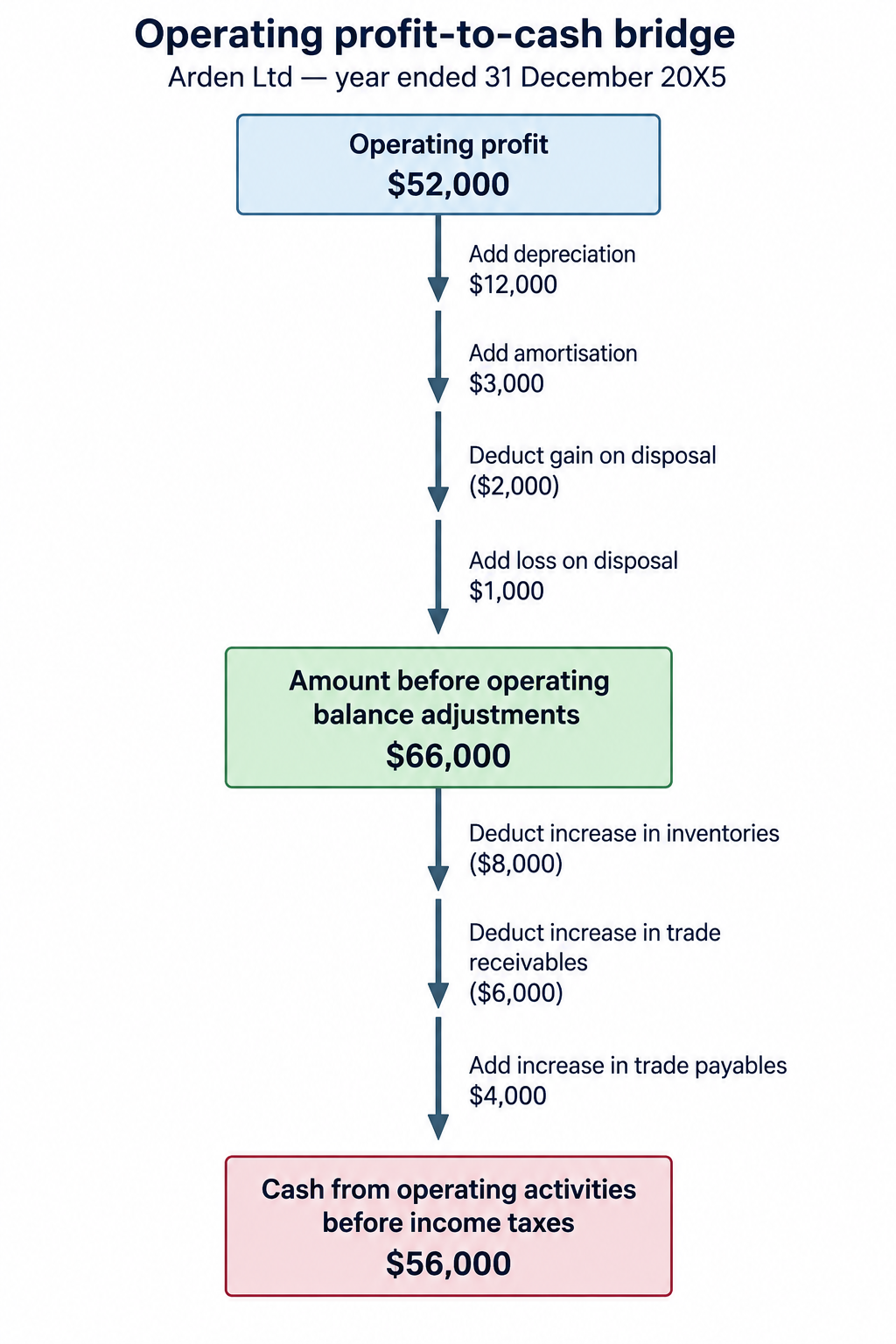
- Reverse the non-cash charges and disposal results: $52,000 + $12,000 + $3,000 − $2,000 + $1,000 = $66,000.
- Inventories increased by $38,000 − $30,000 = $8,000.
- Trade receivables increased by $46,000 − $40,000 = $6,000.
- Trade payables increased by $29,000 − $25,000 = $4,000.
- Apply the directions: deduct the two increases in assets and add the increase in payables.
| Indirect operating cash flow reconciliation | Amount |
|---|---|
| Operating profit | $52,000 |
| Add depreciation | $12,000 |
| Add amortisation | $3,000 |
| Deduct gain on disposal | ($2,000) |
| Add loss on disposal | $1,000 |
| Amount before operating balance adjustments | $66,000 |
| Deduct increase in inventories | ($8,000) |
| Deduct increase in trade receivables | ($6,000) |
| Add increase in trade payables | $4,000 |
| Cash from operating activities before income taxes | $56,000 |
Check: the three balance movements reduce cash by a net $10,000 ($8,000 + $6,000 − $4,000), and $66,000 − $10,000 = $56,000.
The last step of the operating section is income taxes paid, which is not necessarily the same as the income tax expense. Arden Ltd had tax payable of $5,000 at 1 January 20X5, an income tax expense of $11,000 for 20X5 and tax payable of $7,000 at 31 December 20X5. Where tax payable changes only through the expense and the payments, the tax paid is the opening payable plus the expense, less the closing payable.
- Tax available to be paid: $5,000 + $11,000 = $16,000.
- Less the amount still unpaid at the year end: $16,000 − $7,000 = $9,000 paid.
- Check: $5,000 + $11,000 − $9,000 = $7,000, the closing payable.
| Operating cash flow extract for Arden Ltd, 20X5 | Amount |
|---|---|
| Cash from operating activities before income taxes | $56,000 |
| Income taxes paid | ($9,000) |
| Net cash from operating activities | $47,000 |
Direct method: receipts from customers and payments to suppliers
The direct method shows the main classes of gross operating cash receipts and payments: receipts and payments are listed separately, not offset. It does not begin with profit. Operating receipts less operating payments give the same subtotal, cash from operating activities before income taxes.
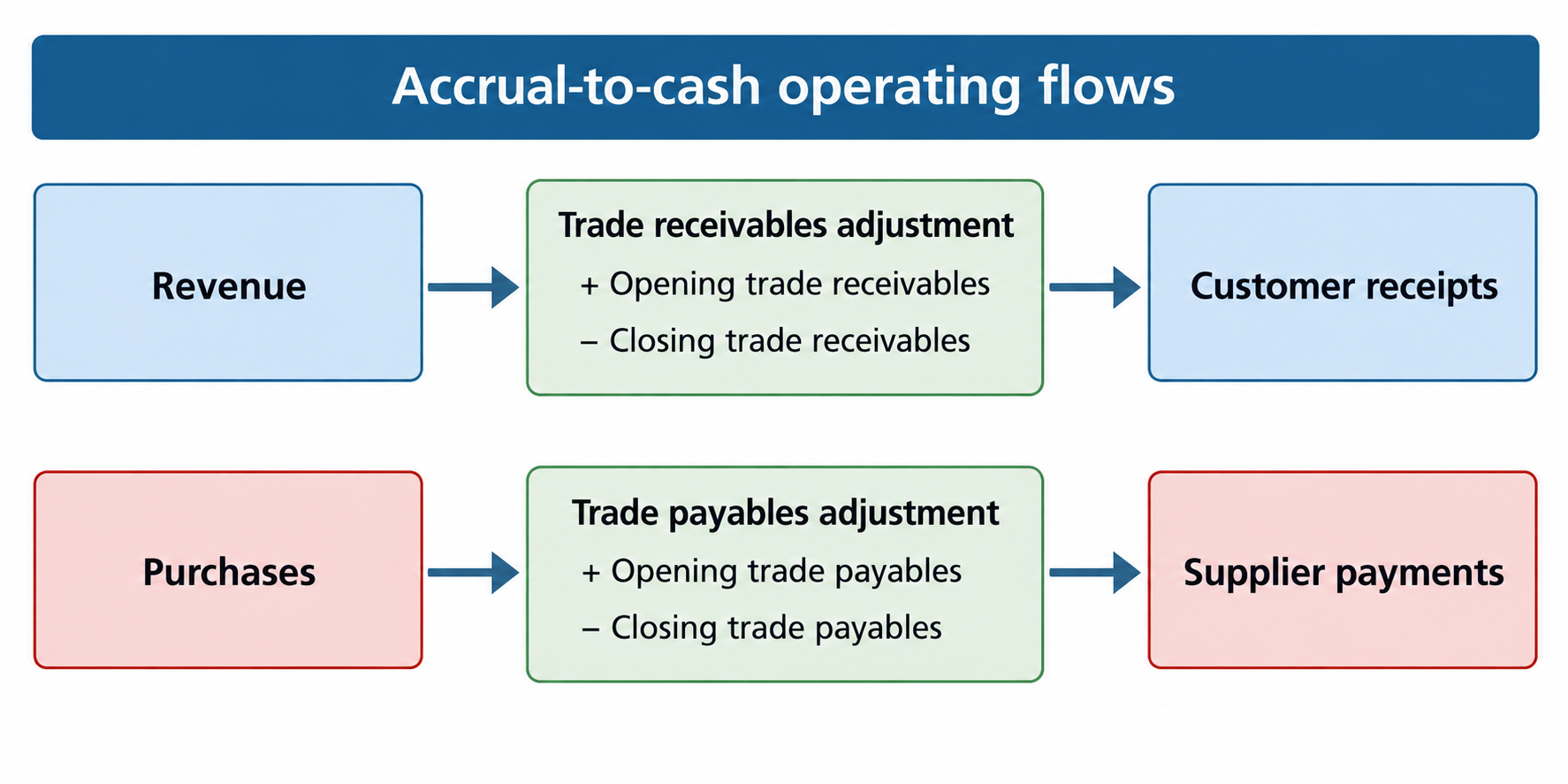
When the cash figures are not given, you rebuild them from the accruals figures and the opening and closing balances:
- Customer receipts = revenue + opening trade receivables − closing trade receivables.
- Where irrecoverable debts are written off: customer receipts = revenue + opening trade receivables − closing trade receivables − irrecoverable debts written off. Use trade receivables before deducting any allowance for irrecoverable debts: a change in the allowance is not a receipt.
- Purchases = cost of sales + closing inventories − opening inventories.
- Supplier payments = purchases + opening trade payables − closing trade payables.
Depreciation, losses on disposal and other non-cash expenses, such as irrecoverable debts, are left out of payments. Leaving them out does not create a receipt; it stops a non-cash charge being treated as a payment.
The figure shows the two basic relationships, without write-offs and without the step from cost of sales to purchases.
Arden Ltd's revenue for 20X5 was $300,000, its cost of sales $180,000 and its other operating expenses, paid in full, $54,000. Using the balances above:
- Customer receipts: $300,000 + $40,000 − $46,000 = $294,000.
- Purchases: $180,000 + $38,000 − $30,000 = $188,000.
- Supplier payments: $188,000 + $25,000 − $29,000 = $184,000.
- Other operating payments: $54,000, as the expenses were paid in full. Nothing is included for depreciation or amortisation.
| Direct operating cash flow extract for Arden Ltd, 20X5 | Amount |
|---|---|
| Cash received from customers | $294,000 |
| Cash paid to suppliers | ($184,000) |
| Cash paid for other operating expenses | ($54,000) |
| Cash from operating activities before income taxes | $56,000 |
Indirect vs direct method
Both methods give Arden Ltd the same $56,000. What changes is the presentation and the working, not the cash the transactions generated.
| Comparison for Arden Ltd, 20X5 | Indirect method | Direct method |
|---|---|---|
| Starting point | Operating profit of $52,000 | Customer receipts of $294,000 |
| Depreciation and amortisation | Added back to profit | Left out of cash payments |
| Movements in operating balances | Adjust operating profit | Used to work out receipts and payments |
| Cash from operating activities before income taxes | $56,000 | $56,000 |
The same figures also support the operating profit: $300,000 − $180,000 − $54,000 − $12,000 − $3,000 + $2,000 − $1,000 = $52,000.
When the two methods agree, that is a useful check on your arithmetic. It does not prove the records are right, because an item missed from both calculations would leave them agreeing.
The indirect method in the ACCA FA and K1 syllabuses
Both methods are in section G5 of the FA syllabus and section F3 of the K1 syllabus. They are examined in the FA exam of the current ACCA Qualification, and K1 Financial Accounting in the future ACCA Qualification, on demand from July 2027. A pass in FA gives credit for K1.
| Exam | Reference | What it asks |
|---|---|---|
| FA | G5 (a) | "Differentiate between profit and cash flow" |
| FA | G5 (e)(i) | Calculate "Cash flows from operating activities (direct and indirect methods for calculating cash from operating activities before income taxes)" |
| K1 | F3 (a) | "Explain the difference between profit/loss and cash flows" |
| K1 | F3 (d) | "Prepare a statement of cash flows (or extracts thereof) using both the direct and indirect methods for calculating" cash from operating activities before income taxes |
You can read both in full in the FA syllabus and the K1 syllabus.
FA and K1 are both two-hour computer-based exams: 35 two-mark objective test questions in Section A and two 15-mark multi-task questions in Section B. The pass mark is 50%.
Both syllabuses say the questions "will assess all parts of the syllabus". The FA exam guide covers the rest of the format and the move to K1.
Every topic on this page is in both syllabuses.
Indirect method practice questions (ACCA FA and K1)
The three practice questions below are from Medly's ACCA K1 Financial Accounting course, and the answers follow Medly's mark schemes. Try each one before you open the answer.
One tests the signs in an indirect method reconciliation and two test the direct method.
Question 1: (2 marks)
A junior accountant prepared the following draft using the indirect method. Four sign-change revisions have been proposed.
Bramley Co: Draft reconciliation of operating profit to cash generated from operations for the year ended 31 March 20X8
| $'000 | |
|---|---|
| Operating profit | 420 |
| Depreciation charge for the year | (65) |
| Increase in inventories | (28) |
| Decrease in trade receivables | (19) |
| Increase in trade payables | 34 |
| Cash generated from operations | 342 |
For which of the proposed revisions to the draft reconciliation is a correction needed?
- Change the depreciation charge from deducted to added.
- Change the increase in inventories from deducted to added.
- Change the decrease in trade receivables from deducted to added.
- Change the increase in trade payables from added to deducted.
A. 3 only
B. 1 and 3 only
C. 1 only
D. 1, 2 and 3 only
Answer
B. 1 and 3 only.
- Revision 1 is needed: depreciation reduced profit without a cash payment, so it is added back, not deducted.
- Revision 2 is not needed: an increase in inventories is deducted, as the draft already does.
- Revision 3 is needed: a decrease in trade receivables means customers paid more than the year's revenue, so it is added, not deducted.
- Revision 4 is not needed: an increase in trade payables is added, as the draft already does.
The corrected draft: 420 + 65 − 28 + 19 + 34 = 510 ($'000). The draft's "cash generated from operations" is the subtotal this page calls cash from operating activities before income taxes.
A misses revision 1. C misses revision 3. D also includes revision 2, which would wrongly add an increase in inventories. The 2 marks are for the correct option.
Question 2: (2 marks)
The following information relates to Oakridge Co for the year ended 31 December 20X6. All revenue was on credit, and there were no other movements in trade receivables or other operating cash flows.
| $ | |
|---|---|
| Credit revenue | 640,000 |
| Trade receivables at 1 January 20X6 | 52,000 |
| Trade receivables at 31 December 20X6 | 67,000 |
| Irrecoverable debts written off | 4,000 |
| Cash paid to suppliers | 380,000 |
| Cash paid to and on behalf of employees | 115,000 |
What is cash from operating activities before income taxes using the direct method for the year ended 31 December 20X6?
A. $126,000
B. $130,000
C. $156,000
D. $621,000
Answer
A. $126,000.
- Customer receipts: $52,000 + $640,000 − $4,000 − $67,000 = $621,000.
- Operating payments: $380,000 + $115,000 = $495,000.
- Cash from operating activities before income taxes: $621,000 − $495,000 = $126,000.
B leaves the $4,000 written off out of the receipts calculation. C adds the increase in trade receivables to revenue instead of deducting it. D is the customer receipts alone, before any payments. The 2 marks are for the correct option.
Question 3: (2 marks)
The following information relates to Belmont Co for the year ended 31 March 20X7:
| Amount | |
|---|---|
| Credit purchases | $420,000 |
| Trade payables at 1 April 20X6 | $48,000 |
| Trade payables at 31 March 20X7 | $39,000 |
| Wages and other operating expenses | $165,000 |
Wages and other operating expenses include depreciation of $28,000 and a loss on disposal of equipment of $5,000. The remaining expenses were paid in the year and are separate from credit purchases.
What is the total cash paid to suppliers and employees, including payments for other operating expenses, in Belmont Co's statement of cash flows for the year ended 31 March 20X7?
A. $543,000
B. $561,000
C. $566,000
D. $594,000
Answer
B. $561,000.
- Supplier payments: $48,000 + $420,000 − $39,000 = $429,000.
- Other cash payments: $165,000 − $28,000 depreciation − $5,000 loss on disposal = $132,000.
- Total: $429,000 + $132,000 = $561,000.
A deducts the decrease in trade payables from purchases instead of adding it. C leaves out the depreciation but keeps the loss on disposal as a payment. D treats both the depreciation and the loss on disposal as payments. The 2 marks are for the correct option.
Medly's ACCA K1 Financial Accounting course has lessons for every topic of the course and full-length practice papers, with answers marked step by step. It is free to start, with no card needed.
Frequently asked questions
Why is depreciation added back in the indirect method?
Depreciation reduced operating profit but involved no cash payment. Adding it back removes its effect on profit; it is not a cash receipt.
Is an increase in trade receivables added or deducted?
Deducted. An increase means more of the year's revenue is still unpaid, so cash received is lower than revenue.
Do the direct and indirect methods give the same figure?
Yes. They work out the same cash from operating activities before income taxes from the same transactions, in different ways.
Which method does the ACCA FA syllabus ask for?
Both. The FA syllabus asks you to calculate operating cash flows by the "direct and indirect methods for calculating cash from operating activities before income taxes".
What figure does the indirect method start from?
Operating profit. FA has examined operating profit as the starting point since September 2025.