
Reducing balance method and straight line depreciation for ACCA FA and K1, with practice questions
Work out depreciation by both methods for full and part years, post the journal and recalculate the charge when an estimate changes.
On this page
The reducing balance method charges depreciation as a fixed percentage of an asset's opening carrying amount. Because that amount falls each year, later charges are normally smaller than earlier ones. Straight line depreciation charges the same amount in every full year: cost less residual value, divided by the useful life. This page works both methods for full and part years, gives the journal and the effect of a change of estimate, and ends with two ACCA FA and K1 practice questions with answers.
What is depreciation in ACCA Financial Accounting?
Depreciation is the systematic allocation of an asset's depreciable amount over its useful life. It records the cost of using up an asset such as a machine or a van over the years it earns revenue, instead of charging the whole cost in the year it was bought.
It is an allocation of cost, not a valuation. A depreciation charge does not try to measure a fall in market price, so an asset may still need depreciating when its market price has risen. Depreciation is not a cash payment either, and it does not set aside money to replace the asset. Land normally has an unlimited useful life and is not depreciated; a building on that land is.
Five terms carry every calculation on this page:
- Depreciable amount: cost less residual value. This is the amount spread over the asset's life.
- Useful life: the period over which the business expects to use the asset, which may be shorter than its physical life.
- Residual value: what the business expects to recover when it disposes of the asset at the end of its useful life, after disposal costs.
- Accumulated depreciation: the total depreciation recorded on the asset to date, across all the years so far.
- Carrying amount: cost less accumulated depreciation.
The year's depreciation expense and accumulated depreciation are different figures. The expense belongs to one year; accumulated depreciation is every year's charge added together.
Reducing balance method: formula and example
The reducing balance method applies a fixed percentage to the asset's opening carrying amount each year. The rate stays the same, but the amount it is applied to falls after each year's charge, so later charges are normally smaller.
Annual depreciation = Opening carrying amount × Depreciation rate
Closing carrying amount = Opening carrying amount − Depreciation charge
The closing carrying amount becomes the next year's opening carrying amount. In the first full year, before any depreciation has been charged, the opening carrying amount is the asset's cost.
Both ACCA syllabuses name the methods "straight-line and diminishing-balance (reducing-balance) methods". So when a question says diminishing balance, it means the reducing balance method.
Residual value works differently from straight line. It is not deducted from the opening carrying amount before the percentage is applied. Instead, it limits the total amount that can be depreciated: a charge must be restricted if the normal calculation would take the carrying amount below residual value.
Worked example
Equipment costing $16,000 is available for use at the beginning of Year 1. It is depreciated at 25% a year on the reducing balance method, and its estimated residual value is $1,000. What are the depreciation charges in its first three full years?
- Year 1 starts with cost: $16,000 × 25% = $4,000. Closing carrying amount: $16,000 − $4,000 = $12,000.
- Year 2 starts with Year 1's closing carrying amount: $12,000 × 25% = $3,000. Closing carrying amount: $12,000 − $3,000 = $9,000.
- Year 3 starts with Year 2's closing carrying amount: $9,000 × 25% = $2,250. Closing carrying amount: $9,000 − $2,250 = $6,750.
| Year | Opening carrying amount ($) | Depreciation charge ($) | Closing carrying amount ($) |
|---|---|---|---|
| Year 1 | 16,000 | 4,000 | 12,000 |
| Year 2 | 12,000 | 3,000 | 9,000 |
| Year 3 | 9,000 | 2,250 | 6,750 |
Accumulated depreciation at the end of each year is $4,000 after Year 1, $7,000 after Year 2 and $9,250 after Year 3. The charge falls each year because the same 25% applies to a smaller opening carrying amount, and every carrying amount stays above the $1,000 residual value.
Part-year reducing balance depreciation
When the policy is to charge depreciation pro rata, apply the rate to the carrying amount and then take the fraction of the year the asset was available for use.
If the same $16,000 equipment is available for use from 1 July, with a year end of 31 December, the first charge is $16,000 × 25% × 6/12 = $2,000. The closing carrying amount is $16,000 − $2,000 = $14,000. The next full year's charge is $14,000 × 25% = $3,500. That second calculation starts from $14,000: not the $16,000 cost, and not the $12,000 from the full-year example above.
Straight line depreciation: formula and example
Straight line depreciation allocates an equal amount to each full year of the asset's useful life, as long as the estimates do not change.
Annual depreciation = (Cost − Residual value) ÷ Useful life in years
A question may give a percentage instead. If it is a straight line rate on cost, the annual charge is cost × rate. Follow the basis the question states: a percentage of cost is not the same as a percentage of the opening carrying amount.
Worked example
Equipment is available for use at the beginning of the accounting year. It cost $20,000, its estimated residual value is $2,000 and its estimated useful life is five years. It is depreciated on the straight line method. What is its annual charge, and what is its carrying amount after two full years?
- Depreciable amount: $20,000 − $2,000 = $18,000.
- Annual depreciation: $18,000 ÷ 5 = $3,600.
- Accumulated depreciation after two full years: 2 × $3,600 = $7,200.
- Carrying amount: $20,000 − $7,200 = $12,800.
The second year's depreciation expense is $3,600. At the end of that year, the statement of financial position shows the equipment at a carrying amount of $12,800: cost of $20,000 less accumulated depreciation of $7,200. As a check, five full years of $3,600 total $18,000, which leaves the $2,000 residual value.
Part-year straight line depreciation
Depreciation begins when the asset is available for use. For a part year:
Part-year depreciation = Annual depreciation × Months available for use ÷ 12
If the same equipment is available for use from 1 October and the year ends on 31 December, depreciation runs for three months: $3,600 × 3/12 = $900. The carrying amount at 31 December is $20,000 − $900 = $19,100. Don't use a full year's charge when the policy asks for pro rata depreciation.
Reducing balance vs straight line depreciation
Both methods allocate an asset's depreciable amount over its life. They differ in what each year's charge is calculated on.
| Feature | Straight line | Reducing balance |
|---|---|---|
| What the charge is based on | Depreciable amount divided by useful life | A fixed percentage of the opening carrying amount |
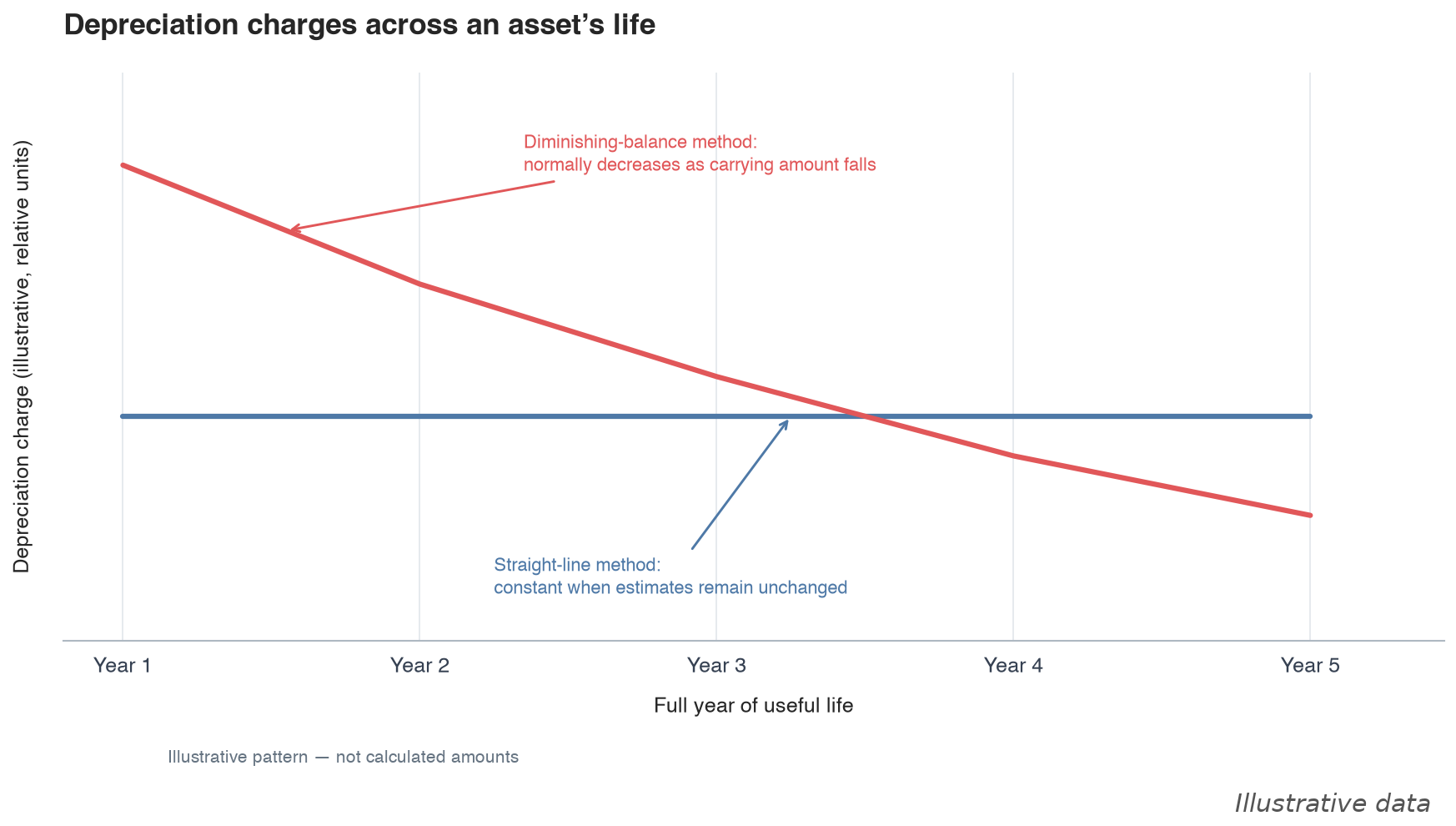
| Charge for a full year | The same each year while the estimates are unchanged | Normally smaller each year as the carrying amount falls |
| Effect of earlier charges | They do not change the base for later years | They reduce the base for later years |
The method should follow the pattern in which the business expects to use up the asset's benefits, not the profit figure it would prefer. Straight line suits an asset whose benefits are used up fairly evenly, such as an office building that gives much the same accommodation each year. Reducing balance suits an asset that gives more benefit in its early years and less later, such as equipment that is most productive when new. A falling market price on its own is not a reason to choose reducing balance, because depreciation allocates cost and does not measure value.
The chart shows the pattern only. It has no amounts on it, so don't read figures off it.
Depreciation journal entry: debit and credit
The journal is the same under both methods: debit depreciation expense and credit accumulated depreciation with the year's charge. The debit records the expense for the year. The credit increases accumulated depreciation, which is kept in its own account and deducted from cost to give the carrying amount. Recording depreciation does not normally credit the asset's cost account.
The full-year charge of $3,600 from the straight line worked example is recorded as:
| Account | Debit ($) | Credit ($) |
|---|---|---|
| Depreciation expense | 3,600 | |
| Accumulated depreciation: equipment | 3,600 |
The Year 2 charge of $3,000 from the reducing balance worked example is recorded as:
| Account | Debit ($) | Credit ($) |
|---|---|---|
| Depreciation expense | 3,000 | |
| Accumulated depreciation: equipment | 3,000 |
The journal records the year's charge, not the accumulated balance. In the reducing balance example, Year 2 adds $3,000 to the existing credit balance of $4,000, which gives accumulated depreciation of $7,000.
The expense reduces profit in the statement of profit or loss. In the statement of financial position, the asset appears at cost less accumulated depreciation. In a trial balance drawn up before year-end adjustments, accumulated depreciation cannot be reported as it stands until the year's charge has been added.
Change in useful life or residual value
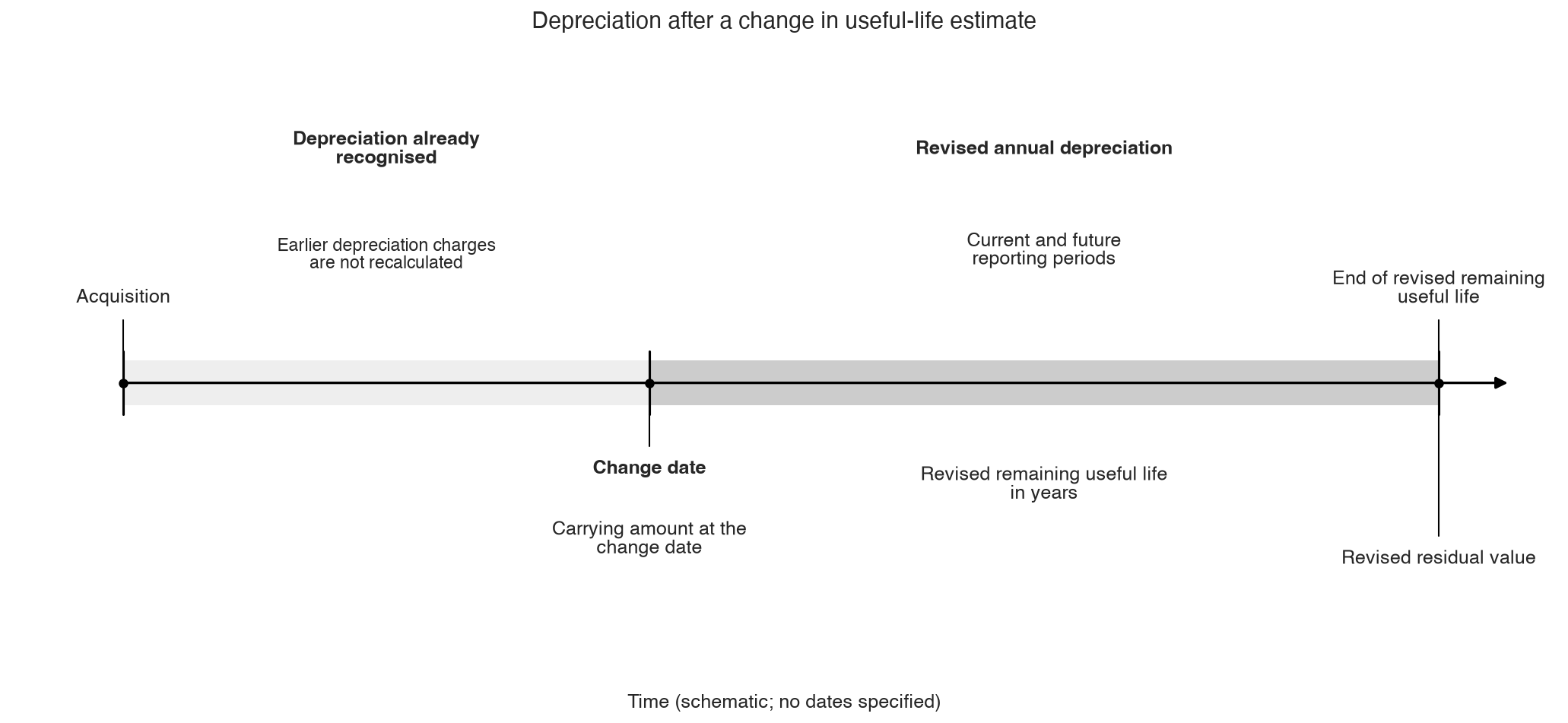
Useful life and residual value are reviewed at least at each financial year end. When either changes, the new estimate applies from the date of the change, for the current year and the years after it. Charges already made are not recalculated.
Start from the carrying amount at the date of the change, not from the original cost. For straight line depreciation:
Revised annual depreciation = (Carrying amount at the change date − Revised residual value) ÷ Revised remaining useful life in years
Read the wording of the revised life carefully. A revised total useful life of ten years includes the years already used, so deduct them. An asset expected to remain in use for another ten years has a remaining life of ten years. If only one estimate changes, keep the other as it was.
The timeline shows a change in useful life. A revised residual value goes into the same formula.
Worked example
A business acquired equipment on 1 January 20X1 for $60,000. It uses straight line depreciation over an original useful life of six years with no residual value, and charged $10,000 in each of 20X1 and 20X2. Three separate revisions are considered from 1 January 20X3, each starting from the same carrying amount. What annual charge applies under each?
- Accumulated depreciation at 1 January 20X3: 2 × $10,000 = $20,000.
- Carrying amount at the change date: $60,000 − $20,000 = $40,000.
- Remaining useful life: if the total life becomes ten years, 10 − 2 = 8 years remain. If the total life stays at six years, 6 − 2 = 4 years remain.
| Revision from 1 January 20X3 | Working | Revised annual charge |
|---|---|---|
| Useful life only: total life becomes 10 years | ($40,000 − $0) ÷ 8 | $5,000 |
| Residual value only: residual value becomes $8,000 | ($40,000 − $8,000) ÷ 4 | $8,000 |
| Both: total life 10 years and residual value $8,000 | ($40,000 − $8,000) ÷ 8 | $4,000 |
Under the third revision, the charge for the year ended 31 December 20X3 is $4,000 instead of the original $10,000, so profit for 20X3 is $6,000 higher, other things being equal. The journal is the usual one, with no separate entry for the revision itself:
| Account | Debit ($) | Credit ($) |
|---|---|---|
| Depreciation expense | 4,000 | |
| Accumulated depreciation: equipment | 4,000 |
At 31 December 20X3, accumulated depreciation is $20,000 + $4,000 = $24,000 and the carrying amount is $40,000 − $4,000 = $36,000. The cost of $60,000 is unchanged. As a check, seven years remain at that date: 7 × $4,000 = $28,000, and $36,000 − $28,000 = $8,000, the revised residual value.
When only one estimate changes, a longer remaining life lowers the annual straight line charge and a shorter one raises it, and a higher residual value lowers the amount still to be depreciated and a lower one raises it. When both change, work out their combined effect. After an asset is revalued, the charge is worked out from the revalued amount instead: our revaluation reserve page works that through.
Depreciation in the ACCA FA and K1 syllabuses
Depreciation sits in the section on recording transactions and events in both syllabuses.
| Topic | FA (D5) | K1 (C5) |
|---|---|---|
| Purpose | (a) "Explain the purpose of depreciation." | (e) "Explain the purpose of depreciation." |
| The two methods | (b) "Calculate the charge for depreciation using straight-line and diminishing-balance (reducing-balance) methods." | (g) "Calculate depreciation charges using straight-line and diminishing-balance (reducing-balance) methods and prepare journal entries to account for these." |
| Choosing a method | (c) "Identify the circumstances where different methods of depreciation would be appropriate." | (f) "Explain the circumstances where different methods of depreciation would be appropriate." |
| Recording it | (d) "Illustrate how the depreciation charge and accumulated depreciation are recorded in the general ledger accounts." | (g), as above |
| Change of estimate | (f) "Calculate the adjustments to depreciation necessary if changes are made in the estimated useful life and/ or residual value of a tangible non-current asset." | (k) "Calculate depreciation charges following a change in the estimated useful life and/or residual value of a tangible non-current asset and prepare journal entries to account for these." |
You can read both documents in full: the FA syllabus for September 2026 to June 2027, and the K1 syllabus for July 2027 to August 2028.
FA and K1 are both two-hour computer-based exams: 35 two-mark objective test questions in Section A and two 15-mark multi-task questions in Section B. The pass mark is 50%. The two exams are the FA exam of the current ACCA Qualification, and K1 Financial Accounting in the future ACCA Qualification, on demand from July 2027. A pass in FA gives credit for K1. Everything else about the exam is on our ACCA FA exam page.
Every topic on this page is in both syllabuses.
Depreciation practice questions (ACCA FA and K1)
The two practice questions below are from Medly's ACCA K1 Financial Accounting course, and the answers follow Medly's mark schemes. Try each one before you open the answer. Both ask for the year's profit after an estimate is revised.
Question 1: (2 marks)
Meridian Co calculated a draft profit before depreciation of $315,000 for the year ended 31 December 20X5. Its only depreciable asset is a specialist press acquired on 1 January 20X3 for $160,000. The press was originally depreciated on a straight-line basis over five years with no residual value. Its carrying amount at 1 January 20X5 was $96,000. On that date, the directors revised its remaining useful life to four years and its residual value to $12,000.
What is the profit for the year in Meridian Co's statement of profit or loss for the year ended 31 December 20X5? State your answer to the nearest whole dollar.
Answer
$294,000.
- Start from the carrying amount at the date of the change: $96,000. (As a check, $160,000 ÷ 5 = $32,000 a year for 20X3 and 20X4, and $160,000 − $64,000 = $96,000.)
- Amount still to depreciate: $96,000 − $12,000 = $84,000.
- The question gives the remaining life directly, so divide by four: $84,000 ÷ 4 = $21,000.
- Profit for the year: $315,000 − $21,000 = $294,000.
Both marks need the exact figure. Two slips to avoid: restarting from the $160,000 cost, and forgetting to deduct the revised residual value.
Question 2: (2 marks)
Solstice Co prepares financial statements to 31 December each year. On 1 January 20X4, it purchased warehouse robotics for $240,000, with an estimated useful life of eight years and a residual value of $0. Straight-line depreciation of $30,000 was charged in each of 20X4 and 20X5. On 1 January 20X6, following a technical review, the directors revised the total useful life from the purchase date to six years. The residual value remained $0. Draft profit for the year ended 31 December 20X6 before charging depreciation on the robotics was $420,000.
What is the profit for the year in Solstice Co's statement of profit or loss for the year ended 31 December 20X6? State your answer to the nearest whole dollar.
Answer
$375,000.
- Carrying amount at 1 January 20X6: $240,000 − (2 × $30,000) = $180,000.
- The revision is to the total life from the purchase date, so deduct the two years used: 6 − 2 = 4 years remain.
- Revised charge: $180,000 ÷ 4 = $45,000.
- Profit for the year: $420,000 − $45,000 = $375,000.
Both marks need the exact figure. Dividing by six instead of four gives a charge of $30,000 and the wrong profit.
Medly's ACCA K1 Financial Accounting course has lessons for every topic of the course and full-length practice papers, with answers marked step by step. It is free to start, with no card needed.
Frequently asked questions
What is the formula for the reducing balance method?
Annual depreciation = opening carrying amount × depreciation rate. The closing carrying amount, opening carrying amount less the charge, becomes the next year's opening figure.
What is another name for the reducing balance method?
Diminishing balance. Both the FA and the K1 syllabuses call it the "diminishing-balance (reducing-balance)" method.
How do you calculate straight line depreciation?
Deduct the residual value from cost and divide by the useful life in years. For a part year, multiply the annual charge by the months the asset was available for use and divide by 12.
Is residual value deducted under the reducing balance method?
No. The rate is applied to the full opening carrying amount. Residual value is a floor: the charge is restricted if it would take the carrying amount below residual value.
Which method gives a higher charge in the first year?
Reducing balance normally gives larger charges in the early years and smaller ones later, while straight line gives the same charge in each full year. In a question, work both out from the figures given.
What happens to depreciation when the useful life changes?
The charge is recalculated from the date of the change: the carrying amount at that date, less the revised residual value, divided by the revised remaining life. Charges already made are not changed.