
Revaluation reserve and revaluation surplus: journals, excess depreciation and disposal for ACCA FA and K1, with practice questions
Follow one machine from its revaluation to the yearly transfer to retained earnings, then see a fall in value and a disposal.
On this page
A revaluation reserve is the balance in equity where gains from revaluing assets upwards build up. UK company law calls it the revaluation reserve, and ACCA's FA and K1 syllabuses call it the revaluation surplus, which is the name this page uses from here on. The page follows one machine from its revaluation through the journals, the higher depreciation and the yearly transfer to retained earnings, then covers a fall in value and a disposal, with two practice questions.
Revaluation reserve or revaluation surplus: the two names
Revaluation reserve and revaluation surplus are two names for the same balance in equity. UK company law calls it the revaluation reserve.
ACCA's syllabuses use the name revaluation surplus. The FA syllabus asks you to record "the transfer of excess depreciation between the revaluation surplus and retained earnings", and the K1 syllabus lists "share premium and revaluation surplus" as other components of equity.
What is a revaluation surplus and where does it appear?
A revaluation surplus is the equity balance in which qualifying upward revaluation gains build up. After an item of property, plant and equipment is first recognised, IAS 16 allows two models: the cost model and the revaluation model. Under the revaluation model, the asset's carrying amount is adjusted to its fair value at the revaluation date: the price it would fetch in an orderly sale between market participants.
A revaluation policy applies to a whole class of assets, such as all machinery, not to selected items. That stops a business from revaluing only the assets that have gone up in value.
A first upward revaluation is not profit. The gain is recognised in other comprehensive income and builds up in equity as the revaluation surplus. Where the movement goes depends on its direction and on the asset's history:
| Circumstance | Where the movement goes |
|---|---|
| Upward revaluation, with no earlier decrease charged to profit or loss | Other comprehensive income, building up in the revaluation surplus |
| Upward revaluation reversing an earlier decrease charged to profit or loss | Profit or loss up to the amount of that earlier decrease; any rest to other comprehensive income |
| Downward revaluation, with no surplus for that asset | An expense in profit or loss |
| Downward revaluation, with a surplus for that asset | Reduce that surplus through other comprehensive income first; any decrease beyond it is an expense in profit or loss |
A surplus belongs to the asset it came from. It is not used to absorb a fall in the value of a different asset.
Revaluation journal: worked example
The revaluation gain is the difference between the revalued amount and the carrying amount just before the revaluation, not the original cost. Any depreciation due up to the revaluation date is recorded first.
Worked example
A company revalues a machine on 1 January 20X6. The machine cost $120,000, its accumulated depreciation at that date is $30,000 and it is revalued to $150,000. Its original useful life was 20 years, 15 years remain, its residual value is $0 and it is depreciated on the straight line method. The machine has not been revalued before, so it has no earlier revaluation decrease or surplus. What revaluation gain arises, and what is the journal?
- Carrying amount before the revaluation: $120,000 − $30,000 = $90,000.
- Revaluation gain: $150,000 − $90,000 = $60,000, recognised in other comprehensive income and credited to the revaluation surplus.
- Check: the old carrying amount of $90,000 plus the gain of $60,000 equals the new carrying amount of $150,000.
The journal removes the accumulated depreciation and takes the asset account up to the new valuation:
| Account | Debit ($) | Credit ($) |
|---|---|---|
| Machine (asset account) | 30,000 | |
| Accumulated depreciation: machine | 30,000 | |
| Revaluation surplus | 60,000 | |
| Total | 60,000 | 60,000 |
The asset account rises by only $30,000, from $120,000 to $150,000. The other $30,000 of the increase in carrying amount comes from removing the accumulated depreciation. Straight after the journal, the machine account holds $150,000, accumulated depreciation is zero, the carrying amount is $150,000 and the revaluation surplus has risen by $60,000.
Depreciation after a revaluation and excess depreciation
After a revaluation, depreciation is based on the revalued amount, the residual value and the remaining useful life. The original useful life does not start again.
Annual depreciation = (Revalued amount − Residual value) ÷ Remaining useful life
For the same machine, revalued on 1 January 20X6, the charge for the year ended 31 December 20X6 is ($150,000 − $0) ÷ 15 = $10,000. The journal is the usual one:
| Account | Debit ($) | Credit ($) |
|---|---|---|
| Depreciation expense | 10,000 | |
| Accumulated depreciation: machine | 10,000 |
The carrying amount at 31 December 20X6 is $150,000 − $10,000 = $140,000. The full $10,000 is charged to profit or loss. For how the charge is worked out more generally, see our depreciation page.
Excess depreciation and the transfer to retained earnings
Excess depreciation is the difference between depreciation on the revalued amount and depreciation on the original cost. Without the revaluation, the machine would have been charged $120,000 ÷ 20 = $6,000 a year, which also equals $90,000 ÷ 15.
| Depreciation basis, year ended 31 December 20X6 | Annual charge ($) |
|---|---|
| Revalued amount | 10,000 |
| Original cost | 6,000 |
| Excess depreciation | 4,000 |
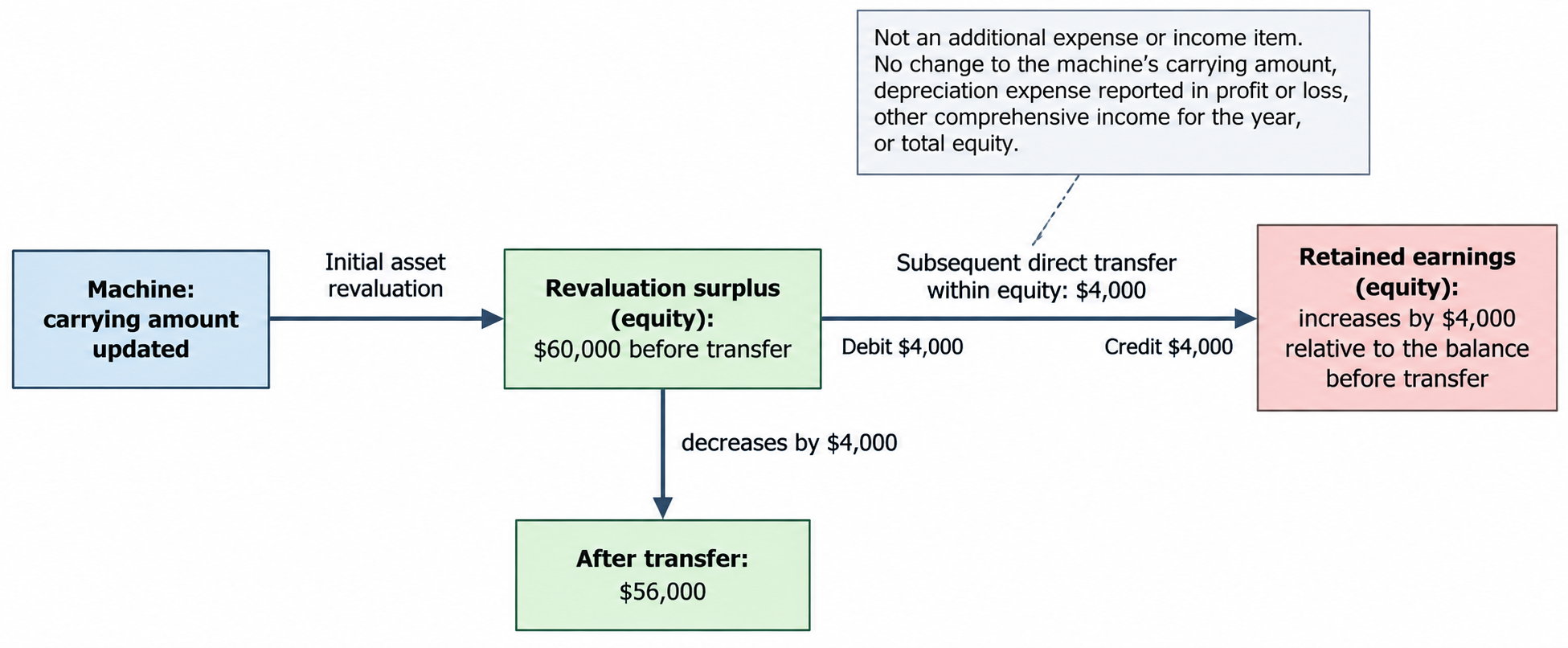
A business may transfer the excess depreciation from the revaluation surplus to retained earnings each year as the asset is used. It is a transfer between two equity accounts, not an expense or income:
| Account | Debit ($) | Credit ($) |
|---|---|---|
| Revaluation surplus | 4,000 | |
| Retained earnings | 4,000 |
The surplus falls from $60,000 to $56,000. The transfer does not change the machine's carrying amount, the depreciation expense, other comprehensive income for the year or total equity.
Closing balances
Assume opening retained earnings are $200,000 and nothing else moves in the year. Closing retained earnings are $200,000 − $10,000 depreciation + $4,000 transfer = $194,000.
| Section | Item | 31 December 20X6 ($) |
|---|---|---|
| Non-current assets | Machine: revalued amount less accumulated depreciation | 140,000 |
| Equity | Revaluation surplus | 56,000 |
| Equity | Retained earnings | 194,000 |
The $60,000 gain is in other comprehensive income and the $10,000 depreciation is in profit or loss, so together they raise total equity by $50,000. As a check, the surplus and retained earnings total $56,000 + $194,000 = $250,000, which is $50,000 more than the opening $200,000.
The transfer does not cut the depreciation expense to $6,000. The expense stays at $10,000. Retained earnings fall by a net $6,000 only because the $10,000 expense reduces profit and the $4,000 transfer adds back directly within equity.
When a revalued asset falls in value
A fall in value first uses up any surplus that asset already has, through other comprehensive income. Any fall beyond that surplus is an expense in profit or loss.
Worked example
This is a separate asset, not the machine above. It has a recorded gross amount of $120,000, accumulated depreciation of $30,000 and an existing revaluation surplus of $20,000 for that asset. It is revalued to $65,000. How is the fall recorded?
- Carrying amount before the revaluation: $120,000 − $30,000 = $90,000.
- Decrease: $90,000 − $65,000 = $25,000.
- The first $20,000 reduces this asset's surplus through other comprehensive income.
- The remaining $25,000 − $20,000 = $5,000 is an expense in profit or loss.
| Account | Debit ($) | Credit ($) |
|---|---|---|
| Accumulated depreciation | 30,000 | |
| Revaluation surplus | 20,000 | |
| Revaluation loss: profit or loss | 5,000 | |
| Asset account | 55,000 |
After this entry, the asset account is $120,000 − $55,000 = $65,000, accumulated depreciation is zero and the surplus for this asset is used up.
Disposal of a revalued asset
On disposal, the gain or loss is worked out from the carrying amount based on the revalued amount, not the original cost. What is left of that asset's surplus may then be transferred straight to retained earnings. That transfer is not part of the gain and does not go through profit or loss.
Worked example
This is a different asset again. A business sells equipment that it revalued earlier. The equipment is recorded at a valuation of $60,000, with accumulated depreciation since the revaluation of $18,000. The cash proceeds are $45,000, and the remaining revaluation surplus for this equipment is $20,000. What is the result on disposal, and what are the journals?
- Carrying amount, using the recorded valuation: $60,000 − $18,000 = $42,000.
- Gain on disposal: $45,000 − $42,000 = $3,000.
- Remove the equipment and record the sale through the disposal account:
| Entry | Debit | Credit | Amount ($) |
|---|---|---|---|
| Remove recorded valuation | Disposal account | Equipment | 60,000 |
| Remove accumulated depreciation | Accumulated depreciation | Disposal account | 18,000 |
| Record cash proceeds | Bank | Disposal account | 45,000 |
| Transfer gain on disposal | Disposal account | Profit or loss | 3,000 |
- Transfer the remaining surplus within equity: debit revaluation surplus $20,000, credit retained earnings $20,000.
- Check: the disposal account has debits of $60,000 + $3,000 = $63,000 and credits of $18,000 + $45,000 = $63,000, so it clears. The $20,000 transfer changes the make-up of equity, not the $3,000 gain.
Only the surplus that belongs to the asset sold is transferred. A surplus on any other asset stays where it is.
Revaluation surplus in the ACCA FA and K1 syllabuses
Revaluation sits in the section on recording transactions and events in both syllabuses, and the surplus is also named among the components of equity.
| Topic | FA | K1 |
|---|---|---|
| Recording a revaluation | D4(g) "Record the revaluation of a tangible non-current asset in the general ledger accounts and illustrate how it is presented in the statement of profit or loss and other comprehensive income and in the statement of financial position." | C5(h) "Calculate the revaluation of a tangible non-current asset and prepare journal entries to account for this." |
| Disposal of a revalued asset | D4(h) "Calculate the gain or loss on disposal of a revalued tangible non-current asset." | C5(i) "Calculate the gain or loss on the disposal of a revalued tangible non-current asset and prepare journal entries to account for this." |
| Excess depreciation | D5(e) "Calculate and update the general ledger accounts to record the depreciation on a revalued tangible non-current asset, including the transfer of excess depreciation between the revaluation surplus and retained earnings." | C5(j) "Calculate the transfer of excess depreciation between the revaluation surplus and retained earnings and prepare journal entries to account for this." |
You can read both documents in full: the FA syllabus for September 2026 to June 2027, and the K1 syllabus for July 2027 to August 2028. For how other comprehensive income fits into equity as a whole, see our accounting equation page.
FA and K1 are both two-hour computer-based exams: 35 two-mark objective test questions in Section A and two 15-mark multi-task questions in Section B. The pass mark is 50%. The two exams are the FA exam of the current ACCA Qualification, and K1 Financial Accounting in the future ACCA Qualification, on demand from July 2027. A pass in FA gives credit for K1. Everything else about the exam is on our ACCA FA exam page.
Every topic on this page is in both syllabuses.
Revaluation reserve practice questions (ACCA FA and K1)
The two practice questions below are from Medly's ACCA K1 Financial Accounting course, and the answers follow Medly's mark schemes. Try each one before you open the answer. Question 1 asks for the gain on a revaluation, and Question 2 for the surplus after the year's transfer.
Question 1: (2 marks)
Halcyon Co purchased a freehold warehouse on 1 January 20X1 for $800,000. The warehouse had an estimated useful life of 40 years and a nil residual value. Halcyon Co depreciated it on a straight-line basis and had recognised no impairment loss.
On 1 January 20X6, the warehouse was revalued to its fair value of $910,000. Halcyon Co recorded the revaluation by adjusting the asset cost account and removing accumulated depreciation against the revaluation surplus.
What is the revaluation gain recognised in other comprehensive income and credited to the revaluation surplus on 1 January 20X6? State your answer in dollars.
Answer
$210,000.
- Annual depreciation: $800,000 ÷ 40 = $20,000.
- Years from 1 January 20X1 to 1 January 20X6: 5, so accumulated depreciation is 5 × $20,000 = $100,000.
- Carrying amount before the revaluation: $800,000 − $100,000 = $700,000. This earns the first mark.
- Revaluation gain: $910,000 − $700,000 = $210,000. The second mark needs this exact figure.
The same answer comes from the journal: the cost account rises by $910,000 − $800,000 = $110,000, and removing $100,000 of accumulated depreciation adds the rest, so $110,000 + $100,000 = $210,000. Comparing the valuation with the original cost gives only $110,000.
Question 2: (2 marks)
Meridian Co purchased a factory building for $600,000. The building had an estimated useful life of 30 years and a nil residual value. Meridian Co depreciates the building on a straight-line basis. On 1 January 20X7, the building was revalued to $760,000, with 20 years of useful life remaining. The revaluation created a surplus of $360,000. Meridian Co transfers excess depreciation from the revaluation surplus to retained earnings each year.
What amount should Meridian Co report in its revaluation surplus at 31 December 20X7 after the annual transfer? State your answer as a whole number in $.
Answer
$342,000.
- Depreciation on the revalued amount: $760,000 ÷ 20 = $38,000.
- Depreciation on the original cost: $600,000 ÷ 30 = $20,000.
- Excess depreciation: $38,000 − $20,000 = $18,000. This earns the first mark. Dividing the surplus by the remaining life gives the same figure: $360,000 ÷ 20 = $18,000.
- Closing revaluation surplus: $360,000 − $18,000 = $342,000. The second mark needs this exact figure.
The transfer reduces the surplus; it does not reduce the $38,000 depreciation expense.
Medly's ACCA K1 Financial Accounting course has lessons for every topic of the course and full-length practice papers, with answers marked step by step. It is free to start, with no card needed.
Frequently asked questions
Is the revaluation reserve the same as the revaluation surplus?
They are two names for the same balance in equity. UK company law calls it the revaluation reserve, and ACCA's FA and K1 syllabuses call it the revaluation surplus.
What is the journal for a revaluation?
Debit the asset account with the increase from cost to valuation, debit accumulated depreciation to remove it, and credit the revaluation surplus with the gain. For a machine costing $120,000 with $30,000 accumulated depreciation, revalued to $150,000, that is debits of $30,000 and $30,000 and a credit of $60,000.
Is a revaluation gain profit?
No. An upward revaluation is recognised in other comprehensive income and builds up in the revaluation surplus. The exception is a gain that reverses an earlier decrease charged to profit or loss, which goes to profit or loss up to that earlier decrease.
What is excess depreciation?
It is depreciation on the revalued amount less depreciation on the original cost. A business may transfer it each year from the revaluation surplus to retained earnings.
What happens to the revaluation surplus when the asset is sold?
The surplus left for that asset may be transferred straight to retained earnings. The transfer is not part of the gain on disposal and does not go through profit or loss.
Can the revaluation surplus go down?
Yes. It falls when the asset's value falls, when excess depreciation is transferred to retained earnings and when the remaining surplus is transferred on the asset's sale.