
The accounting equation: assets, liabilities and equity explained, with examples and practice questions for ACCA FA and K1
Learn what each term means, see how transactions and profit change the equation, and link it to the statement of financial position.
On this page
The accounting equation says that a business's assets equal its liabilities plus its equity. What the business controls is matched by what it owes to others and by the owners' remaining interest. Every correctly recorded transaction keeps the two sides equal, though not every transaction changes both sides. This guide explains each term, works the equation through a sole trader's transactions, shows how profit, dividends and share issues change equity, and ends with four practice questions.
What is the accounting equation?
The accounting equation expresses the relationship between a business's resources and the claims against those resources:
Assets = Liabilities + Equity
Each term has a precise meaning:
- An asset is a present economic resource controlled by the entity as a result of past events. Cash and equipment used by the business are examples.
- A liability is a present obligation to transfer an economic resource as a result of past events. A loan the business owes is an example, and so are trade payables, the amounts owed to suppliers for purchases on credit.
- Equity is the residual interest in the entity's assets after deducting its liabilities. It is the owners' interest in the business.
Rearranged, equity equals assets less liabilities. That makes equity a calculated amount: it is not a separate fund of cash sitting somewhere in the business. If liabilities are larger than assets, equity is negative. The equation does not require equity to be positive.
For a sole trader, equity is commonly described as capital. This guide uses the word equity throughout.
The business entity concept: whose assets count
The business entity concept treats a business as separate from its owners for accounting purposes. The records cover the business's resources, obligations and transactions, and leave out the owner's personal affairs. That boundary has to be drawn before the equation is applied.
The separation applies whatever the business's legal form. A sole trader's business has no legal identity apart from its owner, but its accounts still keep business transactions apart from personal ones. A sole trader cannot put a private house in the business records just because the same person owns both.
Two owner transactions change equity without being income or expenses:
- Capital is the owner's investment in the business, in cash or in another asset such as equipment. Capital introduced is not income earned by the business.
- Drawings are cash or other assets taken out by the owner for personal use. They reduce the owner's interest and are not business expenses.
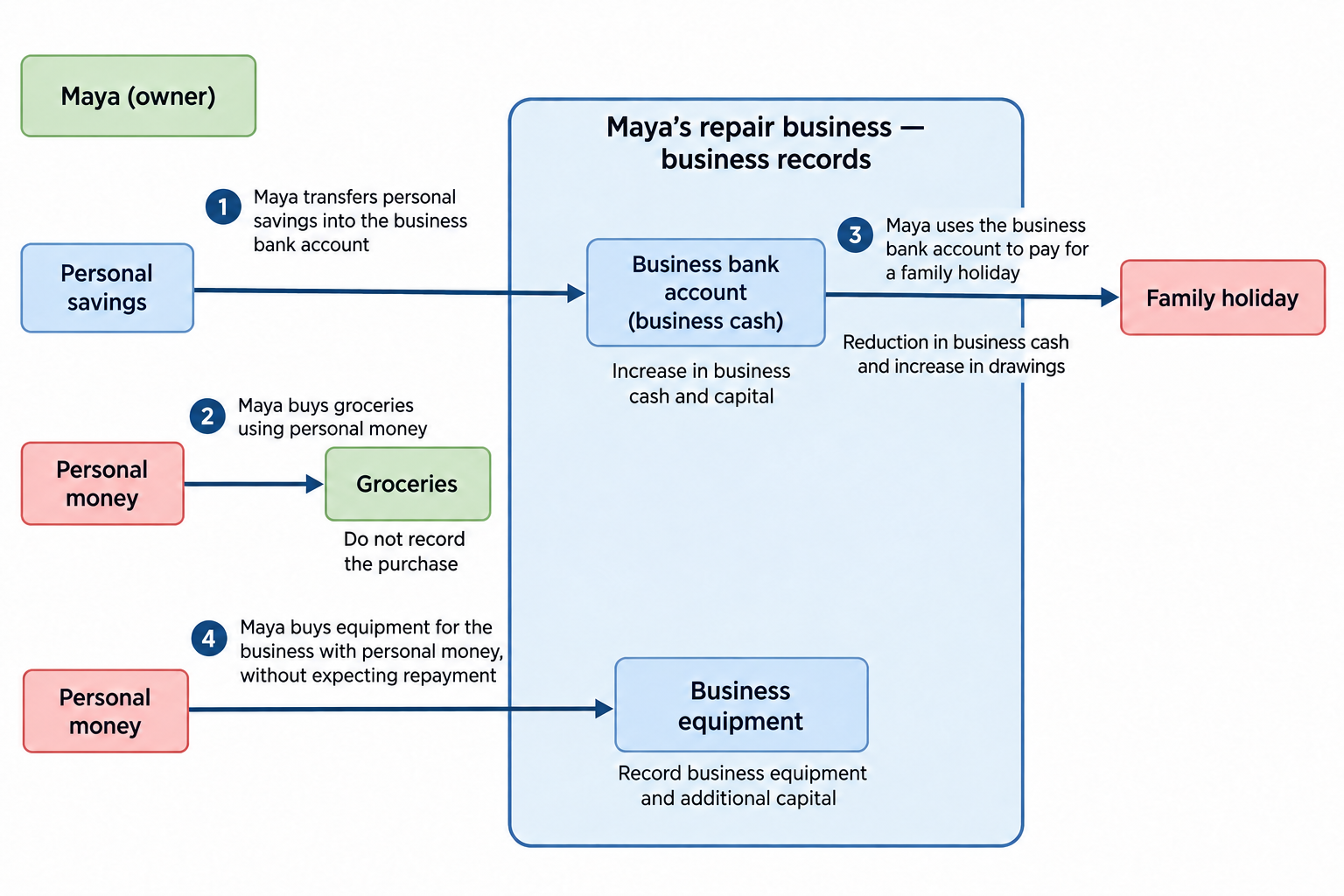
A transaction belongs in the business records when it changes the business's resources, its obligations or the owner's interest. Who made the payment does not decide it on its own. Maya, a sole trader who runs a repair business, shows how this works.
| Transaction | Treatment in the business records | Reason |
|---|---|---|
| Maya transfers personal savings into the business bank account | Record an increase in business cash and capital | The owner has invested resources in the business |
| Maya buys groceries using personal money | Do not record the purchase | Neither business resources nor the owner's investment changes |
| Maya uses the business bank account to pay for a family holiday | Record a reduction in business cash and an increase in drawings | Business resources have been withdrawn for personal use |
| Maya buys equipment for the business with personal money, without expecting repayment | Record business equipment and additional capital | The owner has contributed an asset to the business |
The holiday cannot be left out because its purpose was personal: it reduced business cash. The equipment cannot be left out because the business bank account was not used: the business received an asset.
Duality: why the accounting equation always balances
Duality is the principle that every transaction has two-sided, balanced effects on the accounts. Something else always explains the source, the use or the matching obligation, so a correctly recorded transaction keeps assets equal to liabilities plus equity.
Equipment bought on credit gives the business equipment and an obligation to pay the supplier. Paying that supplier later reduces both cash and the obligation. Two-sided does not mean exactly two accounts: a purchase paid partly in cash and partly on credit changes equipment, cash and the amount owed, and the combined effects still balance.
Every correctly recorded transaction preserves the equation, but it does not have to increase both sides.
| Transaction | Effect on assets | Effect on liabilities or equity |
|---|---|---|
| Owner contributes cash as capital | Cash increases | Equity increases by the same amount |
| Business buys equipment on credit | Equipment increases | Liabilities increase by the same amount |
| Business buys equipment with cash | Equipment increases and cash decreases equally | No change |
| Business pays an existing supplier liability | Cash decreases | Liabilities decrease by the same amount |
| Owner withdraws business cash | Cash decreases | Equity decreases by the same amount |
A cash purchase of equipment swaps one asset for another. It changes what the assets are made of but not their total, so the equation still holds with liabilities and equity unchanged.
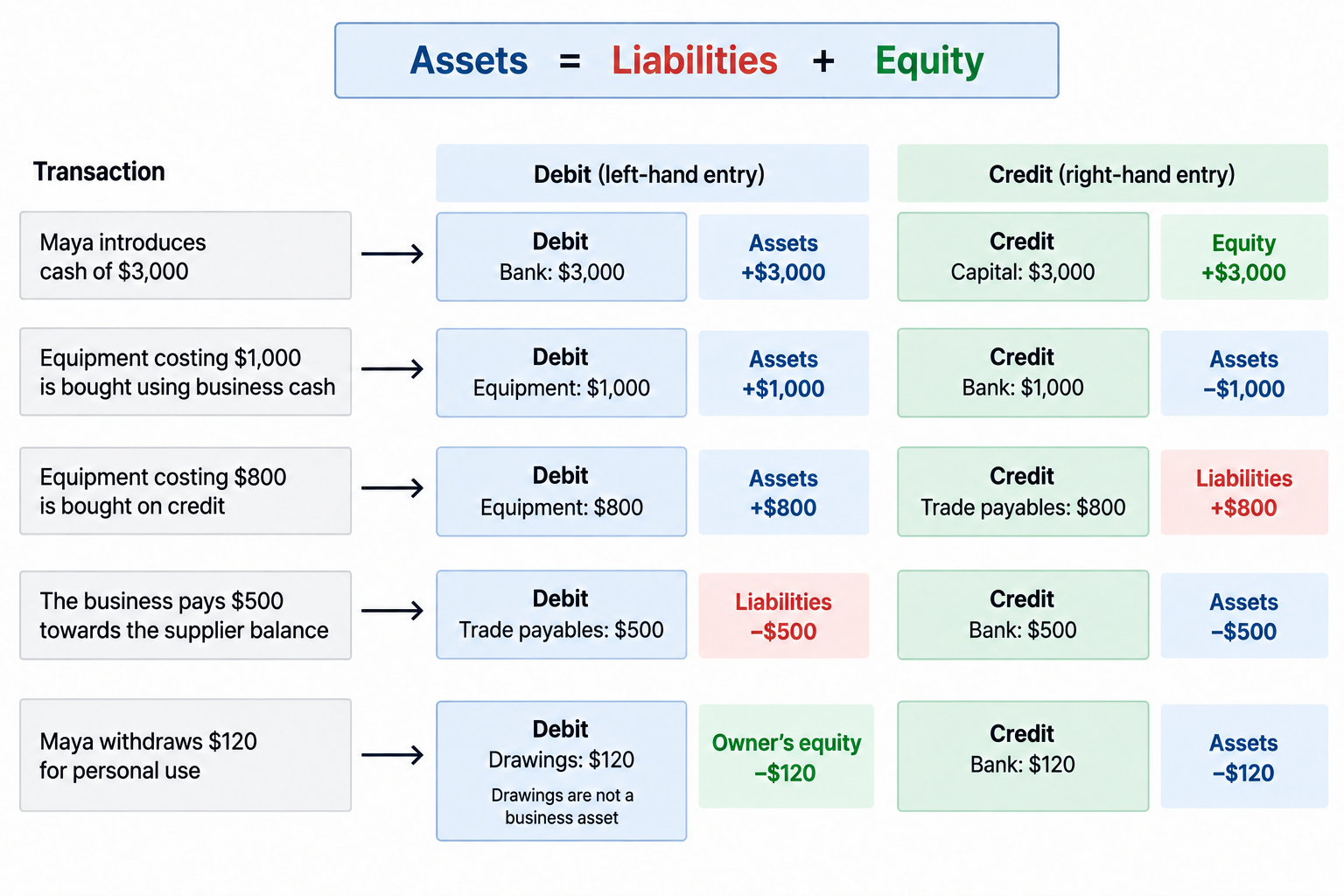
In the ledger, each transaction is recorded with equal debits and credits. The figure shows five transactions of Maya's, a separate set from the worked example below, with their entries and their effect on the equation: she introduces cash of $3,000; equipment costing $1,000 is bought with business cash; equipment costing $800 is bought on credit; the business pays $500 towards the supplier balance; and Maya withdraws $120 for personal use. The rules for which side records an increase belong with double entry and are not repeated here.
Accounting equation example: a sole trader's transactions
The business entity concept decides which transactions go into the records. Duality then makes sure each one that does go in keeps the equation balanced.
Worked example
How do Maya's transactions affect the business records and the closing accounting equation?
| Opening item | Amount |
|---|---|
| Business cash | $6,000 |
| Equipment | $4,000 |
| Trade payables | $2,000 |
| Owner's equity | $8,000 |
The opening equation balances: assets of $6,000 + $4,000 = $10,000 equal liabilities of $2,000 plus equity of $8,000.
During the period there are five transactions, one of which is not the business's. Maya:
- Introduces another $500 of personal savings into the business bank account.
- Buys business equipment for $1,600 using the business bank account.
- Buys personal clothing for $200 using personal cash.
- Pays a personal household bill of $300 from the business bank account.
- Pays $700 towards the existing trade payables.
Step 1: decide what belongs in the business records, then record its balanced effects.
| Transaction | Business entity decision | Debit entry | Credit entry |
|---|---|---|---|
| Additional investment of $500 | Record an owner contribution | Bank: $500 | Capital: $500 |
| Equipment purchase of $1,600 | Record a business asset purchase | Equipment: $1,600 | Bank: $1,600 |
| Personal clothing purchase of $200 | Exclude: only personal resources change | No business entry | No business entry |
| Household bill paid from business cash, $300 | Record drawings, not a business expense | Drawings: $300 | Bank: $300 |
| Supplier payment of $700 | Record settlement of part of the liability | Trade payables: $700 | Bank: $700 |
Step 2: calculate the closing balances.
| Closing item | Working | Closing amount |
|---|---|---|
| Business cash | $6,000 + $500 − $1,600 − $300 − $700 | $3,900 |
| Equipment | $4,000 + $1,600 | $5,600 |
| Trade payables | $2,000 − $700 | $1,300 |
| Owner's equity | $8,000 + $500 − $300 | $8,200 |
Step 3: check the equation.
- Total assets: $3,900 + $5,600 = $9,500.
- Liabilities plus equity: $1,300 + $8,200 = $9,500.
- The equation still balances.
The clothing is left out because it does not affect the business. The household bill is included because it reduced business cash, and recording it as drawings stops personal spending being treated as a business expense.
From the accounting equation to the statement of financial position
The statement of financial position reports an entity's assets, liabilities and equity at a reporting date, such as 31 December 20X5. It is the accounting equation set out at that date.
Three ideas work together behind it. The business entity concept identifies whose items are reported. IFRS Accounting Standards govern how they are treated: whether and when an item is included (recognition), the amount it is reported at (measurement), and how it is classified and shown (presentation). The accounting equation then expresses the relationship between the resulting assets, liabilities and equity.
The equation alone cannot tell you the right amount for an asset, or whether a gain belongs in profit or loss or in other comprehensive income. Those decisions need the accounting standards. Because the standards involve estimates and judgement, the reported position is not necessarily what the whole business could be sold for.
Worked example
At 31 December 20X4, a company reports assets of $80,000 and liabilities of $30,000. What equity follows from the accounting equation?
- Equity equals assets less liabilities.
- Equity = $80,000 − $30,000 = $50,000.
- Set out the relationship: $80,000 = $30,000 + $50,000.
The $50,000 is neither the company's profit nor its cash balance. The check confirms the arithmetic, but it does not show that each item has been correctly recognised or measured.
How do profit, dividends and share issues change equity?
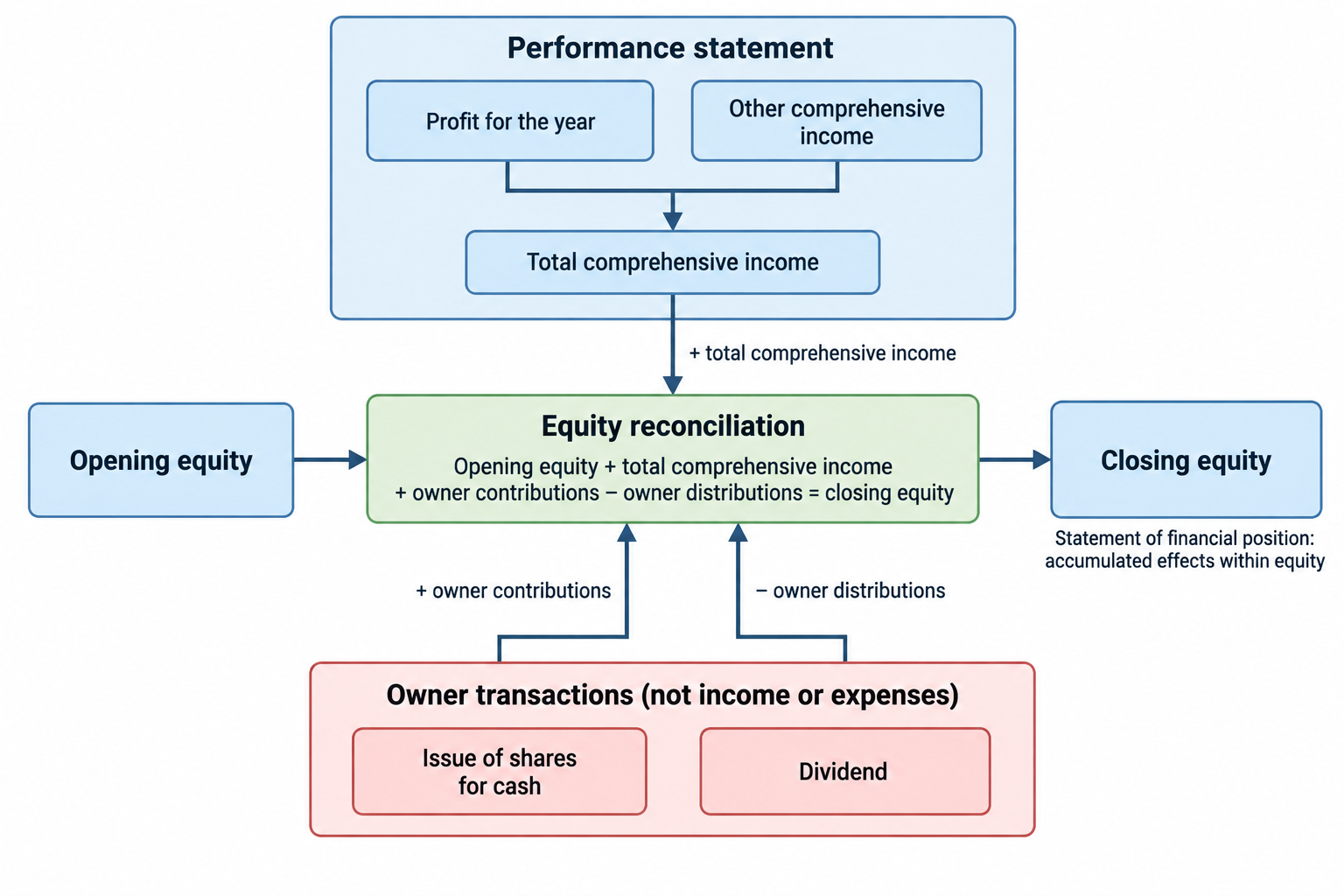
Equity at the end of a year is opening equity plus the year's performance, adjusted for transactions with the owners. Breaking equity down this way is the idea behind the expanded accounting equation: the same equation, with equity split into the things that change it. The FA and K1 syllabuses themselves refer to the accounting equation.
Performance changes equity:
- Profit for the period increases retained earnings, the accumulated profits kept within equity. A loss reduces them.
- Other comprehensive income also changes equity but is not part of profit. A property revaluation gain is normally reported in other comprehensive income and built up in a revaluation surplus within equity.
- Profit or loss and other comprehensive income together form total comprehensive income.
Transactions with owners change equity without being income or expenses:
- An issue of shares for cash increases the company's assets and its contributed equity. It does not create profit.
- A dividend is a distribution to shareholders. It reduces equity and is not an expense in working out profit.
- For a sole trader, capital introduced increases equity and drawings reduce it.
Worked example
How does the company's equity change during the year ended 31 December 20X5?
| Equity balance or movement | Amount |
|---|---|
| Opening equity at 1 January 20X5 | $50,000 |
| Profit for the year | $12,000 |
| Property revaluation gain recognised in other comprehensive income | $8,000 |
| Cash received from issuing shares | $5,000 |
| Dividends recognised as distributions during the year | $3,000 |
- Total comprehensive income: $12,000 + $8,000 = $20,000.
- Closing equity: $50,000 + $20,000 + $5,000 − $3,000 = $72,000.
- By component: profit adds $12,000 to retained earnings and dividends take away $3,000, a net increase of $9,000. The revaluation gain adds $8,000 to the revaluation surplus. The share issue adds $5,000 to contributed equity.
- Check: the total increase of $22,000 is comprehensive income of $20,000 plus net owner contributions of $2,000.
Closing equity at 31 December 20X5 is $72,000.
A reader who sees equity rise from $50,000 to $72,000 cannot conclude that the company made a $22,000 profit. Profit was $12,000. The rest of the rise came from the $8,000 revaluation gain in other comprehensive income and $2,000 of net owner contributions. Closing equity on its own does not show the year's profit, because it also carries earlier years, other comprehensive income and owner transactions.
A balanced accounting equation is necessary, but it is not proof that the financial statements are correct. Wrong measurements, omitted transactions or a personal payment recorded as a business expense can all leave assets equal to liabilities plus equity. In the same way, totals that agree on a trial balance do not prove the records are right.
The accounting equation in the ACCA FA and K1 syllabuses
The accounting equation is in both ACCA Financial Accounting syllabuses: the FA exam of the current ACCA Qualification, and K1 Financial Accounting in the future ACCA Qualification, on demand from July 2027. A pass in FA gives credit for K1. How the two qualifications fit together is in our ACCA exams guide.
| Exam | Syllabus references | What they ask |
|---|---|---|
| FA | C1(c); B1(a)(vii) and (viii); G1(a); G2(e) | "Explain and apply the accounting equation"; define and apply duality and business entity; "Explain how the accounting equation, IFRS Accounting Standards and the business entity concept underlie the statement of financial position"; "Explain the interrelationship between the statement of financial position and the statement of profit or loss and other comprehensive income" |
| K1 | B1(d); A6(a)(vii) and (viii); F1(a); F2(a) | "Explain and apply the accounting equation"; explain and apply duality and business entity; "Explain how the accounting equation, IFRS Accounting Standards and the business entity concept underlie the statement of financial position"; "Explain the relationship between the statement of financial position and the statement of profit or loss and other comprehensive income" |
You can read the full FA syllabus and K1 syllabus on ACCA's site. Both say the questions "will assess all parts of the syllabus".
FA and K1 are both two-hour computer-based exams: 35 two-mark objective test questions in Section A and two 15-mark multi-task questions in Section B. The pass mark is 50%. The exam guide covers everything else about the two exams.
Every topic on this page is in both syllabuses.
Accounting equation practice questions (ACCA FA and K1)
The four practice questions below are from Medly's ACCA K1 Financial Accounting course, and the answers follow Medly's mark schemes. Try each one before you open the answer.
Two of these questions ask how transactions change the accounting equation and the business's records. The other two ask how performance and the equation relate to equity and the statement of financial position.
Question 1: (2 marks)
Northgate Trading purchased office fixtures for $8,500 on 1 June 20X7. It paid $2,500 immediately from its business bank account and agreed to pay the supplier the remaining $6,000 in 30 days. On the same date, the owner paid an existing business trade payable of $1,800 directly from a personal bank account.
Which of the following states the combined effect of these transactions on the accounting equation?
A. Assets increase by $6,000; liabilities increase by $7,800; equity decreases by $1,800.
B. Assets rise by $6,000; liabilities rise by $4,200; equity rises by $1,800.
C. Assets increase by $8,500; liabilities increase by $4,200; equity increases by $4,300.
D. Assets increase by $4,200; liabilities increase by $4,200; equity remains unchanged.
Answer
B. Assets rise by $6,000; liabilities rise by $4,200; equity rises by $1,800.
- Fixtures purchase: fixtures increase by $8,500 and the bank balance falls by $2,500, so total assets increase by $6,000.
- The $6,000 still owed to the supplier increases liabilities by $6,000.
- The owner's personal payment settles $1,800 of business liabilities, so liabilities fall by $1,800. The business's bank account is not used, so assets do not change.
- The owner has paid a business debt from personal funds, which is a contribution to the business: equity increases by $1,800.
- Net effect: liabilities $6,000 − $1,800 = +$4,200; check $6,000 = $4,200 + $1,800.
A reverses the effects of the owner's payment on liabilities and equity. C leaves out the $2,500 fall in the bank balance and makes equity the balancing figure. D treats the owner's personal payment as if it came out of the business bank account, instead of as an increase in equity.
Question 2: (2 marks)
Elena operates a wholesale catering supply business as a sole trader. During the month ended 31 March 20X6, she paid $3,400 from the business bank account for a commercial refrigeration unit for the warehouse. She also paid $1,250 from that account for insurance on her private home.
Which of the following entries should be made in the general ledger accounts for these payments?
A. Dr Equipment $3,400; Dr Drawings $1,250; Cr Bank account $4,650
B. Dr Equipment $3,400; Cr Bank account $3,400
C. Dr Bank $4,650; Cr Equipment $3,400; Cr Drawings $1,250
D. Dr Equipment $3,400; Dr Insurance $1,250; Cr Bank account $4,650
Answer
A. Dr Equipment $3,400; Dr Drawings $1,250; Cr Bank account $4,650
- The refrigeration unit is used in the warehouse, so it is a business asset: equipment of $3,400.
- The home insurance is a personal cost paid from business funds, so it is drawings of $1,250, not a business expense.
- Both payments left the business bank account: $3,400 + $1,250 = $4,650.
B leaves out the home insurance payment, although it reduced business cash. C has the debit and credit directions the wrong way round. D treats the home insurance as a business insurance expense, but it is a personal cost.
Question 3: (6 marks)
This question is three two-mark tasks on one scenario. In FA and K1, a multi-task question carries 15 marks.
Cervell Precision Co is a manufacturing company preparing financial statements for the year ended 31 December 20X8.
During the year, the company revalued its freehold factory land and buildings from $1,400,000 to $1,750,000, giving a gain of $350,000. There was no previous revaluation decrease recognised in profit or loss for the property. Profit for the year after all year-end adjustments was $420,000, and ordinary dividends of $95,000 were paid.
Part 1 (2 marks): Which statements about the factory revaluation are correct?
- The gain is reported in other comprehensive income.
- The gain is included in total comprehensive income for the year.
- The gain is credited to revenue in profit or loss.
- The gain is excluded from the statement of profit or loss and other comprehensive income.
A. 2 and 3 only
B. 1 and 2 only
C. 3 and 4 only
D. 1 and 4 only
Part 2 (2 marks): Which statement describes the effect of the $420,000 profit for the year on Cervell Precision Co's statement of financial position?
A. It increases retained earnings within shareholders' equity.
B. It increases the revaluation surplus.
C. It increases share capital and share premium.
D. It is a current liability pending distribution to shareholders.
Part 3 (2 marks): Which TWO statements describe links between Cervell Precision Co's performance for the year and changes in equity? Select 2 answers.
A. The $350,000 revaluation gain links other comprehensive income to an increase in the revaluation surplus.
B. The $420,000 profit links other comprehensive income to an increase in the revaluation surplus.
C. Total comprehensive income of $770,000 links total recognised performance to an increase in total equity.
D. The $95,000 dividend paid links profit or loss to a reduction in equity.
Answer
Part 1: B (1 and 2 only)
- A revaluation gain on property is reported in other comprehensive income (statement 1).
- Profit and other comprehensive income together form total comprehensive income, so the gain is included in it (statement 2).
A and C include statement 3, which is false: the gain is not revenue. C and D include statement 4, which is false: the gain is in other comprehensive income, which is part of the statement of profit or loss and other comprehensive income.
Part 2: A
- Profit for the year increases retained earnings within equity. Dividends reduce retained earnings separately.
B is wrong because it is the revaluation gain, not the profit, that increases the revaluation surplus. C is wrong because profit does not increase share capital or share premium; those come from share issues. D is wrong because profit is not a liability waiting to be paid out.
Part 3: A and C (both needed for the 2 marks)
- The $350,000 gain is reported in other comprehensive income and increases the revaluation surplus (A).
- Total comprehensive income is $420,000 + $350,000 = $770,000, which links the year's total performance to the increase in equity from changes other than owner transactions (C).
B is wrong because the $420,000 profit is reported in profit or loss and increases retained earnings, not the revaluation surplus. D is wrong because a dividend is a distribution to owners taken directly to equity; it is not an expense in profit or loss.
Question 4: (4 marks)
FA and K1 set two-mark objective test questions and 15-mark multi-task questions, so a four-mark written question like this one is practice, not an exam format.
Hawthorne Co is preparing its statement of financial position at 31 December 20X5. Explain how the accounting equation, IFRS Accounting Standards and the business entity concept underpin this statement. Also explain its relationship with the statement of profit or loss and other comprehensive income.
Explain the foundations of the statement of financial position and its relationship with the statement of profit or loss and other comprehensive income.
Answer
Four marks, one for each of these points. A sentence like each one below earns its mark.
- The accounting equation: "The accounting equation is assets = liabilities + equity, and Hawthorne Co's statement of financial position presents its balances in that relationship." (1 mark)
- The business entity concept: "The business entity concept treats Hawthorne Co as separate from its owners, so the statement reports the company's own assets and liabilities, with the owners' interest shown as equity." (1 mark)
- IFRS Accounting Standards: "IFRS Accounting Standards set the principles and rules for recognising, measuring and presenting the assets, liabilities and equity in the statement." (1 mark)
- The link to the performance statement: "The statement of profit or loss and other comprehensive income reports performance for a period, and the profit and other comprehensive income it reports change the equity shown in the statement of financial position." (1 mark)
Medly's ACCA K1 Financial Accounting course has lessons for every topic of the course and full-length practice papers, with answers marked step by step. It is free to start, with no card needed.
Frequently asked questions
What is the accounting equation?
Assets = Liabilities + Equity. What a business controls is matched by what it owes and by the owners' remaining interest, so equity is always assets less liabilities.
Does the accounting equation always balance?
Yes, for every correctly recorded transaction. A transaction can change both sides, or swap one asset for another and leave the totals unchanged, but the two sides stay equal.
What does equity mean in the accounting equation?
Equity is the residual interest in the assets after deducting liabilities: the owners' interest in the business. It is a calculated amount, not a fund of cash, and it can be negative if liabilities exceed assets.
Are drawings an expense?
No. Drawings are cash or other assets the owner takes out for personal use. They reduce equity, but they are not business expenses and do not reduce profit.
How does profit affect the accounting equation?
Profit increases equity. For a company it increases retained earnings, and for a sole trader it increases capital; a loss reduces them.
Does a balanced accounting equation mean the accounts are right?
No. A wrong amount, a missing transaction or a personal payment recorded as a business expense can still leave assets equal to liabilities plus equity.