
Deferred income and accrued income: journals, examples and ACCA FA practice questions
See why deferred income is a liability and accrued income an asset, post each journal and its reversal, and calculate the year's income.
On this page
Deferred income is cash a business has received for goods or services it has not yet provided, so at the year end it is shown as a liability. Accrued income is income the business has earned in the period but has not yet invoiced or received, so it is shown as an asset. This guide gives the journal for each, shows how both are reversed in the next period, and works out a year's income from opening and closing balances, with three ACCA FA and K1 practice questions.
What is deferred income?
Deferred income is income received before the period in which it is earned. The business still owes the customer the goods or services it has been paid for, so the unearned part of the receipt is a liability at the reporting date.
Under accrual accounting, income belongs to the period in which it is earned, not the period in which the cash arrives. A receipt on its own does not show that income has been earned. If a customer pays in December for a service you will provide in January, the cash is December's but the income is January's.
When the receipt has first been credited to income, the year-end adjustment moves the unearned part out of income and into a liability:
- Debit the income account (income falls).
- Credit deferred income (a liability is created).
Bank does not change, because the cash has already been received. The adjustment changes how the receipt is classified, not the amount of cash held.
What is accrued income?
Accrued income is income earned during the reporting period that has not yet been invoiced or received. The business has earned a right to be paid, so the outstanding amount is an asset at the reporting date.
Rent earned in December belongs in the year ending 31 December even if the tenant pays in January. The absence of a receipt does not stop the income being recognised once it has been earned.
When the income account holds only what has been received, the year-end adjustment adds the amount earned but not yet received:
- Debit accrued income (an asset is created).
- Credit the income account (income rises).
Bank does not change, because the cash has not yet arrived. An amount that has already been invoiced and recorded as a trade receivable needs no accrued-income adjustment: it is in the accounts already.
The same timing questions arise for expenses, as accruals and prepayments. Those are on the accruals and prepayments page.
Accrued income vs deferred income
The two adjustments are mirror images. With accrued income the income comes first and the cash later. With deferred income the cash comes first and the income later.
| At the reporting date | Accrued income | Deferred income |
|---|---|---|
| Timing | Earned before it is invoiced or received | Received before it is earned |
| What is recognised | A right to be paid | An obligation to provide goods or services |
| Statement of financial position | Asset | Liability |
| Year-end journal | Debit accrued income, credit income | Debit income, credit deferred income |
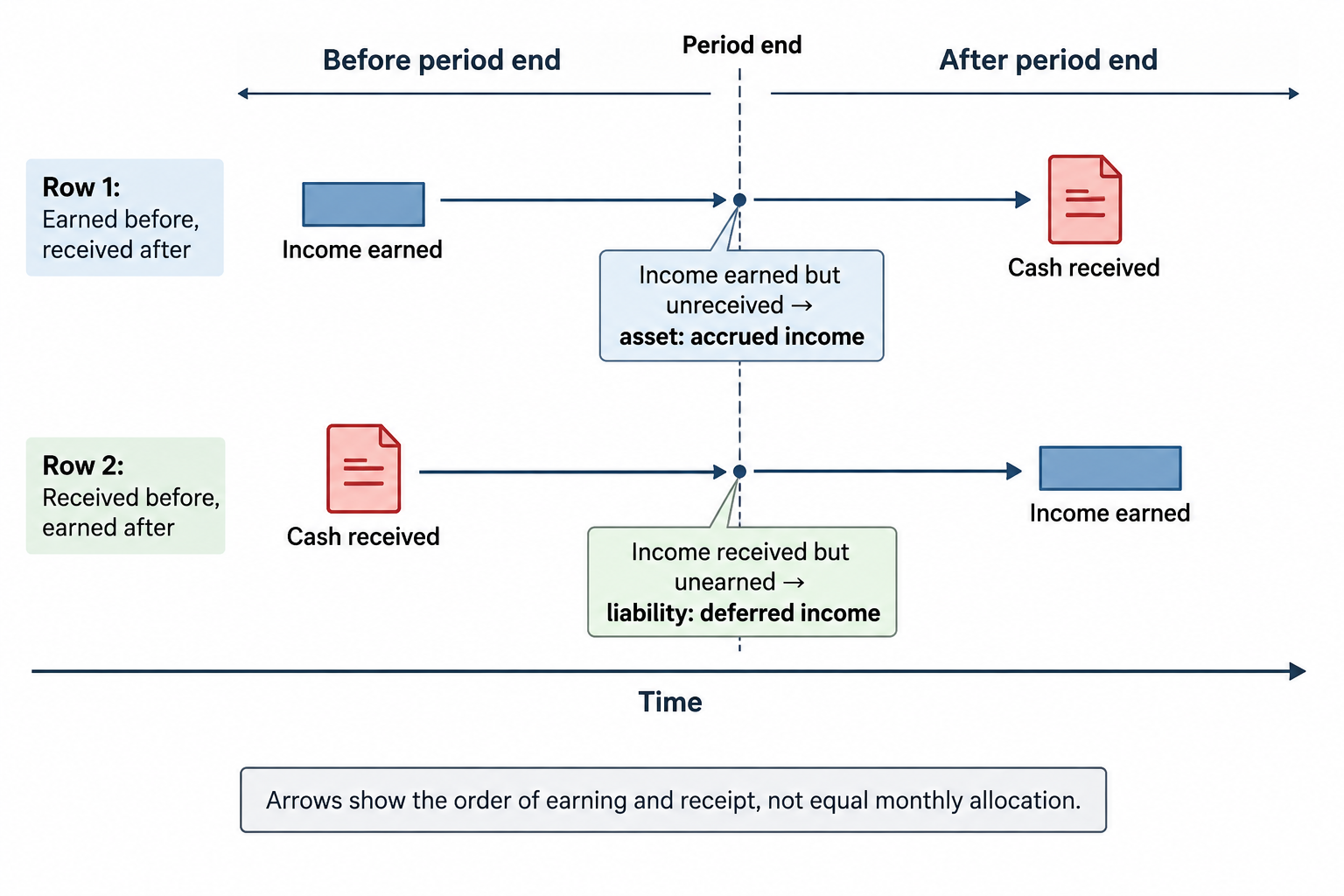
At each period end, work through the same four steps:
- Identify the activity that earns the income and the reporting period it belongs to.
- Classify income earned but not yet invoiced or received as accrued income (an asset), and cash received for income not yet earned as deferred income (a liability).
- Recognise the balance and the matching adjustment to income.
- Measure the adjustment from the contract amount and the part that belongs to the period.
Where income is earned evenly over a stated period, split it by time: a twelve-month contract gives twelve equal monthly amounts. That split is only valid when the income really is earned evenly. The date of the receipt alone does not justify spreading it equally.
Keep the two sides apart in your head. An amount owed by a customer may be accrued income, an asset. An amount owed to a supplier may be an accrued expense, a liability.
Accrued income double entry, with a worked example
The worked examples below assume each receipt was credited to the income account when it arrived. The year-end journal then corrects that account.
Worked example: accrued rental income
A business earns rent of $600 a month evenly through the year ended 31 December 20X5. It has received $6,000, covering January to October. November and December have not yet been invoiced or received. There is no opening accrued income. What rental income and accrued-income asset should it report?
- Closing accrued income: $600 × 2 months = $1,200.
- Income earned in the year: $600 × 12 months = $7,200.
- Check against the cash: $6,000 received + $1,200 accrued = $7,200.
- Report rental income of $7,200 in the statement of profit or loss and an accrued-income asset of $1,200 in the statement of financial position.
The rental income account holds the $6,000 received, so the year-end journal adds the $1,200 earned but not received:
| Account at 31 December 20X5 | Debit | Credit |
|---|---|---|
| Accrued income | $1,200 | |
| Rental income | $1,200 |
The debit creates the asset. The credit brings rental income up to the $7,200 earned. Bank is unchanged.
Reversing accrued income in the next period
The $1,200 asset at 31 December 20X5 is the opening balance for 20X6. A common method reverses it on the first day of the new year:
| Account at 1 January 20X6 | Debit | Credit |
|---|---|---|
| Rental income | $1,200 | |
| Accrued income | $1,200 |
When the tenant pays the $1,200, bank is debited and rental income is credited. That credit cancels the debit from the reversal, so collecting last year's rent does not count as income earned in 20X6. At 31 December 20X6 a fresh adjustment records whatever is earned but unreceived at that date; the old balance is not simply carried forward.
Deferred income double entry, with a worked example
Worked example: deferred maintenance income
A business receives $4,800 on 1 October 20X5 for a twelve-month maintenance service running from 1 October 20X5 to 30 September 20X6. The service is provided evenly. Its reporting date is 31 December 20X5 and there is no opening deferred income. What service income and deferred-income liability should it report?
- Monthly income: $4,800 ÷ 12 = $400.
- Months earned by 31 December: October, November and December, which is three months.
- Income for 20X5: $400 × 3 = $1,200.
- Months still unearned: nine, so deferred income is $400 × 9 = $3,600.
- Report service income of $1,200 in the statement of profit or loss and a deferred-income liability of $3,600 in the statement of financial position.
Check: $1,200 earned + $3,600 unearned = $4,800 received.
The service income account holds the full $4,800, so the journal takes the unearned part out:
| Account at 31 December 20X5 | Debit | Credit |
|---|---|---|
| Service income | $3,600 | |
| Deferred income | $3,600 |
The debit reduces service income to the $1,200 earned in 20X5. The credit creates the liability to provide the remaining nine months of service.
Reversing deferred income in the next period
Under the same reversal method, the opening deferred income is moved back into income on 1 January 20X6:
| Account at 1 January 20X6 | Debit | Credit |
|---|---|---|
| Deferred income | $3,600 | |
| Service income | $3,600 |
In this example the remaining nine months of service are all provided in 20X6, so the $3,600 belongs in that year's income. The reversal is a bookkeeping step, not evidence that the whole balance was earned on 1 January. Anything still unearned at 31 December 20X6 is taken back out with a new closing adjustment.
How to calculate income with opening and closing balances
Two of the practice questions below give you the cash received in the year with opening and closing balances of accrued and deferred income, and ask for the income figure. You can reach it either by reversing the opening balances and recording the full closing balances, or by the movement-only method below. Both give the same answer.
Under the movement-only method, the opening balance stays in the trial balance and is not reversed. The year-end journal posts only the change needed to bring it to the required closing balance:
| Movement from opening to closing balance | Year-end journal for the movement |
|---|---|
| Accrued income increases | Debit accrued income, credit income |
| Accrued income decreases | Debit income, credit accrued income |
| Deferred income increases | Debit income, credit deferred income |
| Deferred income decreases | Debit deferred income, credit income |
In figures:
- The adjustment to income for accrued income is closing accrued income less opening accrued income.
- The adjustment to income for deferred income is opening deferred income less closing deferred income.
Use one method or the other for a balance, never both.
Worked example: Lenvora Co, movement-only method
Lenvora Co's customers pay for services in advance. Receipts are credited to service income, and the opening deferred-income balance has not been reversed. Contract records show how much is still unearned at the year end. What journal and service income does Lenvora Co report for 20X6?
| Information for 20X6 | Amount |
|---|---|
| Opening deferred income at 1 January 20X6 | $2,400 |
| Cash receipts during 20X6 | $12,000 |
| Required closing deferred income at 31 December 20X6 | $3,600 |
- The liability must rise from $2,400 to $3,600: $3,600 − $2,400 = $1,200.
- Debit service income $1,200 and credit deferred income $1,200. The existing $2,400 plus this $1,200 gives the required $3,600.
- Service income: $12,000 − $1,200 = $10,800.
- Check with the reversal method: $12,000 receipts + $2,400 opening deferred income − $3,600 closing deferred income = $10,800.
Lenvora Co reports service income of $10,800 and a deferred-income liability of $3,600 under either method.
Effect on profit, assets and liabilities
If nothing else changes, every change in income is an equal change in profit. For the closing adjustments in the first two worked examples, the accrued rent of $1,200 and the deferred maintenance income of $3,600, the effects are:
| Effect of the closing adjustment | Accrued income of $1,200 | Deferred income of $3,600 |
|---|---|---|
| Income in the statement of profit or loss | Increases by $1,200 | Decreases by $3,600 |
| Profit | Increases by $1,200 | Decreases by $3,600 |
| Assets | Increase by $1,200 | No change |
| Liabilities | No change | Increase by $3,600 |
Net assets move by the same amount as profit: up $1,200 for the accrued income and down $3,600 for the deferred income. FA asks you to identify this impact on profit and net assets.
Both balances are short-term. The accrued rent is a current asset, because it is expected to be collected within the following year, and the deferred maintenance income is a current liability, because the remaining service will be provided within the following year.
Accrued and deferred income in the ACCA FA and K1 syllabuses
Accrued and deferred income are in both ACCA Financial Accounting syllabuses: the FA exam of the current ACCA Qualification, and K1 Financial Accounting in the future ACCA Qualification, on demand from July 2027. A pass in FA gives credit for K1. How the two qualifications fit together is in our ACCA exams guide.
| Exam | Syllabus reference | What it asks |
|---|---|---|
| FA | D7 "Accrued expenses (accruals), prepaid expenses (prepayments), accrued income, and deferred income", (a) to (f) | Apply accrual accounting to them; calculate the adjustments; illustrate the process of adjusting; "Prepare manual journal entries and update the general ledger accounts for the creation and reversal" of each; "Identify the impact … on profit and net assets"; report them in the financial statements |
| K1 | C8 "Accrued expenses (accruals), prepaid expenses (prepayments), accrued income and deferred income", (a) to (d) | Apply the principle of accrual accounting to them; "Calculate the manual adjustments required"; prepare journal entries; "Calculate and explain the impact … on the financial statements" |
You can read the full FA syllabus and K1 syllabus on ACCA's site. Both say the questions "will assess all parts of the syllabus".
FA and K1 are both two-hour computer-based exams: 35 two-mark objective test questions in Section A and two 15-mark multi-task questions in Section B. The pass mark is 50%. The exam guide covers everything else about the two exams.
Every topic on this page is in both syllabuses.
Accrued and deferred income practice questions (ACCA FA and K1)
The three practice questions below are from Medly's ACCA K1 Financial Accounting course, and the answers follow Medly's mark schemes. Try each one before you open the answer.
Question 1: (2 marks)
Horizon Co has a financial year ended 31 December 20X4. On 1 October 20X4, it received $24,000 in advance for a 12-month equipment maintenance contract running to 30 September 20X5. The income is earned evenly over the contract period. Horizon Co credited the full receipt to maintenance income. No year-end adjustment has been made.
Which adjustment and resulting effects on profit and financial position are correct at 31 December 20X4?
A. Dr Maintenance income $18,000; Cr Deferred income $18,000. Reduces profit by $18,000 and increases current liabilities by $18,000.
B. Dr Maintenance income $6,000; Cr Deferred income $6,000. Reduces profit by $6,000 and increases current liabilities by $6,000.
C. Dr Accrued income $6,000; Cr Maintenance income $6,000. Increases profit by $6,000 and increases current assets by $6,000.
D. Dr Deferred income $18,000; Cr Maintenance income $18,000. Increases profit by $18,000 and increases current assets by $18,000.
Answer
A. Both marks go to the complete correct option.
- By 31 December 20X4, three months (October to December) have been earned. Nine months, January to September 20X5, are still unearned.
- Unearned income: 9/12 × $24,000 = $18,000.
- The full receipt was credited to income, so the unearned $18,000 is taken out: debit maintenance income, credit deferred income.
- Income and profit fall by $18,000, and current liabilities rise by $18,000.
B defers $6,000, which is the three months already earned, not the nine still to come. C treats the amount as accrued income, but the cash has already been received and recorded: the problem is income received too early, not income earned and unpaid. D reverses the entry; a debit to deferred income reduces a liability and cannot increase current assets.
Question 2: (2 marks)
A fire-protection company provides maintenance services under customer contracts.
For the year ended 31 December 20X5, it received $360,000 from customers; deferred maintenance income was $24,000 and accrued maintenance income was $9,000 at the start of the year.
The receipts were entered in the maintenance income ledger account.
At the end of the year, deferred maintenance income was $31,000 and accrued maintenance income was $12,000, and no adjustments have been made to the account.
Which of the following amounts should be reported as maintenance income in the financial statements for the year ended 31 December 20X5?
A. $350,000
B. $353,000
C. $356,000
D. $364,000
Answer
C. $356,000
- Start with the cash received: $360,000.
- Add opening deferred income, received last year and earned this year: + $24,000.
- Deduct closing deferred income, received but not yet earned: − $31,000.
- Deduct opening accrued income, earned last year and received this year: − $9,000.
- Add closing accrued income, earned this year and not yet received: + $12,000.
- $360,000 + $24,000 − $31,000 − $9,000 + $12,000 = $356,000.
A gets the deferred income right but reverses both accrued-income adjustments (adding the opening $9,000 and deducting the closing $12,000). B adjusts for deferred income and leaves out the accrued income altogether. D reverses the adjustments for both deferred and accrued income.
Question 3: (2 marks)
Veridian Co sub-lets storage bays and prepares financial statements for the year ended 31 December 20X6. At 1 January, accrued rent was $14,200 and deferred rent was $21,500; these were received and earned, respectively, during 20X6. Cash received from tenants during the year was $186,400 and was entered in the bank general ledger account. At 31 December, rent of $4,900 per month for November and December remained unpaid and unbilled. Receipts included $32,400 received on 1 November for a six-month licence from 1 November 20X6 to 30 April 20X7. Licence income is earned evenly over its term. There were no other opening or closing rental income adjustments.
What is the rental income to be recognised in the company's statement of profit or loss for the year ended 31 December 20X6? State your answer to the nearest whole $.
Answer
$181,900 (enter 181900). Both marks are for the correct figure.
- Cash received: $186,400.
- Add opening deferred rent, earned in 20X6: + $21,500.
- Deduct opening accrued rent, which was last year's income received in 20X6: − $14,200.
- Add closing accrued rent for November and December: 2 × $4,900 = + $9,800.
- Deduct the licence income still unearned at 31 December. January to April 20X7 is four months of six: 4/6 × $32,400 = − $21,600.
- $186,400 + $21,500 − $14,200 + $9,800 − $21,600 = $181,900.
Take care with the licence: only November and December 20X6 (2/6 × $32,400 = $10,800) belong in this year's income, so the other $21,600 comes out of the receipts.
Medly's ACCA K1 Financial Accounting course has lessons for every topic of the course and full-length practice papers, with answers marked step by step. It is free to start, with no card needed.
Frequently asked questions
Is deferred income a liability?
Yes. Deferred income is cash received for goods or services not yet provided, so the business has an obligation to the customer. It is shown as a liability in the statement of financial position until the income is earned.
Is accrued income an asset?
Yes. Accrued income is income earned but not yet invoiced or received, so the business has a right to be paid. It is shown as an asset in the statement of financial position.
What is the double entry for deferred income?
When the receipt has been credited to income, debit the income account and credit deferred income with the unearned part. Bank does not change, because the cash has already been received.
What is the double entry for accrued income?
Debit accrued income and credit the income account with the amount earned but not yet invoiced or received. Bank does not change until the customer pays.
What is the difference between accrued income and deferred income?
The timing of the cash. Accrued income is earned before the cash arrives and is an asset; deferred income is received before it is earned and is a liability.
What happens to accrued and deferred income in the next year?
Under the reversal method, the opening balance is reversed on the first day of the new year, so last year's income is not counted again and this year's income is recognised when earned. A new closing balance is then calculated at the next reporting date.