
Statement of cash flows: format, a full example and practice questions for ACCA FA
See what goes in operating, investing and financing activities, build a whole statement from one question, and practise with marked answers.
On this page
A statement of cash flows shows the cash and cash equivalents a business received and paid during a period, grouped under operating, investing and financing activities. It ends by reconciling the opening cash balance to the closing one. This guide sets out the format the ACCA Financial Accounting (FA) exam uses, builds one complete statement from a 15-mark question, and finishes with four practice questions and their answers.
What is a statement of cash flows?
A statement of cash flows reports the receipts and payments of cash and cash equivalents during an accounting period. It groups them by the activity that produced them and reconciles the opening and closing balances. It is prepared under IAS 7 Statement of Cash Flows.
Its purpose is to show whether a business generates the cash it needs. Investors, lenders and suppliers want to know whether there is cash to pay employees, settle suppliers, repay borrowings and make payments to owners, and reported profit alone does not tell them that. Because the statement separates cash from ordinary trading from cash raised through borrowing or from owners, it also shows where a healthy bank balance came from.
Three definitions decide what counts as cash in the statement:
- Cash is cash on hand and demand deposits: bank balances that can be withdrawn when required.
- Cash equivalents are short-term investments that are highly liquid. They convert readily into a known amount of cash, and the risk of a change in their value is insignificant. An investment normally qualifies only if it matures within three months of being acquired, so an investment in ordinary shares would not normally count.
- A bank overdraft that is repayable on demand and forms part of day-to-day cash management is included in cash and cash equivalents as a negative amount.
Moving money between a bank account and a cash equivalent changes what the balance is made of, not its total, so it is not a cash flow.
Why profit is not the same as cash
Profit is measured on the accruals basis: income and expenses are recognised in the period they relate to, which is not always the period in which cash moves. The statement of cash flows reports only the receipts and payments themselves.
| Transaction | Effect on profit | Effect on cash |
|---|---|---|
| Credit sale, not yet paid by the customer | Revenue is recognised when earned | No receipt until the customer pays |
| Expense incurred but not yet paid | Reduces profit in the period it relates to | No payment until it is settled |
| Depreciation charged on equipment | Reduces profit | No cash flow at all |
| Equipment bought for cash | Recorded as an asset, not an expense | Investing outflow |
| Cash received from a new loan | No income arises | Financing inflow |
So the differences come from three places: income and expenses recognised before or after the cash moves, expenses such as depreciation that involve no payment, and cash movements such as asset purchases and borrowing that are not income or expenses at all. A profitable business can still show weak operating cash flow if its customers have not yet paid.
In the operating section, the indirect method starts from operating profit and reverses these differences: it adds back non-cash charges, removes disposal gains and losses, and adjusts for the movements in inventories, receivables and payables. The indirect method guide takes each adjustment in turn and explains its direction.
The three sections: operating, investing and financing activities
Every cash flow goes into one of three sections. Operating activities are the business's main revenue-producing activities, plus anything that is not investing or financing. Investing activities are buying and selling long-term assets and investments that are not cash equivalents. Financing activities are those that change the size and make-up of the business's contributed equity and borrowings.
| Section | Cash inflows | Cash outflows |
|---|---|---|
| Operating | Receipts from customers, including settlement of trade receivables | Payments to suppliers and employees; rent and other operating expenses; income tax on ordinary operations (normally) |
| Investing | Proceeds from selling equipment and other long-term assets; proceeds from selling investments that are not cash equivalents; interest received; dividends received from investments by an ordinary trading entity | Purchase of equipment and other long-term assets; purchase of investments that are not cash equivalents |
| Financing | Proceeds from issuing shares; cash from a new loan; cash a sole trader pays into the business | Repayment of loan principal; dividends paid to shareholders; interest paid; cash a sole trader withdraws |
Interest has a fixed place in the FA exam. For an ordinary company, interest received is reported only in investing activities, and interest paid only in financing activities. FA has examined this format, including operating profit as the starting point of the indirect method, since September 2025. Where a question on this page says how a company classifies its interest, it is where this format puts it.
Each section can contain both receipts and payments, and its total is the inflows less the outflows. A transaction that moves no cash stays out of the statement, even when it changes the statement of financial position: equipment bought on credit (until it is paid for), a bonus issue of shares, a loan converted into shares or an upward revaluation of land.
Read each section for what it says about the business. Spending on equipment reduces cash now but may support future trading, so an investing outflow is not a bad sign in itself. A financing inflow can keep a business paying its bills while its operations generate little cash, which is why the source of an increase in cash matters as much as its size.
Statement of cash flows format
The statement lists operating activities first, then investing, then financing, and ends with the movement in cash and cash equivalents. The table shows the lines in order, as this page uses them. Brackets in a statement show an outflow.
| Section | Line | What goes in it |
|---|---|---|
| Operating | Operating profit | The starting point of the indirect method |
| Operating | Add depreciation and amortisation | Charges that reduced profit without a cash payment |
| Operating | Deduct gain on disposal, or add loss on disposal | Disposal results included in operating profit |
| Operating | Increase or decrease in inventories, trade receivables and trade payables | Timing differences between profit and cash |
| Operating | Cash from operating activities before income taxes | The operating subtotal |
| Operating | Income taxes paid | Tax actually paid in the year |
| Operating | Net cash from operating activities | The section total |
| Investing | Purchase of property, plant and equipment | Cash paid for additions |
| Investing | Proceeds from disposal of equipment | Cash received from the sale, not the gain |
| Investing | Interest received | Cash received, not interest accrued |
| Investing | Net cash used in investing activities | The section total |
| Financing | Proceeds from issue of shares | Share capital and share premium together |
| Financing | Proceeds from borrowings | Cash from new loans |
| Financing | Repayment of borrowings | Loan principal repaid |
| Financing | Dividends paid | Cash paid, not the amount charged to retained earnings |
| Financing | Interest paid | Cash paid, not the finance cost charged |
| Financing | Net cash from financing activities | The section total |
| Movement | Net increase in cash and cash equivalents | The three section totals added together |
| Movement | Cash and cash equivalents at the start of the year | Including a qualifying overdraft as a negative amount |
| Movement | Cash and cash equivalents at the end of the year | The opening balance plus the net increase |
Three points about the layout:
- The operating section starts from operating profit. The direct method reaches the same subtotal from cash received and paid instead.
- Income taxes paid come after the subtotal "cash from operating activities before income taxes", the name both syllabuses use.
- Receipts and payments are shown separately, not netted. Buying equipment and selling equipment are two lines, and so are new borrowing and repayments.
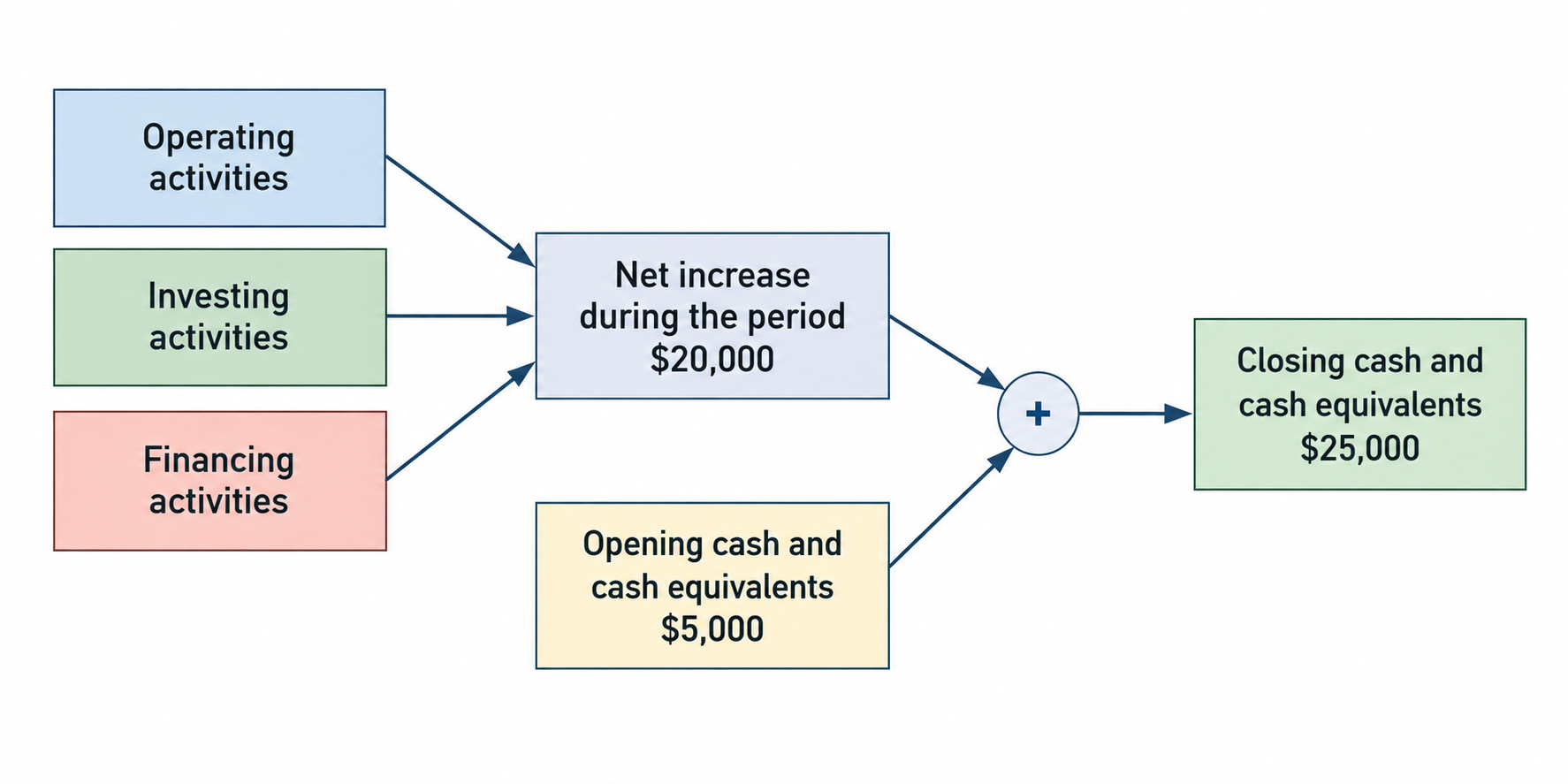
Here is how the three section totals reconcile the cash balance, in the smallest possible case. A sole trader receives $70,000 from customers, pays $45,000 to suppliers and employees, buys equipment for $20,000 and pays $15,000 of their own cash into the business. Opening cash and cash equivalents are $5,000.
| Line | $ |
|---|---|
| Operating activities ($70,000 − $45,000) | 25,000 |
| Investing activities | (20,000) |
| Financing activities | 15,000 |
| Net increase in cash and cash equivalents | 20,000 |
| Opening cash and cash equivalents | 5,000 |
| Closing cash and cash equivalents | 25,000 |
As a check, total receipts of $85,000 less total payments of $65,000 also give $20,000.
Statement of cash flows example: Penderford Co (15 marks)
The worked example below and the four practice questions at the end are from Medly's ACCA K1 Financial Accounting course, and the answers follow Medly's mark schemes. This one builds a whole statement of cash flows in six parts, with all three sections, a revaluation that moves no cash, and an overdraft at the start of the year. Read the question, then follow each part and the finished statement.
Worked example (15 marks)
Penderford Co is preparing its statement of cash flows for the year ended 31 December 20X6. Extracts from its financial statements are shown below.
Statement of profit or loss for the year ended 31 December 20X6
| $'000 | |
|---|---|
| Revenue | 1,800 |
| Cost of sales | (1,080) |
| Gross profit | 720 |
| Operating expenses | (390) |
| Operating profit | 330 |
| Finance costs | (30) |
| Profit before tax | 300 |
| Income tax expense | (70) |
| Profit for the year | 230 |
Statements of financial position at 31 December
| 20X6 $'000 | 20X5 $'000 | |
|---|---|---|
| Property, plant and equipment | 1,260 | 1,000 |
| Inventories | 210 | 180 |
| Trade receivables | 240 | 260 |
| Cash at bank | 40 | nil |
| Share capital ($1 shares) | 500 | 400 |
| Share premium | 150 | 100 |
| Revaluation surplus | 100 | nil |
| Retained earnings | 565 | 415 |
| Loan notes | 200 | 300 |
| Trade payables | 150 | 120 |
| Interest payable | 10 | 5 |
| Income tax payable | 75 | 60 |
| Bank overdraft | nil | 40 |
Additional information:
- Operating expenses include depreciation of $90,000 and a profit of $15,000 on the sale of plant.
- The plant sold had a carrying amount of $50,000.
- Land was revalued upwards by $100,000 during the year.
- Dividends of $80,000 were paid during the year.
- Penderford Co presents interest paid within financing activities.
- All additions to property, plant and equipment were paid in cash, all shares were issued for cash, and the decrease in loan notes was a cash repayment.
- The bank overdraft is repayable on demand and forms an integral part of Penderford Co's cash management.
Part 1 (3 marks): Using the indirect method, what is Penderford Co's cash generated from operations for the year ended 31 December 20X6? Give your answer in $'000.
Part 2 (3 marks): What amount did Penderford Co pay to acquire property, plant and equipment during the year? Give your answer in $'000.
Part 3 (2 marks): What amount of income tax did Penderford Co pay during the year? Give your answer in $'000.
Part 4 (3 marks): What is Penderford Co's net cash outflow from financing activities for the year? Give your answer in $'000.
Part 5 (2 marks): What is Penderford Co's net increase in cash and cash equivalents for the year? Give your answer in $'000.
Part 6 (2 marks): In the statement of cash flows, what is Penderford Co's figure for cash and cash equivalents at 1 January 20X6?
A. ($40,000), the bank overdraft
B. $40,000, the bank overdraft shown as a positive amount
C. ($80,000), the overdraft less the year's increase
D. Nil, because the bank overdraft is a liability
Part 1: cash from operating activities before income taxes, $425,000 (3 marks)
The statement of profit or loss prints operating profit of $330,000. It is the profit before tax of $300,000 with the finance costs of $30,000 added back, so the reconciliation starts from 330.
- Start with operating profit: 330.
- Add depreciation of 90, which reduced profit without a payment.
- Deduct the profit on sale of plant of 15. The cash from the sale is an investing inflow.
- Inventories rose from 180 to 210, so deduct 30.
- Trade receivables fell from 260 to 240, so add 20.
- Trade payables rose from 120 to 150, so add 30.
- 330 + 90 − 15 − 30 + 20 + 30 = 425.
The question calls this subtotal "cash generated from operations". The statement below uses the syllabus name, "cash from operating activities before income taxes". Here the two names mean the same figure. All 3 marks are for the final figure.
Part 2: purchase of property, plant and equipment, $300,000 (3 marks)
- Closing balance 1,260 less opening balance 1,000 = 260.
- Take off the revaluation of 100, which increased the balance without any cash: 160.
- Add back the carrying amount of the plant sold, 50, which left the balance: 210.
- Add back the depreciation of 90, which also reduced the balance: 300.
- Check: 1,000 + 100 + 300 − 50 − 90 = 1,260.
All additions were paid in cash, so the outflow is 300. The 3 marks are for the final figure.
Part 3: income taxes paid, $55,000 (2 marks)
- Opening tax payable 60 plus the year's expense 70 = 130 available to be paid.
- Less the closing payable of 75, still unpaid: 130 − 75 = 55.
The 2 marks are for the final figure.
Part 4: net cash outflow from financing activities, $55,000 (3 marks)
- Proceeds from issue of shares: share capital rose by 500 − 400 = 100 and share premium by 150 − 100 = 50, so 150.
- Repayment of loan notes: 300 − 200 = 100.
- Dividends paid: 80, as given.
- Interest paid: opening payable 5 + finance costs 30 − closing payable 10 = 25.
- 150 − 100 − 80 − 25 = −55, an outflow of 55.
The 3 marks are for the final figure.
Part 5: net increase in cash and cash equivalents, $80,000 (2 marks)
- Net cash from operating activities: 425 − 55 = 370.
- Proceeds from sale of plant: carrying amount 50 + profit 15 = 65.
- Net cash used in investing activities: 300 − 65 = 235.
- Net increase: 370 − 235 − 55 = 80.
- Check: cash and cash equivalents moved from an overdraft of 40 to cash at bank of 40, an increase of 80.
The 2 marks are for the final figure.
Part 6: A, ($40,000) (2 marks)
The overdraft is repayable on demand and part of Penderford Co's cash management, so it is included in cash and cash equivalents as a negative amount. B shows it as positive, which would treat money owed to the bank as cash held. C takes the year's increase from the opening figure, but the increase changes the closing figure. D leaves the overdraft out, although a qualifying overdraft belongs in cash and cash equivalents.
The finished statement
Penderford Co: statement of cash flows for the year ended 31 December 20X6
| Line | $'000 |
|---|---|
| Operating profit | 330 |
| Depreciation | 90 |
| Profit on sale of plant | (15) |
| Increase in inventories | (30) |
| Decrease in trade receivables | 20 |
| Increase in trade payables | 30 |
| Cash from operating activities before income taxes | 425 |
| Income taxes paid | (55) |
| Net cash from operating activities | 370 |
| Purchase of property, plant and equipment | (300) |
| Proceeds from sale of plant | 65 |
| Net cash used in investing activities | (235) |
| Proceeds from issue of shares | 150 |
| Repayment of loan notes | (100) |
| Dividends paid | (80) |
| Interest paid | (25) |
| Net cash used in financing activities | (55) |
| Net increase in cash and cash equivalents | 80 |
| Cash and cash equivalents at 1 January 20X6 | (40) |
| Cash and cash equivalents at 31 December 20X6 | 40 |
The revaluation of $100,000 does not appear anywhere in the statement, because no cash moved. The closing figure of 40 agrees with the cash at bank in the statement of financial position.
Statement of cash flows in the ACCA FA and K1 syllabuses
The statement of cash flows is section G5 of the FA syllabus and section F3 of the K1 syllabus. It is examined in the FA exam of the current ACCA Qualification, and K1 Financial Accounting in the future ACCA Qualification, on demand from July 2027. A pass in FA gives credit for K1.
| Exam | Reference | What it asks |
|---|---|---|
| FA | G5 (a) to (c) | "Differentiate between profit and cash flow", "Describe the need for management to control cash flow" and "Explain the benefits and drawbacks to users of the financial statements of a statement of cash flows" |
| FA | G5 (d) to (g) | "Classify the effect of transactions on cash flows"; calculate the operating, investing and financing figures, using "direct and indirect methods for calculating cash from operating activities before income taxes"; "Prepare a statement of cash flows or extracts as applicable"; "Identify the treatment of given transactions in a statement of cash flows" |
| K1 | F3 (a), (b) | "Explain the difference between profit/loss and cash flows" and the advantages and disadvantages to users of analysing the statement of cash flows alongside the statement of profit or loss |
| K1 | F3 (c), (d) | "Explain the effect of accounting transactions on cash flows and summarise their treatment in the statement of cash flows", and prepare a statement of cash flows or extracts using both the direct and indirect methods for cash from operating activities before income taxes |
You can read both in full in the FA syllabus and the K1 syllabus.
FA and K1 are both two-hour computer-based exams: 35 two-mark objective test questions in Section A and two 15-mark multi-task questions in Section B. The pass mark is 50%.
Both syllabuses say the questions "will assess all parts of the syllabus". FA's syllabus says the Section B questions "will test consolidations and accounts preparation", and that the accounts preparation question "could be set in the context of a sole trader or a limited company". For K1, one Section B question "will examine syllabus section F: Preparing individual financial statements", the section that contains the statement of cash flows. The FA exam guide covers the rest of the format and the move to K1.
Every topic on this page is in both syllabuses.
Statement of cash flows practice questions (ACCA FA and K1)
Try each one before you open the answer. One asks which flows are investing, one the net movement and closing cash, one an investing total and one a financing total.
Question 1: (2 marks)
Crestline Co is preparing its financial statements for the year ended 31 March 20X6. The following transactions were entered in its bank general ledger account during the year.
| Date | Transaction | Amount |
|---|---|---|
| 30 April 20X5 | Cash received from credit customers for sales of goods | $145,000 |
| 30 June 20X5 | Cash paid to acquire new warehouse machinery | $62,000 |
| 30 September 20X5 | Cash proceeds from the sale of office equipment | $8,500 |
| 31 January 20X6 | Cash proceeds from the issue of ordinary shares | $50,000 |
Which TWO of these transactions are reported as investing activities in the statement of cash flows? Select 2 answers.
A. Customer receipts for goods: $145,000
B. Machinery purchase payment: $62,000
C. Share issue proceeds: $50,000
D. Office equipment sale proceeds: $8,500
Answer
B and D.
- B: the payment buys a long-term asset, so it is an investing outflow.
- D: the proceeds come from disposing of a long-term asset, so they are an investing inflow.
- A is wrong: receipts from customers for goods are operating inflows.
- C is wrong: a share issue changes contributed equity, so its proceeds are a financing inflow.
Both answers are needed for the 2 marks. There is no mark for one of them alone.
Question 2: (2 marks)
Halcyon Co is preparing its financial statements for the year ended 30 September 20X6. The following information is available:
| $ | |
|---|---|
| Net cash inflow from operating activities | 94,000 |
| Net cash outflow from investing activities | (58,000) |
| Net cash outflow from financing activities | (12,000) |
| Opening cash and cash equivalents at 1 October 20X5 | 19,000 |
During September 20X6, Halcyon Co made credit sales of $26,000. Customer payment for these sales will be received in November 20X6.
Which TWO statements about Halcyon Co's financial statements for the year ended 30 September 20X6 are correct?
Select 2 answers.
A. Net cash inflow is $24,000; closing cash and cash equivalents are $43,000.
B. The $26,000 credit sales increase profit for the year ended 30 September 20X6 but do not affect cash flows for that year.
C. The $26,000 credit sales are added to operating cash inflows for the year ended 30 September 20X6.
D. Net cash inflow is $36,000; closing cash is $55,000.
Answer
A and B.
- Net cash flow: $94,000 − $58,000 − $12,000 = $24,000 inflow.
- Closing cash and cash equivalents: $19,000 + $24,000 = $43,000, so A is correct.
- The credit sales are revenue for the year, but no cash arrives until November 20X6, so B is correct.
- C is wrong: the customers have not paid by the year end, so there is no cash inflow for these sales in this year.
- D is wrong: $36,000 and $55,000 leave out the $12,000 financing outflow.
Both answers are needed for the 2 marks. There is no mark for one of them alone.
Question 3: (2 marks)
Cervell Logistics Co prepares a statement of cash flows. During the year ended 30 September 20X7, it sold refrigerated trailers for cash which had cost $240,000 and had accumulated depreciation of $155,000 at disposal, recording a gain of $18,000 in profit or loss. It received $14,000 in dividends from long-term equity investments and had accrued $5,000 of investment interest, unpaid at 30 September 20X7.
How should these transactions be reported within investing activities in Cervell Logistics Co's statement of cash flows for the year ended 30 September 20X7?
A. Trailers $67,000; dividends and interest $19,000; total $86,000
B. Trailer disposal $18,000; dividends $14,000; total $32,000
C. Trailers $103,000; dividends and interest $19,000; total $122,000
D. Trailers $103,000; dividends $14,000; total $117,000
Answer
D. Trailers $103,000; dividends $14,000; total $117,000.
- Carrying amount at disposal: $240,000 − $155,000 = $85,000.
- Disposal proceeds: $85,000 + $18,000 gain = $103,000.
- Investing inflows: $103,000 + $14,000 dividends received = $117,000.
- The $5,000 of interest is accrued and unpaid, so no cash has been received and it is left out.
A deducts the gain from the carrying amount and includes the unpaid interest. B reports the gain instead of the cash proceeds. C includes the unpaid interest. The 2 marks are for the correct option.
Question 4: (2 marks)
A private cinema chain company is preparing its statement of cash flows for the year ended 31 December 20X5.
The following information is available:
Cash received from a new loan was $180,000; loan principal of $65,000 was repaid; ordinary share dividends of $24,000 were paid; interest received on investments was $8,000; and $30,000 of an existing loan was converted into ordinary shares without a cash payment.
The company classifies interest received as an investing cash flow.
What is the net cash flow from financing activities in the company's statement of cash flows for the year ended 31 December 20X5?
A. $91,000 inflow
B. $99,000 inflow
C. $115,000 inflow
D. $221,000 inflow
Answer
A. $91,000 inflow.
- Cash from the new loan: $180,000 inflow.
- Less the principal repaid: $65,000.
- Less the dividends paid: $24,000.
- $180,000 − $65,000 − $24,000 = $91,000 inflow.
- The $30,000 conversion moves no cash, and interest received is an investing inflow, so neither is in financing.
B adds the $8,000 interest received. C leaves out the $24,000 dividends paid. D treats the $65,000 repayment as an inflow. The 2 marks are for the correct option.
Medly's ACCA K1 Financial Accounting course has lessons for every topic of the course and full-length practice papers, with answers marked step by step. It is free to start, with no card needed.
Frequently asked questions
What is the purpose of a statement of cash flows?
It shows whether a business generates the cash it needs to pay its suppliers, employees, lenders and owners. It also shows whether that cash came from trading, from selling assets or from new finance, which profit alone does not show.
What are the three sections of a statement of cash flows?
Operating activities, investing activities and financing activities. Their totals add up to the net increase or decrease in cash and cash equivalents for the year.
Is a bank overdraft part of cash and cash equivalents?
Yes, when it is repayable on demand and forms part of day-to-day cash management. It is included as a negative amount.
Where does interest paid go in the FA exam?
In financing activities only. Interest received goes in investing activities only, and FA has examined this format since September 2025.
Is the statement of cash flows in the ACCA FA exam?
Yes. It is section G5 of the FA syllabus, which asks you to prepare a statement of cash flows or extracts, and section F3 of the K1 syllabus.
Should I use the direct or indirect method?
FA and K1 both ask for both methods to calculate cash from operating activities before income taxes, and the two give the same figure. The indirect method guide works one company through both.