
Fractional distillation of crude oil: how it works, the fractions and GCSE exam questions
Explain the column in terms of evaporation and condensation, name the fuels AQA lists, and practise exam questions with answers.
On this page
Fractional distillation separates crude oil, a mixture of hydrocarbons, into fractions: the oil is heated so many of its hydrocarbons evaporate, and the vapours condense at different heights in a column. This guide follows AQA GCSE Chemistry (8462) and Combined Science: Trilogy (8464) at both tiers, and covers how the column works, what the fractions are used for, how their properties change, and exam questions with answers.
What is fractional distillation?
Fractional distillation is the process used in oil refineries to separate crude oil into fractions. Crude oil is a mixture of a very large number of compounds, and most of them are hydrocarbons: molecules made of hydrogen and carbon atoms only. The hydrocarbons have different boiling points, which is what lets them be separated.
AQA's specification says each fraction contains "molecules with a similar number of carbon atoms". The molecules in one fraction have similar boiling points, so a fraction has a boiling range rather than one boiling point. A fraction is still a mixture of several hydrocarbons, not a pure substance.
Paper 2, for both AQA courses: see the Paper 2 guide.
How does fractional distillation work?
Fractional distillation works by evaporation and then condensation. Many of the hydrocarbons evaporate when the crude oil is heated, and each one condenses at the height in the column where the temperature falls below its boiling point.
- Crude oil is heated, and many of its hydrocarbons evaporate, changing from liquid to gas.
- The hot vapours enter a tall fractionating column, which is hottest near its base and cooler towards its top.
- The vapours rise through the column and cool as they move upwards.
- Each hydrocarbon condenses, changing from gas to liquid, when it reaches a part of the column where the temperature is below its boiling point. Hydrocarbons that need a higher temperature to stay as vapour condense lower down.
- The liquid that condenses at each height is removed through an outlet at that level, as a separate fraction.
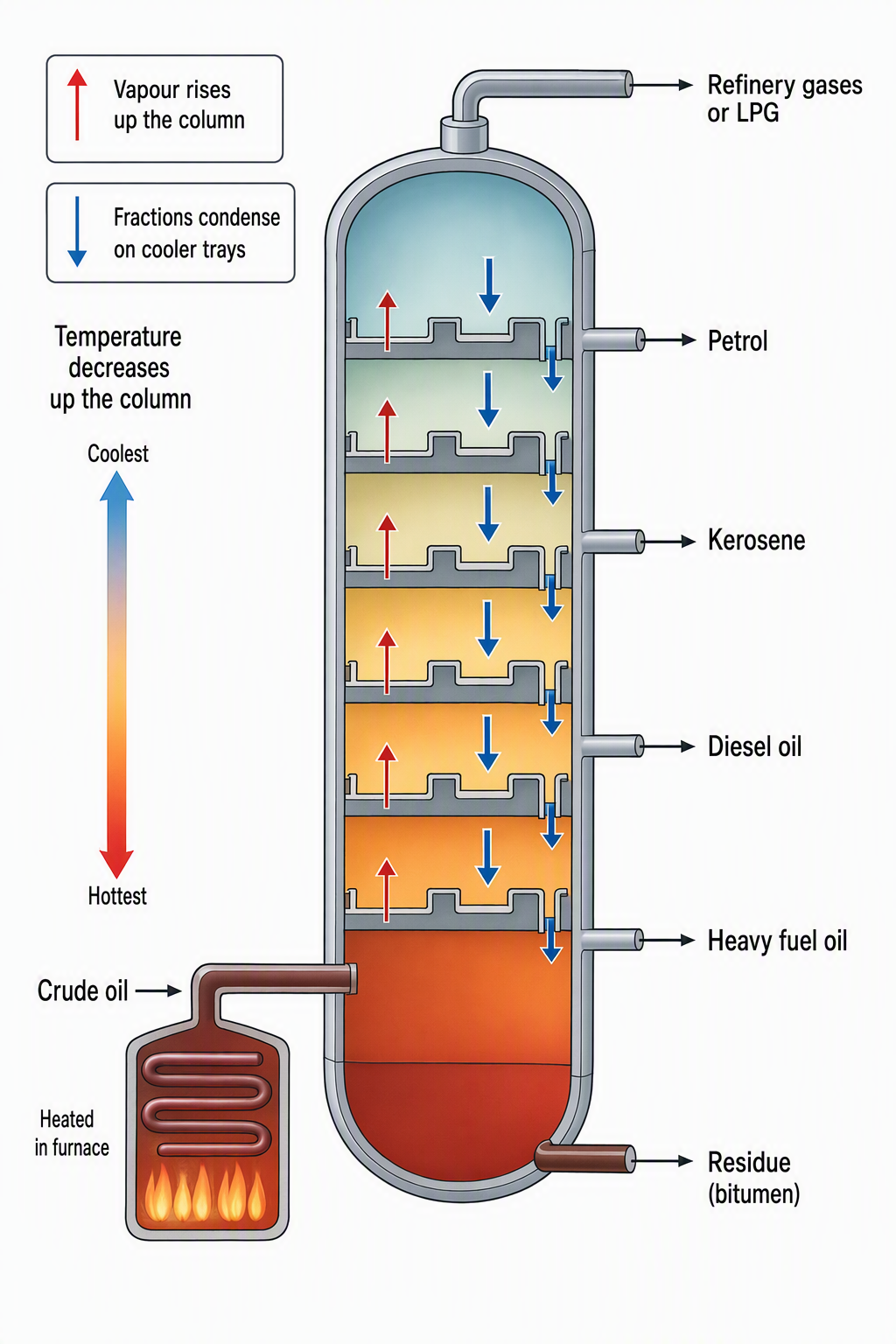
The picture labels more outlets than the five fuels AQA names, which are in the next section.
Crude oil fractions and what they are used for
The fractions are processed to make fuels and to provide feedstock, the raw material the petrochemical industry uses to make other substances. AQA names five fuels produced from crude oil:
| Fuel | Example of use |
|---|---|
| Petrol | Cars and other road vehicles |
| Diesel oil | Buses, lorries and some cars |
| Kerosene | Aircraft |
| Heavy fuel oil | Large engines and some industrial uses |
| Liquefied petroleum gases | Heating and cooking |
Liquefied petroleum gases are gases that have been changed into liquids for storage and transport.
The petrochemical industry also makes useful materials from crude oil feedstock: solvents, which dissolve other substances; lubricants, which reduce friction between moving surfaces; polymers, used for packaging, fibres and household items; and detergents, which help remove grease and dirt.
AQA's specification says: "Knowledge of the names of other specific fractions or fuels is not required."
How boiling point, viscosity and flammability change with molecule size
Some properties of hydrocarbons depend on the size of their molecules. As molecules get bigger, boiling point and viscosity increase and flammability decreases.
| Property | What it means | As molecules get bigger |
|---|---|---|
| Boiling point | The temperature at which a liquid boils | Increases |
| Viscosity | A measure of how easily a liquid flows: a liquid with a high viscosity flows slowly | Increases (flows more slowly) |
| Flammability | How easily a substance ignites and burns | Decreases |
Boiling point rises because larger molecules have stronger attractions between neighbouring molecules, so more energy is needed to separate them. Our covalent bonding guide explains these forces between molecules. That is also why the fractions with larger molecules condense lower in the column, where it is hotter.
These properties affect how a hydrocarbon is used as a fuel. A fuel that has to flow through pipes needs a low viscosity, and a fuel that has to ignite readily needs a high flammability. Both usually come with smaller molecules.
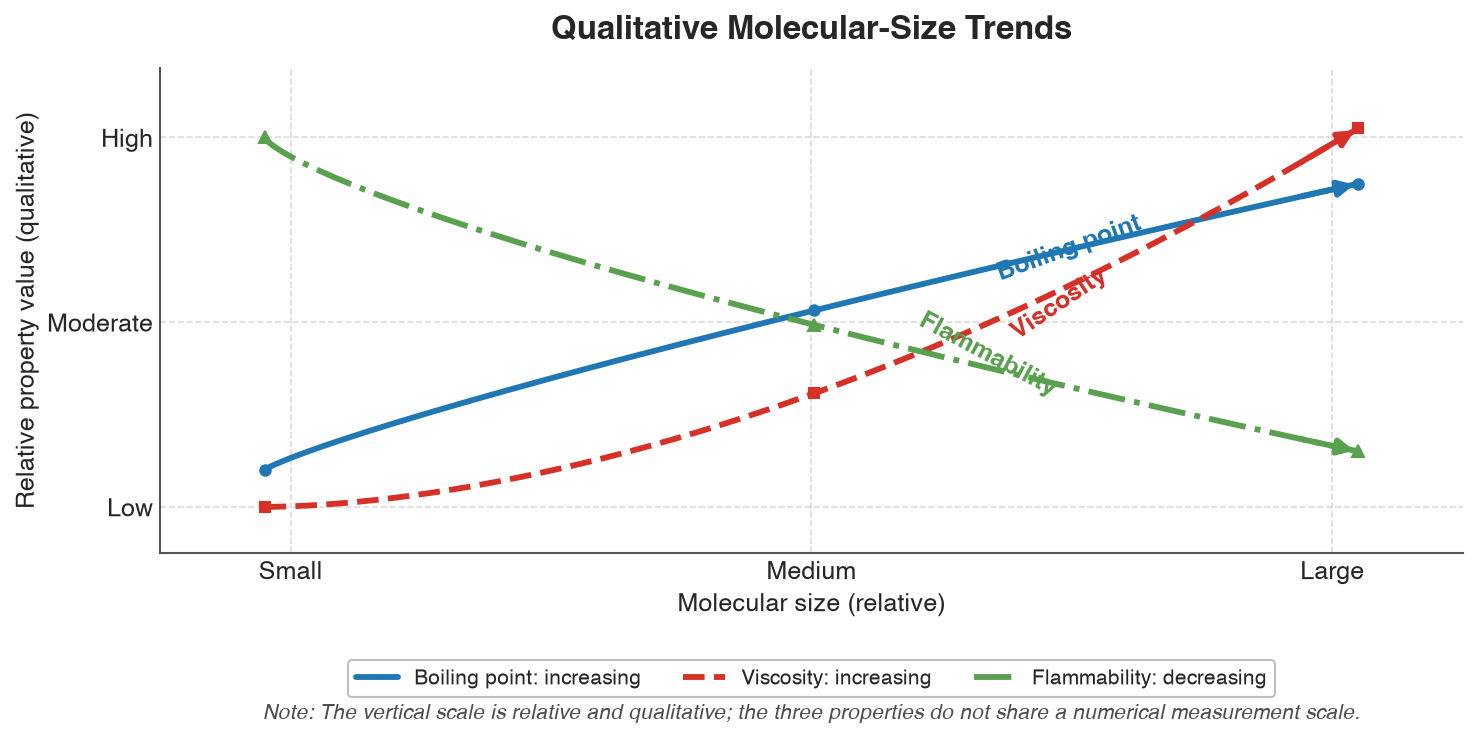
AQA's specification says: "Knowledge of trends in properties of hydrocarbons is limited to:" boiling points, viscosity and flammability.
Where marks are lost on fractional distillation questions
Each row is from one of AQA's published GCSE Chemistry (8462) Higher Paper 2 mark schemes.
| Question | What the mark scheme did | How to fix it |
|---|---|---|
| June 2024, 05.5: kerosene in the column (3 marks) | 1 mark for a temperature gradient in the column, with "the column gets cooler going up" allowed | Say the column is hotter at the bottom and cooler at the top |
| June 2024, 05.5, same question | Two marks for kerosene condensing at the level corresponding to its boiling point. Both needed a reference to kerosene | Name the fraction the question asks about, not just "the hydrocarbons" |
| June 2025, 02.2: what happens at the heater and in the column | "evaporation" at the heater, with "liquid to gas" and "boiling" allowed; "condensation" in the column, with "gas to liquid" allowed | Name the change of state, not just the state |
Fractional distillation exam questions with answers
The worked example and the three questions below are exam-style questions from Medly, marked with Medly's mark schemes.
Worked example (3 marks)
A refinery separated crude oil obtained from rocks by fractional distillation.
Describe how heating crude oil and using a fractionating column produce separate fractions. Refer to evaporation and condensation.
- Heating the crude oil vaporises many of its hydrocarbons (1 mark). Medly's mark scheme allows "evaporates" for "vaporises".
- The hydrocarbon vapours rise through the column, which is cooler towards the top (1 mark). Both the upward movement and the temperature change are needed for this mark.
- Hydrocarbons with different boiling ranges condense at different positions in the column, so separate fractions can be collected (1 mark). Condensing at different temperatures is allowed instead of different positions, as long as the separate collection is clear.
Question 1: (1 mark)
An independent refinery inspector analysed three crude-oil samples.
| Sample | Numbers of carbon atoms in the hydrocarbon molecules found |
|---|---|
| P | 5, 6 or 7 |
| Q | 9, 10 or 11 |
| R | 15, 16 or 17 |
Which of the following claims is supported by the evidence in the table?
Select one answer.
A. Each sample is a pure hydrocarbon because its molecules have carbon atoms and are therefore carbon-based.
B. P, Q and R must all be the same fraction because they are all hydrocarbons with identical compositions.
C. All molecules in each sample have exactly the same number of carbon atoms, and therefore show no variation within every sample.
D. Each sample could be a crude-oil fraction as its hydrocarbon molecules have similar numbers of carbon atoms.
Answer
D (1 mark). Each sample contains hydrocarbon molecules with similar, but not necessarily identical, numbers of carbon atoms, which supports its classification as a crude-oil fraction.
A is wrong because the presence of carbon atoms does not show that a sample is a pure hydrocarbon. B is wrong because different carbon-number ranges show the samples need not be the same fraction. C is wrong because a fraction contains molecules with similar numbers of carbon atoms, not necessarily exactly the same number.
Question 2: (3 marks)
A pilot fractionating column is being tested at the Calder refinery. A vaporised crude-oil mixture enters the column.
The positions and temperatures at which two fractions were collected are shown in the table.
| Fraction observed | Delta | Echo |
|---|---|---|
| Boiling range / °C | 160 to 180 | 80 to 100 |
| Outlet where liquid was collected | lower outlet | upper outlet |
| Temperature at that outlet / °C | 170 | 90 |
Explain why Delta is collected at a lower outlet than Echo. You should refer to the table in your answer.
Answer
- Delta has the higher boiling range (160 to 180 °C), so it is collected at the hotter, lower outlet (170 °C) than Echo (1 mark).
- Different boiling ranges cause the vapours to condense at different temperatures (1 mark).
- Condensation at the temperature matching a fraction's boiling range allows separate fractions to be collected by fractional distillation (1 mark). This point is needed for full marks.
Medly's mark scheme allows each point the other way round, written about Echo.
Question 3: (3 marks)
The table gives boiling points for hydrocarbons with different numbers of carbon atoms.
| Hydrocarbon | Number of carbon atoms in each molecule | Boiling point / °C |
|---|---|---|
| propane | 3 | −42 |
| butane | 4 | −1 |
| pentane | 5 | 36 |
| heptane | 7 | 98 |
Hexane has 6 carbon atoms in each molecule.
Fraction R contains smaller hydrocarbon molecules than Fraction S. Fraction S takes longer to flow through a channel.
Blend A contains smaller hydrocarbon molecules. The rescue flare must ignite readily.
(a) Use the table. Predict the boiling point of hexane. [1 mark]
(b) Suggest one reason why Fraction S takes longer to flow through the channel. [1 mark]
(c) Suggest one reason why Blend A is suitable for the rescue flare. [1 mark]
Answer
(a) About 67 °C (1 mark). Hexane, with 6 carbon atoms, sits between pentane (36 °C) and heptane (98 °C), and halfway between them is (36 + 98) ÷ 2 = 67 °C. Medly's mark scheme allows any value from 65 °C to 72 °C.
(b) Fraction S has larger hydrocarbon molecules, which give it a greater viscosity, so it flows more slowly (1 mark).
(c) The smaller hydrocarbon molecules in Blend A make it more flammable, so it ignites readily (1 mark).
The column questions all turn on one chain: molecule size, boiling point, then where in the column a fraction condenses. Medly marks written answers like Question 2 against the mark scheme, so you can see which point you missed. Medly has AQA GCSE Chemistry courses at Foundation and Higher, and AQA GCSE Combined Chemistry courses at Foundation and Higher for Combined Science students. In a randomised controlled trial in GCSE science, students using Medly for 30 minutes a week for four weeks scored 22% higher on the post-test than students revising in their usual way, adjusted for where they started. The students they were compared with used revision guides, notes, videos and, in most classes, other online revision platforms, and the trial covered biology, chemistry and physics.
Frequently asked questions
What is the difference between simple and fractional distillation?
Simple distillation separates a solvent from a solution, and the dissolved solid stays behind. Fractional distillation separates liquids that mix completely but have different boiling points, using a fractionating column in which evaporation and condensation happen again and again.
Is a fraction a pure substance?
No. A fraction is a mixture of hydrocarbons with similar numbers of carbon atoms, not one single substance.
Which fuels do I need to know for AQA?
AQA names petrol, diesel oil, kerosene, heavy fuel oil and liquefied petroleum gases. AQA's specification says: "Knowledge of the names of other specific fractions or fuels is not required."
Which properties of hydrocarbons do I need to know?
AQA's specification says: "Knowledge of trends in properties of hydrocarbons is limited to:" boiling points, viscosity and flammability.
Which paper is fractional distillation on?
Paper 2, for both GCSE Chemistry and Combined Science: Trilogy.