
Supplier statement reconciliation: steps, a worked example and practice questions for ACCA FA and K1
Sort each difference into timing or error, post the correcting journals and find the trade payables balance to report.
On this page
A supplier statement reconciliation compares the balance a supplier says you owe, shown on its statement, with that supplier's account in your own records at the same date. It explains every difference between the two. Some differences are only timing, such as a payment the supplier has not yet received, and need no entry. Others are errors or omissions in your own ledger and need a correcting journal before the trade payables balance is reported.
What is a supplier statement?
A supplier statement is the supplier's summary of its transactions with the business over a period, and of the balance it believes the business owes. Comparing it with the business's own records is a check from outside the business on what it owes that supplier.
| Entry on the supplier statement | Effect on the amount the business owes |
|---|---|
| Opening balance | Amount outstanding at the start of the period |
| Invoices issued by the supplier | Increase the amount owed |
| Credit notes issued by the supplier | Reduce the amount owed |
| Payments received by the supplier | Reduce the amount owed |
| Discounts recorded by the supplier | Reduce the amount owed |
| Closing balance | Amount outstanding according to the supplier at the statement date |
A payment shown as received on the statement is a payment the business made. Dated invoices with their references, credit notes and payments let you match each entry to your own records.
On the business's side, two records hold what it owes:
- The trade payables account in the general ledger shows the total the business owes all its credit suppliers. Trade payables are amounts owed to suppliers for goods or services bought on credit.
- The payables ledger is the collection of individual supplier accounts. It shows how much is owed to each supplier and which transactions make up each balance.
An individual supplier account normally has a credit balance. Purchase invoices increase it, and payments and supplier credit notes reduce it through debit entries. In an integrated accounting system, one transaction updates both the supplier's account and the general ledger total. That saves posting work, but an incorrect amount or a missed transaction then affects both records.
What a supplier statement reconciliation is for
A reconciliation compares two records of the same balance, finds the differences and explains how they arose. It also shows which accounting corrections are needed before the balance can be reported.
Checking a supplier's statement against the supplier's account tests whether transactions have been recorded:
- Completely: every relevant invoice, credit note and payment is included.
- Accurately: the amounts are entered correctly.
- Validly: each entry relates to a genuine transaction with the right supplier.
The business's own records agreeing with each other does not prove the balance is right. If an invoice was left out of both the supplier's account and the general ledger, the two would still agree, and both would understate the amount owed. Agreement between the general ledger total and the total of the individual accounts does not rule out an omission affecting both sets of internal records.
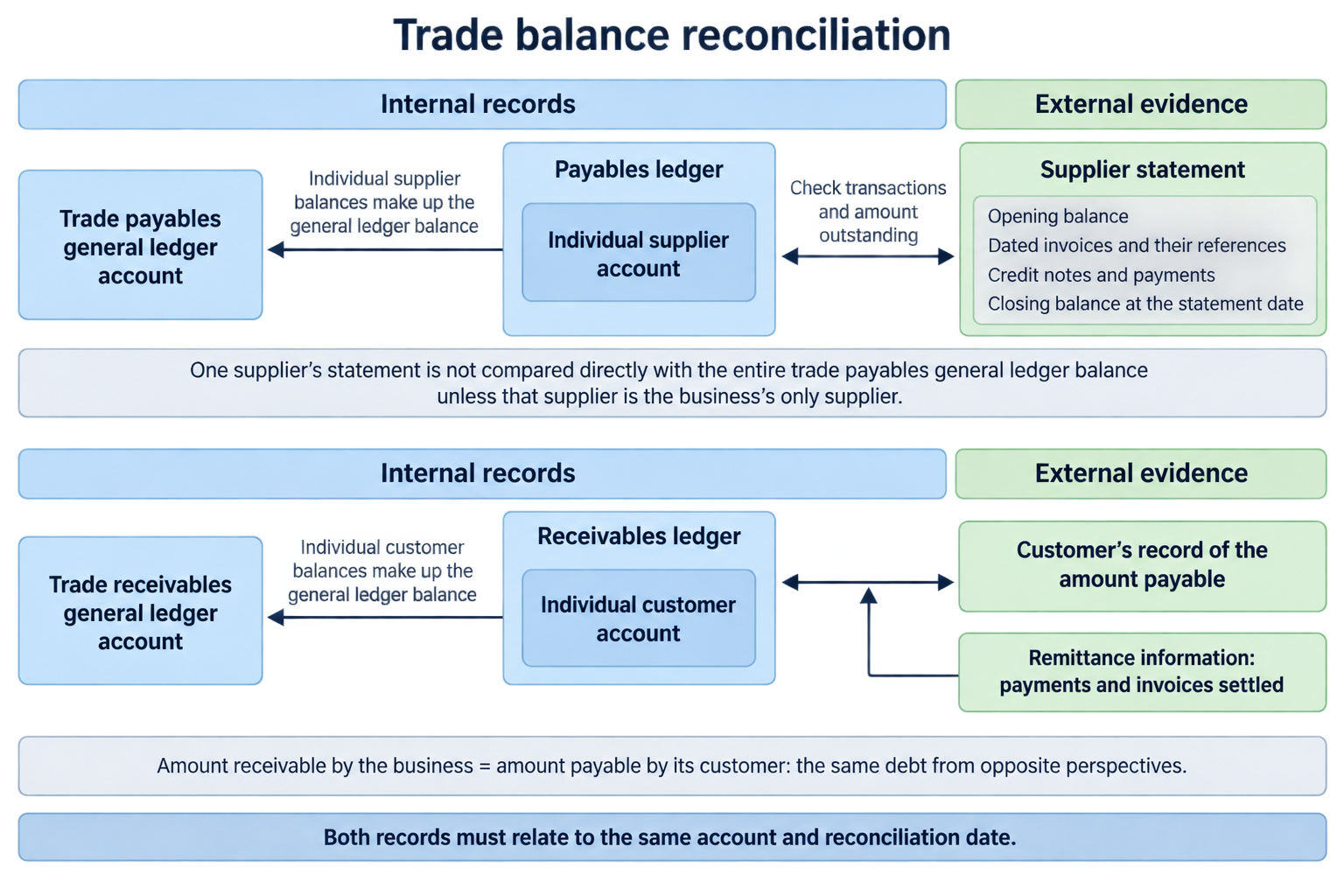
Compare one supplier's statement with that supplier's account in the payables ledger, not with the whole trade payables balance, unless that supplier is the business's only supplier. Both records must relate to the same account and the same date.
The figure shows this check in its upper row. Its lower row shows the same check on the customer side: each customer's account is compared with the customer's own record of the amount it owes, supported by remittance information on payments and invoices settled. The ACCA K1 syllabus asks for both checks.
Why do the supplier statement and your ledger balance differ?
Differences come from the business's records, the supplier's records or the timing of when each side processed a transaction. A difference does not automatically mean the business has made an error.
| Reason for the difference | Effect on the records |
|---|---|
| Incorrect amount | An invoice for $1,500 entered as $1,050 understates the amount owed by $450 |
| Omission | An invoice, payment or credit note appears in one record but not the other |
| Duplication | A transaction has been entered twice in one record |
| Allocation to the wrong account | A payment or invoice has been entered in another supplier's account |
| Payment in transit | The business has recorded a payment it sent, but the supplier has not yet received or recorded it |
| Invoice awaiting processing | One side has correctly recorded an invoice and the other has not yet processed it |
| Supplier's recording error | The supplier has entered a wrong amount, left out an item or duplicated a transaction |
Allocation errors need particular care. An invoice posted to the wrong supplier can leave total trade payables unchanged while making two individual supplier balances wrong.
For each item that does not match, establish:
- Which transaction it is, using its date, reference and supporting document.
- Whether it belongs to the reporting period and to the correct supplier.
- Which side has recorded it, and whether that entry is correct.
- Whether it needs an accounting correction or only an adjustment in the reconciliation.
Which differences need a correcting journal?
Errors and omissions in the business's own records need correcting entries, such as an incorrect invoice amount or a credit note that was never recorded. Timing differences need no correction, because the business has already recorded the transaction correctly.
A payment sent to a supplier and correctly recorded by the business may not yet be on the supplier's statement. The business's payable is then lower than the statement balance. Recording the payment a second time would reduce the payable twice.
If the supplier has made the error, raise it with the supplier. Where the business's own entry is correct, do not change it just to agree with a wrong external balance; show the supplier's error separately in the reconciliation until it is corrected. Once an error has been corrected in the ledger, do not also list it as a remaining difference, or it will be counted twice.
The correcting journals follow the rules for a liability:
- An increase in trade payables is a credit, and a reduction is a debit.
- An understated purchase invoice needs a debit to purchases and a credit to trade payables for the omitted amount only, since part of the invoice is already recorded.
- A supplier credit note for goods returned is a debit to trade payables and a credit to purchases returns.
- A duplicate entry is corrected by reversing the duplicate, not the valid original.
Correcting purchases also changes profit. Opening inventories plus purchases, less closing inventories, gives cost of sales, which is deducted from revenue to give gross profit. So if the goods are already correctly counted in closing inventory, recording a missing part of a purchase invoice increases cost of sales and reduces gross profit by the same amount. The cost of sales working is covered in more detail with inventory valuation.
Supplier statement reconciliation example: Cedar Supplies
Worked example
What is the corrected trade payables general ledger balance after investigating Cedar Supplies' statement at 30 June 20X5? Before the investigation, the individual supplier accounts agree with the general ledger total.
| Record or transaction at 30 June 20X5 | Amount |
|---|---|
| Trade payables general ledger credit balance | $12,900 |
| Cedar Supplies' individual account credit balance | $8,700 |
| Other supplier balances, checked and agreed | $4,200 |
| Cedar Supplies' statement balance | $10,900 |
| Correct amount of a Cedar purchase invoice | $1,500 |
| Amount entered for that purchase invoice | $1,050 |
| Valid Cedar credit note omitted by the business | $250 |
| Payment correctly recorded by the business but not yet received by Cedar | $2,000 |
The credit note relates to goods returned to Cedar Supplies.
Step 1: identify the accounting corrections.
- The purchase invoice was understated by $1,500 − $1,050 = $450. Purchases and trade payables both increase by $450.
- The omitted credit note reduces trade payables by $250.
- The $2,000 payment is already correctly recorded. It is a timing difference and needs no entry.
Step 2: calculate the corrected general ledger balance.
$12,900 + $450 − $250 = $13,100 credit.
Step 3: record the correcting journals.
| Correction | Debit | Credit | Amount |
|---|---|---|---|
| Record the omitted part of the invoice | Purchases | Trade payables | $450 |
| Record the supplier credit note | Trade payables | Purchases returns | $250 |
Step 4: update the supplier's account and check the total.
- Cedar Supplies' corrected balance: $8,700 + $450 − $250 = $8,900 credit.
- Add the other supplier balances: $8,900 + $4,200 = $13,100, which agrees with the corrected general ledger.
Step 5: reconcile to the supplier's statement.
The payment in transit is the remaining difference: $8,900 + $2,000 = $10,900, which is Cedar Supplies' statement balance.
The corrections update Cedar Supplies' individual account as well as the general ledger. In an integrated system, the same transaction entries normally do both.
Which trade payables balance goes in the statement of financial position?
The balance reported is the trade payables general ledger balance after the correcting journals, which is $13,100 in the Cedar Supplies example. The supplier's statement balance is not used in its place: it still includes the timing difference, and the business does not change a correct entry just to agree with it.
Trade payables are normally presented as a current liability.
Supplier statement reconciliation in the ACCA FA and K1 syllabuses
Supplier statements are in both ACCA Financial Accounting syllabuses: the FA exam of the current ACCA Qualification, and K1 Financial Accounting in the future ACCA Qualification, on demand from July 2027. A pass in FA gives credit for K1. How the two qualifications fit together is in our ACCA exams guide.
| Exam | Syllabus references | What they ask |
|---|---|---|
| FA | E2 Payables account reconciliations, (a) to (e); D8(k) | Explain the purpose of the payables general ledger account and of reconciling it to external documents; "Prepare a reconciliation of the payables general ledger account to supplier statements"; identify and correct the errors a reconciliation highlights; "Identify the payables balance to be reported in the financial statements"; "Prepare, reconcile and explain the purpose of supplier statements" |
| K1 | D2 Receivables and payables reconciliations, (a) to (d); C7(g) | Explain the purpose of trade receivables and trade payables reconciliations; summarise the reasons for differences from external, third-party records; "Prepare journal entries to correct errors and/or omissions in the trade receivables and trade payables general ledger accounts"; calculate the reconciled balances for the statement of financial position; explain the purpose of supplier statements |
You can read the full FA syllabus and K1 syllabus on ACCA's site. Both say the questions "will assess all parts of the syllabus".
FA and K1 are both two-hour computer-based exams: 35 two-mark objective test questions in Section A and two 15-mark multi-task questions in Section B. The pass mark is 50%. The exam guide covers everything else about the two exams.
The other reconciliation in both syllabuses is the bank reconciliation.
The supplier statement reconciliation on this page is in both syllabuses, and K1 also asks for the same reconciliation for trade receivables.
Supplier statement reconciliation practice questions (ACCA FA and K1)
The three practice questions below are from Medly's ACCA K1 Financial Accounting course, and the answers follow Medly's mark schemes. Try each one before you open the answer.
Two of these questions are on reconciling a supplier's account to its statement, and one is on what an error does to trade payables and gross profit.
Question 1: (2 marks)
At 31 October 20X6, Meriden Co's general ledger trade payables balance was $48,200, representing the total owed to its credit suppliers. The following records relate to Velt Co for October 20X6:
| Individual supplier account | Supplier statement | |
|---|---|---|
| Opening balance, 1 October | $4,200 | $4,200 |
| Purchase invoices | $5,600 | $6,450 |
| Credit notes | $450 | $630 |
| Payments made/received | $2,750 | $2,750 |
| Settlement discount received/allowed | $150 | $150 |
| Closing balance, 31 October | $6,450 | $7,120 |
The statement includes invoice 814 for $850 dated 29 October and credit note 109 for $180 dated 30 October. Neither appears in Meriden Co's records.
Which of the following adjustments correctly reconciles the closing balance on the individual supplier account to the closing balance on the supplier statement?
A. Deduct invoice 814 ($850) and deduct credit note 109 ($180)
B. Deduct invoice 814 ($850) and add credit note 109 ($180)
C. Add invoice 814 ($850) and deduct credit note 109 ($180)
D. Add invoice 814 ($850) and add credit note 109 ($180)
Answer
C. Add invoice 814 ($850) and deduct credit note 109 ($180)
- An invoice increases the amount owed, so the missing invoice is added: +$850.
- A credit note reduces the amount owed, so the missing credit note is deducted: −$180.
- $6,450 + $850 − $180 = $7,120, the supplier statement balance.
The $48,200 general ledger total is not needed: the comparison is between one supplier's account and that supplier's statement.
A deducts the invoice, which reduces the balance instead of increasing it, giving $6,450 − $850 − $180 = $5,420. B reverses both effects, giving $6,450 − $850 + $180 = $5,780. D adds the credit note, which increases the balance instead of reducing it, giving $6,450 + $850 + $180 = $7,480.
Question 2: (2 marks)
Bramley Co is reconciling a supplier statement at 31 October 20X7. A purchase invoice for $8,400 was recorded as $4,800 in both the purchases and trade payables general ledger accounts. A payment of $2,100 sent on 31 October 20X7 was recorded in the ledger but has not yet appeared on the supplier statement.
Which of the following journal entries is required to correct Bramley Co's general ledger?
A. Dr Purchases $5,700; Cr Trade payables $5,700
B. Dr Purchases $8,400; Cr Trade payables $8,400
C. Dr Purchases $3,600; Cr Trade payables $3,600
D. Dr Trade payables $3,600; Cr Purchases $3,600
Answer
C. Dr Purchases $3,600; Cr Trade payables $3,600
- The invoice was understated by $8,400 − $4,800 = $3,600.
- Only the missing $3,600 is recorded: debit purchases and credit trade payables.
- The $2,100 payment is already correctly recorded. It is a timing difference and needs no further entry.
A adds the payment in transit to the understatement ($3,600 + $2,100 = $5,700), although the payment needs no entry. B records the whole invoice again instead of the missing amount. D has the debit and credit the wrong way round.
Question 3: (2 marks)
In reconciling the year-end statement from Cervell Supplies with its supplier account and trade payables general ledger account, Kestrel Co found that a credit purchase invoice dated 24 September 20X7 for $8,400 had been recorded as $4,800 in purchases and trade payables. The goods were received before 30 September 20X7 and correctly included at $8,400 in the physical closing inventory count at that date, and no entry has been made to correct the $3,600 understatement.
Which combination of statements is correct about the effects of correcting the ledger accounts?
- Trade payables at 30 September 20X7 will increase by $3,600.
- Gross profit for the year ended 30 September 20X7 will decrease by $3,600.
- Closing inventory at 30 September 20X7 will increase by $3,600.
- Gross profit for the year ended 30 September 20X7 will increase by $3,600.
A. 1 and 4
B. 1 and 2
C. 3 and 4
D. 2 and 3
Answer
B. 1 and 2
- The correction is a debit to purchases of $3,600 and a credit to trade payables of $3,600, so trade payables increase by $3,600 (statement 1).
- Closing inventory was already counted correctly at $8,400, so it does not change.
- Cost of sales is opening inventories plus purchases less closing inventories. Purchases rise by $3,600 and closing inventory is unchanged, so cost of sales rises by $3,600.
- Gross profit is revenue less cost of sales, so it falls by $3,600 (statement 2).
A is wrong because the extra purchases reduce gross profit; they do not increase it. C is wrong on both points: closing inventory is unchanged and gross profit decreases. D is right about gross profit but wrong about inventory, which was already counted correctly.
Medly's ACCA K1 Financial Accounting course has lessons for every topic of the course and full-length practice papers, with answers marked step by step. It is free to start, with no card needed.
Frequently asked questions
What is a supplier statement?
It is the supplier's summary of its transactions with your business over a period: the opening balance, invoices, credit notes, payments received, discounts and the closing balance it believes you owe.
Why does a supplier statement differ from the ledger?
Because of timing, errors or omissions on either side. A payment in transit or an invoice one side has not yet processed is timing; a wrong amount, a missed or duplicated entry, or an entry in the wrong supplier's account is an error.
Is a payment in transit corrected in the ledger?
No. The business has already recorded the payment correctly, so recording it again would reduce the payable twice. It is shown as a difference in the reconciliation.
Which trade payables balance is reported?
The trade payables general ledger balance after the business's own errors and omissions have been corrected. It is normally presented as a current liability.
Should you change your ledger to match the supplier's statement?
Only for errors and omissions in your own records. If the supplier has made the error, raise it with the supplier and leave your correct entry as it is.