
Bank reconciliation statement: how to prepare one, a worked example and practice questions for ACCA FA and K1
Correct the bank general ledger account, reconcile it to the bank statement and find the balance to report, step by step.
On this page
A bank reconciliation compares the business's own record of its bank account with the bank statement at the same date. It explains every difference between the two and arrives at the correct bank balance for the statement of financial position. This guide does it in two stages: correct the bank general ledger account for anything missed or recorded wrongly, then prepare a bank reconciliation statement for the timing differences left over. One example runs through both stages, and three practice questions follow.
What is a bank reconciliation?
A bank reconciliation compares the business's bank records with the bank's records at a specified date, identifies the differences and establishes the correct balance to report. It verifies the bank balance that goes into the statement of financial position.
Two records are being compared:
- The bank general ledger account is the business's own record of money received into, and paid out of, its bank account.
- The bank statement is the bank's independent record of the same account: its transactions and its balance.
A reconciliation helps the business to:
- Find transactions the bank has recorded but the business has not.
- Find recording and calculation errors.
- Explain differences caused by transactions reaching the two records at different times.
- Confirm the bank balance to be presented in the statement of financial position.
Both records must be taken at the same date. A difference does not necessarily mean that either record is wrong: a transaction can be recorded correctly by the business and simply not yet processed by the bank.
The bank reconciliation statement is the working that explains whatever difference remains once the ledger has been corrected. It is a separate comparison, and nothing in it is posted as a journal.
Why the bank statement shows a credit when you have money in the bank
The business and the bank look at the same account from opposite sides. Money in the bank is an asset of the business, but to the bank it is money it owes its customer, so the bank shows it as a credit.
An overdraft arises when the business has taken out more than is available in the account. It then owes money to the bank, and the sides swap.
| Position | Business's ledger | Bank statement | Sign in the reconciliation |
|---|---|---|---|
| Money available in the account | Debit balance | Credit balance | Positive |
| Overdraft | Credit balance | Debit balance | Negative |
So a credit balance of $3,000 on the bank statement is the same position as a debit balance of $3,000 in the business's ledger. A debit balance of $800 on the bank statement is an overdraft, and in the reconciliation it is written as −$800.
Some bank statements say "available balance" or "overdrawn" instead of debit and credit. What matters is whether the business has money available or owes money to the bank.
Why do the ledger and bank statement balances differ?
The two balances differ for three reasons: a transaction reaches one record before the other, a transaction has been left out of the business's records, or an amount has been recorded wrongly.
Timing differences. A transaction has been recorded correctly in one record but has not yet appeared in the other.
- Outstanding lodgements are receipts recorded by the business but not yet recorded by the bank, such as money paid in close to the reporting date.
- Unpresented cheques are payments recorded by the business but not yet recorded by the bank. The business records a cheque when it issues it; the bank records it when the cheque is presented and processed.
- Electronic receipts and payments can be timing differences too, when the business has recorded them and the bank has not yet cleared or processed them.
Transactions the bank records first. These need entries in the business's bank general ledger account if the business has not already made them:
- bank charges, and interest charged or credited
- standing orders, which are instructions to the bank to make regular payments of a set amount
- direct debits, which let an authorised organisation collect payments from the account
- receipts paid straight into the account by customers.
Errors. A transposition error puts digits in the wrong order, such as $264 recorded instead of $624. A casting error is a mistake in adding up a column or total. The bank can also make an error, such as charging another customer's payment to the account. A bank error is reported to the bank and is not entered as a business transaction.
The first decision for each difference is whether the business's ledger needs correcting. Make it before you prepare the reconciliation statement.
| Type of difference | In the bank general ledger account | In the bank reconciliation statement |
|---|---|---|
| Receipt or payment omitted from the business's records | Record the transaction | Use the updated ledger balance and do not adjust for it again |
| Incorrect amount recorded by the business | Correct the error | Use the corrected ledger balance |
| Receipt correctly recorded, not yet processed by the bank | No further entry | Include it as an outstanding receipt |
| Payment correctly recorded, not yet processed by the bank | No further entry | Include it as an outstanding payment |
| Confirmed error made by the bank | Do not record the bank's mistake | Adjust for it until the bank corrects it |
A transaction that appears only on the bank statement is not automatically a timing difference. If it is a genuine business transaction that the ledger has missed, the business records it.
How do you do a bank reconciliation?
Stage 1 corrects the business's bank general ledger account. Stage 2 explains the difference that is left between the corrected ledger balance and the bank statement.
Stage 1: correct the bank general ledger account. Each correction is a journal with equal debits and credits.
- A receipt increases the bank asset, so it is a debit to the bank account.
- A payment reduces the bank asset, so it is a credit to the bank account.
- The other account depends on what the transaction was. A customer's payment reduces trade receivables; a payment to a supplier reduces trade payables; for a standing order or direct debit, the other account depends on what the payment was for, which is not always an expense.
- Where part of a transaction is already recorded, correct only the missing amount.
- A casting error is put right by recalculating the total and the balance. It does not necessarily need a new journal if the individual entries are correct.
Stage 2: prepare the bank reconciliation statement. Starting from the bank statement balance:
- Treat money available as positive and an overdraft as negative.
- Add outstanding lodgements and uncleared electronic receipts.
- Deduct unpresented cheques and uncleared electronic payments.
- Adjust for any confirmed bank errors.
- Compare the result with the corrected bank general ledger balance.
Outstanding receipts are added because the business has recorded money that the bank has not yet included. Outstanding payments are deducted because the business has recorded payments that the bank has not yet taken out. For a bank error, remove its effect from the statement balance: an incorrect bank debit of $150 is added back.
Bank reconciliation example: Cedar Traders
Worked example
Cedar Traders compares its bank statement with its bank general ledger account, payment records and deposit records at 30 April 20X5.
| Record at 30 April 20X5 | Balance |
|---|---|
| Bank general ledger account before corrections | $6,840 debit |
| Bank statement | $7,050 credit |
The comparison finds these differences:
| Item | Amount | What the records show |
|---|---|---|
| Receipt from a credit customer | $900 | On the bank statement, not recorded by the business |
| Bank charges | $80 | On the bank statement, not recorded by the business |
| Standing order for rent | $450 | On the bank statement, not recorded by the business |
| Direct debit for electricity | $120 | On the bank statement, not recorded by the business |
| Bank interest charged | $30 | On the bank statement, not recorded by the business |
| Cheque paid to a supplier | Actual payment $624; recorded payment $264 | The business entered $264 in both the bank account and the supplier account; the bank correctly recorded $624 |
| Outstanding lodgement | $1,250 | Correctly recorded by the business, not yet on the bank statement |
| Uncleared electronic receipt | $250 | Correctly recorded by the business, not yet on the bank statement |
| Unpresented cheque | $1,600 | Correctly recorded by the business, not yet on the bank statement |
| Uncleared electronic payment | $250 | Correctly recorded by the business, not yet on the bank statement |
The first six items need corrections in the ledger. The last four are timing differences: the business has already recorded them correctly, and recording them again would count them twice.
Stage 1: correct the bank general ledger account
The supplier cheque was understated by $624 − $264 = $360. Only the missing $360 is recorded, because $264 is already in the accounts.
| Correction | Debit | Credit | Amount |
|---|---|---|---|
| Record the customer receipt | Bank | Trade receivables | $900 |
| Record bank charges | Bank charges expense | Bank | $80 |
| Record the standing order | Rent expense | Bank | $450 |
| Record the direct debit | Electricity expense | Bank | $120 |
| Record interest charged | Bank interest expense | Bank | $30 |
| Correct the understated supplier payment | Trade payables | Bank | $360 |
Add the omitted receipt and deduct the omitted payments and the payment correction:
| Working | Effect on the bank balance |
|---|---|
| Balance before corrections | $6,840 |
| Add customer receipt | +$900 |
| Deduct bank charges | −$80 |
| Deduct rent payment | −$450 |
| Deduct electricity payment | −$120 |
| Deduct interest charged | −$30 |
| Deduct supplier payment correction | −$360 |
| Corrected bank general ledger balance | $6,700 |
- The deductions total $80 + $450 + $120 + $30 + $360 = $1,040.
- $6,840 + $900 − $1,040 = $6,700.
- The result is positive, so the corrected ledger has a debit balance of $6,700.
If the bank had credited interest that the business had not recorded, the entry would instead be a debit to bank and a credit to bank interest income.
Stage 2: the bank reconciliation statement
| Reconciliation item | Amount |
|---|---|
| Bank statement balance (credit) | $7,050 |
| Add outstanding lodgement | +$1,250 |
| Add uncleared electronic receipt | +$250 |
| Deduct unpresented cheque | −$1,600 |
| Deduct uncleared electronic payment | −$250 |
| Reconciled balance | $6,700 |
- Outstanding receipts: $1,250 + $250 = $1,500.
- Outstanding payments: $1,600 + $250 = $1,850.
- $7,050 + $1,500 − $1,850 = $6,700.
This agrees with the corrected bank general ledger balance of $6,700. The four timing differences need no journals.
Reconciling the other way round
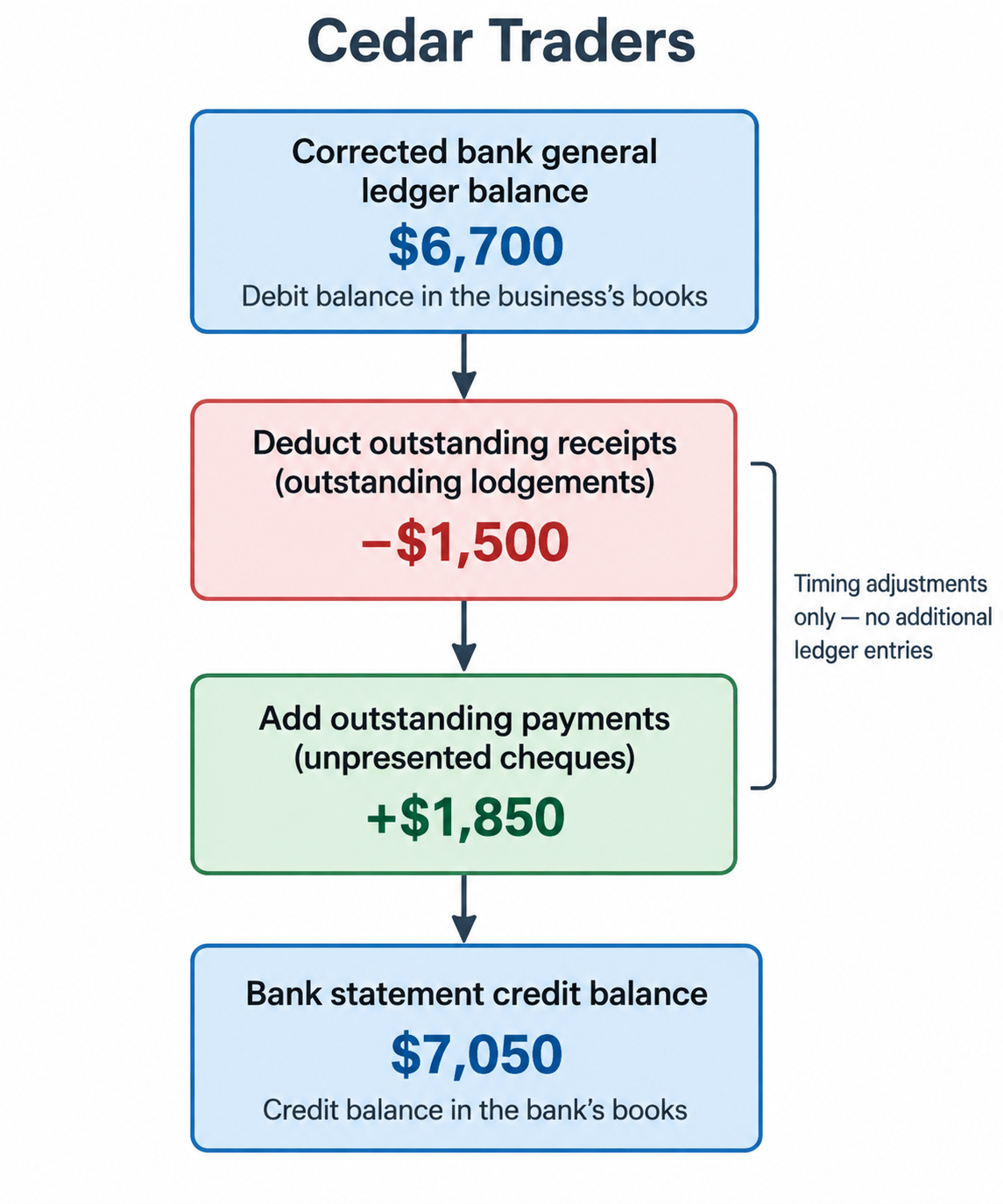
You can also start from the corrected ledger balance and finish at the bank statement balance. The adjustments are then reversed: deduct outstanding receipts and add outstanding payments. For Cedar Traders, $6,700 − $1,500 + $1,850 = $7,050.
In the figure, the $1,500 of outstanding receipts is the $1,250 outstanding lodgement and the $250 uncleared electronic receipt. The $1,850 of outstanding payments is the $1,600 unpresented cheque and the $250 uncleared electronic payment.
Which bank balance goes in the statement of financial position?
The corrected bank general ledger balance is the amount reported in the statement of financial position. The unadjusted ledger balance and the bank statement balance are not used in its place, even if one of them is available first.
For Cedar Traders, that is the corrected debit balance of $6,700. A positive bank balance is money available to the business, so it is presented as a current asset.
An overdraft is a credit balance in the business's bank general ledger account. It is money owed to the bank, so it is presented as a liability rather than as a negative current asset. Current liabilities include amounts due within twelve months of the reporting date, and an overdraft repayable on demand is a current liability.
Bank reconciliation in the ACCA FA and K1 syllabuses
Bank reconciliation is in both ACCA Financial Accounting syllabuses: the FA exam of the current ACCA Qualification, and K1 Financial Accounting in the future ACCA Qualification, on demand from July 2027. A pass in FA gives credit for K1. How the two qualifications fit together is in our ACCA exams guide.
| Exam | Syllabus reference | What it asks |
|---|---|---|
| FA | E1 Bank reconciliations, (a) to (f) | Explain the purpose of bank reconciliations; identify the main reasons for differences between the bank general ledger account and the bank statement; "Identify and correct errors and/ or omissions in the bank general ledger account"; prepare the reconciliation; derive the bank statement and ledger balances from given information; "Identify the bank balance to be reported in the financial statements" |
| K1 | D1 Bank reconciliations, (a) to (d) | Explain the purpose of bank reconciliations; summarise the reasons for differences between the bank general ledger account and external, third-party records; "Prepare journal entries to correct errors and/or omissions in the bank general ledger account"; "Calculate the reconciled bank balance to be presented on the statement of financial position" |
You can read the full FA syllabus and K1 syllabus on ACCA's site. Both say the questions "will assess all parts of the syllabus".
FA and K1 are both two-hour computer-based exams: 35 two-mark objective test questions in Section A and two 15-mark multi-task questions in Section B. The pass mark is 50%. The exam guide covers everything else about the two exams.
The other reconciliation in both syllabuses is the supplier statement reconciliation, which checks trade payables against suppliers' records.
Every topic on this page is in both syllabuses.
Bank reconciliation practice questions (ACCA FA and K1)
The three practice questions below are from Medly's ACCA K1 Financial Accounting course, and the answers follow Medly's mark schemes. Try each one before you open the answer.
Two of these questions ask for the bank balance to report after a reconciliation, and one asks how an overdraft is recorded and presented.
Question 1: (2 marks)
Hollowmere Co, a professional rugby club, is reconciling its bank records at 31 December 20X5.
The following information is available:
The bank general ledger shows a debit balance of $18,460, while the bank statement shows a positive balance of $18,400.
The statement includes bank charges of $160 and a direct credit from a sponsor of $900, neither of which has been entered in the ledger. A lodgement of $2,100 and an unpresented cheque for $1,300 have both been correctly recorded in the ledger.
What is the bank balance to be presented as an asset in the company's statement of financial position at 31 December 20X5?
A. $17,900
B. $18,300
C. $18,400
D. $19,200
Answer
D. $19,200
- The bank charges and the sponsor's direct credit are on the statement but not in the ledger, so the ledger is corrected for them.
- Corrected ledger balance: $18,460 − $160 + $900 = $19,200.
- The lodgement and the unpresented cheque are already recorded correctly. They are timing differences and do not change the ledger.
- Check from the bank side: $18,400 + $2,100 − $1,300 = $19,200.
A deducts the unpresented cheque from the corrected ledger balance, which counts that payment twice. B corrects for the bank charges but leaves out the sponsor's direct credit. C is the bank statement balance before the reconciliation.
Question 2 calls the bank general ledger account the cash book.
Question 2: (2 marks)
Vale Vineyard Co is preparing its statement of financial position at 31 December 20X6.
The following information is available:
The cash book showed a debit balance of $24,700; the bank statement showed a credit balance of $31,100 and included an unrecorded customer receipt of $2,100 and bank charges of $300; a lodgement of $2,800 and payments of $7,400 recorded in the cash book had not appeared on the bank statement.
No other items affect the bank reconciliation.
What is the bank balance to be reported in Vale Vineyard Co's statement of financial position at 31 December 20X6?
A. Current asset of $26,500
B. Current asset of $31,100
C. Current liability of $26,500
D. Current asset of $24,700
Answer
A. Current asset of $26,500
- Correct the cash book for the items only the bank has recorded: $24,700 + $2,100 − $300 = $26,500.
- The lodgement and the payments are already in the cash book. They are timing differences.
- Check from the bank side: $31,100 + $2,800 − $7,400 = $26,500.
- The balance is positive, so it is a current asset.
B is the bank statement balance before adjusting for the lodgement and payments the bank has not yet shown. C has the right amount but the wrong side: a positive bank balance is a current asset. D is the cash book balance before the customer receipt and bank charges are recorded.
Question 3: (2 marks)
The directors of North Shoal Wind Co are reviewing the presentation of a bank overdraft that is repayable on demand.
Which TWO statements about the bank overdraft are correct? Select 2 answers.
A. It is presented as a current liability.
B. It is recorded as a debit balance in the company's bank account.
C. It is recorded as a credit balance in the bank account.
D. It is presented as a current asset.
Answer
A and C. Both are needed for the 2 marks.
- An overdraft is money the company owes the bank, so its bank general ledger account has a credit balance (C).
- An overdraft repayable on demand is a current liability (A).
B is wrong because an overdraft is a credit balance in the company's own bank account; the debit balance appears on the bank's statement. D is wrong because an overdraft is a liability, not an asset.
Medly's ACCA K1 Financial Accounting course has lessons for every topic of the course and full-length practice papers, with answers marked step by step. It is free to start, with no card needed.
Frequently asked questions
What is a bank reconciliation statement?
It is the working that explains the difference between the bank statement balance and the corrected bank general ledger balance at the same date. It lists the timing differences, such as outstanding lodgements and unpresented cheques, and is never posted as a journal.
What are unpresented cheques and outstanding lodgements?
Unpresented cheques are payments the business has recorded that the bank has not yet recorded. Outstanding lodgements are receipts the business has recorded that the bank has not yet recorded.
Why does the bank statement show a credit balance when the account has money in it?
Because the bank records the account from its own side. Money in the account is an asset to the business but a debt the bank owes its customer, so it is a debit in the business's ledger and a credit on the bank statement.
Which bank balance goes in the financial statements?
The corrected bank general ledger balance. A positive balance is a current asset, and an overdraft repayable on demand is a current liability.
What do you correct in the ledger and what do you leave as a reconciling item?
Correct the ledger for anything the business has left out or recorded wrongly, such as bank charges, direct debits, standing orders, direct receipts and transposition errors. Leave timing differences and confirmed bank errors in the reconciliation statement.