
Provisions in accounting: IAS 37, contingent liabilities and ACCA FA practice questions
Apply the three recognition tests, classify provisions, contingent liabilities and contingent assets, and measure and journal a provision.
On this page
Provisions in accounting are liabilities of uncertain timing or amount: the business has an obligation, but it has to estimate how much it will pay, or when. IAS 37 requires a provision to be recognised when, and only when, a past event has created a present obligation, an outflow to settle it is probable and the amount can be estimated reliably. When those tests are not all met, the item may be a contingent liability, which is disclosed in the notes rather than recorded. This guide covers provisions, contingent liabilities and contingent assets, how a provision is measured and moved each year, and four ACCA FA and K1 practice questions.
What is a provision in accounting?
A provision is a liability of uncertain timing or amount. The business already has an obligation, but it must estimate the cost of settling it or when settlement will happen. A product warranty shows the uncertainty: the seller knows it will have to repair some products, but not how many or at what cost.
Provisions, contingent liabilities and contingent assets are all governed by IAS 37 Provisions, Contingent Liabilities and Contingent Assets. The allowance for irrecoverable debts, which our doubtful debts page covers, is not a provision in this sense: it is deducted from trade receivables and is not a liability.
IAS 37 requires a provision to be recognised when, and only when, all three of these are true:
- A past event has created a present obligation, either legal or constructive.
- An outflow of resources to settle that obligation is probable.
- A reliable estimate of the obligation can be made.
Probable means more likely than not: the chance that the outflow happens is greater than the chance that it does not. Whether an obligation exists and whether an outflow is probable are separate questions. A careful estimate of a possible payment does not, on its own, show that an obligation exists.
Recognition comes before measurement. If the past event has not created a present obligation, no calculation, however reliable, justifies a provision.
Legal and constructive obligations
A legal obligation comes from a contract, from legislation or from some other operation of law. A company that sells goods with a contractual repair warranty becomes obliged when it makes the sale: the sale is the past event, and the warranty creates the responsibility to repair qualifying faults.
A constructive obligation comes from the business's own conduct. An established pattern of past practice, published policies or a sufficiently specific statement can create a valid expectation that the business will accept a responsibility. A retailer with a well-publicised policy of refunding purchases, even where customers have no legal right to a refund, can have a constructive obligation for sales made under that policy, if its established practice creates a valid expectation that the policy will be honoured.
An intention to spend money is not an obligation. A budget for future repairs that management expects to need is not a provision, because nothing in the past has committed the business to that spending. The difference is between spending the business plans to do and a responsibility a past event has already created.
Applying the tests: a warranty provision
Cedar Ltd sells products with contractual repair warranties during the year ended 31 December 20X5.
| Recognition test | Evidence for Cedar Ltd |
|---|---|
| Present obligation from a past event | Products have already been sold with enforceable warranties |
| Probable outflow | Experience shows repairs will be needed across the products covered |
| Reliable estimate | Repair experience gives probabilities and estimated costs |
All three tests are met, so Cedar Ltd recognises a warranty provision at 31 December 20X5. Where there are many similar obligations, such as warranties, the probability of an outflow is judged for the class as a whole. A claim may be unlikely on any one product while some spending across the whole population is still probable.
What is a contingent liability?
A contingent liability is not recorded in the statement of financial position. It is disclosed in the notes, unless the possibility of an outflow is remote. A contingent liability is either:
- a possible obligation arising from past events, whose existence depends on uncertain future events not wholly within the business's control; or
- a present obligation arising from past events that is not recognised, because an outflow is not probable or the amount cannot be measured reliably.
A possible obligation. Arden Ltd is defending a claim about goods it supplied before the reporting date. The evidence does not establish a present obligation: whether one exists depends on the outcome of the proceedings. If an outflow is not remote, Arden Ltd discloses a contingent liability and records no provision.
A present obligation that is not recognised. Legal advice may confirm that a company has a present obligation, but put the chance of having to pay at only 30%. An outflow is not probable, so no provision is recognised. The company discloses a contingent liability unless the possibility of an outflow is remote.
The disclosure describes the nature of the uncertainty and, where practicable, its estimated financial effect. It tells users about the risk without presenting an uncertain obligation as a recognised liability.
What is a contingent asset?
A contingent asset is a possible asset arising from past events, whose existence depends on uncertain future events not wholly within the business's control. A disputed claim for compensation may create a contingent asset for the claimant. A contingent asset is never recognised. It is disclosed only when an inflow is probable.
Briar Ltd has claimed compensation from a supplier for damage already suffered. The supplier disputes the claim, so whether Briar Ltd has an asset depends on the outcome.
| How likely Briar Ltd is to receive the money | Accounting treatment |
|---|---|
| Possible, but not probable | Neither recognise an asset nor disclose a contingent asset |
| Probable, but not virtually certain | Disclose the contingent asset; do not recognise it |
| Virtually certain | Recognise an asset: it is no longer contingent |
If legal advice puts the chance of success at 70%, the inflow is probable. Briar Ltd discloses the nature of the claim and, where practicable, its estimated financial effect, and records no asset. Once the inflow is virtually certain, the asset and the related income are recognised.
Possible gains are treated more strictly than obligations. A probable outflow supports a provision, but a probable inflow only supports disclosure. This keeps gains from being recognised while there is real doubt about whether the business will receive them.
Provision vs contingent liability: the decision tree
The likelihood of the outcome decides the treatment, alongside whether an obligation or a possible asset exists and whether it can be measured reliably.
| Likelihood | Meaning | What it means for the accounts |
|---|---|---|
| Remote | The possibility of the outcome is slight | A contingent liability normally needs no disclosure |
| Possible but not probable | The outcome could happen, but is not more likely than not | An unrecognised obligation may need disclosure as a contingent liability |
| Probable | The outcome is more likely than not | Supports recognising a provision for an obligation; supports disclosing a contingent asset |
| Virtually certain | There is very high assurance the outcome will happen | An inflow is recognised as an asset rather than left as contingent |
The decision tree below follows the same logic. It gives the probable test both ways: more likely than not, and a probability above 50%, which is the same test expressed as a number.
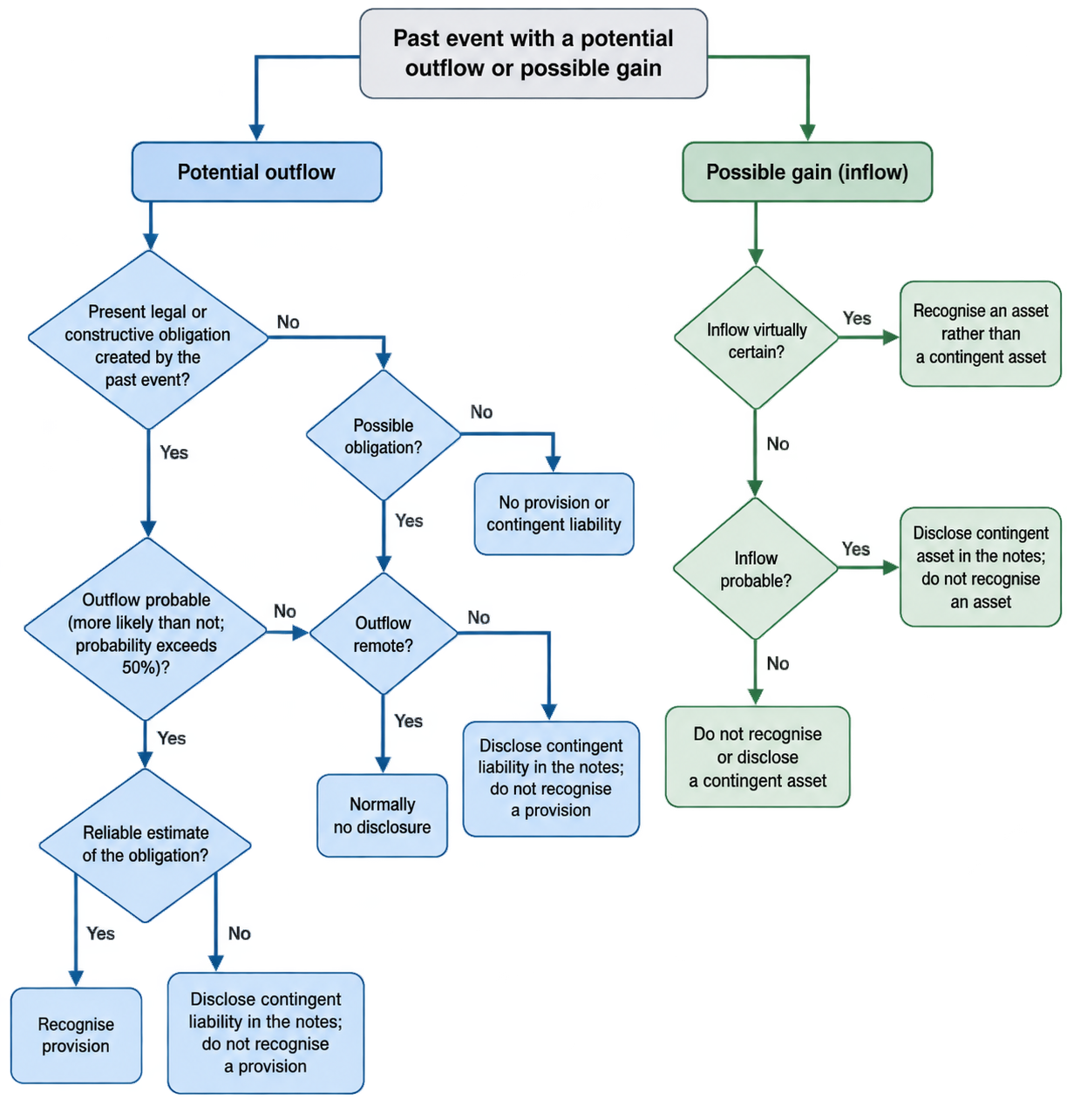
Read it from the top. For a potential outflow, ask first whether a past event has created a present obligation, then whether an outflow is probable, then whether the amount can be estimated reliably. With no present obligation, ask whether there is a possible one; if there is not, there is nothing to recognise or disclose. A possible obligation, or an outflow that is not probable, is disclosed as a contingent liability unless the outflow is remote. A present, probable obligation that cannot be estimated reliably is also disclosed as a contingent liability. For a possible gain, ask whether the inflow is virtually certain, then whether it is probable.
How is a provision measured?
A provision is measured at the best estimate, at the reporting date, of the spending needed to settle the present obligation. The estimate rests on the evidence available. It is not an arbitrary reserve or a deliberately generous figure.
The method depends on whether there is one obligation or many similar ones.
A single obligation: the most likely outcome. Legal advisers conclude that Marsh Ltd has a present obligation for one claim. They estimate a 70% chance of paying $30,000 and a 30% chance of paying nothing. An outflow is probable, and the most likely outcome is a payment of $30,000, so Marsh Ltd measures the provision at $30,000, provided the evidence supports that amount as the best estimate.
Many similar obligations: expected value. For a large population, weight each possible outcome by its probability and add the results. Expected value does not predict the cost of any one claim. It estimates the total cost across the whole group.
Worked example: Cedar Ltd's warranty provision
Cedar Ltd sold 1,000 products with warranties during 20X5. The warranties are still outstanding at 31 December 20X5 and no provision has yet been recorded. What provision should Cedar Ltd recognise?
| Outcome for each product | Probability | Repair cost per product |
|---|---|---|
| No defect | 75% | $0 |
| Minor defect | 20% | $40 |
| Major defect | 5% | $200 |
- Expected repair cost per product: (0.75 × $0) + (0.20 × $40) + (0.05 × $200) = $0 + $8 + $10 = $18.
- Provision for the products covered: 1,000 × $18 = $18,000.
- Record a warranty provision of $18,000 as a liability and a warranty expense of $18,000: debit warranty expense $18,000, credit warranty provision $18,000.
Check: the probabilities add up to 100%, and the products expected to need no repair are included in the calculation. Only 25% of products are expected to develop a fault, but across 1,000 warranties some spending is probable.
Movements in a provision and the journal entries
A provision is reviewed at every reporting date, so that its closing balance is the current best estimate of what is still needed to settle the obligation. Payments that settle the obligation reduce the provision. The balance left after those payments is then compared with the required closing figure, and only the difference goes to the statement of profit or loss.
- If the required closing provision is more than the balance left, the provision is increased.
- If it is less, the provision is decreased.
- If the obligation is settled in full, no liability remains for it. A provision that is no longer justified is released.
Cedar Ltd's warranty provision continues over the next two years. No new warranties are issued in these two years.
| Provision movement | Year ended 31 December 20X6 | Year ended 31 December 20X7 |
|---|---|---|
| Opening provision | $18,000 | $14,000 |
| Payments settling warranty claims | $7,000 | $6,000 |
| Balance left before adjustment | $11,000 | $8,000 |
| Required closing provision | $14,000 | $5,000 |
| Adjustment at the reporting date | $3,000 increase | $3,000 decrease |
In 20X6, payments bring the provision down from $18,000 to $11,000. The required balance is $14,000, so only the extra $3,000 is charged as an expense. In 20X7, payments leave $8,000 and the required balance is $5,000, so $3,000 is released, which reduces the expense. The closing provision is not the year's expense: the expense is the movement needed after the payments have been recorded.
The journal rules are:
- Creating or increasing a provision: debit the expense, credit the provision.
- Decreasing a provision: debit the provision, credit the expense.
- Paying to settle the obligation: debit the provision, credit bank. The payment is not charged as an expense again, because the cost was charged when the provision was made.
| Transaction | Debit | Credit |
|---|---|---|
| Initial provision, 20X5 | Warranty expense $18,000 | Warranty provision $18,000 |
| Warranty payments, 20X6 | Warranty provision $7,000 | Bank $7,000 |
| Increase at 31 December 20X6 | Warranty expense $3,000 | Warranty provision $3,000 |
| Warranty payments, 20X7 | Warranty provision $6,000 | Bank $6,000 |
| Decrease at 31 December 20X7 | Warranty provision $3,000 | Warranty expense $3,000 |
In the financial statements, the closing provision is a liability in the statement of financial position. The notes explain the nature of the provision, the expected timing of settlement and the significant uncertainties about its amount or timing, and they reconcile the opening balance to the closing balance through additions, amounts used and unused amounts released.
Provisions and contingencies in the ACCA FA and K1 syllabuses
Provisions and contingencies are in both ACCA Financial Accounting syllabuses: the FA exam of the current ACCA Qualification, and K1 Financial Accounting in the future ACCA Qualification, on demand from July 2027. A pass in FA gives credit for K1. How the two qualifications fit together is in our ACCA exams guide.
| Exam | Syllabus reference | What it asks |
|---|---|---|
| FA | D9 Provisions and contingencies, (a) to (f) | "Define a provision, contingent liability and contingent asset in accordance with IFRS Accounting Standards"; distinguish between and classify them; illustrate the methods of accounting for each; "Calculate provisions and changes in provisions"; "Prepare manual journal entries for the movement in provisions"; report provisions in the financial statements |
| K1 | C9 Provisions and contingencies, (a) to (d) | "Explain the nature of provisions, contingent liabilities and contingent assets"; summarise the differences in their accounting treatment; "Calculate provisions and movements in provisions"; "Prepare journal entries to account for provisions" |
IAS 37 is on ACCA's list of examinable documents for FA from September 2026 to June 2027. You can read the full FA syllabus and K1 syllabus on ACCA's site. Both say the questions "will assess all parts of the syllabus".
FA and K1 are both two-hour computer-based exams: 35 two-mark objective test questions in Section A and two 15-mark multi-task questions in Section B. The pass mark is 50%. The exam guide covers everything else about the two exams.
Every topic on this page is in both syllabuses.
Provisions and contingent liabilities practice questions (ACCA FA and K1)
The four practice questions below are from Medly's ACCA K1 Financial Accounting course, and the answers follow Medly's mark schemes. Try each one before you open the answer. They test recognition, classification and measurement; none asks for a movement in a provision.
Question 1: (2 marks)
A freight-forwarding agency prepares financial statements for the year ended 31 December 20X5:
A customer has made a claim for goods damaged during delivery. The agency has a present legal obligation, settlement is probable and the best estimate of the amount payable is $48,000.
No amount has been recorded and none is recoverable from insurance.
Which TWO treatments are required in the financial statements for the year ended 31 December 20X5? Select 2 answers.
A. Recognise an asset of $48,000
B. Recognise an expense of $48,000
C. Recognise a provision of $48,000
D. Disclose the claim without recognising a liability
Answer
B and C. Both are needed for the 2 marks.
- The damage happened before the year end and the agency has a present legal obligation: the first test is met.
- Settlement is probable and there is a best estimate of $48,000: the other two tests are met.
- So a provision of $48,000 is recognised as a liability (C), and the other side of the entry is an expense of $48,000 (B): debit expense, credit provision.
A is wrong because the claim creates an obligation, not an asset, and nothing is recoverable from insurance. D is wrong because all three recognition tests are met, so disclosure on its own is not enough.
Question 2: (2 marks)
Which statements are correct according to IAS 37 Provisions, Contingent Liabilities and Contingent Assets?
1. A contingent liability arising from a possible obligation is recognised in the statement of financial position.
2. A present obligation from a past event is a contingent liability if settlement is not probable or its amount cannot be measured reliably.
3. A contingent asset is not recognised in the financial statements while the inflow remains contingent.
4. An asset is recognised when the associated inflow becomes virtually certain, as the asset is no longer contingent.
A. 2 and 3 only
B. 2, 3 and 4 only
C. 1, 2 and 3 only
D. 1 and 4 only
Answer
B. 2, 3 and 4 only. Both marks go to the complete correct selection.
- Statement 1 is false: a contingent liability is never recognised. It is disclosed unless the outflow is remote.
- Statement 2 is true: it is the second part of the definition of a contingent liability.
- Statement 3 is true: a contingent asset is not recognised.
- Statement 4 is true: once an inflow is virtually certain, the asset is no longer contingent and is recognised.
A leaves out statement 4, which is true. C includes statement 1, which is false, and leaves out statement 4. D includes the false statement 1 and leaves out statements 2 and 3, which are both true.
Question 3: (2 marks)
Vesper Co is preparing its financial statements for the year ended 30 June 20X6. Two legal claims arose from events before the year end.
A customer has brought a claim for faulty installation. Legal advisers state that Vesper Co has a present obligation and a 75% chance of losing the case. If it loses, it will pay $120,000; otherwise it will pay nothing.
A former supplier has claimed $80,000. Legal advisers estimate that the supplier has a 30% chance of succeeding.
How should these claims be reported as liabilities in Vesper Co's statement of financial position as at 30 June 20X6?
A. Customer: $90,000; supplier: $24,000
B. Customer: $90,000; supplier: no liability
C. Customer: $120,000; supplier: nil
D. Customer: $120,000; supplier: $80,000
Answer
C. Customer: $120,000; supplier: nil
- Customer claim: there is a present obligation from a past event, and a 75% chance of paying is more likely than not, so the outflow is probable. A provision is recognised.
- It is a single obligation, so it is measured at the most likely outcome: $120,000.
- Supplier claim: a 30% chance of success means an outflow is not probable. It is a contingent liability, disclosed in the notes, so no liability is reported.
A uses probability-weighted amounts (75% × $120,000 = $90,000; 30% × $80,000 = $24,000) and wrongly recognises the supplier claim. B is right about the supplier but uses the expected value of $90,000 for a single obligation. D recognises the supplier claim even though its outflow is not probable.
Question 4: (2 marks)
Marlow Waste Co prepares financial statements for the year ended 31 December 20X6:
A spill before that date left the company legally responsible for restoring the affected site.
The outflow is assessed as 80% likely, with a cost of $40,000; the final amount and payment date are uncertain.
Which TWO of the following are correct for the financial statements for the year ended 31 December 20X6? Select 2 answers.
A. Recognise a provision.
B. Disclose a contingent liability.
C. Recognise a liability of $40,000 in the statement of financial position.
D. Recognise a liability of $32,000 in the statement of financial position.
Answer
A and C. Both are needed for the 2 marks.
- The spill before the year end created a present legal obligation.
- An 80% likely outflow is probable, and the cost can be estimated reliably, so a provision is recognised (A).
- It is a single obligation, so it is measured at the most likely outcome of $40,000 (C). The uncertain final amount and payment date are why it is a provision rather than an ordinary liability.
B is wrong because a contingent liability is only for an item that fails the recognition tests; this one meets all three. D is wrong because $32,000 is the expected value (80% × $40,000), which is used for a large population of similar obligations, not for one.
Medly's ACCA K1 Financial Accounting course has lessons for every topic of the course and full-length practice papers, with answers marked step by step. It is free to start, with no card needed.
Frequently asked questions
What is a provision in accounting?
A provision is a liability of uncertain timing or amount. Under IAS 37 it is recognised only when a past event has created a present obligation, an outflow is probable and the amount can be reliably estimated.
Is a provision a liability?
Yes. A provision is a liability in the statement of financial position. What sets it apart is uncertainty about how much will be paid or when.
What is the difference between a provision and a contingent liability?
A provision meets all three recognition tests and is recorded as a liability. A contingent liability is a possible obligation, or a present obligation that fails the probable or reliable-estimate test; it is not recorded, and is disclosed in the notes unless the outflow is remote.
Is a contingent asset recognised?
No. A contingent asset is disclosed when an inflow is probable, and not mentioned at all when it is only possible. When the inflow becomes virtually certain, it is no longer contingent and an asset is recognised.
How is a provision measured?
At the best estimate of the spending needed to settle the obligation at the reporting date. For a single obligation, the most likely outcome may be the best estimate; a large population of similar obligations is measured at expected value.
What is the double entry for a provision?
To create or increase a provision, debit the expense and credit the provision. To decrease it, debit the provision and credit the expense; to pay the obligation, debit the provision and credit bank.