
Provision for doubtful debts and irrecoverable debts: the double entry, the allowance and ACCA FA practice questions
Write off a debt, record a recovery, create and adjust the allowance, and bring them together into the year's expense.
On this page
A provision for doubtful debts is an estimate of the trade receivables a business may not collect, deducted from receivables in the statement of financial position. ACCA's FA and K1 syllabuses call it the allowance for irrecoverable debts, and this guide uses that name from here on. An irrecoverable debt is different: it is a specific debt the business no longer expects to collect, so it is written off. This guide gives the double entry for a write-off, a later recovery and each change in the allowance, works one set of figures through to the year's expense, and ends with four ACCA FA and K1 practice questions.
Provision for doubtful debts and the allowance for irrecoverable debts
ACCA uses one term in both syllabuses. FA asks you to "Prepare manual journal entries to create and adjust an allowance for irrecoverable debts", and K1 asks you to "Calculate and prepare journal entries to account for the creation of and movements in an allowance for irrecoverable debts". Other names for the same thing, such as a doubtful debt provision or a provision for bad and doubtful debts, are also in use. This page uses ACCA's.
The topic covers two different things, and the treatment depends on which you have.
- Doubtful debts are amounts whose collection is uncertain. They stay in trade receivables, and the allowance reflects the risk that some will not be paid.
- Irrecoverable debts are amounts identified as uncollectable. They are written off and removed from trade receivables.
The allowance is kept in its own general ledger account, separate from trade receivables. Trade receivables normally have a debit balance and the allowance a credit balance, and the allowance is deducted from receivables in the statement of financial position. It is not a liability or a separate fund of cash. A provision in the IAS 37 sense is a liability, and is covered on our provisions page. The allowance is an estimate, reviewed at each reporting date, and it does not cancel any customer's obligation to pay.
How do you write off an irrecoverable debt?
An irrecoverable debt is a specific debt the business no longer expects to collect, for example because the customer has ceased trading with no funds to pay. A late payment on its own does not make a debt irrecoverable. Once there is no expected benefit from collecting it, the debt is no longer an asset and is written off.
The journal is:
- Debit irrecoverable debts expense
- Credit trade receivables
There is no entry to bank, because writing off a debt involves no cash.
Worked example
A business invoiced a customer for $5,000. The customer paid $1,800, which has already been recorded. On 12 May, the business establishes that it will receive nothing further. What amount should be written off, and what journal is required?
- Outstanding balance: $5,000 − $1,800 = $3,200.
- None of it is expected to be collected, so the irrecoverable debt is $3,200, not the original $5,000 invoice.
- Record the write-off on 12 May.
| Account | Debit ($) | Credit ($) |
|---|---|---|
| Irrecoverable debts expense | 3,200 | |
| Trade receivables | 3,200 |
Expense rises by $3,200 and trade receivables fall by $3,200. Bank does not change.
Irrecoverable debt recovered after it was written off
Sometimes a customer pays after the debt has been written off. The recovery is recorded at the amount actually received, in the period it is received.
The journal is:
- Debit bank
- Credit irrecoverable debts expense
Trade receivables do not change, because the debt was already removed. The credit reduces the expense: it is not a new credit sale and does not create sales revenue. If the recovery comes in a later period, it is recorded in that later period, and the earlier write-off is left as it was.
Continuing the worked example: on 20 June the same customer unexpectedly pays $900 into the bank.
| Account | Debit ($) | Credit ($) |
|---|---|---|
| Bank | 900 | |
| Irrecoverable debts expense | 900 |
The remaining $3,200 − $900 = $2,300 stays written off. Suppose total trade receivables were $18,000 just before the write-off, including this customer's $3,200, and both dates fall in the same reporting period, with no other movements in receivables. The checks are:
- Trade receivables: $18,000 − $3,200 = $14,800. The recovery does not reduce them again.
- Net irrecoverable debts expense: $3,200 − $900 = $2,300.
- Bank rises by $900. The write-off itself moved no cash.
Allowance for irrecoverable debts: creating, increasing and decreasing it
The figures from here on belong to a different business from the $3,200 customer above. This business has trade receivables of $60,000 at 31 December 20X5 before a $3,000 irrecoverable debt is written off, and it keeps an allowance of 4% of the receivables that remain.
First work out the required closing allowance, on receivables after write-offs:
- Receivables after the write-off: $60,000 − $3,000 = $57,000.
- Required closing allowance: $57,000 × 4% = $2,280.
Use $57,000, not $60,000, because the $3,000 has already left receivables. Do not deduct the existing allowance before applying the percentage: it is a separate balance that you compare with the new requirement.
The required closing allowance is not necessarily the expense. The entry is the difference between the required balance and the balance already in the account. This business had an existing credit balance of $1,800, so the increase is $2,280 − $1,800 = $480.
The table shows three separate situations, each needing a closing allowance of $2,280.
| Situation | Existing balance | Adjustment | Journal |
|---|---|---|---|
| Create | $0 | Increase of $2,280 | Dr Irrecoverable debts expense $2,280; Cr Allowance for irrecoverable debts $2,280 |
| Increase | $1,800 | Increase of $480 | Dr Irrecoverable debts expense $480; Cr Allowance for irrecoverable debts $480 |
| Decrease | $3,000 | Decrease of $720 | Dr Allowance for irrecoverable debts $720; Cr Irrecoverable debts expense $720 |
An increase is an extra expense, so it reduces profit, and the bigger deduction from receivables reduces net assets by the same amount. A decrease does the opposite: it reduces the expense and increases profit and net assets. Neither changes gross trade receivables or cash. The customers still owe the same amounts; only the estimate has changed.
A write-off does not reduce the allowance automatically. After any write-off, work out the allowance again on its stated basis.
Irrecoverable debts expense for the year: worked example
The year's irrecoverable debts expense brings all of these together: debts written off, plus any increase in the allowance, less recoveries of debts written off before, less any decrease in the allowance.
Worked example
The $60,000 business above has three items for 20X5: the $3,000 write-off and the $480 allowance increase from the last section, and $500 received during 20X5 from a debt written off in an earlier period. What is the irrecoverable debts expense, and what is shown for trade receivables at 31 December 20X5?
| Component | Amount | Treatment |
|---|---|---|
| Debt written off in 20X5 | $3,000 | Add |
| Increase in the allowance | $480 | Add |
| Recovery of a debt written off earlier | $500 | Deduct |
- Irrecoverable debts expense: $3,000 + $480 − $500 = $2,980.
- The closing allowance of $2,280 is not the expense: $1,800 of it was already recorded before this year's adjustment.
- Trade receivables after the write-off are $57,000. Deduct the closing allowance: $57,000 − $2,280 = $54,720 net trade receivables.
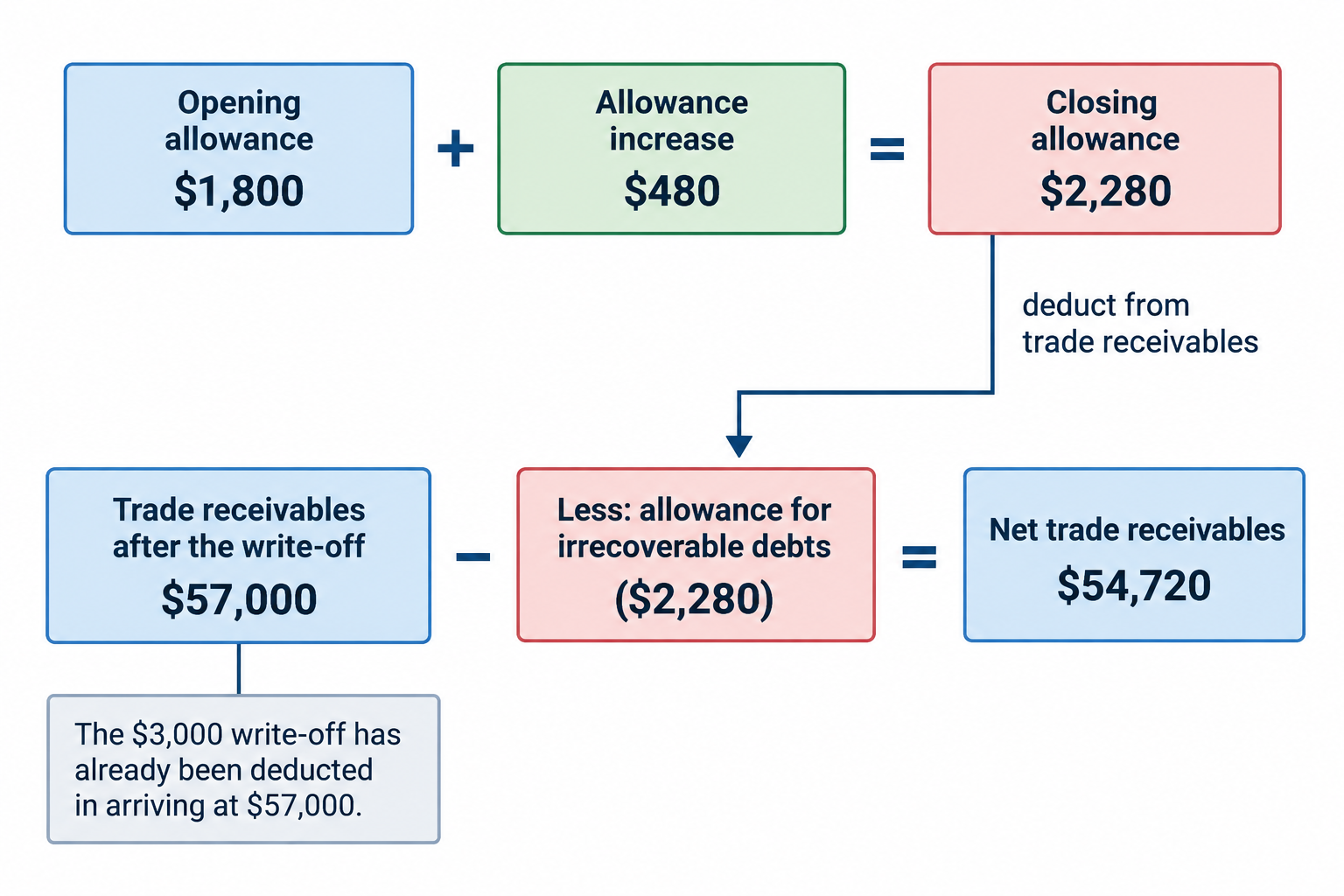
The statement of profit or loss shows an irrecoverable debts expense of $2,980. The statement of financial position shows trade receivables of $57,000 less an allowance of $2,280, which is $54,720. The $500 recovery is in cash, not in receivables, and the $3,000 write-off is already out of the $57,000, so deducting it again would understate receivables.
The allowance account rolls forward as $1,800 opening + $480 increase = $2,280 closing.
Irrecoverable debts in the ACCA FA and K1 syllabuses
Both syllabuses cover writing off irrecoverable debts, recoveries and the allowance, in the section on recording transactions.
| Exam | Reference | What it asks |
|---|---|---|
| FA | D8(e) to (i) | Journals to write off an irrecoverable debt and to recognise one later recovered; the impact on both statements; journals to create and adjust the allowance; how its movement and closing balance are presented |
| K1 | C7(c) to (f) | Calculations and journals for a write-off, a recovery and the creation of and movements in the allowance; the impact of each on the financial statements |
FA and K1 are both two-hour computer-based exams: 35 two-mark objective test questions in Section A and two 15-mark multi-task questions in Section B. The pass mark is 50%. The two exams are the FA exam of the current ACCA Qualification, and K1 Financial Accounting in the future ACCA Qualification, on demand from July 2027. A pass in FA gives credit for K1. Everything else about the exam is on our ACCA FA exam page.
The allowance is also one of the balances in a trial balance that usually has to be updated before it can be reported.
Every topic on this page is in both syllabuses.
Provision for doubtful debts practice questions (ACCA FA and K1)
The four practice questions below are from Medly's ACCA K1 Financial Accounting course, and the answers follow Medly's mark schemes. Try each one before you open the answer. They cover writing off debts, recoveries and movements in the allowance.
Question 1: (2 marks)
Rossiter Co is preparing its financial statements for the year ended 30 September 20X6. Orlan Co, a credit customer owing $4,200, has gone into liquidation and the balance is to be written off. Rossiter Co has also received a bank transfer of $1,500 from Tallow Co in settlement of a balance written off in the year ended 30 September 20X5. Neither event has been recorded.
Which TWO of the following double entries are required to record these events? Select 2 answers.
A. Dr Bank $1,500; Cr Trade receivables $1,500
B. Dr Bank $1,500; Cr Irrecoverable debts expense $1,500
C. Dr Irrecoverable debts expense $4,200; Cr Trade receivables $4,200
D. Dr Trade receivables $4,200; Cr Irrecoverable debts expense $4,200
Answer
The answers are B and C. You need both for the 2 marks.
- Orlan Co's debt is written off: Dr irrecoverable debts expense $4,200, Cr trade receivables $4,200 (C).
- Tallow Co's balance was written off last year, so it is no longer in trade receivables. The receipt is Dr bank $1,500, Cr irrecoverable debts expense $1,500 (B).
A is wrong because the Tallow Co balance was already removed from trade receivables when it was written off. D is wrong because it reverses the write-off entry.
Question 2: (2 marks)
Kestrel Co is preparing its financial statements for the year ended 31 October 20X7.
Before year-end adjustments, trade receivables were $248,000. The allowance for irrecoverable debts brought forward at 1 November 20X6 was $14,200.
A customer in liquidation owes $8,000, which must be written off as irrecoverable. A receipt of $1,500 in full settlement of a debt written off in the previous year has been entered in the bank general ledger account and credited to a suspense account. The recovery has not been recognised in irrecoverable debts expense. The closing allowance is to be 5% of remaining trade receivables. There were no other irrecoverable debts or recoveries during the year.
What is the irrecoverable debts expense in Kestrel Co's statement of profit or loss for the year ended 31 October 20X7? State your answer to the nearest whole dollar.
Answer
- Remaining trade receivables: $248,000 − $8,000 = $240,000.
- Required closing allowance: 5% × $240,000 = $12,000.
- Movement: $14,200 − $12,000 = a decrease of $2,200, which reduces the expense.
- The $1,500 recovery also reduces the expense. The cash is already in the bank; recognising the recovery moves it out of the suspense account and into irrecoverable debts expense.
- Expense: $8,000 − $1,500 − $2,200 = $4,300.
The answer is $4,300 for 2 marks. Using the $12,000 closing allowance as if it were the movement gives the wrong figure.
Question 3: (2 marks)
A mail-order pet-supplies company prepares financial statements at its reporting date.
Trade receivables are $80,000 at that date.
The allowance for irrecoverable debts has a credit balance of $6,000.
The company requires a closing allowance of 4% of trade receivables.
Which of the following journal entries records the required adjustment?
A. Dr Irrecoverable debts expense $2,800; Cr allowance for irrecoverable debts $2,800
B. Dr Allowance for irrecoverable debts $3,200; Cr irrecoverable debts expense $3,200
C. Dr Allowance for irrecoverable debts $2,800; Cr irrecoverable debts expense $2,800
D. Dr Irrecoverable debts expense $3,200; Cr allowance for irrecoverable debts $3,200
Answer
The answer is C.
- Required closing allowance: 4% × $80,000 = $3,200.
- Existing allowance: $6,000, so it must fall by $6,000 − $3,200 = $2,800.
- A decrease debits the allowance and credits the expense: Dr allowance $2,800, Cr irrecoverable debts expense $2,800.
A is wrong because it increases the allowance instead of reducing it. B is wrong because it treats the $3,200 closing allowance as the adjustment, which would leave an allowance of $2,800. D is wrong because it also treats the closing allowance as the adjustment, and adds it to the existing balance, giving an allowance of $9,200.
Question 4: (2 marks)
An art auction house prepares financial statements for the year ended 31 December 20X5.
Trade receivables before writing off a customer's debt of $8,000 were $240,000. The existing allowance for irrecoverable debts was $9,000.
The required closing allowance for irrecoverable debts is 5% of remaining trade receivables. No other irrecoverable debt transactions occurred during the year.
Which TWO amounts are correct for the financial statements for the year ended 31 December 20X5? Select 2 answers.
A. Irrecoverable debts expense for the year: $2,600
B. Irrecoverable debts expense for the year: $10,600
C. Closing allowance for irrecoverable debts: $12,000
D. Closing allowance for irrecoverable debts: $11,600
Answer
The answers are B and D. You need both for the 2 marks.
- Remaining trade receivables: $240,000 − $8,000 = $232,000.
- Closing allowance: 5% × $232,000 = $11,600 (D).
- Increase in the allowance: $11,600 − $9,000 = $2,600.
- Expense: $8,000 write-off + $2,600 increase = $10,600 (B).
A is wrong because it is only the allowance increase and leaves out the $8,000 write-off. C is wrong because it applies 5% to receivables before the debt is written off.
Medly's ACCA K1 Financial Accounting course has lessons for every topic of the course and full-length practice papers, with answers marked step by step. It is free to start, with no card needed.
Frequently asked questions
Is a provision for doubtful debts the same as an allowance for irrecoverable debts?
Yes. Both are estimates of the receivables that may not be collected, deducted from trade receivables. ACCA's FA and K1 syllabuses use the name allowance for irrecoverable debts.
What is the double entry for a provision for doubtful debts?
To create or increase the allowance, debit irrecoverable debts expense and credit the allowance for irrecoverable debts with the increase. To decrease it, debit the allowance and credit the expense with the decrease.
What is the double entry for writing off an irrecoverable debt?
Debit irrecoverable debts expense and credit trade receivables with the amount still owed that will not be collected. There is no entry to bank.
What is a bad debt?
Bad debt is another name for an irrecoverable debt: a specific debt the business no longer expects to collect, which is written off to an expense.
Is the allowance for irrecoverable debts an asset or a liability?
Neither on its own. It is a credit balance that is deducted from trade receivables in the statement of financial position, and it is not a liability or a fund of cash.
What happens when a debt that was written off is paid?
Debit bank and credit irrecoverable debts expense with the amount received, in the period it arrives. Trade receivables do not change, because the debt was removed when it was written off.
Is an increase in the allowance an expense?
Yes. When an allowance already exists, only the movement in it goes to irrecoverable debts expense, not the whole closing balance, so an increase reduces profit and a decrease adds to it.