
Semi-conservative replication of DNA: A-Level Biology steps and exam questions
Follow DNA replication step by step, see how Meselson and Stahl tested the model, and try exam questions with answers.
On this page
Semi-conservative replication is how DNA copies itself: each new DNA molecule keeps one strand of the original molecule and gains one newly made strand. This guide follows AQA A-Level Biology (7402) and AQA AS Biology (7401) through the steps, the two enzymes, the evidence and exam questions with answers.
What is semi-conservative replication?
In replication, each original DNA strand acts as a template: its exposed bases decide the order of bases in a new strand. A template reading A C T G, for example, gives a new strand reading T G A C.
When replication is complete there are two daughter DNA molecules, and each contains one original strand and one newly made strand. That is what semi-conservative means: each new molecule conserves one strand of the old one. Because each template sets the base sequence of its new partner, both daughter molecules carry the same genetic information when replication is accurate, which gives genetic continuity between generations of cells.
DNA structure you need for replication
A DNA molecule is two polynucleotide chains twisted into a double helix. The chains are held together by hydrogen bonds between complementary base pairs: adenine with thymine, and cytosine with guanine. DNA carries the genetic code for the production of proteins.
Each DNA nucleotide contains a phosphate group, the sugar deoxyribose and one organic base. Within each strand, nucleotides are joined by phosphodiester bonds, formed by condensation reactions that link the phosphate group of one nucleotide to the sugar of the next.
The steps of DNA replication
AQA's specification describes the process "in terms of" five points: "unwinding of the double helix"; "breakage of hydrogen bonds between complementary bases in the polynucleotide strands"; "the role of DNA helicase in unwinding DNA and breaking its hydrogen bonds"; "attraction of new DNA nucleotides to exposed bases on template strands and base pairing"; and "the role of DNA polymerase in the condensation reaction that joins adjacent nucleotides". It also says students should be able to "evaluate the work of scientists in validating the Watson-Crick model of DNA replication".
In order:
- DNA helicase unwinds the double helix.
- DNA helicase breaks the hydrogen bonds between complementary bases, so the two strands separate. The sugar-phosphate part of each strand stays intact.
- The bases on each original strand are now exposed, and each strand acts as a template.
- Free DNA nucleotides are attracted to their complementary exposed bases, and hydrogen bonds form between the paired bases.
- DNA polymerase joins adjacent nucleotides in condensation reactions, building the sugar-phosphate backbone of the new strand and releasing water.
- The result is two DNA molecules, each with one original strand and one new strand.
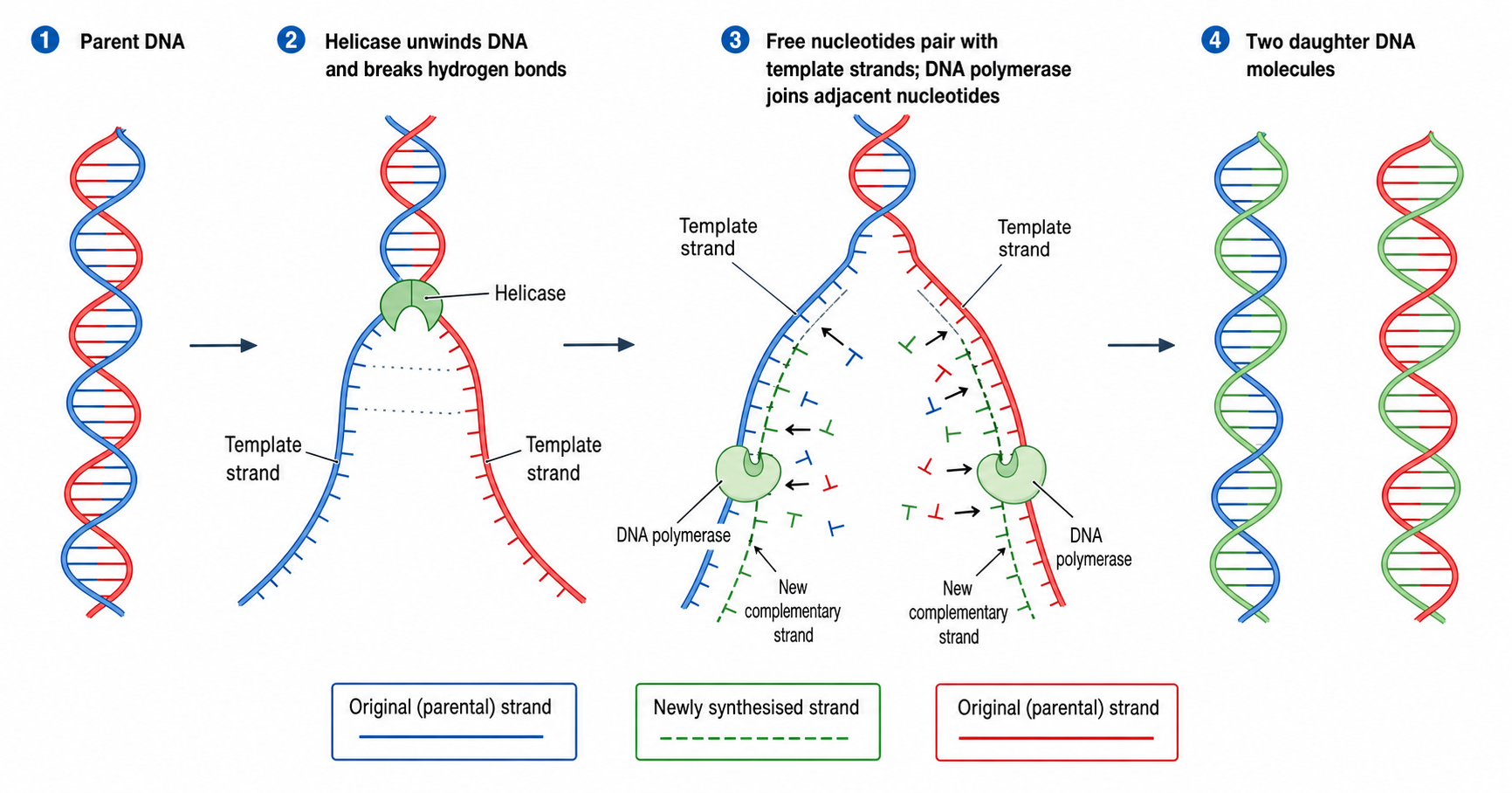
What do DNA helicase and DNA polymerase do?
DNA helicase separates the two strands; DNA polymerase builds each new strand.
| Enzyme | What it acts on | What it does |
|---|---|---|
| DNA helicase | The original double helix | Unwinds it and breaks the hydrogen bonds between complementary bases |
| DNA polymerase | Free nucleotides paired on a template strand | Joins adjacent nucleotides by condensation reactions into a new polynucleotide strand |
Meselson and Stahl: evidence for semi-conservative replication
The Watson-Crick model proposed that DNA replication is semi-conservative. In 1958, Matthew Meselson and Franklin Stahl tested it with Escherichia coli. They grew the bacteria in a medium containing nitrogen-15, which made their DNA dense, then moved them to nitrogen-14, which makes less dense new DNA. They sampled the DNA after one and two rounds of replication and separated it by density.
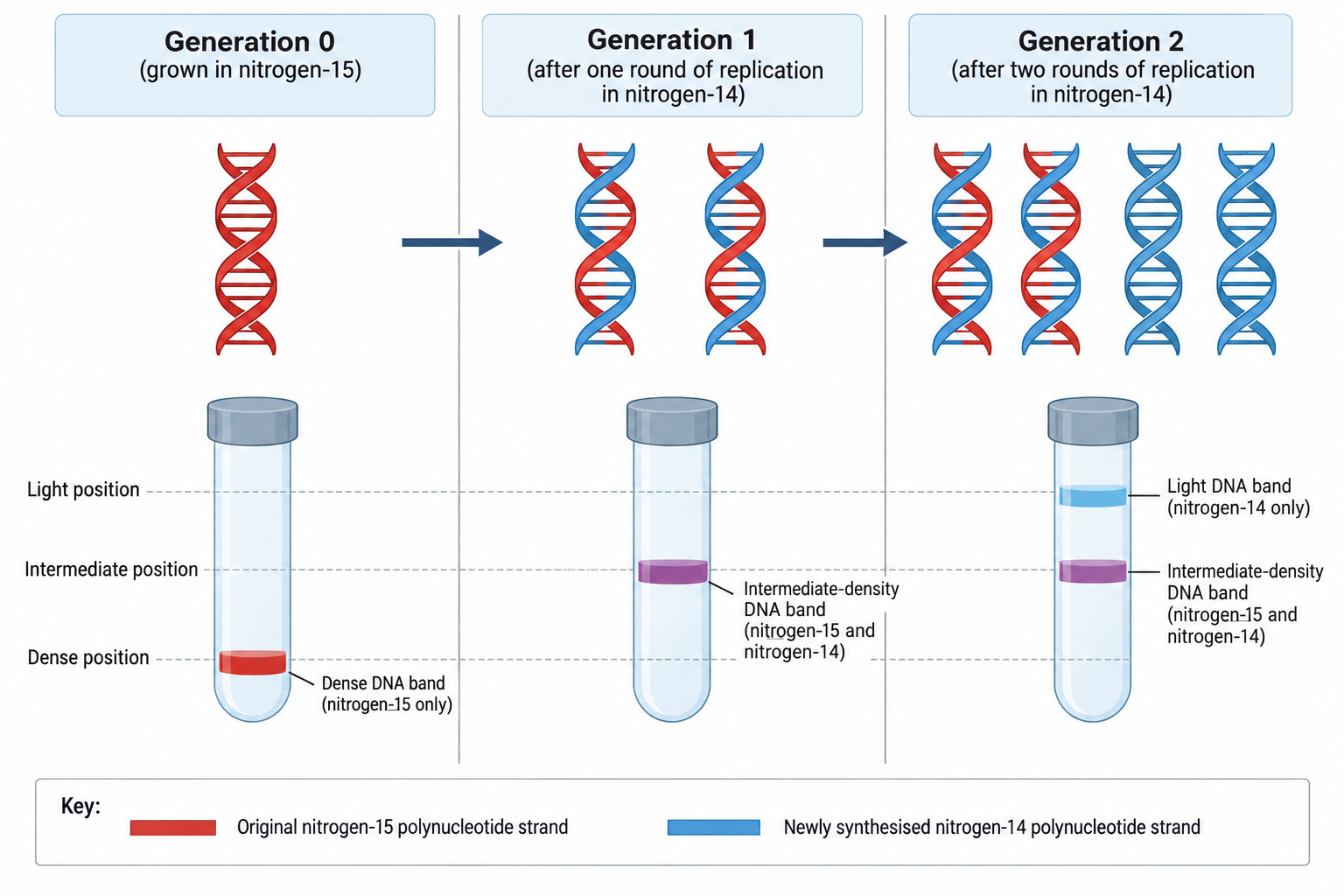
| After one round | After two rounds | |
|---|---|---|
| Conservative model predicts | One dense band and one light band | Dense and light bands remain |
| Semi-conservative model predicts | One intermediate band | One intermediate band and one light band |
| Dispersive model predicts | One intermediate band | One band that becomes progressively lighter |
| Meselson and Stahl observed | One intermediate band | One intermediate band and one light band |
The observations match semi-conservative replication. After one round every molecule had one nitrogen-15 strand and one nitrogen-14 strand. Conservative replication was rejected because there were no separate dense and light bands after the first round, and dispersive replication because two distinct bands appeared after the second.
The experiment supported the model through its products. It used E. coli only and measured DNA density, so it did not show hydrogen bonds, base pairing or enzyme action directly.
DNA replication exam questions with answers (AQA A-Level Biology)
The worked example and the two questions below are exam-style questions from Medly, marked with Medly's mark schemes.
Worked example (3 marks)
Researchers first grew bacteria in a medium containing a dense nitrogen isotope.
They then transferred the bacteria to a medium containing a light nitrogen isotope.
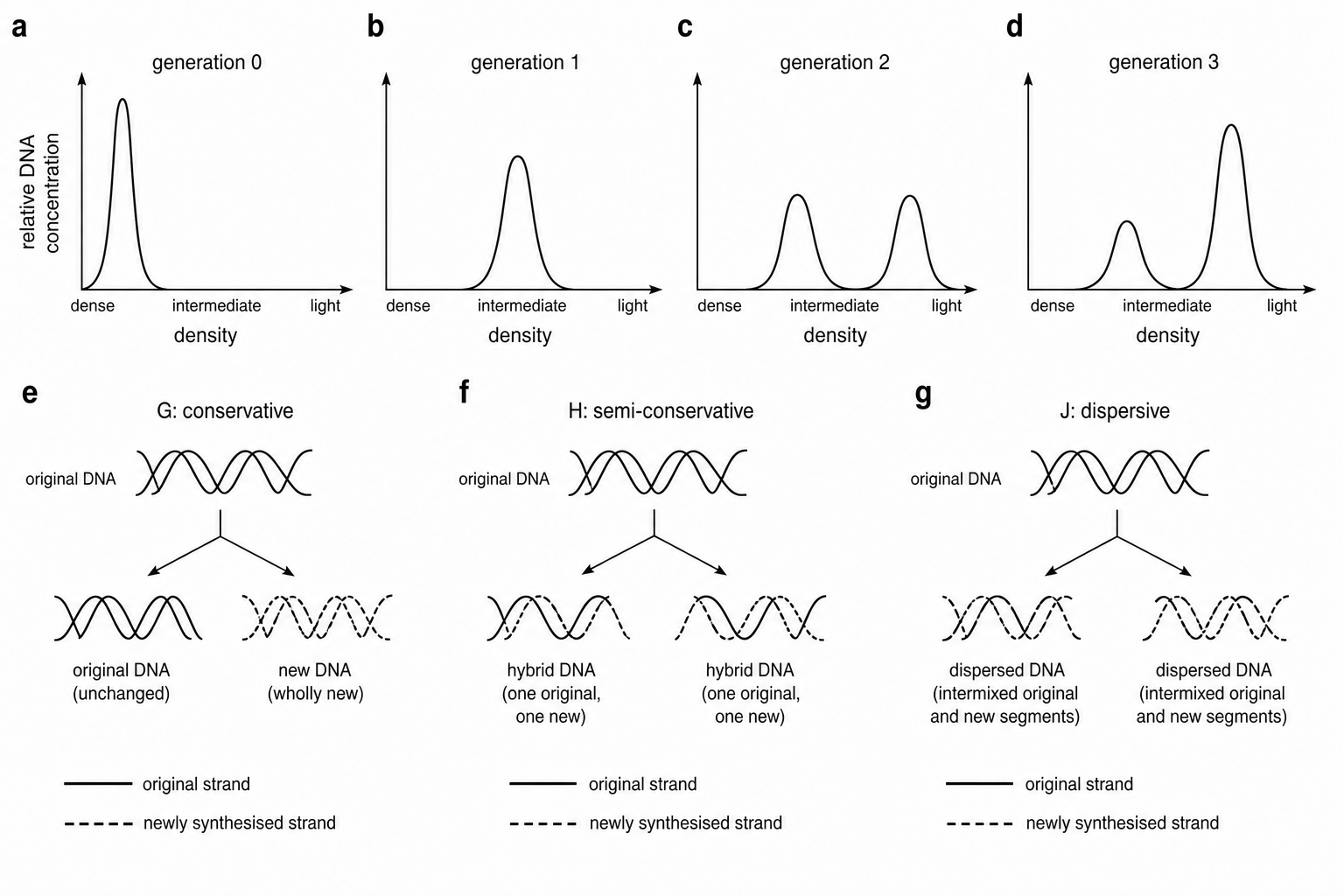
Give the model letter and name supported by the results shown in the figure, and explain why the other models should not be selected.
- Model H, semi-conservative replication: 1 mark, needed for full marks. Medly's mark scheme needs both the letter and the name.
- Conservative replication (G) predicts separate dense and light bands after generation 1, not the single intermediate-density band the figure shows: 1 mark.
- Dispersive replication (J) predicts one band that becomes progressively lighter, not the separate intermediate and light bands at generation 3: 1 mark.
Question 1: (3 marks)
Scientists investigated how DNA is copied. They grew bacteria in a medium containing heavy nitrogen, so all of the bacterial DNA was dense. They then moved the bacteria to a medium containing light nitrogen and measured the density of the DNA after each generation.
The diagram shows their results (a to d) and three models of DNA replication (e to g).
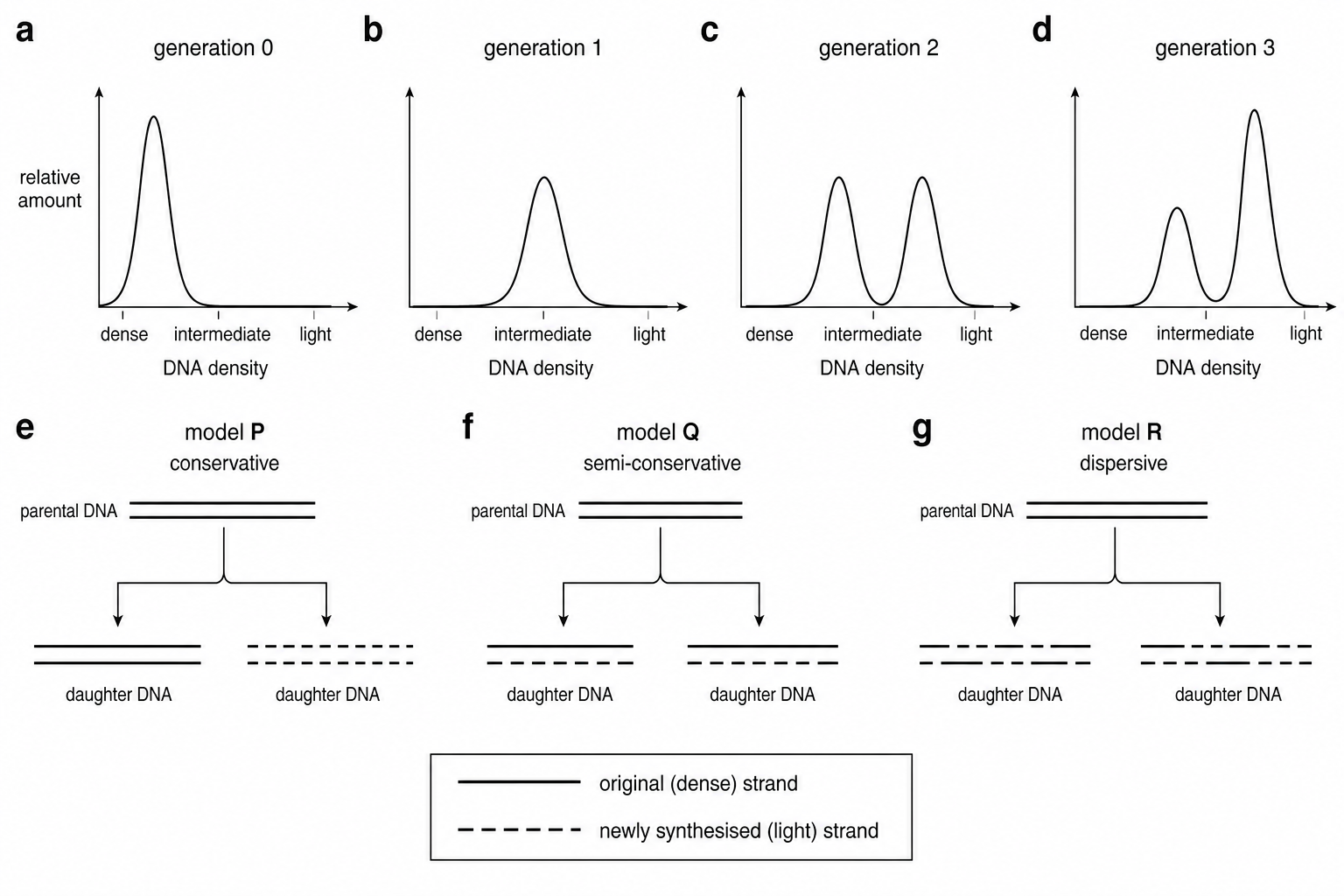
Which model, P, Q or R, is supported by the results in the diagram?
Explain why the other two models are not supported.
Answer
- Model Q, semi-conservative replication (1 mark, needed for full marks).
- Conservative replication predicts dense and light DNA after one replication, not the observed intermediate band (1 mark).
- Dispersive replication predicts one progressively lighter band after two replications, not the observed separate intermediate and light bands (1 mark).
Question 2: (3 marks)
Catalase converts hydrogen peroxide into water and oxygen. Different alleles of the gene coding for catalase have different DNA base sequences.
Some strains of mung bean produce seedlings with different tolerances to high concentrations of hydrogen peroxide.
(a) State one structural feature of a DNA molecule. [1 mark]
(b) Explain how two DNA sequences with different base sequences can carry information for contrasting tolerance to hydrogen peroxide in mung bean seedlings. [2 marks]
Answer
(a)
- DNA is a polymer consisting of many nucleotide subunits (1 mark). Medly's mark scheme also accepts "DNA is a polynucleotide / double helix / two antiparallel polynucleotide strands held together by complementary base pairing".
(b) Any two of these, up to 2 marks; the last point is needed for full marks:
- The sequence of bases in DNA determines its genetic information.
- Different base sequences represent different genetic information.
- The DNA sequence can determine the amino-acid sequence of catalase.
- Different genetic information can produce a different catalase protein, causing contrasting tolerance to hydrogen peroxide in mung bean seedlings.
In Medly's mark schemes, the two model questions above are marked on naming the semi-conservative model, then on one reason against each of the other two. Medly marks written answers like Question 1 against the mark scheme, so you can see which point you missed. Medly's free plan includes 5 marked questions, 20 AI tutor messages and 1 uploaded paper a day, with no card needed. Medly has an AQA A-Level Biology course.
Where marks are lost on DNA replication questions
- Medly's mark scheme for the worked example says: "Both H and semi-conservative required."
- Medly's mark scheme for Question 1 gives one mark for each of the other two models, and each needs the prediction that the bands contradict.
- AQA A-Level Biology (7402) Paper 1, June 2023, report on the examination, question 10.2, a question on the structure of DNA: "some students only provided first letters of the base names which, as in previous examinations, was not credited."
Which paper is DNA replication on?
AQA's A-Level Paper 1 and Paper 3 can examine DNA replication, and so can both AS papers: our papers guide has what each paper covers.
Frequently asked questions
What does semi-conservative mean?
Each new DNA molecule keeps one strand of the original molecule and has one newly made strand.
What does DNA helicase do?
It unwinds the double helix and breaks the hydrogen bonds between complementary bases, separating the two strands.
What does DNA polymerase do?
It joins adjacent DNA nucleotides on a template strand by condensation reactions, forming the new strand.
When does DNA replication happen?
During interphase, before the cell divides. Our mitosis page covers the cell cycle.
Are leading and lagging strands on AQA's specification?
AQA's specification does not mention leading or lagging strands. It describes the process "in terms of" the five points listed above. Our specification guide shows where DNA replication sits in the course.