
Rf value: the formula, paper chromatography and GCSE exam questions
Measure and calculate Rf values, follow the paper chromatography practical and practise with exam questions and answers.
On this page
An Rf value compares how far a substance moved up a chromatogram with how far the solvent moved: Rf = distance moved by substance ÷ distance moved by solvent. This guide follows AQA, for both GCSE Chemistry (8462) and Combined Science: Trilogy (8464), at both tiers. It shows you how to measure and calculate an Rf value, how paper chromatography works, the required practical method and how it is examined, with exam questions and answers.
What is the Rf value formula?
The Rf value is the distance moved by a substance divided by the distance moved by the solvent.
Rf = distance moved by substance ÷ distance moved by solvent
Both distances are measured from the origin, the pencil line where the sample was placed. Exam questions also call it the start line. AQA's specification defines the substance's distance as the "centre of spot from origin". An Rf value has no unit, because it is a ratio of two distances measured in the same unit. A spot cannot travel further than the solvent front, so for a spot between the origin and the front the Rf value is greater than 0 and less than 1.
Paper 2, for both AQA courses: see the Paper 2 guide.
How to calculate an Rf value from a chromatogram
You need two measurements, both from the origin: one to the centre of the spot and one to the solvent front.
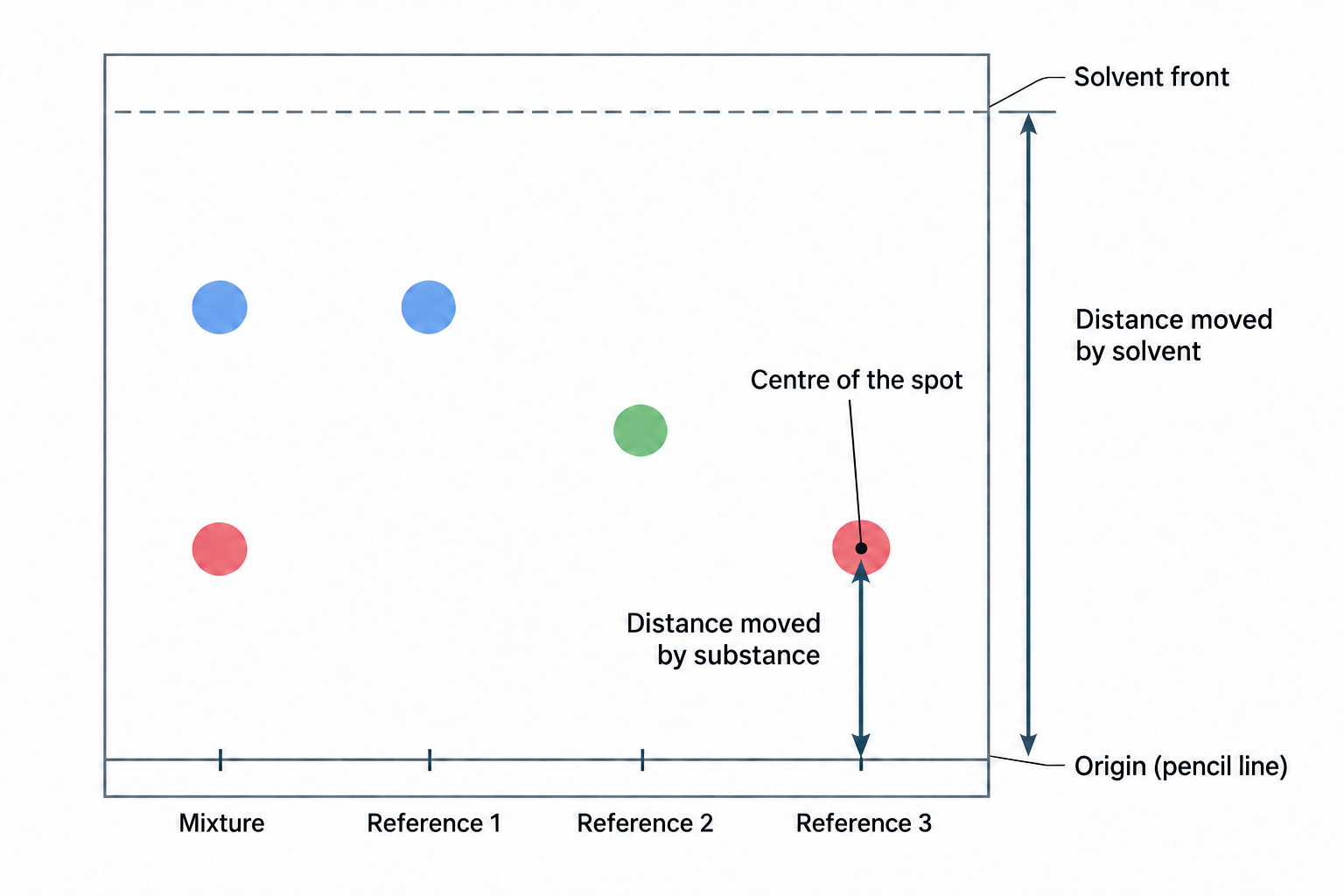
- Find the origin (the pencil line) and the solvent front (the furthest point the solvent reached).
- Measure from the origin to the solvent front.
- Measure from the origin to the centre of the spot, not to its top or bottom edge.
- Use the same unit for both, usually millimetres.
- Divide the spot distance by the solvent distance.
- Give the answer to a sensible number of significant figures, with no unit, and check it is less than 1.
For example, a spot has moved 26 mm and the solvent front 42 mm. Rf = 26 ÷ 42 = 0.619…, which is 0.62 to two significant figures, because both distances were measured to two significant figures.
To find the distance moved by the solvent from an Rf value, rearrange the formula: distance moved by solvent = distance moved by substance ÷ Rf.
On AQA's GCSE science papers from 2027, where a calculation says "show your working", the right answer alone earns one mark (see our Paper 2 guide).
How does paper chromatography work?
Paper chromatography separates substances because each one is shared differently between two phases. AQA's specification puts it like this: "Chromatography involves a stationary phase and a mobile phase. Separation depends on the distribution of substances between the phases."
- The stationary phase does not move. In paper chromatography it is the paper.
- The mobile phase moves through the stationary phase. In paper chromatography it is the solvent.
- A substance more strongly attracted to the solvent travels further up the paper.
- A substance more strongly attracted to the paper travels less far, because it spends more time attached to the paper.
Different substances have different attractions to the two phases, so they travel different distances and separate into spots.
Paper chromatography required practical: method
AQA's required practical asks you to "investigate how paper chromatography can be used to separate and tell the difference between coloured substances. Students should calculate Rf values." It is required practical 6 in GCSE Chemistry and required practical 12 in Combined Science: Trilogy.
- Draw a pencil origin line near the bottom of the chromatography paper. Pencil does not dissolve in the solvent, but ink would and could form extra coloured marks.
- Use a capillary tube to put small, concentrated spots of each known substance and the unknown sample on the line, and let them dry. Large or dilute spots spread into each other.
- Add a shallow layer of solvent to the beaker or tank. Hang the paper so its bottom edge is in the solvent but the origin stays above it, then cover the vessel. If the spots were below the solvent, they would dissolve into it instead of moving up the paper.
- Take the paper out before the solvent reaches the top and mark the solvent front in pencil straight away, before the solvent evaporates and the front disappears. Let the paper dry.
- Record the number and colour of the spots. Measure from the origin to the centre of each spot and to the solvent front, then calculate each Rf value.
AQA's method for this practical uses water as the solvent, with food colourings as the samples. The paper hangs from a support across the beaker so its sides do not touch the beaker wall, and with water as the solvent a lid is not essential.
Wear eye protection. This practical is done in the school lab with your teacher.
What does a chromatogram tell you?
A chromatogram can show whether a substance is pure and help identify what is in a mixture.
| What you see | What it shows |
|---|---|
| One spot | Evidence of a pure compound |
| Several separate spots | Evidence of a mixture |
| Spots level with reference substances | Evidence that the mixture may contain those substances |
AQA's specification says "a pure compound will produce a single spot in all solvents". To identify a substance, compare its Rf value with a known substance run on the same paper, in the same solvent and under the same conditions. For example, a green food colouring that gives a yellow spot with Rf 0.30 and a blue spot with Rf 0.60, the same as known yellow and blue substances, gives evidence that it contains both. A matching Rf value is supporting evidence, not proof: different compounds can sometimes travel similar distances in one solvent. Changing the solvent can change the Rf values, so only compare values from the same solvent.
How AQA examines Rf values and chromatography
AQA's recent GCSE Chemistry (8462) papers have asked for the calculation, the reasons behind the method and what the spots mean.
- June 2024 Higher Paper 2, question 04. A student tested orange dyes. 04.1 (2 marks): the yellow dye travels further because it has a weaker attraction to the chromatography paper. 04.2 (3 marks): in a second experiment the yellow dye travelled further, because the solvent was different and the yellow dye was more soluble in, or more attracted to, ethanol than water. 04.3 (2 marks): dye A gave two spots, so it is impure, and dye B gave one, so it is pure. 04.4 (3 marks): 0.48 = 5.4 ÷ distance moved by solvent, so distance = 5.4 ÷ 0.48 = 11.25 cm, with any answer correctly rounded to at least 2 significant figures allowed. 04.5 (1 mark): the Rf value does not depend on how far the solvent travels because the ratio of the spot's distance to the solvent's distance is constant.
- June 2025 Foundation Paper 2, question 05. 05.2 (1 mark): the start line is drawn in pencil so it does not smudge, run or dissolve. 05.3 (3 marks): 0.80 = 5.2 ÷ distance moved by solvent, so distance = 5.2 ÷ 0.80 = 6.5 cm. 05.4 (1 mark): measure from the start line to the centre of the spot.
Rf value exam questions with answers
The worked example and the six questions below are exam-style questions from Medly, marked with Medly's mark schemes.
Worked example (6 marks)
Telling a pure substance from its melting point is a separate sub-topic of the same AQA section.
A manufacturer mixes carefully measured quantities of ingredients to make coloured cleaning tablets. Samples P, Q and R of a solid colouring were supplied for use in the tablets. Table 1 shows the temperatures at which each sample began and finished melting.
Table 1
| Sample | Temperature when melting began / °C | Temperature when melting finished / °C |
|---|---|---|
| P | 112 | 122 |
| Q | 125 | 125 |
| R | 138 | 138 |
The tablets must contain colouring D. A reference sample of pure D melts at 138 °C. Table 2 shows results from paper chromatography of the reference and the three supplied samples. The same paper, solvent and conditions were used for all four samples. The solvent front moved 6.0 cm from the origin.
Table 2
| Sample | Distance of each spot centre from the origin / cm |
|---|---|
| P | 2.4 and 4.5 |
| Q | 2.4 |
| R | 4.5 |
| Pure D | 4.5 |
Calculate the Rf values of both spots in P. Explain, using both tables and the two phases in chromatography, which supplied sample is most suitable for making tablets of consistent colour.
Medly's mark scheme for this question uses three levels: 1 to 2 marks, 3 to 4 marks and 5 to 6 marks. AQA marks extended response questions in levels, with two marks in each level: on its June 2025 Higher papers, each 6-mark extended response question had three levels, of 1 to 2, 3 to 4 and 5 to 6 marks.
An answer at the top level of Medly's mark scheme could read:
An Rf value is the distance from the origin to the centre of a spot divided by the distance from the origin to the solvent front. For P's nearer spot, Rf = 2.4 ÷ 6.0 = 0.40, and for its farther spot, Rf = 4.5 ÷ 6.0 = 0.75. P melts over a range, from 112 °C to 122 °C, and gives two spots, so both results show that P is a mixture. Q melts at one temperature, but at 125 °C rather than 138 °C, and its spot travels a different distance from pure D's spot, so Q is not D. R melts at 138 °C, like pure D, and gives one spot at the same distance as pure D's spot under the same conditions, so its results are consistent with R being pure D. The paper is the stationary phase and the solvent is the mobile phase, and the substances travel different distances because they are distributed differently between the two phases. R is the most suitable sample, because a measured quantity of the specified colouring helps give the tablets a consistent colour.
The top level of Medly's mark scheme needs both Rf values for P worked out correctly, both tables used to reject P and Q and choose R, the two phases linked to the different distances, and the choice linked to consistent colour.
Question 1: (2 marks)
This question is about paper chromatography.
The solvent travelled 8.0 cm and dye C moved 3.6 cm.
The Rf value of a dye is the distance travelled by the dye divided by the distance travelled by the solvent.
Calculate the Rf value of dye C. Give your answer to two significant figures.
Answer
- Rf = 3.6 ÷ 8.0 (1 mark).
- Rf = 0.45 (1 mark).
An answer of 0.45 scores both marks on its own. Medly's mark scheme accepts only 0.45.
Question 2: (3 marks)
The Rf value of the violet dye is 0.72. It moves 5.4 cm. Calculate the distance moved by the solvent.
Answer
- Rf = distance moved by dye ÷ distance moved by solvent (1 mark).
- Distance moved by solvent = distance moved by dye ÷ Rf = 5.4 ÷ 0.72 (1 mark).
- Distance moved by solvent = 7.5 cm (1 mark).
Medly's mark scheme accepts only 7.5 cm for the last mark, and the unit is needed.
Question 3: (2 marks)
A student investigated an orange textile dye. The figure shows the results of testing the dye with solvent A and solvent B on chromatography paper. The same chromatography paper was used in both trials.
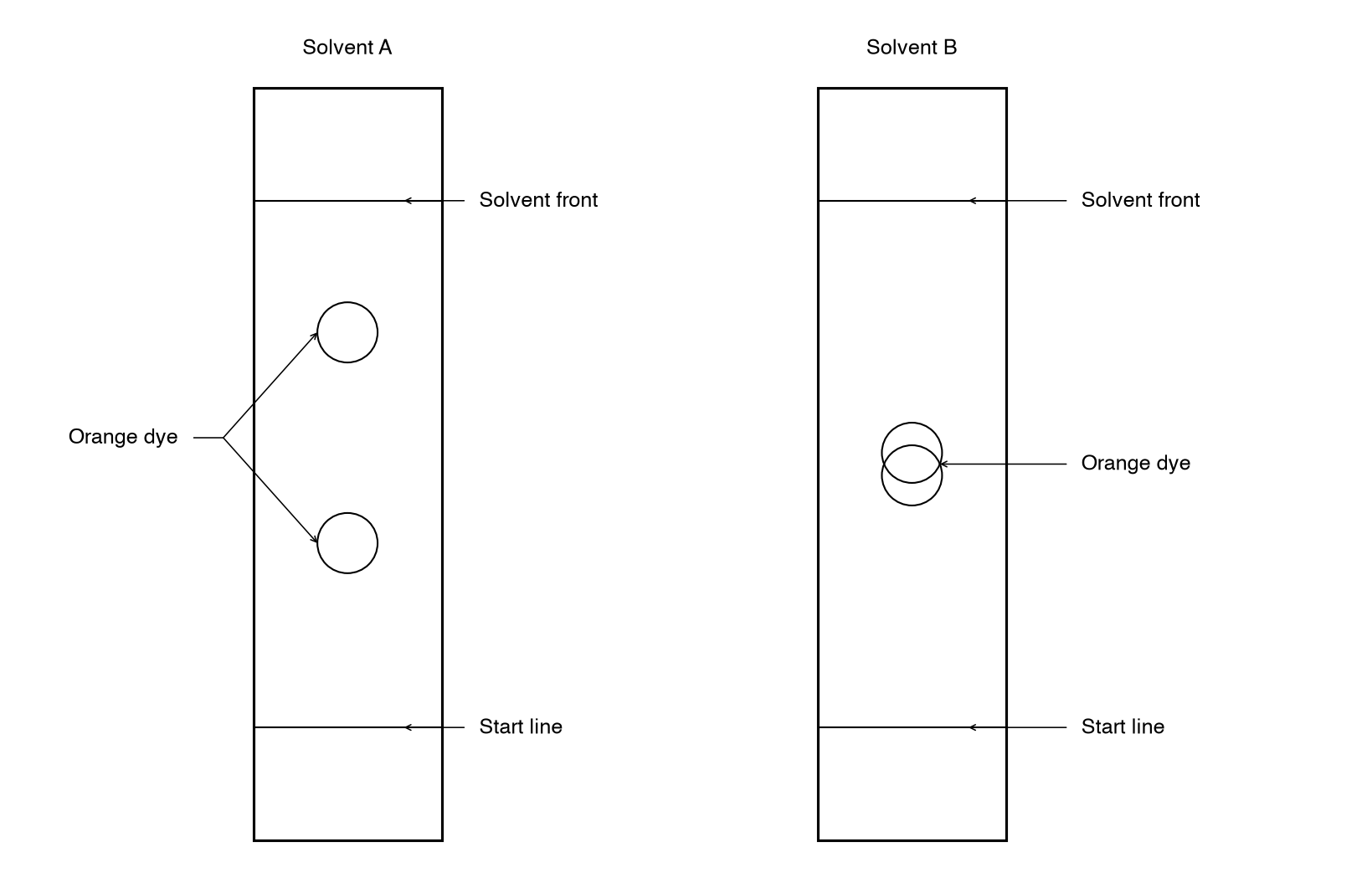
Explain why the upper orange spot travels farther than the lower orange spot. Refer to attraction to the chromatography paper in your answer.
Answer
- The upper orange spot is less strongly attracted to the chromatography paper than the lower orange spot (1 mark).
- So the upper spot is carried farther by the mobile phase: it spends more time in the solvent, or is more strongly attracted to it (1 mark).
Medly's mark scheme accepts the converse for both points: the lower spot is more strongly attracted to the paper and is carried less far.
Question 4: (3 marks)
A manufacturer makes purple ink for marking parcels. A student analysed the ink using paper chromatography.
(a) In paper chromatography, name the stationary phase and the mobile phase. [2 marks]
(b) In a separate trial, the student drew the origin with a coloured pen instead of a pencil. Suggest why this could give a misleading chromatogram. [1 mark]
Answer
(a)
- The stationary phase is the paper (1 mark).
- The mobile phase is the solvent (1 mark).
Medly's mark scheme does not accept the solvent as the stationary phase. It allows "solvent moving through the paper" for the mobile phase.
(b)
The pen ink could dissolve in the solvent and produce spots that could be mistaken for components of the sample (1 mark). Medly's mark scheme also allows "the pen ink travels up the paper and interferes with the sample spots", but not "pencil dissolves in the solvent".
Question 5: (1 mark)
This question is about paper chromatography. A citrus sports drink contains one yellow dye. Two students tested the dye in different solvents.
Rf = distance moved by dye ÷ distance moved by solvent
Student A: 1:1 water:ethanol; dye 2.4 cm, solvent front 6.0 cm, Rf = 0.40.
Student B: 1:3 water:ethanol; dye 4.2 cm, solvent front 6.0 cm, Rf = 0.70.
Which of the following claims is supported by the results? Select one answer.
A. The yellow dye must have changed into a different substance.
B. Changing the solvent composition can change the Rf value of the same dye.
C. The dye with the higher Rf value has a greater mass.
D. Paper chromatography can only be used with one solvent.
Answer
B. Changing the solvent composition can change the Rf value of the same dye (1 mark). The same dye has an Rf value of 0.40 in one solvent and 0.70 in the other.
A is wrong: the stem states that the same yellow dye was tested in both solvents. C is wrong: an Rf value gives a distance ratio, not the mass of the dye. D is wrong: the results show that different solvents can be used in paper chromatography.
Question 6: (1 mark)
During a repeat test, the paper was left to dry before the solvent front was marked.
Suggest how this affects the reliability of any calculated Rf values.
Answer
The distance moved by the solvent cannot be measured accurately, so the calculated Rf values are unreliable (1 mark).
Medly's mark scheme allows "the solvent front may no longer be visible". It does not accept saying the Rf value definitely goes up or down without a valid reason.
Two slips are worth checking for in every Rf answer: measuring to the edge of a spot instead of its centre, and measuring from the bottom of the paper instead of the origin. Medly has AQA GCSE Chemistry courses at Foundation and Higher, and AQA GCSE Combined Chemistry courses at Foundation and Higher for Combined Science students. Medly marks written answers like Question 3 against the mark scheme, so you can see which point you missed. Medly's free plan includes 5 marked questions, 20 AI tutor messages and 1 uploaded paper a day, with no card needed.
Frequently asked questions
Does an Rf value have a unit?
No. It is a ratio of two distances measured in the same unit, so the units cancel.
What does an Rf value close to 1 mean?
The spot travelled almost as far as the solvent front. An Rf value above 1 means the distances were measured wrongly, or not from the same origin.
Why is the start line drawn in pencil?
Pencil does not dissolve in the solvent. An ink line would dissolve and could form extra coloured marks on the chromatogram.
Can two substances have the same Rf value?
Yes, sometimes. Different compounds can travel similar distances in one solvent, so a matching Rf value is evidence, not proof, that two substances are the same.
Is chromatography on GCSE Combined Science?
For AQA, paper chromatography is in both GCSE Chemistry (8462) and Combined Science: Trilogy (8464). It is required practical 6 in GCSE Chemistry and required practical 12 in Trilogy.