
Photosynthesis equation for GCSE Biology: word and symbol equations, with exam questions and answers
Learn both equations, check the symbol equation balances, read limiting factor graphs and practise with exam questions and answers.
On this page
The word equation for photosynthesis is carbon dioxide + water → glucose + oxygen, with "light" written above the arrow. The balanced symbol equation is 6CO₂ + 6H₂O → C₆H₁₂O₆ + 6O₂. This guide follows AQA GCSE Biology (8461) and Combined Science: Trilogy (8464), covering each part, limiting factors and uses of glucose, with exam questions and answers.
Photosynthesis word equation, term by term
| Substance | Symbol | Reactant or product | Where it comes from or goes |
|---|---|---|---|
| Carbon dioxide | CO₂ | Reactant | From the air, in through the stomata |
| Water | H₂O | Reactant | From the soil, up from the roots in xylem |
| Glucose | C₆H₁₂O₆ | Product | Used or stored by the plant |
| Oxygen | O₂ | Product | Released from the leaf |
Light sits above the arrow because it's a condition, not a reactant: it isn't a substance. It transfers energy to the chloroplasts.
Photosynthesis symbol equation and how to balance it
6CO₂ + 6H₂O → C₆H₁₂O₆ + 6O₂
A balanced equation has the same number of atoms of each element on both sides:
- Carbon: 6 in 6CO₂, and 6 in C₆H₁₂O₆.
- Hydrogen: 6 × 2 = 12 in 6H₂O, and 12 in C₆H₁₂O₆.
- Oxygen: 12 in 6CO₂ + 6 in 6H₂O = 18, and 6 in C₆H₁₂O₆ + 12 in 6O₂ = 18.
AQA's specification gives the equation in words and says: "Students should recognise the chemical symbols: CO₂, H₂O, O₂ and C₆H₁₂O₆." That's the same for both courses. So for AQA, know the word equation and recognise each formula. On another board, check your own board's specification. Our AQA specification guide covers the rest of the course.
Where does photosynthesis happen, and why is it endothermic?
Photosynthesis happens in chloroplasts, where chlorophyll absorbs light. Plant cells often have chloroplasts and animal cells don't, as our animal cells guide shows.
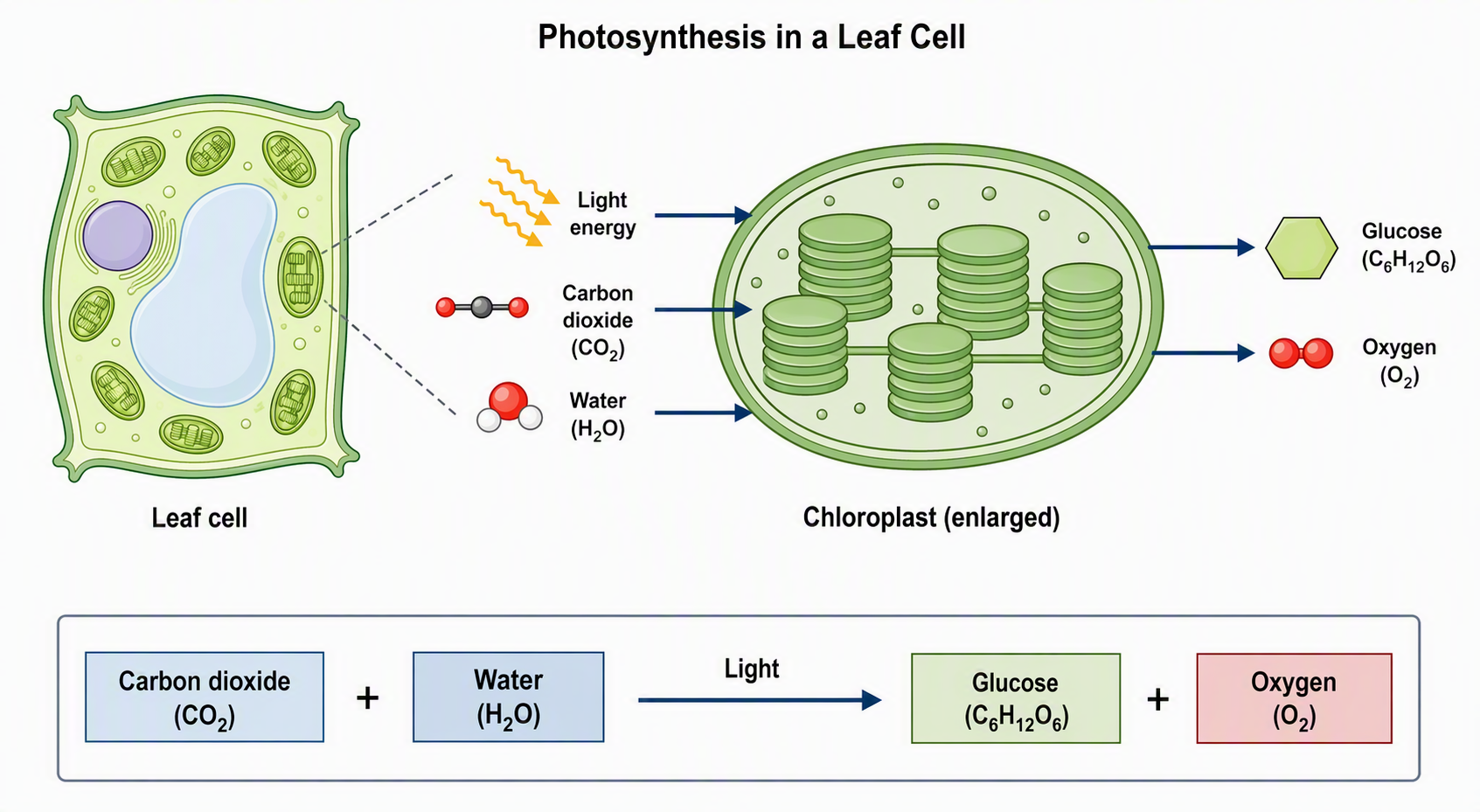
AQA asks you to "describe photosynthesis as an endothermic reaction in which energy is transferred from the environment to the chloroplasts by light". Endothermic means it takes in energy from the surroundings, which ends up stored in glucose.
Energy is transferred, never made: AQA's June 2024 Higher tier Paper 1 mark scheme does not accept "energy produced / made / created". Medly holds you to the same verb: on its practice paper question about why photosynthesis is endothermic, the mark scheme rejects "energy is created by chloroplasts".
Limiting factors of photosynthesis
A limiting factor is whatever is in shortest supply. AQA names four:
- temperature: the rate rises to an optimum, then falls as enzymes are denatured
- light intensity: more light, more energy, until something else runs short
- carbon dioxide concentration: the rate rises, then levels off
- the amount of chlorophyll: more chlorophyll absorbs more light
On both tiers, AQA expects you to "extract and interpret graphs of photosynthesis rate involving one limiting factor", like these two.
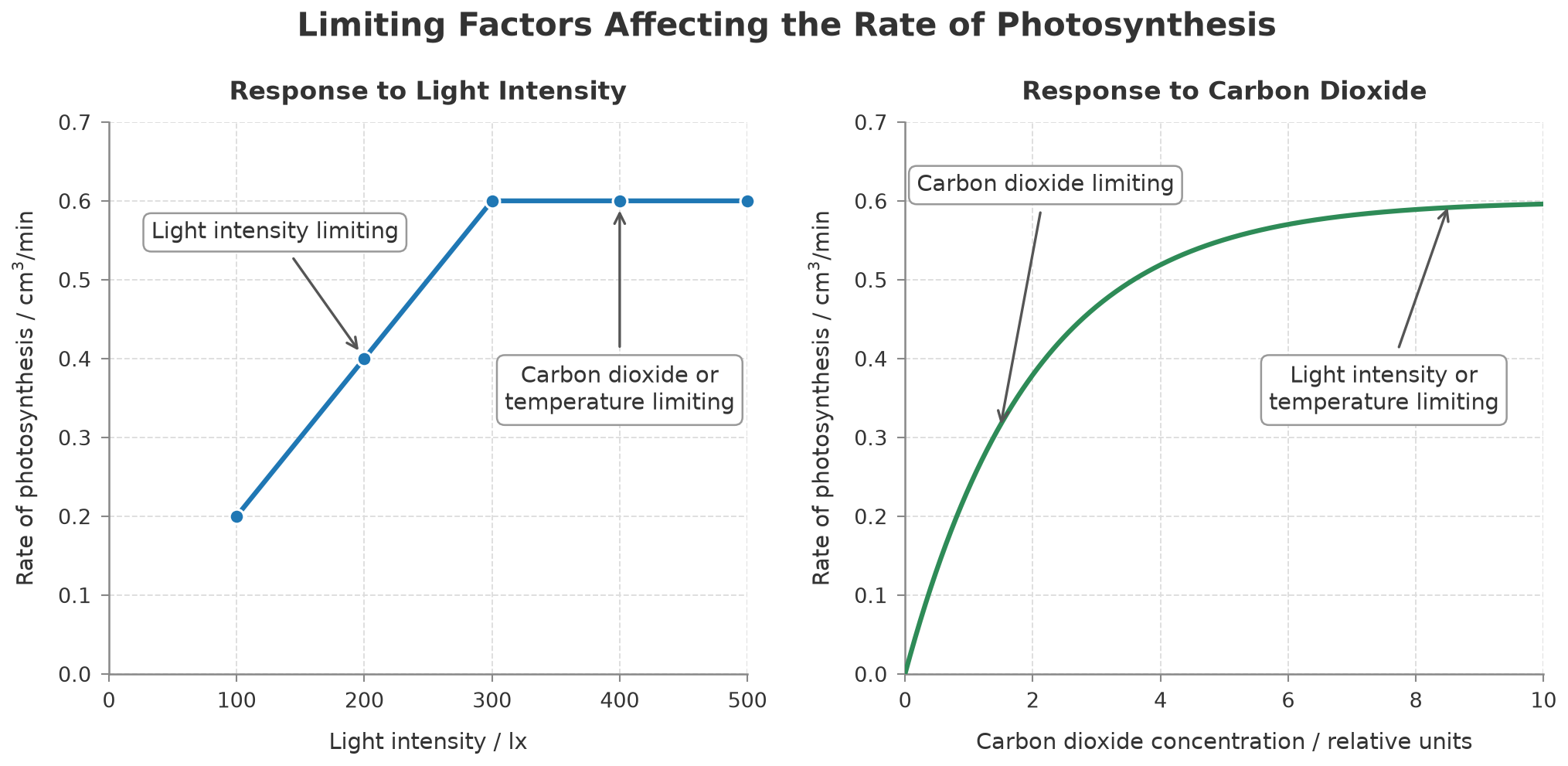
On the light intensity graph, the rate rises from 0.20 cm³/min at 100 lx to 0.60 at 300 lx: light intensity is limiting. From 300 to 500 lx it stays at 0.60, so extra light changes nothing and carbon dioxide or temperature is limiting. The carbon dioxide graph also rises then levels off, with carbon dioxide limiting on the steep part.
You'll measure this in the pondweed practical: required practical 6 in GCSE Biology, required practical 5 in Trilogy. The Paper 1 guide lists every practical on the paper.
Higher tier only: interacting factors, inverse square law and greenhouses
AQA labels these four points Higher tier only, in both courses. Foundation students can skip this part.
- The factors interact, and any one can be limiting.
- On graphs with two or three factors, compare curves at the same light intensity. Where they sit together, light is limiting. Where they separate, the factor that differs is.
- Light intensity follows the inverse square law: intensity ∝ 1 ÷ distance². Double the distance and the intensity falls to a quarter.
- Adding heat, light or carbon dioxide to a greenhouse pays only if it raises the limiting factor and the extra crop is worth more than it costs.
Worked example (1 mark)
A plant receives a light intensity of 80 arbitrary units when it is 1.5 m from a point lamp.
The lamp is moved so that the plant is 3.0 m from it.
Which option shows the intensity when the distance is increased to 3.0 m? Select one answer.
A. 40 arbitrary units
B. 320 arbitrary units
C. 20 arbitrary units
D. 10 arbitrary units
- 3.0 ÷ 1.5 = 2, so the distance has doubled.
- Intensity ∝ 1 ÷ distance², so it is multiplied by 1 ÷ 2² = 1 ÷ 4.
- 80 ÷ 4 = 20 arbitrary units. The answer is C.
A forgets to square, B squares the wrong way so the light gets brighter, and D divides by 2³.
What do plants do with the glucose from photosynthesis?
AQA lists five uses, the same in both courses. The glucose may be:
- used for respiration
- converted into insoluble starch for storage
- used to produce fat or oil for storage
- used to produce cellulose, which strengthens the cell wall
- used to produce amino acids for protein synthesis
To make proteins, plants also use nitrate ions absorbed from the soil.
Photosynthesis and respiration compared
| Process | Word equation | Energy change |
|---|---|---|
| Photosynthesis | carbon dioxide + water → glucose + oxygen | Endothermic |
| Aerobic respiration | glucose + oxygen → carbon dioxide + water | Exothermic |
GCSE biology photosynthesis exam questions with answers
Each question below is a Medly question, marked with Medly's mark scheme. Questions 2 and 3 come from one of Medly's Higher tier practice papers.
Question 1: (2 marks)
Complete the equation for photosynthesis.
[formula] + [formula] → [formula] + O₂
Write the missing formulae, in equation order.
Answer
- CO₂ before the arrow.
- H₂O before the arrow.
- C₆H₁₂O₆ after the arrow.
1 mark for each correct formula, up to 2 marks. The reactants can go in either order. Carbon monoxide, hydrogen or starch earn nothing.
Questions 2 and 3 use this experiment. A scientist investigated photosynthesis in the green and pale sections of leaves from a striped houseplant. The green sections contained more chlorophyll than the pale sections. For each measurement, the scientist used 30 cm² of leaf, kept the temperature at 21 °C and measured the oxygen produced in 12 minutes.
The table shows the results.
| Light intensity / W m⁻² | 80 | 160 | 320 | 640 |
|---|---|---|---|---|
| Oxygen produced by green sections in 12 minutes / cm³ | 0.12 | 0.24 | 0.48 | 0.50 |
| Oxygen produced by pale sections in 12 minutes / cm³ | 0.06 | 0.12 | 0.24 | 0.25 |
Question 2: (3 marks)
Calculate the volume of oxygen produced per minute per cm² of green leaf at a light intensity of 320 W m⁻². Give your answer to three significant figures and include units.
Answer
- 0.48 cm³ ÷ 12 minutes = 0.040 cm³ per minute (1 mark).
- 0.040 ÷ 30 cm² = 0.001333... (1 mark).
- 0.00133 cm³ per minute per cm², to three significant figures (1 mark).
Write out all three steps: on AQA's GCSE science papers from 2027, where a calculation says "show your working", a correct answer with no working gains one mark (the Paper 1 guide explains the rule).
Question 3: (4 marks)
Use the table to explain the change in oxygen produced by green leaf sections between 320 and 640 W m⁻². Suggest how the scientist could test whether carbon dioxide is limiting at 640 W m⁻².
Answer
- Oxygen rises by only 0.02 cm³, from 0.48 to 0.50 cm³, although light intensity doubles (1 mark).
- Light intensity is no longer the limiting factor (1 mark).
- Another factor, possibly carbon dioxide (or temperature), is limiting (1 mark).
- Increase carbon dioxide at 640 W m⁻², keep everything else the same and compare the oxygen produced. An increase would support carbon dioxide being limiting (1 mark).
The table can't prove carbon dioxide is limiting, so "possibly" matters.
Medly has more photosynthesis questions like these, each marked against its mark scheme. In a randomised controlled trial in GCSE science, students using Medly for 30 minutes a week for four weeks scored 22% higher on the post-test than students revising in their usual way, adjusted for where they started. The comparison group kept revising with guides, notes, videos and, in most classes, other online revision platforms. You can start on the free plan, or try AQA's real Biology past papers.
Frequently asked questions
What is the formula for photosynthesis?
6CO₂ + 6H₂O → C₆H₁₂O₆ + 6O₂, with light above the arrow. In words: carbon dioxide + water → glucose + oxygen.
What is a word equation?
One that uses names instead of symbols: reactants left of the arrow, products right.
What is 6CO₂ + 12H₂O → C₆H₁₂O₆ + 6O₂ + 6H₂O?
A version with water on both sides. It balances, and taking 6H₂O off each side gives 6CO₂ + 6H₂O → C₆H₁₂O₆ + 6O₂.
Which paper is photosynthesis on?
Paper 1, for both AQA courses. Its date, length and marks are in the Paper 1 guide.