
Bacteria cell: labelled diagram, structure and GCSE exam questions with answers
Label each part, compare bacterial, animal and plant cells, work out cell sizes in standard form and practise with exam questions and answers.
On this page
A bacteria cell is a prokaryotic cell, much smaller than an animal or plant cell. It has cytoplasm and a cell membrane surrounded by a cell wall, and its genetic material is a single DNA loop, sometimes with small rings called plasmids, with no nucleus. This guide follows the AQA specification for GCSE Biology (8461) and Combined Science: Trilogy (8464). On another board, check your own specification: the parts table notes where Edexcel's list differs.
Bacteria cell diagram: labelled parts and what they do
The picture labels the five parts AQA lists for a bacterial cell: cell wall, cell membrane, cytoplasm, a single DNA loop (labelled chromosomal DNA) and plasmids. Beside it is a much larger eukaryotic cell.
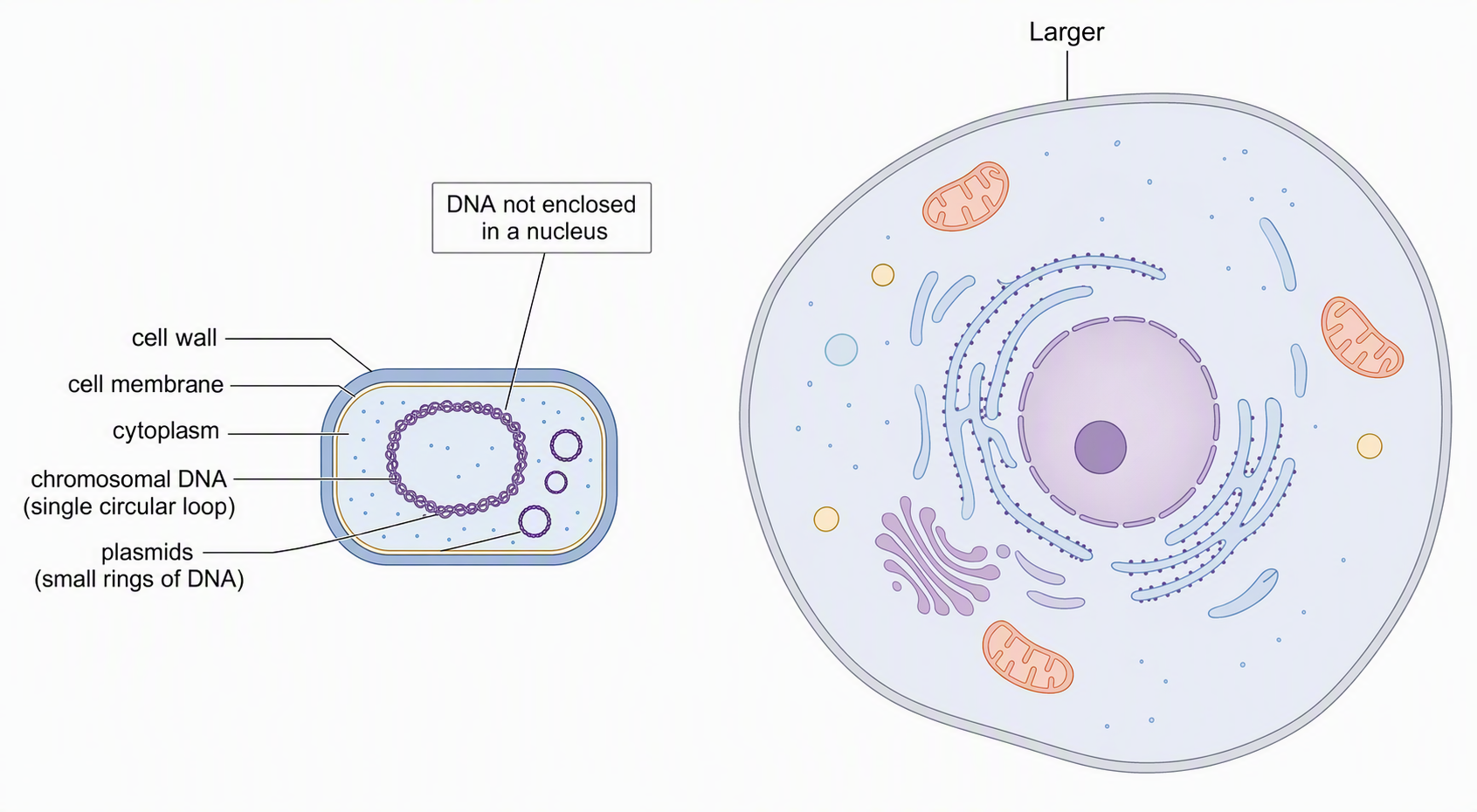
| Part | What it does | In AQA's list? |
|---|---|---|
| Cell wall | An outer layer surrounding the cell membrane | Yes |
| Cell membrane | Controls the movement of substances into and out of the cell | Yes |
| Cytoplasm | Where most chemical reactions take place | Yes |
| Single DNA loop (chromosomal DNA) | The main genetic material, free in the cytoplasm | Yes |
| Plasmids | Small rings of DNA that can carry additional genes | Yes: there may be one or more |
| Ribosomes | Sites of protein synthesis | Not in AQA's list (Edexcel lists them) |
| Flagella | Long structures that let some bacteria move | Not in AQA's list (Edexcel lists them) |
Ribosomes and flagella are real parts of bacteria: bacteria have ribosomes, like animal and plant cells, and some bacteria move using flagella. AQA's specification just doesn't list them for bacterial cells, so for AQA, the five parts marked "Yes" are the ones the specification names. Edexcel's list for bacteria is chromosomal DNA, plasmid DNA, cell membrane, ribosomes and flagella.
Do bacteria have a nucleus, a cell wall or mitochondria?
No nucleus. The genetic material is a single DNA loop in the cytoplasm, not enclosed in a nucleus. That's what makes a bacterium prokaryotic.
Yes, a cell wall, outside the cell membrane. Plant and algal cells have a cell wall too, made of cellulose, so a wall alone doesn't prove a cell is a bacterium.
No mitochondria or chloroplasts. A bacterial cell has neither: mitochondria are found in animal and plant cells, and chloroplasts in plant cells.
Bacterial cells vs animal and plant cells: what's different?
Animal and plant cells are eukaryotic, with their genetic material enclosed in a nucleus. Bacterial cells are prokaryotic.
| Feature | Bacterial cell | Animal cell | Plant cell |
|---|---|---|---|
| Type of cell | Prokaryotic | Eukaryotic | Eukaryotic |
| Genetic material | Single DNA loop, no nucleus | In a nucleus | In a nucleus |
| Cell membrane and cytoplasm | Yes | Yes | Yes |
| Cell wall | Yes, not made of cellulose | No | Yes, made of cellulose |
| Mitochondria | No | Yes | Yes |
| Chloroplasts | No | No | Often |
| Relative size | Much smaller | Larger | Larger |
For the animal against plant detail, see our guide to animal cells.
How big is a bacterial cell? Orders of magnitude and standard form
AQA asks you to "make order of magnitude calculations, including the use of standard form". One micrometre (µm) is 10⁻⁶ m, and one order of magnitude is a factor of 10. Medly's lesson on eukaryotic and prokaryotic cells uses round estimates of 1 µm for a bacterium and 10 µm for a eukaryotic cell.
Worked example
Compare the scale of a bacterial cell of size 1 µm with a eukaryotic cell of size 10 µm.
- Bacterial cell: 1 µm = 1 × 10⁻⁶ m.
- Eukaryotic cell: 10 µm = 1 × 10⁻⁵ m.
- The powers of ten differ by one: −5 − (−6) = 1.
- One order of magnitude is a factor of 10, so the eukaryotic cell is 10 times larger.
Real cells vary, so not every animal cell is exactly 10 times the size of every bacterium. If your answer makes a bacterium millimetres long, check the conversion: 1 mm is 1,000 µm.
How do bacteria divide? Binary fission (GCSE Biology only)
Bacteria multiply by binary fission: one cell divides into two, and each new cell can divide again. With enough nutrients and a suitable temperature, bacteria can divide as often as once every 20 minutes. Binary fission is GCSE Biology content only: it isn't in Combined Science: Trilogy.
You need to find the number of bacteria after a given time from the mean division time. For 200 bacteria dividing every 20 minutes, after 100 minutes:
- Number of divisions = 100 ÷ 20 = 5.
- Each division doubles the population: 2⁵ = 32.
- Number of bacteria = 200 × 32 = 6,400.
On the Higher tier, AQA can ask for the answer in standard form: 6.4 × 10³.
Where marks are lost on bacterial cell questions
- Treating a cell wall as proof of a bacterium. Use no nucleus, a single DNA loop or plasmids.
- Calling a plasmid the main DNA, or saying bacteria have no genetic material.
- Dividing a percentage change by the final value instead of the starting value.
- Writing standard form with a first number of 10 or more, or less than 1.
GCSE biology bacteria cell exam questions with answers
The questions below are Medly questions, marked with Medly's mark scheme. Questions 1 and 2 suit both AQA courses. Write your answer before you open each one.
Question 1: (3 marks)
A scientist used a light microscope to measure cells from two cultures, P and Q, of harmless bacteria.
Describe how genetic material is arranged in the bacterial cells in cultures P and Q. Include their main DNA and any smaller DNA molecules.
Answer
- The genetic material is not enclosed in a nucleus (1 mark).
- The main genetic material is a single DNA loop (1 mark).
- Plasmids are smaller rings of DNA that can carry additional genes (1 mark).
Each point is marked separately. "A single circular DNA molecule" earns the second mark, and "small rings of DNA" earns the third without the extra genes.
Question 2: (2 marks)
A scientist used a light microscope to measure cells from two cultures, P and Q, of harmless bacteria. The table shows the results.
| Culture | P | Q |
|---|---|---|
| Number of cells measured | 8 | 8 |
| Mean cell length / µm | 2.4 | 3.0 |
Calculate the percentage increase in mean cell length from culture P to culture Q. Use the table.
Answer
- Increase in mean length = 3.0 − 2.4 = 0.6 µm.
- Percentage increase = (3.0 − 2.4) ÷ 2.4 × 100 (1 mark).
- 0.6 ÷ 2.4 = 0.25, and 0.25 × 100 = 25% (1 mark).
Dividing by 3.0 gives 20%, which isn't accepted, and neither is 0.25. Show every step: on AQA's GCSE science papers from 2027, where a calculation says "show your working", the right answer alone earns one mark (see the Paper 1 guide).
This one is for GCSE Biology, Higher tier only:
Question 3: (2 marks)
The original measurement was 642,000,000 bacterial cells, recorded to three significant figures.
| Report | Published bacterial population |
|---|---|
| A | 6.42 × 10⁸ |
| B | 64.2 × 10⁷ |
| C | 6.420 × 10⁸ |
| D | 0.642 × 10⁹ |
Give two ways the table shows that three of the reports are unsuitable for publication as standard-form reports.
Answer
Any two of these, 1 mark each:
- Report B: the first number, 64.2, is not less than 10.
- Report C: 6.420 has four significant figures, more than the measurement justifies.
- Report D: the first number, 0.642, is less than 1.
Report A is correct: the decimal point in 642,000,000 moves eight places.
Question 1 is easy to half-write. Medly marks written answers like it against the mark scheme, so you can see which point you missed, and its cell biology lessons have more questions on bacterial cells and cultures. Medly's free plan gives you 5 marked questions, 20 AI tutor messages and 1 uploaded paper a day, with no card needed.
Bacterial cells are on Paper 1: the Paper 1 guide shows what else is on it, the specification checklist lists every topic, and there are past papers to practise on.
Frequently asked questions
What is in a bacterial cell for GCSE?
For AQA: cytoplasm, a cell membrane, a cell wall, a single DNA loop and sometimes one or more plasmids. Other boards' lists differ, so check your own specification.
Are bacteria prokaryotic or eukaryotic?
Prokaryotic. Their genetic material is not enclosed in a nucleus, whereas animal and plant cells are eukaryotic.
Do viruses and bacteria have cells?
A bacterium is a cell: bacteria are single-celled microorganisms. Viruses are not made of cells. They can only reproduce inside living cells, which they damage.
How fast do bacteria divide?
As often as once every 20 minutes with enough nutrients and a suitable temperature. For AQA, this is GCSE Biology content, not Combined Science: Trilogy.
Which paper are bacterial cells on?
Paper 1, for both AQA courses. The Paper 1 guide has the date, the length and the marks.