
Food tests in GCSE Biology: the required practical method, results and exam questions
Learn each reagent and colour change, write the method the way AQA marks it, and practise with exam questions and answers.
On this page
The GCSE food tests are Benedict's for sugars, iodine for starch, Biuret for protein, and the ethanol emulsion test or Sudan III for lipids. This guide follows AQA, where food tests are required practical 4 in GCSE Biology (8461) and required practical 3 in Combined Science: Trilogy (8464). It covers each test, the hazards and the 6-mark question, with exam questions and answers. On another board, check your own specification's list of tests.
Food tests results table: reagents and colour changes
| Testing for | Reagent | What you do | Positive result | Negative result |
|---|---|---|---|---|
| Sugars | Benedict's reagent | Water bath at 80 °C or above, about 5 minutes | Blue turns green, yellow, orange or brick red | Stays blue |
| Starch | Iodine reagent | Add a few drops, no heating | Orange-brown turns blue-black | Stays orange-brown |
| Protein | Biuret reagent | Add, mix gently, no heating | Blue turns lilac or purple | Stays blue |
| Lipids | Ethanol | Add water, then ethanol; shake gently | A cloudy white emulsion forms | Stays clear |
| Lipids | Sudan III | Add several drops, shake, let it stand | A separate red-stained oil layer | No red-stained oil layer |
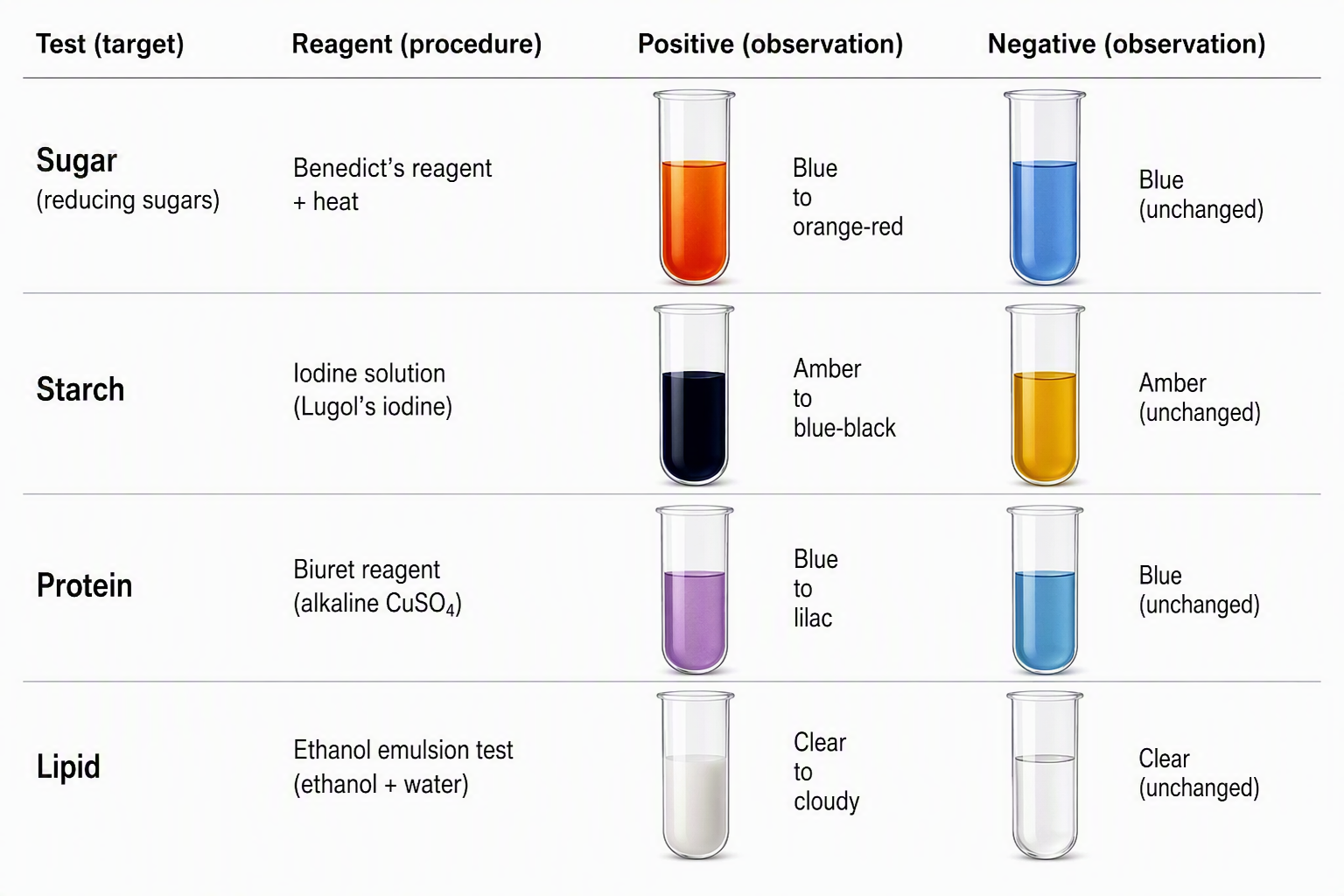
The picture shows the same results for four of the tests: it calls iodine's orange-brown "amber", and for lipids it shows the ethanol emulsion test.
AQA's mark schemes also accept brown for Benedict's, and black or dark blue for iodine. The tests are qualitative: they show whether a substance is there, not how much. Benedict's detects reducing sugars such as glucose, so sucrose (table sugar) leaves it blue.
Print the summary sheet.
How do you do the food tests? Method step by step
Preparing a food sample
- Grind a small amount of solid food with a little distilled water, using a pestle and mortar, to make a suspension.
- Filter it if you want a clearer liquid.
- Use a clean, labelled test tube, a fresh portion and a clean pipette for each test: traces of another food or reagent can give a false positive.
Benedict's test for sugars
- Set up a water bath over a Bunsen burner, with a thermometer in the water.
- Put about 2 cm³ of the food sample into a test tube and add Benedict's reagent.
- Stand the tube in the water bath at 80 °C or above for about 5 minutes, then record the colour.
Never heat it directly in the flame. AQA's June 2024 mark scheme credited heating "to at least 60 °C" or boiling.
Iodine test for starch
- Put some of the food sample into a test tube or a spotting tile well.
- Add a few drops of iodine reagent, mix gently without heating, and record the colour.
Biuret test for protein
- Put about 2 cm³ of the food sample into a test tube.
- Add Biuret reagent and mix gently, without heating. AQA's method adds it as two solutions: 1 cm³ of Biuret A, then 1 cm³ of Biuret B.
- Record the colour.
Ethanol emulsion test for lipids
- Put some of the food sample into a test tube and add a few drops of distilled water.
- With no Bunsen burner lit nearby, add a few drops of ethanol.
- Shake gently and look for a cloudy white emulsion.
This is the order AQA's method uses. Some schools shake the food with ethanol first, then pour it into water.
Sudan III test for lipids
- Put some of the food sample into a test tube and add several drops of Sudan III.
- Stopper or cover the tube and shake it carefully.
- Let it stand, then look for a separate red-stained oil layer.
Which food tests does AQA require?
For AQA, the specification says to "use qualitative reagents to test for a range of carbohydrates, lipids and proteins", then lists three tests: "Benedict's test for sugars; iodine test for starch; and Biuret reagent for protein". No lipid test is named.
AQA's method for this practical tests lipids with the ethanol emulsion test. Medly's food tests lesson teaches Sudan III first, with the ethanol test as the alternative. Questions on the practicals count for at least 15% of the marks (see our Paper 1 guide), so for AQA, learn Benedict's, iodine, Biuret and the ethanol emulsion test, plus Sudan III if your class used it.
Biology and Trilogy share this practical, with no biology only or higher tier label.
Food tests hazards and risk assessment
| Hazard | Risk | How to reduce it |
|---|---|---|
| Bunsen flame, hot glass, boiling water | Burns or scalds | Use a water bath and a test-tube holder; let equipment cool before touching it |
| Benedict's reagent being heated | Spitting into the face or eyes | Wear eye protection; point the test tube away from faces |
| Benedict's and iodine reagents | Irritant | Wear eye protection or gloves; use a dropper bottle; clean up spills straight away |
| Biuret reagent | Contains copper sulfate, which is poisonous, and sodium hydroxide, which is corrosive | Handle with care; wash skin immediately if splashed; wipe up spills |
| Ethanol | Highly flammable | Turn off Bunsen burners first; keep it away from any flames |
How to answer the 6-mark food tests question
AQA marks a 6-mark method question in three levels:
- Level 3 (5 to 6 marks): the method "would lead to the production of a valid outcome", with the key steps "logically sequenced".
- Level 2 (3 to 4 marks): most steps are there, but the method "would not necessarily lead to a valid outcome".
- Level 1 (1 to 2 marks): some relevant steps, but "links are not made clear".
AQA's June 2024 Higher Paper 1 mark scheme also needed, for the top level, "the reagents used to test for starch and sugar with correct positive results, and a risk assessment". That paper is in our AQA Biology past papers.
Here is an exam-style question from Medly, marked with Medly's mark scheme.
Worked example (6 marks)
A student investigated plain oatcake, cooked pasta and baked potato. Each sample contains starch and sugars.
Describe how food tests could be used to identify two types of carbohydrate in the foods.
Include safety measures in your answer.
A top-level answer could read:
Grind each food with a little distilled water, filter it, and put some of the liquid into two clean, labelled test tubes. To test for sugars, add Benedict's solution to the first tube and stand it in a water bath at 80 °C or above for about 5 minutes. If sugars are present, the blue solution turns green, yellow, orange or brick red. If it stays blue, no sugar was detected. To test for starch, add a few drops of iodine solution to the second tube without heating. If starch is present, the orange-brown iodine turns blue-black. Benedict's can spit when heated, so wear eye protection and point the tube away from people. Use a water bath rather than a direct flame, and let the glassware cool before touching it. Both reagents are irritants, so wipe up any spills.
Each test has its reagent, whether to heat and its positive result, in a working order. The safety points match real hazards, which is the kind of risk assessment AQA's June 2024 mark scheme wanted for the top level.
GCSE biology food tests exam questions with answers
Both are from Medly's practice papers, marked with Medly's mark schemes. Answer before you open each one.
Question 1: (3 marks)
An unlabelled thickening powder might contain starch.
Describe how to use iodine reagent to test the powder. Include the results for starch present and starch absent.
Answer
- Add iodine reagent to a sample of the powder, which can be mixed with water first (1 mark).
- A blue-black colour shows starch is present (1 mark). Dark blue or black is also accepted.
- If the iodine stays orange-brown, starch is absent (1 mark).
Heating isn't needed. Calling orange-brown a positive result earns nothing.
Question 2: (2 marks)
A student investigated the digestion of fat in milk, which also contains protein.
Describe how to test a sample of the milk for protein and give the result of a positive test.
Answer
- Add Biuret reagent to the milk sample and mix (1 mark). No heating is needed.
- The mixture changes from blue to lilac or purple (1 mark). Violet is also accepted.
A Benedict's colour earns nothing.
To get your own 6-mark method checked, Medly marks written answers against the mark scheme and shows which step or safety point is missing. Medly's free plan includes 5 marked questions, 20 AI tutor messages and 1 uploaded paper a day, with no card needed.
For the other practicals, see our Paper 1 guide and the specification checklist.
Frequently asked questions
What are the four main food tests in GCSE biology?
Benedict's (sugars), iodine (starch), Biuret (protein), and ethanol emulsion or Sudan III (lipids). AQA's specification names the first three; AQA's method for lipids is the ethanol test.
What is the Biuret test in GCSE biology?
The test for protein: Biuret reagent turns from blue to lilac or purple, without heating.
Does the Benedict's test need heating?
Yes. Stand the tube in a water bath at 80 °C or above for about 5 minutes.
What is the food test used to detect starch?
The iodine test: iodine reagent turns from orange-brown to blue-black.
Which paper are the food tests on?
Paper 1, for both AQA courses. The Paper 1 guide gives the paper's date, length and marks.