
Oxidative phosphorylation A-Level Biology: the electron transfer chain and chemiosmosis
Follow electrons, protons and ATP synthase step by step, see what oxygen does, and try exam questions with answers.
On this page
Oxidative phosphorylation is the stage of aerobic respiration that makes ATP at the inner mitochondrial membrane. Electrons passing down the electron transfer chain move protons into the intermembrane space, and as the protons diffuse back through ATP synthase, ATP is made from ADP and inorganic phosphate. This guide follows AQA A-Level Biology (7402) and covers the steps, chemiosmosis, oxygen's part, how it differs from substrate-level phosphorylation, and exam questions with answers.
What is oxidative phosphorylation and where does it happen?
Oxidative phosphorylation is the synthesis of ATP in mitochondria, using energy from electron transfer and proton movement. It happens at the inner mitochondrial membrane.
AQA's specification lists it in one sentence: "synthesis of ATP by oxidative phosphorylation is associated with the transfer of electrons down the electron transfer chain and passage of protons across inner mitochondrial membranes and is catalysed by ATP synthase embedded in these membranes". Other books often say "electron transport chain". It is the same chain.
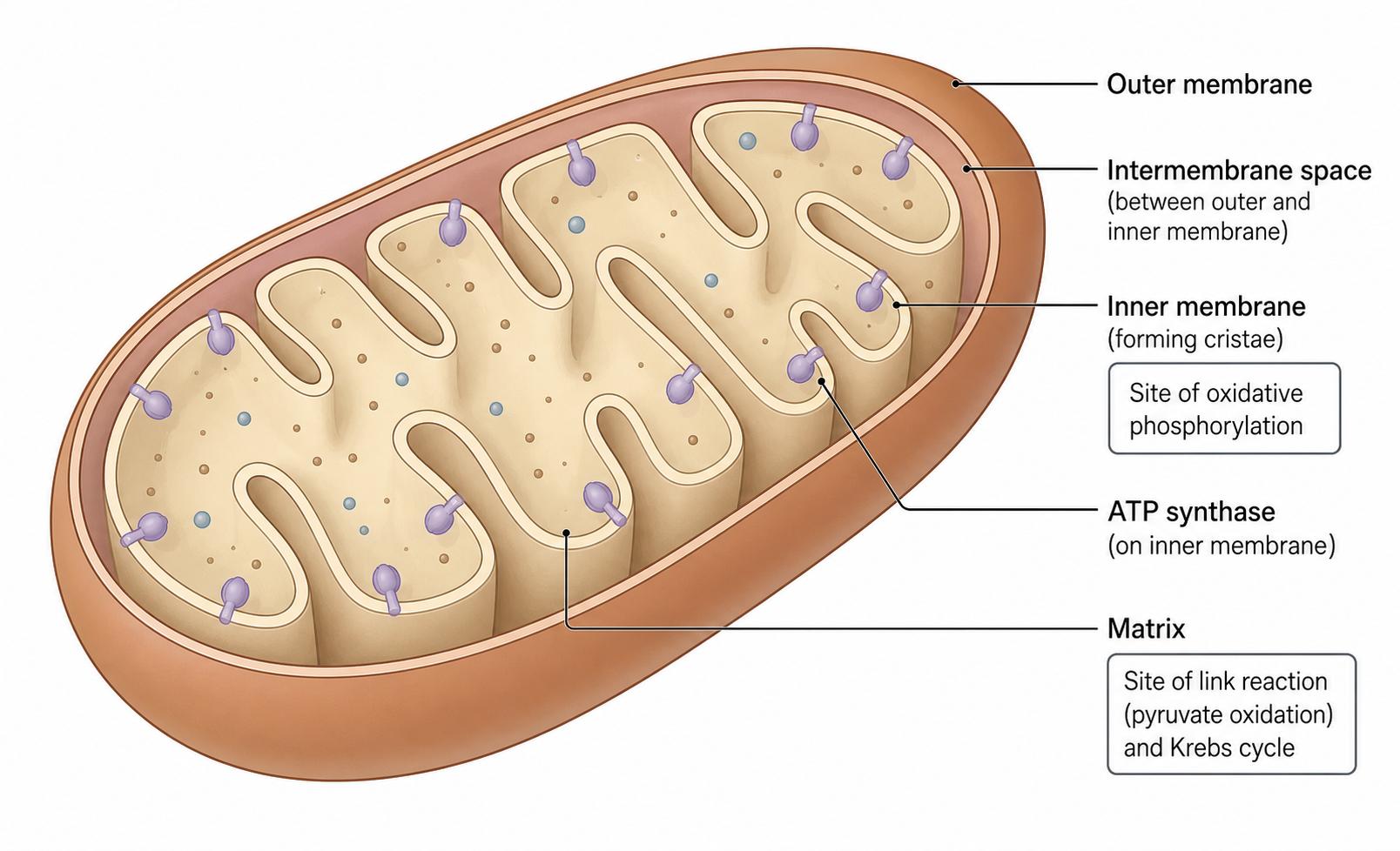
The inner membrane separates the matrix from the intermembrane space. That separation matters, because protons have to be held at different concentrations on its two sides. The membrane also holds the two things the process needs: the electron transfer chain, a sequence of molecules that electrons pass along, and ATP synthase, the enzyme that catalyses ATP production.
Oxidative phosphorylation step by step
Reduced NAD and reduced FAD, made in the earlier stages of respiration, donate electrons to the electron transfer chain. The Krebs cycle is one of the stages that makes them. From there:
- Electrons pass down the electron transfer chain in the inner mitochondrial membrane. Energy is released as they move from one molecule in the chain to the next.
- That energy moves protons from the matrix into the intermembrane space.
- The protons build up on one side of the membrane, setting up an electrochemical gradient.
- Protons diffuse down this gradient, back into the matrix, through ATP synthase.
- ATP synthase catalyses the formation of ATP from ADP and inorganic phosphate.
An electrochemical gradient has two linked parts:
- a concentration difference: the intermembrane space has a higher proton concentration than the matrix
- a charge difference: the intermembrane space becomes more positive, because protons carry a positive charge
Chemiosmosis and ATP synthase
The chemiosmotic theory explains how the ATP is made: protons diffuse down an electrochemical gradient through ATP synthase, and the enzyme uses the energy released as they pass through to make ATP.
Protons do not diffuse straight through the inner membrane. They pass through molecules of ATP synthase embedded in it. If protons could cross the membrane freely, the difference in concentration and charge would be lost, so the membrane has to stay intact. ATP is made only while protons are diffusing through ATP synthase.
ATP synthase makes ATP in photosynthesis too. ATP itself is in AQA's sub-topic 3.1.6 ATP, which AS Biology covers as well.
What does oxygen do in oxidative phosphorylation?
Oxygen is the terminal electron acceptor. At the end of the electron transfer chain, oxygen accepts electrons and combines with protons to form water.
Without oxygen, electrons cannot keep passing along the chain. Proton pumping stops, the gradient is not kept up, and ATP synthase cannot go on making ATP by oxidative phosphorylation.
Substrate-level vs oxidative phosphorylation
Both make ATP, in different ways. Substrate-level phosphorylation forms ATP directly, by transferring a phosphate group from a phosphorylated compound to ADP. Oxidative phosphorylation uses ATP synthase, driven by protons diffusing through it.
| Process | Where it happens | How ATP is made |
|---|---|---|
| Substrate-level phosphorylation (Krebs cycle) | Mitochondrial matrix | A phosphate group is transferred directly from a phosphorylated compound to ADP |
| Oxidative phosphorylation | Inner mitochondrial membrane | ATP synthase makes ATP from ADP and inorganic phosphate as protons diffuse through it |
AQA A-Level Biology oxidative phosphorylation exam questions with answers
The worked example and the question below are exam-style questions from Medly, marked with Medly's mark schemes.
Worked example (4 marks)
Isolated mitochondria are supplied with the same respiratory substrate and ADP in each sample.
Inhibitor N12 prevents one carrier in the electron transfer chain from transferring electrons to the next carrier.
| Treatment | No N12 | N12 present |
|---|---|---|
| Relative rate of electron transfer / arbitrary units | 100 | 35 |
| Proton difference across the inner mitochondrial membrane / arbitrary units | 18 | 5 |
| ATP production rate / arbitrary units | 46 | 14 |
Use the results in the table to explain why a selective inhibitor of an electron-transfer-chain carrier reduces ATP production.
Do not include details of glycolysis or the Krebs cycle in your answer.
Medly's mark scheme has five points, 1 mark each, up to 4 marks. Each one follows from the last:
- Fewer electrons pass down the electron transfer chain when N12 is present: the rate of electron transfer falls from 100 to 35.
- Less electron transfer means less proton movement from the matrix across the inner mitochondrial membrane.
- The proton difference falls from 18 to 5, which shows a smaller electrochemical gradient across the inner mitochondrial membrane.
- Fewer protons diffuse down the electrochemical gradient through ATP synthase.
- So less ATP is produced: the rate falls from 46 to 14.
The scheme gives no credit for details of glycolysis or the Krebs cycle.
Question 1: (4 marks)
The table is printed on its side here, so the "third results column" in the question is the table's last row.
Peptide P4 forms small proton-permeable pores in the lipid region of the inner mitochondrial membrane.
It does not bind to ATP synthase.
The results of an investigation into the effect of P4 are shown in the table.
The values in the third results column, for ATP-synthase activity, were measured after both ATP-synthase preparations were supplied with the same imposed proton gradient.
| Mitochondrial preparation | Untreated | Treated with P4 |
|---|---|---|
| Proton difference across inner membrane / arbitrary units | 21 | 3 |
| ATP production in intact mitochondrial assay / arbitrary units | 50 | 7 |
| ATP-synthase activity with an equal imposed proton gradient / arbitrary units | 49 | 48 |
Use the table to justify the conclusion that proton-permeable pores in the inner mitochondrial membrane, rather than direct loss of ATP-synthase activity, cause the reduction in ATP production.
Do not include details of the electron transfer chain in your answer.
Answer
Medly's mark scheme has five independent one-mark points, up to 4 marks. Each is printed with its notes as the scheme gives them.
- Oxidative phosphorylation occurs at the inner mitochondrial membrane. (Accept the inner mitochondrial membrane as the site of oxidative phosphorylation. Credit any other valid observation linking P4 treatment to reduced ATP production, e.g. ATP production falls from 50 to 7 arbitrary units alongside the reduced proton difference, or ATP production falls to about 14% of the untreated value alongside the reduced proton difference. Do not credit a claim that ATP production stops completely.)
- An intact inner mitochondrial membrane maintains the spatial separation required for chemiosmosis. (Accept 'maintains separate compartments' for 'maintains spatial separation'. Credit any other valid explanation of proton leakage through the pores, e.g. protons cross the inner membrane through the pores without passing through ATP synthase, or protons return to the matrix through the pores and dissipate the proton gradient. Do not credit a claim that the pores prevent protons from crossing the membrane.)
- The lower proton difference in P4-treated mitochondria shows that the electrochemical gradient across the inner membrane is reduced. (Accept reference to the proton difference falling from 21 to 3 arbitrary units.)
- Fewer protons diffuse down their electrochemical gradient through ATP synthase. (Accept 'fewer protons pass through ATP synthase'.)
- ATP synthase catalyses less ATP production in intact mitochondria because proton diffusion through it is reduced. (Accept comparison of the similar ATP-synthase activities with the imposed gradient as evidence against direct ATP-synthase inhibition.)
The 14% in point 1 is 7 ÷ 50 = 0.14. The last row of the table, 49 against 48, is the evidence that ATP synthase itself still works. The scheme does not credit electron-transfer-chain detail alone.
Both questions change one part of the system, the chain or the membrane, and ask you to follow the change through to the ATP. Medly marks written answers like Question 1 against the mark scheme, so you can see which point you missed. Medly's free plan includes 5 marked questions, 20 AI tutor messages and 1 uploaded paper a day, with no card needed, and Medly has an AQA A-Level Biology course.
Which paper is oxidative phosphorylation on?
AQA's A-Level Paper 2 and Paper 3 can examine oxidative phosphorylation: our papers guide has what each paper covers. AQA heads this section of its specification "(A-Level only)", so the AS papers do not test it.
Frequently asked questions
Where does oxidative phosphorylation take place?
At the inner mitochondrial membrane, which is folded into cristae. The electron transfer chain and ATP synthase are both in that membrane.
What is chemiosmosis?
It is ATP production by protons diffusing down an electrochemical gradient through ATP synthase in an organelle membrane, as the chemiosmotic theory explains.
Is the electron transfer chain the same as the electron transport chain?
Yes. They are two names for the sequence of molecules in the inner mitochondrial membrane that electrons pass along, and AQA's specification uses "electron transfer chain".
Why is it called oxidative phosphorylation?
Phosphorylation means adding a phosphate group to a molecule, here to ADP to make ATP. The name refers to ATP synthesis that is linked to electron transfer and proton movement across the inner mitochondrial membrane.
Is oxidative phosphorylation in AS Biology?
AQA places it in 3.5.2 Respiration, which it heads "(A-Level only)", and AQA's AS Biology covers sections 1 to 4 only. Our specification guide sets out which sections the AS covers.