
Nitrogen cycle A-Level Biology: the five processes and exam questions
Learn what each bacterial process does to nitrogen, then practise with exam-style questions and mark schemes.
On this page
The nitrogen cycle is the movement of nitrogen between the atmosphere, the soil, living organisms and dead material, and bacteria carry out its key conversions. Most organisms cannot use nitrogen gas directly, so bacteria turn it into forms that plants can take up, and later return it to the soil and the air. This guide follows AQA A-Level Biology (7402), section 3.5.4 Nutrient cycles, and covers the five processes with exam questions and answers.
The five processes of the nitrogen cycle
The five processes are nitrogen fixation, nitrification, saprobiotic nutrition, ammonification and denitrification, and bacteria carry out each one. The table shows what each starts with and what it produces.
| Process | Starts with | Produces | Carried out by |
|---|---|---|---|
| Nitrogen fixation | Atmospheric nitrogen gas | Ammonia, which may form ammonium ions in soil | Nitrogen-fixing bacteria, free-living in soil or in the root nodules of leguminous plants |
| Nitrification | Ammonium ions | Nitrite ions, then nitrate ions | Bacteria that oxidise ammonium ions, in two stages |
| Saprobiotic nutrition | Dead organisms and waste | Soluble products, absorbed by the bacteria | Saprobiotic bacteria, by extracellular digestion |
| Ammonification | Nitrogen-containing organic compounds | Ammonia or ammonium ions | Bacteria |
| Denitrification | Nitrate ions | Nitrogen gas, returned to the atmosphere | Denitrifying bacteria, most active where oxygen is low |
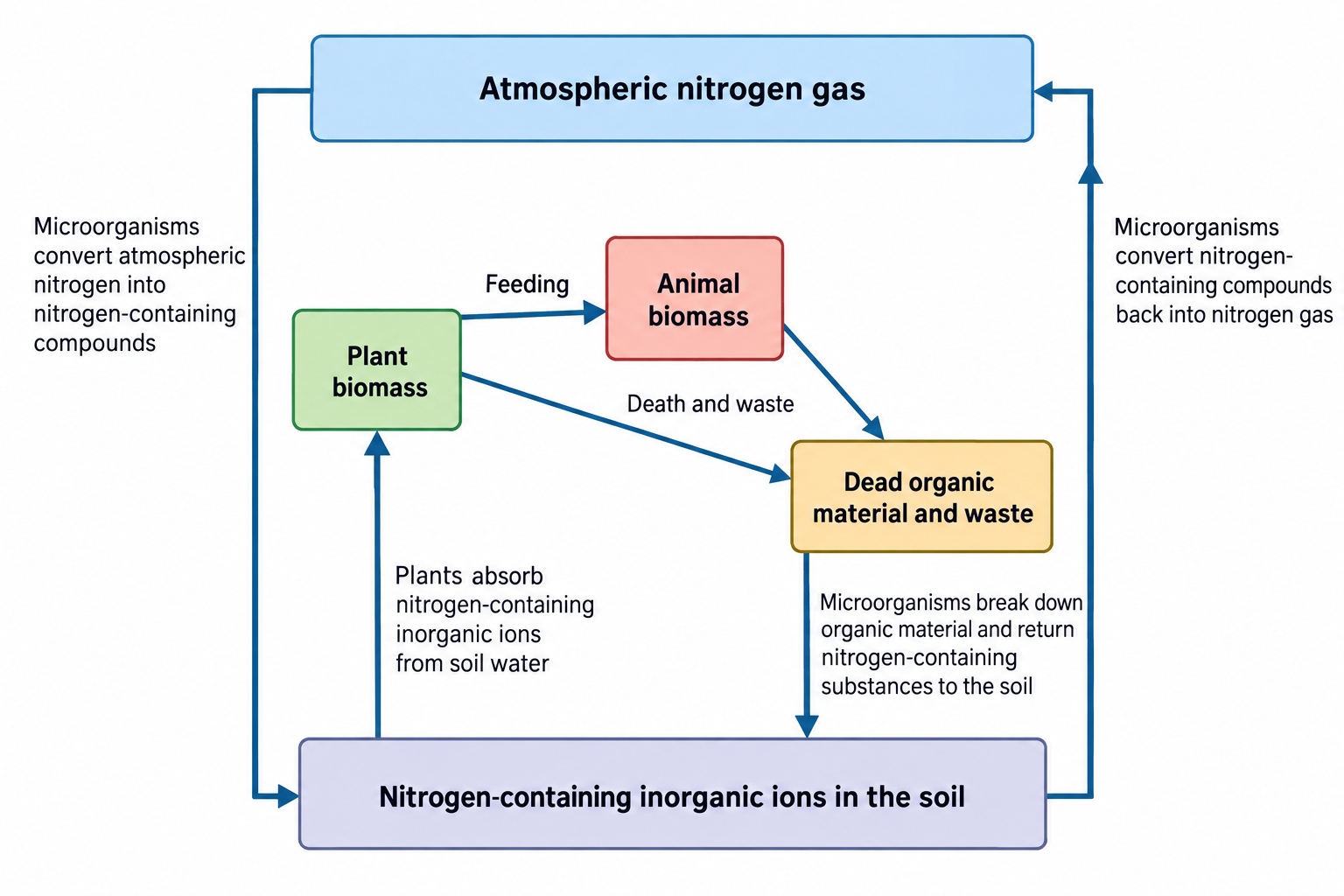
The diagram follows nitrogen from the air into the soil, through plants and animals, back to the soil from dead material and waste, and back to the air, with microorganisms on three of its arrows. The arrow from the air to the soil is nitrogen fixation. The arrow from dead material and waste to the soil is saprobiotic nutrition and ammonification. The arrow from the soil back to the air is denitrification. Nitrification happens within the soil and has no arrow of its own.
What AQA's specification lists for the nitrogen cycle
AQA's specification lists: "The role of bacteria in the nitrogen cycle in sufficient detail to illustrate the processes of saprobiotic nutrition, ammonification, nitrification, nitrogen fixation and denitrification." It adds: "(The names of individual species of bacteria are not required)."
AQA's full wording for section 3.5.4 Nutrient cycles is on its specification page, and our specification guide covers every other section.
How each process works
Each process below follows nitrogen one step further round the cycle, from the air back to the air.
Nitrogen fixation
Nitrogen fixation is the conversion of atmospheric nitrogen gas into biologically available nitrogen compounds by bacteria. Nitrogen gas is abundant in the atmosphere, but plants cannot take it in a usable form, so this is how nitrogen enters the living part of the cycle. The products include ammonia, which may form ammonium ions in soil.
Some nitrogen-fixing bacteria live freely in soil. Others are mutualistic and live in the root nodules of leguminous plants such as peas and beans, Rhizobium being one example. The bacteria supply the plant with ammonium compounds, and the plant supplies the bacteria with carbohydrates.
Nitrification
Nitrification is the oxidation of ammonium ions by bacteria, in two stages:
- Bacteria oxidise ammonium ions to nitrite ions.
- Bacteria oxidise nitrite ions to nitrate ions.
The ammonium ions may have come from nitrogen fixation or from ammonification. Nitrification keeps up the supply of nitrate ions in the soil, which plants absorb and use to make organic compounds in their tissues.
Saprobiotic nutrition and ammonification
Saprobiotic nutrition is a mode of nutrition in which bacteria feed on dead or waste organic matter by extracellular digestion. The bacteria release enzymes onto the dead material or waste, digest large organic molecules outside their cells, and absorb the soluble products.
Ammonification is the conversion of nitrogen-containing organic compounds into ammonia or ammonium ions by bacteria. As bacteria break down dead organisms and waste by saprobiotic nutrition, nitrogen-containing compounds are converted to ammonia, which may be present in soil as ammonium ions. This returns nitrogen from organic material to an inorganic form in the soil, ready for nitrification.
Denitrification
Denitrification is the reduction of nitrate ions to nitrogen gas by bacteria. Denitrifying bacteria are particularly active where oxygen availability is low, such as in waterlogged soil. The nitrogen gas returns to the atmosphere, which completes the cycle.
Where does nitrate go, and how is it lost?
Plants absorb nitrate ions from the soil, and the nitrogen becomes part of their organic material. Plants take up nutrients from soil water mainly as inorganic ions, and nitrogen then passes to animals when they feed on plants.
Nitrate can also leave the soil before plants take it up. Denitrification reduces the amount of nitrate available for plant uptake, and leaching, the movement of soluble mineral ions from soil into water by drainage, can carry nitrate away.
Which AQA paper tests the nitrogen cycle?
AQA's A-Level Paper 2 and Paper 3 can examine the nitrogen cycle: our papers guide has what each paper covers. AQA heads this section of its specification "(A-Level only)", so the AS papers do not test it.
Nitrogen cycle exam questions with answers
The worked example and the two questions below are exam-style questions from Medly, marked with Medly's mark schemes.
Worked example (2 marks)
Dead plant material collects at the edges of shallow fen ponds, where it is decomposed.
Describe how bacteria convert ammonium ions released during decomposition into nitrate ions.
- Bacteria convert ammonium ions into nitrite ions (1 mark).
- Bacteria convert nitrite ions into nitrate ions (1 mark).
Medly's mark scheme accepts "oxidised by nitrifying bacteria" for either step. It also credits, as an alternative point, that these conversions need oxygen, and it rejects the conversion of nitrate into nitrite.
Question 1: (2 marks)
A constructed wetland is a human-made wetland used to treat water.
Water entering the wetland contains 16 mg dm⁻³ nitrate.
Water leaving it contains 5 mg dm⁻³ nitrate.
The gas collected from sediment in the wetland is nitrogen gas.
Use the information provided to explain why nitrate concentration was lower in water leaving the wetland than in water entering it.
Answer
1 mark each:
- Denitrification reduces nitrate ions to nitrogen gas.
- Nitrogen from the nitrate leaves the wetland as nitrogen gas and returns to the atmosphere, so the water leaving has less nitrate.
"The nitrate was simply absorbed by plants" earns nothing: the nitrogen gas collected from the sediment points to denitrification.
Question 2: (4 marks)
Scientists investigated a bacterial inoculant, a preparation containing nitrogen-fixing soil bacteria, under irrigated field conditions. Maize was grown in 24 plots in one field for one growing season, with six plots in each treatment: no inoculant/no nitrate, inoculant/no nitrate, no inoculant/40 kg nitrate nitrogen ha⁻¹, and inoculant/40 kg nitrate nitrogen ha⁻¹; all plots received equal irrigation, seed density and carrier volume.
(a) Suggest two reasons why the scientists used both uninoculated plots and plots supplied with nitrate fertiliser. [2 marks]
(b) Suggest two reasons why the scientists measured both ammonium nitrogen and nitrate nitrogen in soil at the end of the investigation. [2 marks]
Answer
(a) Any two, 1 mark each:
- The uninoculated, no-nitrate plots give a baseline for judging the effect of adding the bacterial inoculant.
- The nitrate-fertiliser plots give a comparison between fertiliser nitrate and nitrogen made available by nitrogen fixation.
- The inoculated plots with nitrate test whether the inoculant still helps when nitrate is already available.
- The comparison helps show that any growth difference comes from the bacteria's nitrogen-cycle activity, not the carrier alone.
"A control was used" on its own is not enough.
(b) Any two, 1 mark each:
- To measure the ammonium left from ammonification of organic matter (or from nitrogen fixation).
- To compare ammonium with nitrate and judge how far nitrification has turned ammonium into nitrate.
- To measure the nitrate left in the soil, which shows the risk of nitrogen loss by leaching or denitrification.
- To compare how the treatments affect the total inorganic nitrogen available to the maize, since it takes up both ammonium and nitrate.
End-point concentrations alone do not give the rate of ammonification or nitrification, and low nitrate alone does not show that denitrification happened.
The three questions above start from decomposing plant material, a treatment wetland and maize plots, and each asks you to link a change to a bacterial process. Medly marks written answers like Question 2 against the mark scheme, so you can see which point you missed. Medly's free plan includes 5 marked questions, 20 AI tutor messages and 1 uploaded paper a day, with no card needed, and Medly has an AQA A-Level Biology course.
Frequently asked questions
What are the five processes of the nitrogen cycle, in order?
Following nitrogen round the cycle: nitrogen fixation turns nitrogen gas into ammonia or ammonium ions, and nitrification turns ammonium into nitrite and then nitrate. After plants and animals die or produce waste, saprobiotic nutrition and ammonification return the nitrogen to ammonium. Denitrification turns nitrate back into nitrogen gas.
What is the difference between nitrification and nitrogen fixation?
Nitrogen fixation converts atmospheric nitrogen gas into biologically available compounds such as ammonia. Nitrification oxidises ammonium ions to nitrite ions and then to nitrate ions.
What is denitrification?
Denitrification is the reduction of nitrate ions to nitrogen gas by bacteria, which returns nitrogen to the atmosphere. Denitrifying bacteria are most active where oxygen is low, such as in waterlogged soil.
What do saprobionts do?
Saprobionts are organisms that feed by saprobiotic nutrition: they obtain nutrients from dead or decaying organic material. They secrete enzymes onto it, digest it outside their cells and absorb the soluble products, which releases nutrients back into the soil.
Do you need to know the names of the bacteria in the nitrogen cycle?
AQA's specification says: "(The names of individual species of bacteria are not required)."
Is the nitrogen cycle in AS Biology?
The nitrogen cycle is in section 3.5.4 Nutrient cycles, under section 3.5, which AQA's specification heads "(A-Level only)". The subject content of AQA AS Biology (7401) is sections 3.1 to 3.4.