
Meiosis A-Level Biology: the two divisions, genetic variation and exam questions
Follow the chromosomes through both meiotic divisions, see how independent segregation and crossing over create variation, and practise exam questions.
On this page
Meiosis is a division in which one diploid cell usually produces four haploid daughter cells that are genetically different from one another. This guide follows AQA A-Level Biology (7402) and AQA AS Biology (7401) through the two divisions, where the variation comes from, how meiosis differs from mitosis, and exam questions with answers.
What is meiosis? Haploid, diploid and homologous chromosomes
Meiosis is a type of cell division with two nuclear divisions. A diploid cell contains two chromosomes from each homologous pair; a haploid cell contains one from each pair, so it has half the chromosome number. Homologous chromosomes carry the same genes at the same positions, and one of each pair came from each parent.
AQA's specification asks for "The process of meiosis only in sufficient detail to show how:" two nuclear divisions "result usually in the formation of four haploid daughter cells from a single diploid parent cell"; "genetically different daughter cells result from the independent segregation of homologous chromosomes"; and "crossing over between homologous chromosomes results in further genetic variation among daughter cells". It also lists four skills, covered below: chromosome-content diagrams, comparing mitosis and meiosis, life cycles and random fertilisation.
The two divisions of meiosis
The first meiotic division separates homologous chromosomes and halves the chromosome number. The second separates sister chromatids and leaves the number unchanged. Each chromosome starts as two attached sister chromatids, because it was copied before meiosis. For a parent cell with two homologous pairs (2n = 4):
| Point in meiosis | Cells | Chromosomes in each cell | Ploidy |
|---|---|---|---|
| Parent cell | 1 | 4, as 2 homologous pairs | Diploid, 2n = 4 |
| After the first division | 2 | 2, one from each pair, each still two chromatids | Haploid, n = 2 |
| After the second division | 4 | 2, each one chromatid | Haploid, n = 2 |
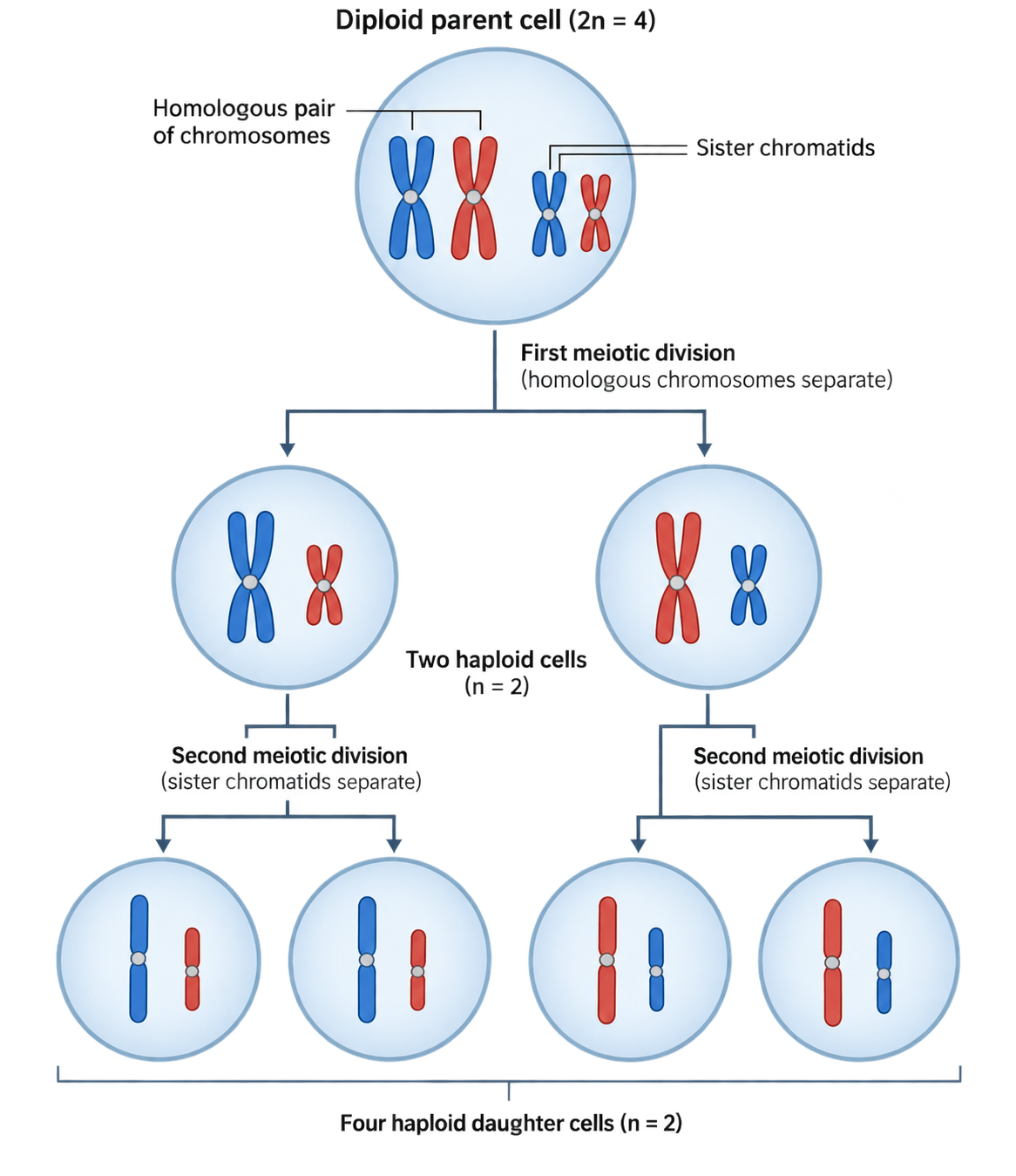
The diagram does not show crossing over, which is why its four daughter cells form two matching pairs.
How to complete a chromosome-content diagram
- Identify the homologous pairs in the parent cell by their matching size and shape.
- After the first division, put one chromosome from each pair in each of two cells.
- Keep the sister chromatids together after the first division.
- After the second division, separate the sister chromatids, so each of four cells gets one chromatid from each chromosome.
- Check that every final cell has one chromosome from each pair, never both.
With four pairs (2n = 8), that gives two cells of n = 4, then four cells, each still n = 4.
Chromosome non-disjunction, a failure of chromosomes to separate correctly, can arise spontaneously in meiosis. One cell can then receive an extra chromosome while another receives no copy of that chromosome: a mutation in chromosome number.
Independent segregation and crossing over
Independent segregation is the random separation of maternal and paternal homologous chromosomes into daughter cells in the first division: how one pair separates does not decide how another does. Crossing over is the exchange of corresponding sections of DNA between non-sister chromatids of homologous chromosomes.
In crossing over:
- A maternal chromosome and its paternal homologue line up closely.
- Non-sister chromatids cross over at the same position.
- Corresponding sections of DNA break and rejoin with the chromatid from the other chromosome.
- The chromatids now carry new combinations of alleles.
Chromatids carrying A and B, and a and b, can become A and b, and a and B. No new alleles are made.
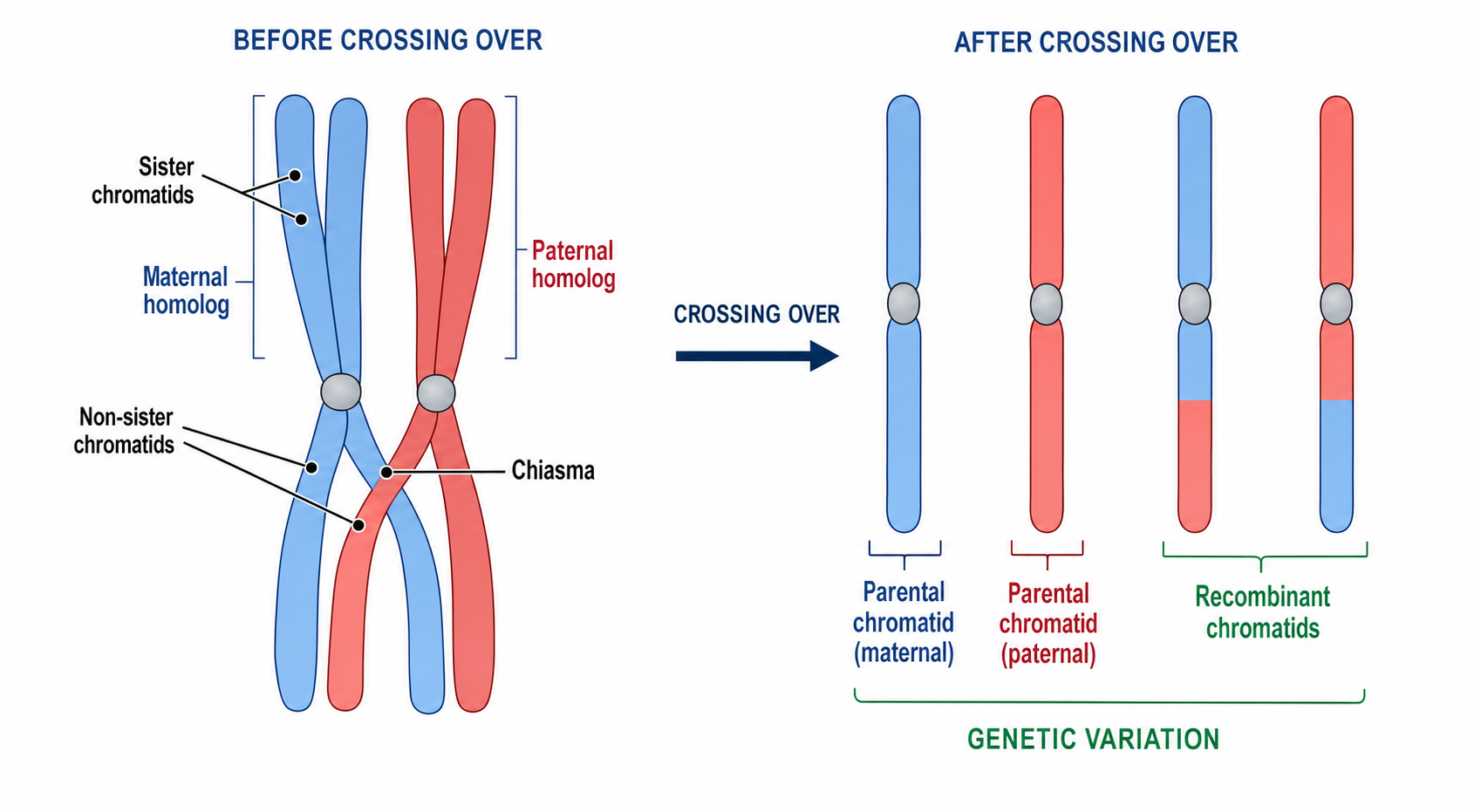
The two blue chromatids are the sister chromatids of the maternal chromosome and the two red ones those of the paternal chromosome; the diagram writes "homolog" for homologue.
Random fertilisation and the 2ⁿ calculation
Random fertilisation is the random fusion of one haploid gamete from one parent with one from the other. Any gamete from one parent can fuse with any gamete from the other, so offspring get many combinations of alleles.
| Source of variation | What it does |
|---|---|
| Crossing over | Produces new allele combinations on chromatids |
| Independent segregation | Produces different chromosome combinations in gametes |
| Random fertilisation | Produces different chromosome combinations in zygotes |
Leaving crossing over out, a cell with n homologous pairs can make 2ⁿ different chromosome combinations in its gametes, because each pair can send either its maternal or its paternal chromosome. With four pairs, that is 2⁴ = 16. If both parents have n pairs, random fertilisation gives 2ⁿ × 2ⁿ = 2²ⁿ combinations: with three pairs, 8 × 8 = 64.
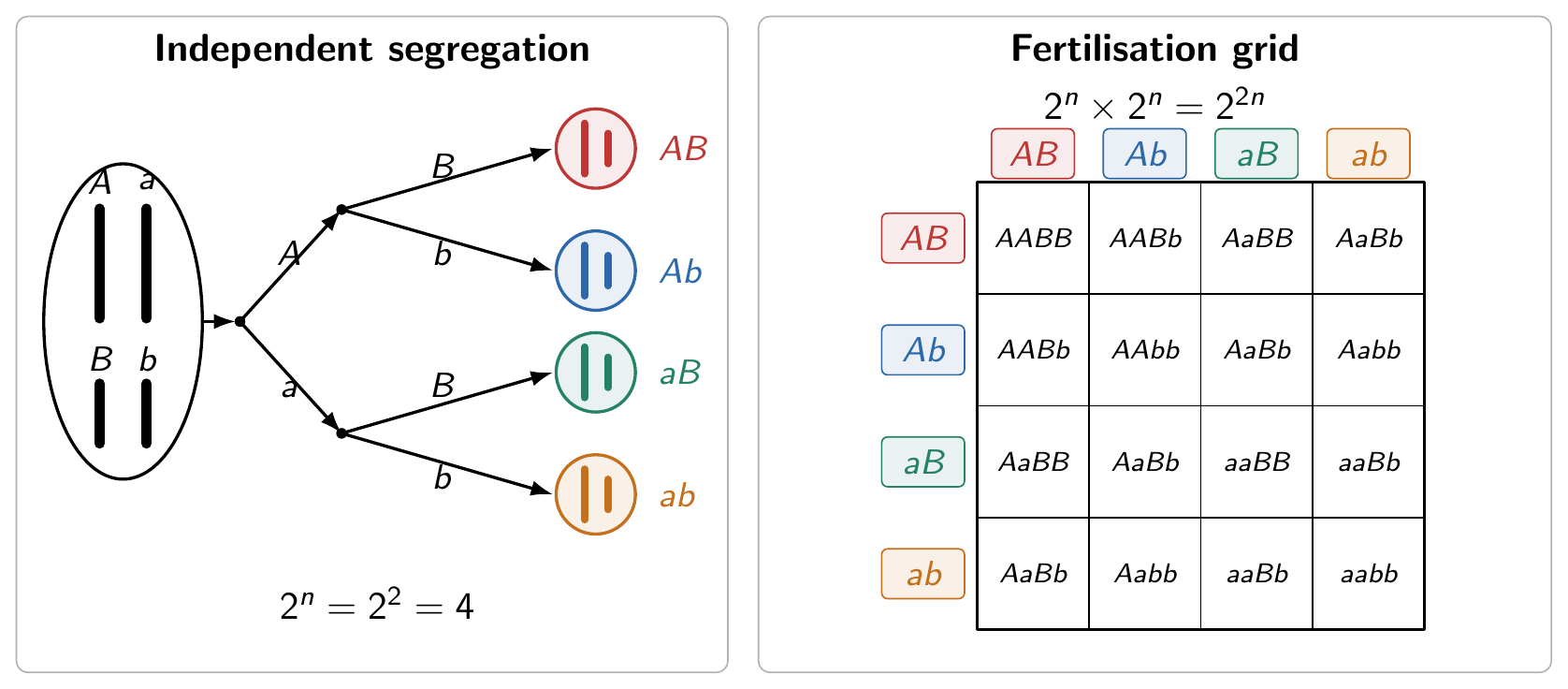
The grid has sixteen boxes, one for each pairing of a gamete from one parent with a gamete from the other.
AQA's specification lists the 2ⁿ expression as something students "could" use, beside maths skill MS 0.5. It prints MS 0.5 in bold, and says skills shown in bold type "would only be tested in the full A-Level course".
Meiosis vs mitosis, and finding meiosis in a life cycle
Meiosis gives four genetically different haploid cells; mitosis usually gives two identical ones. Our mitosis page covers its stages.
| Mitosis | Meiosis | |
|---|---|---|
| Nuclear divisions | One | Two |
| Usual number of daughter cells | Two | Four |
| Daughter cells from a diploid parent | Diploid | Haploid |
| Genetic similarity | Usually identical | Different from one another |
In an unfamiliar life cycle, meiosis is where the chromosome number changes from 2n to n: for example, where diploid cells with six chromosomes give four cells with three.
AQA A-Level Biology meiosis exam questions with answers
The worked example and the three questions below are exam-style questions from Medly, marked with Medly's mark schemes.
Worked example (3 marks)
A newly described freshwater alga has a diploid reproductive cell with two homologous chromosome pairs.
The cell undergoes meiosis before spores are released.
Describe and explain the two nuclear divisions that produce the spores.
Do not include in your answer details of DNA replication before meiosis.
- Two nuclear divisions occur in meiosis: 1 mark.
- Homologous chromosomes separate in the first meiotic division, leaving one chromosome from each homologous pair in each resulting cell: 1 mark.
- Sister chromatids separate in the second meiotic division, producing four genetically different haploid spores from one diploid reproductive cell: 1 mark, needed for full marks.
Question 1: (4 marks)
Dune grasses reproduce sexually. Their gametes are produced by meiosis.
Describe and explain how meiosis followed by random fertilisation can result in genetic variation within a population of dune grasses.
Answer
Any four points; point 5 is needed for full marks:
- Maternal and paternal homologous chromosomes segregate randomly into daughter cells during meiosis.
- Independent segregation produces different chromosome combinations in haploid gametes.
- Crossing over exchanges corresponding DNA sections between homologous chromosomes.
- Crossing over creates new combinations of alleles on chromatids.
- Random fertilisation independently combines haploid gametes and further increases genetic variation within the species.
Question 2: (2 marks)
Define meiosis.
Answer
- Meiosis is a reduction division producing four haploid daughter cells from one diploid cell (1 mark, needed for full marks). Medly's mark scheme rejects "two identical diploid cells".
- The daughter cells produced are genetically different from one another (1 mark).
Question 3: (2 marks)
This question uses the expression 2ⁿ, which draws on a maths skill AQA prints in bold as tested only in the full A-Level course.
Island foxes have 24 pairs of homologous chromosomes.
Calculate the number of different combinations of chromosomes that could be produced in a fox's gametes as a result of independent segregation. Ignore crossing over.
Use the formula 2ⁿ, where n is the number of pairs of homologous chromosomes.
Answer
- Use 2²⁴ (1 mark).
- 2²⁴ = 16,777,216 combinations (1 mark). Medly's mark scheme also accepts 1.68 × 10⁷ or 1.7 × 10⁷.
The questions above cover what the two divisions do and where the variation comes from: independent segregation, crossing over and random fertilisation. Medly marks written answers like Question 1 against the mark scheme, so you can see which point you missed. Medly's free plan includes 5 marked questions, 20 AI tutor messages and 1 uploaded paper a day, with no card needed, and Medly has an AQA A-Level Biology course.
Where marks are lost on meiosis questions
- Medly's mark scheme for the worked example makes the second-division point needed for full marks: sister chromatids separating to give "four genetically different haploid spores".
- Medly's mark scheme for Question 1 says that "a full-mark response must include random fertilisation".
- AQA A-Level Biology (7402) Paper 1, June 2023, report on the examination, question 10.3, a question on how meiosis and fertilisation produce genetic variation: "many did not state that random fertilisation involved gametes; for example, “fertilisation is random” did not achieve a mark."
Which paper is meiosis on?
AQA's A-Level Paper 1 and Paper 3 can examine meiosis, and so can both AS papers: our papers guide has what each paper covers.
Frequently asked questions
How many cells does meiosis produce, and are they haploid?
Usually four haploid daughter cells from one diploid parent cell.
Why are the cells made by meiosis genetically different?
Independent segregation mixes maternal and paternal chromosomes, and crossing over makes new combinations of alleles.
Do you need to know the names of the stages of meiosis?
AQA's specification names no stage of meiosis. It asks for "The process of meiosis only in sufficient detail to show how:" the two nuclear divisions give four haploid cells, independent segregation gives genetically different cells, and crossing over adds further variation.
Is meiosis in AS Biology?
Meiosis is in section 3.4, and both AQA AS Biology (7401) papers test "Any content from topics 1-4, including relevant practical skills". Our specification guide shows which sections each qualification covers.