
Link reaction A-Level Biology: what happens, products and exam questions
See where the link reaction happens, follow pyruvate to acetylcoenzyme A step by step, and try exam questions with answers.
On this page
The link reaction is the stage of aerobic respiration between glycolysis and the Krebs cycle. In the mitochondrial matrix, pyruvate is oxidised to acetate, releasing carbon dioxide and producing reduced NAD, and the acetate then combines with coenzyme A to form acetylcoenzyme A. This guide follows AQA A-Level Biology (7402) and covers where the link reaction happens, each step, the diagram, the products, and exam questions with answers.
Where does the link reaction occur?
The link reaction happens in the mitochondrial matrix, the inside compartment of a mitochondrion.
Pyruvate is made by glycolysis in the cytoplasm. When respiration is aerobic, pyruvate enters the mitochondrion by active transport, which uses energy to move it across the membrane. Once it is in the matrix, the link reaction can start.
What happens in the link reaction
AQA's specification lists three statements for this stage:
- "pyruvate is oxidised to acetate, producing reduced NAD in the process"
- "acetate combines with coenzyme A in the link reaction to produce acetylcoenzyme A"
- "acetylcoenzyme A reacts with a four-carbon molecule, releasing coenzyme A and producing a six-carbon molecule that enters the Krebs cycle"
Step by step:
- Pyruvate is oxidised to acetate. Oxidation means losing electrons or hydrogen: here NAD receives the hydrogen and becomes reduced NAD, and carbon dioxide is released.
- Acetate combines with coenzyme A to form acetylcoenzyme A. Acetate does not enter the Krebs cycle as a separate molecule, so coenzyme A acts as a temporary carrier.
- Acetylcoenzyme A reacts with a four-carbon molecule. Coenzyme A is released, free to be used again in another link reaction, and the acetate part joins the four-carbon molecule to make a six-carbon molecule.
- The six-carbon molecule enters the Krebs cycle.
The third statement is also where the Krebs cycle begins, so you will meet it again there. AQA's three statements don't mention carbon dioxide, but it is released at the oxidation step, and the diagram below shows it.
Link reaction diagram: from pyruvate to acetylcoenzyme A
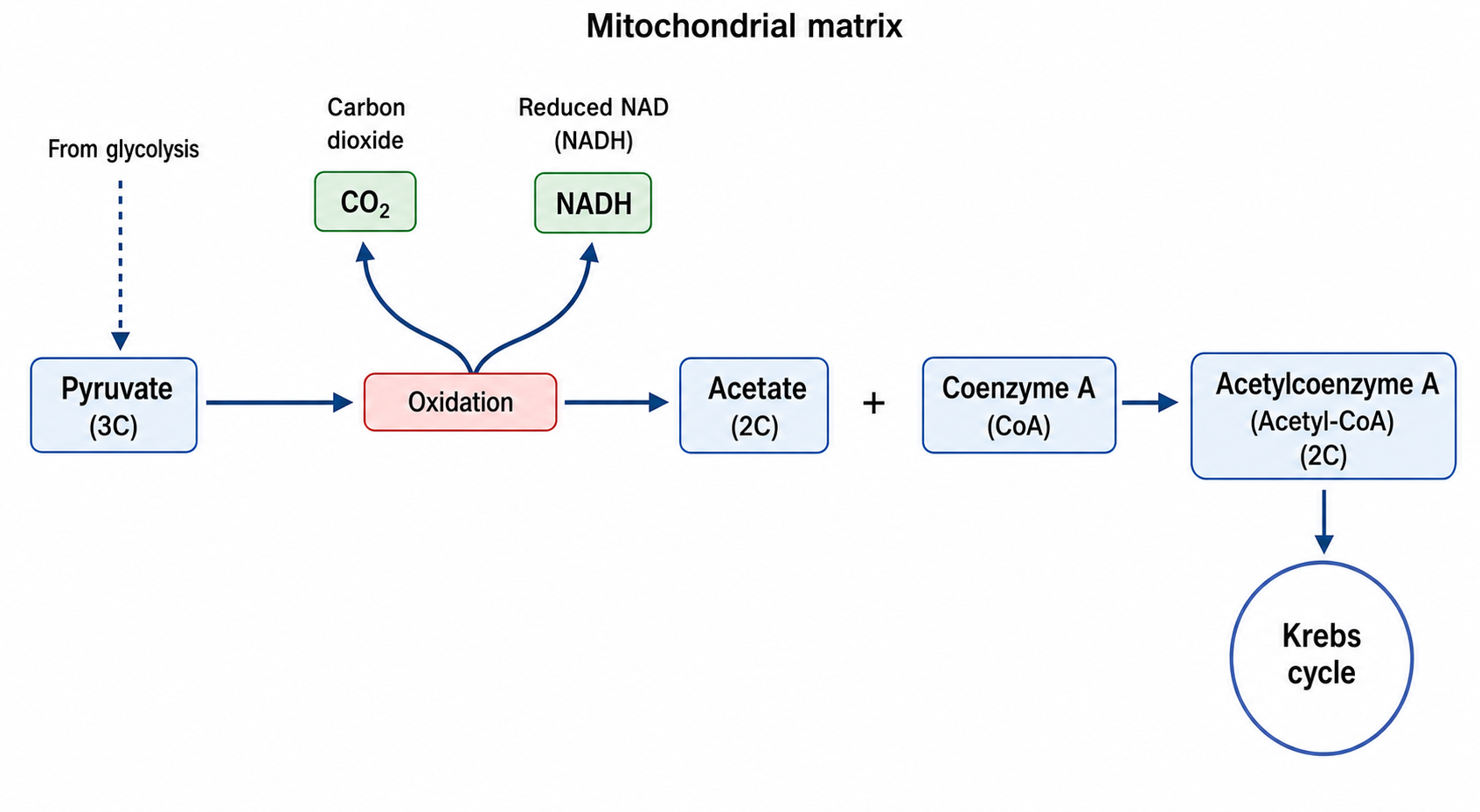
Acetyl-CoA and NADH on the diagram are other names for acetylcoenzyme A and reduced NAD.
Products of the link reaction
For each pyruvate, the link reaction produces acetylcoenzyme A, carbon dioxide and reduced NAD.
| Step | Goes in | Comes out |
|---|---|---|
| Oxidation | Pyruvate and NAD | Acetate, carbon dioxide and reduced NAD |
| Combination | Acetate and coenzyme A | Acetylcoenzyme A |
One molecule of carbon dioxide is released from each pyruvate. Each glucose gives two pyruvate in glycolysis, so the link reaction runs twice for every glucose.
AQA A-Level Biology link reaction exam questions with answers
The worked example and the question below are exam-style questions from Medly, marked with Medly's mark schemes.
Worked example (4 marks)
A student investigates the link reaction using three incubation mixtures.
The molecules detected after incubation are shown.
| Incubation mixture | Molecules detected |
|---|---|
| Pyruvate and NAD | Acetate and reduced NAD |
| Acetate and coenzyme A | Acetylcoenzyme A |
| Acetylcoenzyme A and a four-carbon molecule | Coenzyme A and a six-carbon molecule |
The student plans to add acetylcoenzyme A, rather than pyruvate, to a preparation containing a four-carbon molecule.
Use the information provided to justify this choice.
Do not include details of the Krebs cycle in your answer.
Medly's mark scheme has five points, 1 mark each, up to 4 marks. The fourth and fifth points are both needed for full marks.
- Pyruvate is oxidised to acetate, as the first mixture shows. The scheme accepts "pyruvate is converted to acetate by oxidation".
- Oxidation of pyruvate produces reduced NAD, also from the first mixture.
- Acetate combines with coenzyme A to form acetylcoenzyme A, from the second mixture.
- Acetylcoenzyme A reacts directly with the four-carbon molecule, so it is the molecule to add. This comes from the third mixture.
- That reaction releases coenzyme A and produces the six-carbon molecule that enters the Krebs cycle. The point needs both the release of coenzyme A and the six-carbon molecule.
So a full-mark answer gives the fourth and fifth points and any two of the first three.
Question 1: (3 marks)
A compound is added to isolated mitochondria.
This compound decreases the rate at which pyruvate is oxidised to acetate.
Explain how the decreased rate of pyruvate oxidation causes lower concentrations of acetylcoenzyme A and reduced NAD.
Do not include details of the Krebs cycle in your answer.
Answer
- A lower rate of pyruvate oxidation produces less acetate (1 mark). Medly's mark scheme rejects "more acetate produced".
- Pyruvate oxidation produces reduced NAD, so a lower rate produces less reduced NAD (1 mark).
- Less acetate is available to combine with coenzyme A, so less acetylcoenzyme A is formed (1 mark, needed for full marks). "Less acetyl-CoA formed" is also accepted.
The link reaction takes up only three statements in the specification, and both questions above are built on them. Medly marks written answers like Question 1 against the mark scheme, so you can see which point you missed. Medly's free plan includes 5 marked questions, 20 AI tutor messages and 1 uploaded paper a day, with no card needed, and Medly has an AQA A-Level Biology course.
Which paper is the link reaction on?
AQA's A-Level Paper 2 and Paper 3 can examine the link reaction: our papers guide has what each paper covers. AQA heads this section of its specification "(A-Level only)", so the AS papers do not test it.
Frequently asked questions
Where does the link reaction occur?
In the mitochondrial matrix. When respiration is aerobic, pyruvate gets there from the cytoplasm by active transport.
What are the products of the link reaction?
Acetylcoenzyme A, carbon dioxide and reduced NAD. Acetylcoenzyme A carries the acetate on into the Krebs cycle.
Does the link reaction make ATP?
ATP is not among its products: they are acetylcoenzyme A, carbon dioxide and reduced NAD.
Why is it called the link reaction?
It is the step that connects pyruvate from glycolysis to the Krebs cycle, by converting pyruvate into a form that can react with the four-carbon molecule at the start of the cycle.
Is the link reaction in AS Biology?
AQA places it in 3.5.2 Respiration, which it heads "(A-Level only)", and AQA's AS Biology covers sections 1 to 4 only. Our specification guide sets out which sections the AS covers.