
Haemoglobin A-Level Biology: structure, the oxygen dissociation curve and the Bohr effect
Learn how haemoglobin loads and unloads oxygen, why the curve is S-shaped, what carbon dioxide does to it, and practise with exam questions.
On this page
Haemoglobin is the protein in red blood cells that binds oxygen reversibly, loading it in the lungs and unloading it in respiring tissues. This guide covers haemoglobin as AQA A-Level Biology (7402) and AQA AS Biology (7401) teach it, rather than as a blood-test result, with exam questions and answers.
What is haemoglobin? Structure and red blood cells
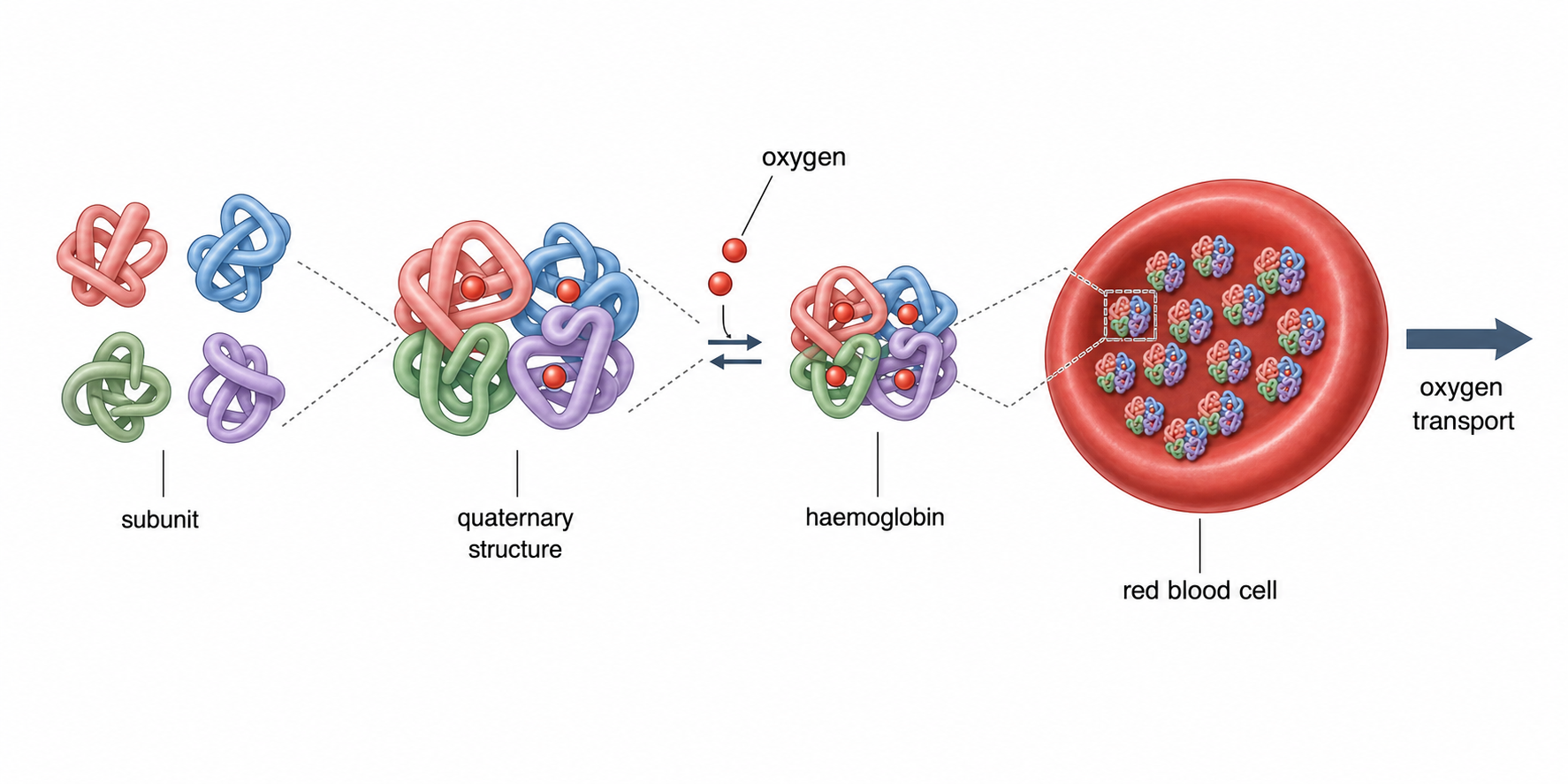
Haemoglobin is a protein with a quaternary structure, meaning it is made of more than one polypeptide chain associated together: one haemoglobin molecule is four polypeptide subunits. Iron ions form part of the molecule. Haemoglobins are a group of chemically similar molecules found in many different organisms.
Each red blood cell contains many haemoglobin molecules, and its biconcave shape gives a large surface area and a short diffusion pathway for oxygen. Oxygen binds to haemoglobin reversibly, so it can be released where it is needed.
Loading and unloading oxygen: the oxyhaemoglobin dissociation curve
An oxyhaemoglobin dissociation curve shows the percentage saturation of haemoglobin with oxygen against oxygen partial pressure (pO₂, a measure of how available oxygen is). That is the specification's name; it is also called the oxygen dissociation curve. Oxyhaemoglobin is haemoglobin with oxygen bound to it.
| Where | pO₂ | Part of the curve | What happens |
|---|---|---|---|
| Lungs | High | The plateau | Haemoglobin loads oxygen and becomes highly saturated, even if pO₂ changes slightly |
| Respiring tissue | Lower | The steep middle part | A small fall in pO₂ causes a large fall in saturation, so oxygen is unloaded |
The amount unloaded depends on the saturation difference between lungs and tissues.
Why the oxygen dissociation curve is S-shaped
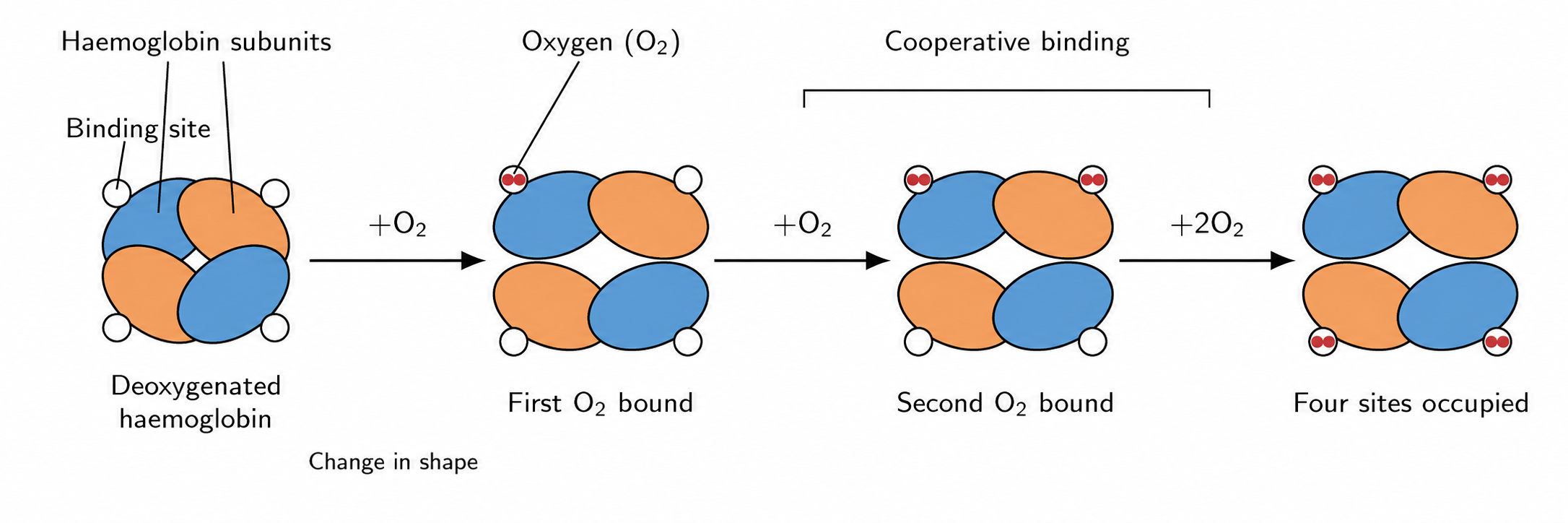
The curve is S-shaped because oxygen binding is cooperative:
- At low pO₂, few oxygen molecules bind, because haemoglobin starts with a relatively low affinity for oxygen.
- Binding of the first oxygen molecule changes the shape of haemoglobin.
- Further oxygen molecules bind more easily.
- At high pO₂, most haemoglobin molecules become highly saturated.
The Bohr effect: how carbon dioxide shifts the curve
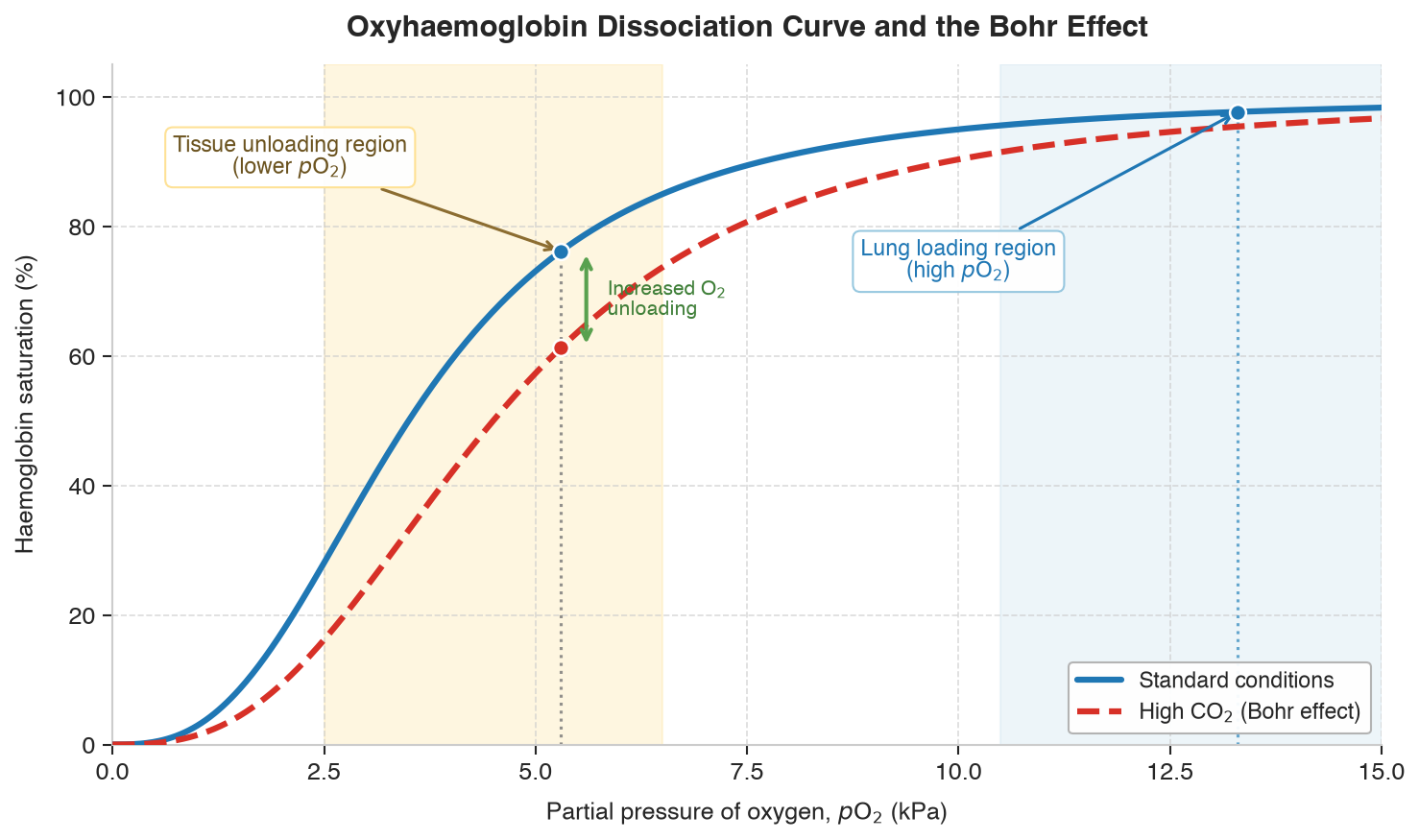
The Bohr effect is the decrease in haemoglobin's affinity for oxygen caused by an increase in carbon dioxide concentration. It shifts the curve to the right, so at the same pO₂ haemoglobin is less saturated and more oxygen is released.
Actively respiring tissues produce more carbon dioxide, so haemoglobin unloads more oxygen there. In the lungs carbon dioxide is lower, so haemoglobin loads oxygen more readily.
Different haemoglobins and oxygen affinity
Oxygen affinity is the tendency of haemoglobin to bind oxygen. Many animals are adapted to their environment by the type of haemoglobin they have.
| High-affinity haemoglobin | Low-affinity haemoglobin | |
|---|---|---|
| Position of the curve | Shifted to the left | Shifted to the right |
| pO₂ needed for loading | A lower pO₂ is enough | A higher pO₂ is needed |
| Unloading at the same tissue pO₂ | Less oxygen released | More oxygen released |
| Main advantage | Loads oxygen where little is available | Unloads oxygen readily to tissues |
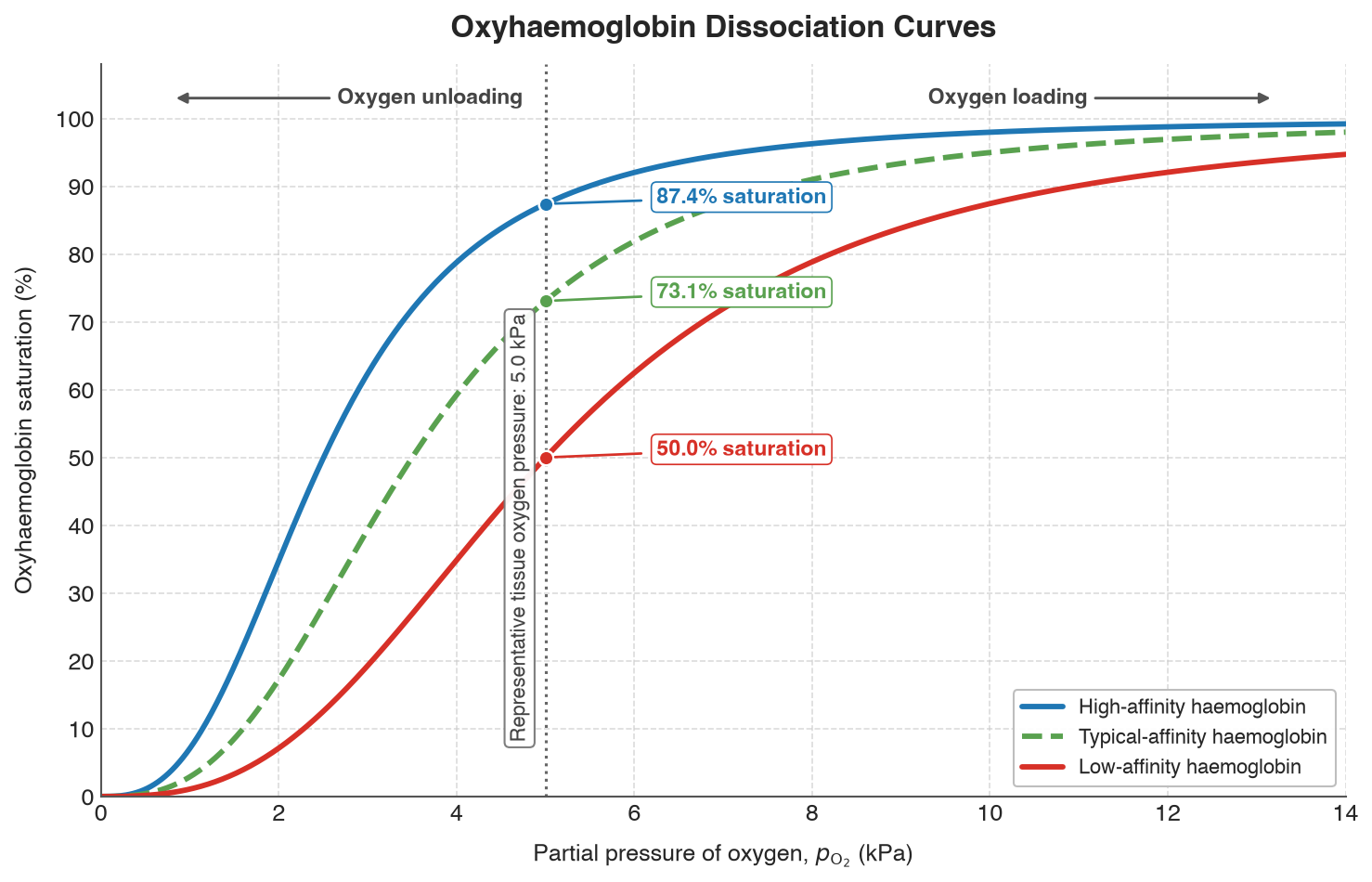
At the 5.0 kPa tissue pressure the graph marks, it prints 87.4% saturation for high-affinity, 73.1% for typical-affinity and 50.0% for low-affinity haemoglobin. Where environmental pO₂ is low, high affinity lets an animal load oxygen, but it releases oxygen less readily in the tissues.
AQA A-Level Biology haemoglobin exam questions with answers
The worked example and the two questions below are exam-style questions from Medly, marked with Medly's mark schemes.
Worked example (3 marks)
The two haemoglobins were obtained from two closely related mammal species living at the same temperature.
Percentage saturation of haemoglobin
| Oxygen partial pressure / kPa | Haemoglobin P / % | Haemoglobin Q / % |
|---|---|---|
| 3 | 58 | 30 |
| 13 | 99 | 94 |
What can you conclude about haemoglobin P and haemoglobin Q affecting oxygen transport, using the table?
Explain your answer.
- At 13 kPa, both haemoglobins are close to fully saturated (99% and 94%): 1 mark.
- At 3 kPa, P is 58% saturated and Q only 30%, so P has the higher oxygen affinity: 1 mark.
- So Q unloads a greater proportion of its oxygen at low oxygen partial pressure: 1 mark, needed for full marks.
Question 1: (3 marks)
A health laboratory is investigating gas M, a pollutant given off by portable heaters in poorly ventilated rooms.
The figure shows oxyhaemoglobin dissociation curves for haemoglobin that was exposed and not exposed to gas M.
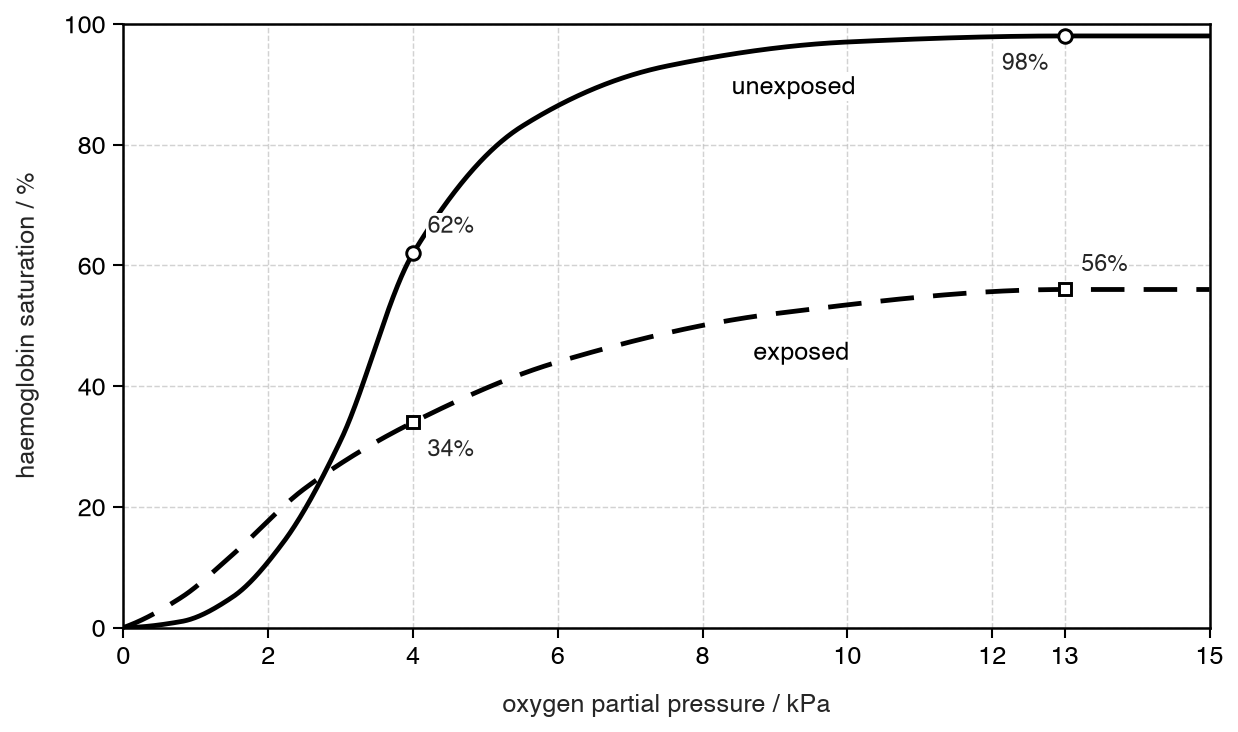
Use the figure to explain how exposure to gas M affects oxygen transport.
Answer
- At 13 kPa, saturation is about 98% in unexposed blood and about 56% in exposed blood (1 mark).
- A lower proportion of haemoglobin is available to bind oxygen reversibly after exposure (1 mark).
- At 4 kPa, exposed blood carries less oxygen for unloading to respiring tissues (1 mark, needed for full marks).
Question 2: (8 marks)
A scientist measured the percentage of oxygen-binding sites occupied on haemoglobin in mammalian red blood cells, at two carbon dioxide concentrations and a constant temperature.
In this mammal:
- in the lungs, oxygen partial pressure is about 13 kPa and carbon dioxide concentration is low
- in active muscle, oxygen partial pressure is about 3 kPa and carbon dioxide concentration is high.
The table shows the results.
| Oxygen partial pressure / kPa | 3 | 5 | 9 | 13 |
|---|---|---|---|---|
| Haemoglobin saturation at low carbon dioxide concentration / % | 24 | 67 | 94 | 97 |
| Haemoglobin saturation at high carbon dioxide concentration / % | 13 | 46 | 86 | 94 |
(a) State what is meant by the quaternary structure of haemoglobin. [1 mark]
(b) Explain how the shape of red blood cells increases the rate of oxygen uptake in the lungs. [2 marks]
(c) At low carbon dioxide concentration, the increase in saturation from 3 to 5 kPa is greater than the increase from 9 to 13 kPa. Explain this difference. [2 marks]
(d) A student concludes that the rise in carbon dioxide concentration between the lungs and the active muscle has no effect on oxygen unloading. Use the table to evaluate this conclusion. [3 marks]
Answer
(a)
- Haemoglobin consists of more than one polypeptide chain (1 mark).
(b)
- The biconcave shape provides a large surface area for oxygen to diffuse into the cell (1 mark).
- The thin centre provides a short diffusion pathway for oxygen to reach haemoglobin inside the cell (1 mark).
(c)
- Binding of the first oxygen molecules changes haemoglobin's shape, making further oxygen binding easier (1 mark).
- At 9 kPa haemoglobin is nearly saturated, so fewer oxygen-binding sites remain available between 9 and 13 kPa (1 mark).
(d)
- Low carbon dioxide in the lungs to high carbon dioxide in the muscle: 97 − 13 = 84 percentage points of saturation are lost (1 mark).
- If carbon dioxide stayed low in the muscle: 97 − 24 = 73 percentage points would be lost (1 mark).
- The rise in carbon dioxide increases unloading by 84 − 73 = 11 percentage points, so the conclusion is not supported (1 mark, needed for full marks).
The worked example, Question 1 and part (d) of Question 2 start from saturation values and end at how much oxygen is unloaded. Medly marks written answers like Question 2 against the mark scheme, so you can see which point you missed. Medly's free plan includes 5 marked questions, 20 AI tutor messages and 1 uploaded paper a day, with no card needed, and Medly has an AQA A-Level Biology course.
Where marks are lost on haemoglobin questions
- Medly's mark scheme for the worked example rejects "Q has more oxygen" without reference to unloading or release.
- Medly's mark scheme for Question 2 (a) says: "Do not accept several amino acids or several haem groups alone."
- Medly's mark scheme for Question 2 (d) notes that 84 is "the proportion of binding sites unloaded, not a percentage change relative to 97%".
- AQA A-Level Biology (7402) Paper 1, June 2023, report on the examination, question 07.1: "many answers showed only a recall of knowledge associated with a general oxygen dissociation curve."
- The same report, question 10.1: "A sizeable number of students think that a quaternary structure is made of four polypeptides". Quaternary means more than one.
Which paper is haemoglobin on?
AQA's A-Level Paper 1 and Paper 3 can examine haemoglobin, and so can both AS papers: our papers guide has what each paper covers.
AQA's specification lists, for haemoglobin, its quaternary structure; "The loading, transport and unloading of oxygen in relation to the oxyhaemoglobin dissociation curve"; cooperative binding; "the Bohr effect"; and different types of haemoglobin "with different oxygen transport properties".
Frequently asked questions
How many oxygen molecules does one haemoglobin carry?
Up to four. The diagram above draws four oxygen-binding sites on one haemoglobin molecule and labels the full state "Four sites occupied".
Why is the oxygen dissociation curve S-shaped?
Because oxygen binding is cooperative. Saturation stays low at first, rises steeply once the first oxygen has changed haemoglobin's shape, then levels off as most binding sites fill.
What is the Bohr effect, and which way does the curve shift?
The decrease in haemoglobin's affinity for oxygen caused by an increase in carbon dioxide concentration. The curve shifts to the right, so more oxygen is released at the same pO₂.
Is haemoglobin in AS Biology?
Haemoglobin is in section 3.3, and both AQA AS Biology (7401) papers test "Any content from topics 1-4, including relevant practical skills". Our specification guide shows which sections each qualification covers.