
Calvin cycle A-Level Biology: the light-independent reaction and exam questions
Learn the four steps from carbon dioxide to triose phosphate, then practise with exam-style questions and mark schemes.
On this page
The Calvin cycle is the light-independent reaction of photosynthesis. In the stroma of the chloroplast, carbon dioxide reacts with RuBP to form glycerate 3-phosphate (GP), and GP is reduced to triose phosphate, using ATP and reduced NADP from the light-dependent reaction. This guide follows AQA A-Level Biology (7402), section 3.5.1 Photosynthesis, and ends with exam questions and answers.
Where does the Calvin cycle take place, and does it need light?
The Calvin cycle takes place in the stroma of the chloroplast. It does not use light directly, but it depends on a continuing supply of ATP and reduced NADP, which the light-dependent reaction makes.
Three things go in. Carbon dioxide provides the carbon atoms that end up in organic molecules. ATP is hydrolysed to release the energy the cycle's reactions need. Reduced NADP provides the reducing power to turn glycerate 3-phosphate into triose phosphate.
It is called a cycle because one of its starting substances, RuBP, is regenerated and can be used again.
What are the steps of the Calvin cycle?
The Calvin cycle has four steps: carbon dioxide fixation, reduction of GP, regeneration of RuBP, and the making of useful organic substances.
- Carbon dioxide fixation. Carbon dioxide reacts with ribulose bisphosphate (RuBP), a five-carbon compound that acts as the carbon dioxide acceptor. The enzyme rubisco catalyses the reaction, which produces two molecules of glycerate 3-phosphate (GP). Incorporating carbon dioxide into an organic molecule like this is called carbon fixation, and GP is the first stable product.
- Reduction of GP. GP is converted into triose phosphate using ATP and reduced NADP. ATP is hydrolysed to provide extra energy, and reduced NADP reduces GP. Here, reduction means the gain of hydrogen. Triose phosphate is a three-carbon sugar phosphate.
- Regeneration of RuBP. Some triose phosphate stays in the cycle and is used to regenerate RuBP, which can then react with more carbon dioxide. Regenerating RuBP uses ATP too.
- Useful organic substances. Some triose phosphate leaves the cycle and is converted into useful organic substances, including simple sugars.
What goes in and what comes out of the Calvin cycle?
Carbon dioxide, ATP and reduced NADP go in, triose phosphate comes out, and RuBP is used and then regenerated. Each substance's role is in the table, with the step it belongs to.
| Substance | Role in the cycle | Step |
|---|---|---|
| Carbon dioxide | Provides the carbon; fixed when it reacts with RuBP | 1 |
| RuBP | Five-carbon carbon dioxide acceptor; regenerated from triose phosphate | 1 and 3 |
| GP | Formed when carbon dioxide reacts with RuBP, two molecules each time; reduced to triose phosphate | 1 and 2 |
| ATP | Hydrolysed to provide energy | 2 and 3 |
| Reduced NADP | Provides the reducing power to turn GP into triose phosphate | 2 |
| Triose phosphate | Three-carbon sugar phosphate; regenerates RuBP or is made into useful organic substances | 2, 3 and 4 |
The numbers balance over six turns of the cycle:
| Over six turns | Molecules |
|---|---|
| Carbon dioxide fixed | 6 |
| RuBP used | 6 |
| GP formed | 12 |
| Triose phosphate formed | 12 |
| Triose phosphate used to regenerate RuBP | 10 |
| Triose phosphate left to make one hexose sugar, such as glucose | 2 |
What happens if ATP and reduced NADP run short?
Less GP is reduced to triose phosphate, so less RuBP is regenerated and less carbon dioxide is fixed. Both ATP and reduced NADP are needed to convert GP into triose phosphate, so a smaller supply means less triose phosphate is made. With less triose phosphate there is less to regenerate RuBP, and the split matters: if no triose phosphate remained in the cycle, RuBP could not be regenerated and carbon dioxide fixation would stop. Question 2 below follows exactly this chain.
How does the Calvin cycle depend on the light-dependent reaction?
The ATP and reduced NADP that the Calvin cycle uses come from the light-dependent reaction, which makes them in the chloroplast membranes using light energy. So although the cycle uses no light itself, it can only run while the light-dependent reaction keeps supplying them. Our light-dependent reaction guide covers that stage.
What AQA's specification lists for the light-independent reaction
AQA's specification says: "The light-independent reaction uses reduced NADP from the light-dependent reaction to form a simple sugar. The hydrolysis of ATP, also from the light-dependent reaction, provides the additional energy for this reaction." It then lists the reaction "in such detail as to show that":
- "carbon dioxide reacts with ribulose bisphosphate (RuBP) to form two molecules of glycerate 3-phosphate (GP). This reaction is catalysed by the enzyme rubisco"
- "ATP and reduced NADP from the light-dependent reaction are used to reduce GP to triose phosphate"
- "some of the triose phosphate is used to regenerate RuBP in the Calvin cycle"
- "some of the triose phosphate is converted to useful organic substances."
AQA's specification page has the whole of section 3.5.1 Photosynthesis, and our specification guide sets out every other section.
Which AQA paper tests the Calvin cycle?
AQA's A-Level Paper 2 and Paper 3 can examine the Calvin cycle: our papers guide has what each paper covers. AQA heads this section of its specification "(A-Level only)", so the AS papers do not test it.
Calvin cycle exam questions with answers
The worked example and the two questions below are exam-style questions from Medly, marked with Medly's mark schemes.
Worked example (3 marks)
Scientists measured the rate of carbon dioxide uptake by leaves in full light and under an amber filter. They took measurements in the early season and the late season.
The figure shows their results.
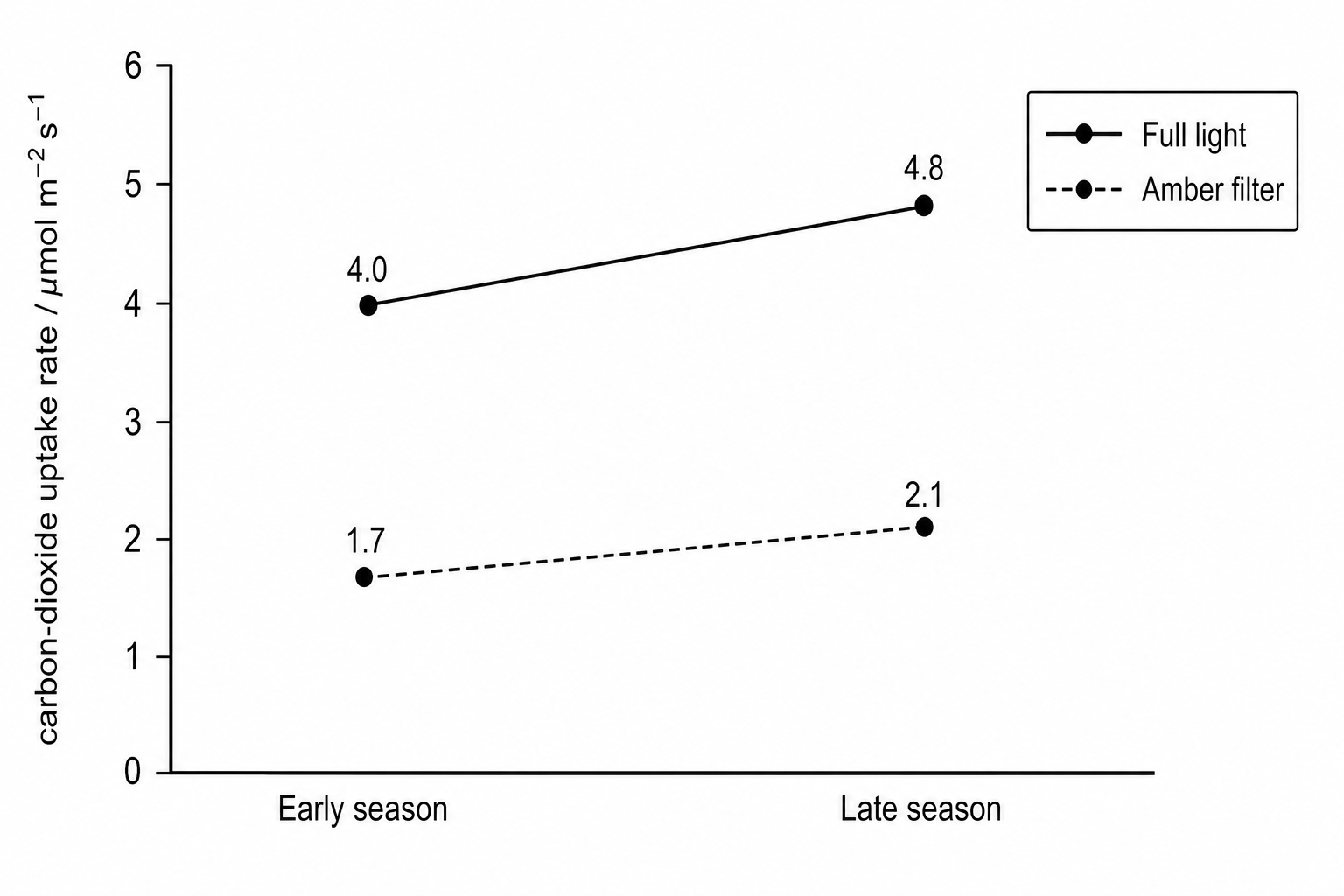
Calculate the total carbon dioxide uptake for a 1.5 m² leaf canopy during 2 hours of full light in the early season. Give your answer in standard form. Show your working.
- Read the rate from the figure: full light in the early season is 4.0 µmol m⁻² s⁻¹.
- Multiply the rate by the area: 4.0 µmol m⁻² s⁻¹ × 1.5 m² = 6.0 µmol s⁻¹.
- Convert 2 hours to seconds: 2 × 60 × 60 = 7200 s.
- Combine them: 4.0 × 1.5 × 7200 = 43 200 µmol.
- Write it in standard form: 4.32 × 10⁴ µmol.
Medly's mark scheme credits the rate-and-area set-up, the conversion to 7200 seconds, the combined expression, the total of 43 200 µmol and the answer in standard form: 1 mark each, up to 3 marks. The answer in standard form, 4.32 × 10⁴ µmol, is needed for full marks.
Question 1: (3 marks)
Scientists investigated photosynthesis in spinach leaf discs.
Describe the role of ATP and reduced NADP in the reduction of glycerate 3-phosphate in the light-independent reaction.
Do not include details of carbon dioxide fixation.
Answer
Any three, 1 mark each:
- ATP from the light-dependent reaction supplies energy for reducing glycerate 3-phosphate.
- Reduced NADP supplies hydrogen or electrons for the reduction of glycerate 3-phosphate.
- ATP provides phosphate to phosphorylate glycerate 3-phosphate, or ATP hydrolysis produces ADP and inorganic phosphate.
- Reduced NADP is oxidised and converted back to NADP, or NADP is regenerated.
Details of carbon dioxide fixation are ignored.
Question 2: (4 marks)
Leaf discs were illuminated at the same temperature and carbon dioxide concentration.
A chemical prevented most electrons released from chlorophyll from passing along the electron transfer chain.
Carbon dioxide fixation fell from 31 to 7 µmol m⁻² s⁻¹.
Suggest how this inhibition caused the decrease in carbon dioxide fixation.
Answer
1 mark each:
- Less ATP and reduced NADP are produced in the light-dependent reaction.
- Less glycerate 3-phosphate (GP) is reduced to triose phosphate.
- Less triose phosphate is available to regenerate RuBP.
- Less regenerated RuBP is available for the rubisco-catalysed fixation of carbon dioxide, so the rate of carbon dioxide fixation decreases.
Point 4 is needed for full marks. NADPH is accepted for reduced NADP.
Both questions turn on what ATP and reduced NADP do in the cycle, and the second follows a shortage of them all the way to carbon dioxide fixation. Medly marks written answers like Question 2 against the mark scheme, so you can see which point you missed. Medly's free plan includes 5 marked questions, 20 AI tutor messages and 1 uploaded paper a day, with no card needed, and Medly has an AQA A-Level Biology course.
Frequently asked questions
Where does the Calvin cycle take place?
In the stroma of the chloroplast.
Does the Calvin cycle need light?
Not directly. The cycle runs on a continuing supply of ATP and reduced NADP from the light-dependent reaction, and that reaction needs light.
What does rubisco do?
Rubisco is the enzyme that catalyses the reaction between carbon dioxide and RuBP, fixing the carbon dioxide and forming two molecules of GP.
What do RuBP and GP stand for?
RuBP is ribulose bisphosphate, the five-carbon carbon dioxide acceptor. GP is glycerate 3-phosphate, the first stable product of carbon dioxide fixation.
What is the difference between the light-dependent reaction and the Calvin cycle?
The light-dependent reaction happens in the chloroplast membranes and uses light to make ATP and reduced NADP, releasing oxygen from water. The Calvin cycle happens in the stroma and uses that ATP and reduced NADP to turn carbon dioxide into triose phosphate.
Is the Calvin cycle in AS Biology?
The Calvin cycle sits in section 3.5, Energy transfers in and between organisms, which AQA's specification heads "(A-Level only)". AQA AS Biology (7401) covers sections 3.1 to 3.4.